
Search
The Rare & Early Newspapers Hobby

Receive the Newsletter

Buy Historic Newspapers

An early attempt at preserving newspapers…
July 6, 2009 by TimHughes · 2 Comments
 You may have noted many of our descriptions of the New York Times from the 1927-1953 period are described as the “rag edition”.
Fellow collector Paul Sarna passed along the following information taken from “News-Week” magazine of Oct. 28, 1933. It’s an interesting report from 76 years ago of the creation of the “rag edition” as a means of preserving newspapers for posterity, which remain a concern for present-day institutions as well.
A brief piece from this 1933 magazine tells of its beginning:
“To preserve valuable newspapers, libraries from time to time have resorted to sprays, rejuvenators, and glassine covers. But none has been to successful. With an eye on this problem the New York times, in 1927, began printing an edition on enduring rag paper. the idea had two disadvantages: the subscription price of the rag edition was $170 annually, and it filled about 870 ft. of new shelf space each year.”
The rag edition was produced on a very high quality newsprint, with a high percentage of cotton & linen content allowing the issues to remain very white & sturdy many years into the future. Given the subscription cost it is not surprising that libraries rather than individuals were the primarily subscribers. We have never seen a never-bound rag edition of the Times although they might exist.
The Times discontinued the rag edition in 1953. A few other newspapers also produced a rag edition during the early part of the 20th century as we’ve encountered a run of Detroit News in rag edition. Is anyone aware of other titles?
Definition of “half drunk” and “whole drunk”…
July 4, 2009 by TimHughes · Leave a Comment
 The Massachusetts Spy newspaper of Worcester, dated July 21, 1830, includes in interesting tidbit on the intoxication levels of four young surgeons in London.
Encouraging newspaper collecting in 1862…
July 2, 2009 by TimHughes · Leave a Comment
An article in the “Charleston Mercury” of June 13, 1862 has a curious item concerning the collecting of early newspapers, and even includes a statement about the value in keeping current (meaning 1862) issues for future posterity:
“NEWSPAPERS—Many people like newspapers but few preserve them; yet the most interesting reading imaginable is a file of old newspapers. It brings up the past age with all its bustle and every day affairs, and marks its genius and its spirit more than the most labored description of the historian. Who can take up a paper half a century old without the thought that almost every name there printed is now upon a tombstone at the head of an epitaph? The newspaper of the present day will be especially interesting years hence, as containing the current record of events fraught with tremendous import to the cause of freedom in all the civilized world. We therefore would urge upon all the propriety of preserving their papers. they will be a source of pleasure and interest to them hereafter.”
Hobby trivia: most used newspaper titles…
June 29, 2009 by TimHughes · 1 Comment
 By far the most common of early titles were “Gazette” and then “Advertiser“. Between 1704 and 1820 “Gazette” was used either by itself or as part of a newspaper title 488 times. This was closely followed by “Advertiser” with 440 times, showing the deference which publishers paid to their advertisers who made up the greater part of a newspaper’s profit.
These two titles were followed by “Herald” with 115 times, “Journal” 114, “Intelligencer” 104, “Register” 86, “Republican” 77, “Chronicle” 75, “Patriot” 57, “Centinel” or “Sentinel” 56, and “Courier” 45.
Titles frequently used, but in lesser number, were “Eagle“, “Mercury“, “Messenger“, “Monitor“, “Museum“, “Observer“, “Post“, “Recorder“, “Repository“, “Star” and “Times“.
It is curious that “Times” was rarely used before 1820, and there is no mention whatever of “Tribune” or “Transcript“, all somewhat common within newspaper titles today.
(The above is excerpted from the book “Journals and Journeymen” by Clarence Brigham)
A 19th century alternative to divorce…
June 27, 2009 by TimHughes · Leave a Comment
 The “New York Transcript” newspaper of March 19, 1836 included an article reporting divorce cases in New Jersey. More than just reporting the news, the editor chose to take considerable license in expressing his own opinion, providing a bit of comedy for us more than 170 years later.
The trek from boyhood to manhood…
June 20, 2009 by TimHughes · Leave a Comment
 The Boston Evening Transcript of July 21, 1862 has an interesting article on the front page headed “Youth And Manhood”, which is the writer’s reflection upon how–for him–the step from youth to manhood was a singular, notable
“Today we are children; tomorrow we are not. Today we stand in life’s vestibule; tomorrow we are in the temple… awed… humbled… and smitten…”
Although a bit morose in tone, it is nicely written and worth sharing.
The time lag in news reporting, 1776…
June 18, 2009 by TimHughes · 6 Comments
Communication throughout the colonies in the 18th century was a slow process, particularly in winter. It took postriders a week to journey from New York to Boston, at least two days from Philadelphia to New York, and two weeks or more to the Southern states.
 A good example of the slowness of mail delivery is revealed by an analysis of the printing of the Declaration of Independence in the various colonial newspapers. The first printing was in the Pennsylvania Evening Post of July 6. Three days later it appeared in Baltimore, and four days later in New York.
The list below gives some indication of the time lag distances required, but it should be remembered that the printing often had to await the proper day of the newspaper’s publications as many were just weekly while others were bi-weekly or tri-weekly, although a few of the papers published “extraordinary” issues.
DECLARATION OF INDEPENDENCE NEWSPAPER PRINTINGS
July 6 Philadelphia, Pennsylvania Evening Post
July 8 Philadelphia, Dunlap’s Pennsylvania Packet
July 9 Philadelphia, Pennsylvanischer Staatsbote
July 9 Baltimore, Dunlap’s Maryland Gazette
July 10 Baltimore, Maryland Journal
July 10 Philadelphia, Pennsylvania Gazette
July 10 New York, Constitutional Gazette
July 11 New York Packet
July 11 New York Journal
July 11 Annap0lis, Maryland Gazette
July 12 New London, Connecticut Gazette
July 13 Philadelphia, Pennsylvania Ledger
July 13 Providence Gazette
July 15 New York Gazette
July 15 Hartford, Connecticut Courant
July 15 Norwich Packet
July 16 Exeter, New Hampshire Gazette, Extraordinary
July 16 Salem, American Gazette
July 17 Worcester, Massachusetts Spy
July 17 New Haven, Connecticut Journal
July 18 Boston, Continental Journal
July 18 Boston, New England Chronicle
July 18 Newport Mercury, Extraordinary
July 19 Newburyport, Essex Journal
July 19 Williamsburg, Virginia Gazette by Purdie (extract; in full July 26)
July 20 Williamsburg, Virginia Gazette by Dixon & Hunter
July 20 Portsmouth, Freeman’s Journal
July 22 Watertown, Boston Gazette
Aug. 2 Charleston, South Carolina & American General Gazette
Aug. 17 London, The London Chronicle
Charles Dickens on newspapers…
June 15, 2009 by TimHughes · 3 Comments
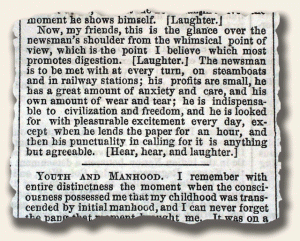 The Boston Evening Transcript of July 21, 1862, has a front page article “Charles Dickens on Newspapers”, a speech he delivered in London at the Newsvenders’ Benevolent Institution. The lengthy speech takes two-thirds of a column and is filled with witty comments, and ends with: “…The newsman is to be meet with at every turn, on steamboats and in railway stations; his profits are small…he is indispensable to civilzation and freedom, and he is looked for with peasurable excitement every day…”.
Male chauvinism has its drawbacks…
June 13, 2009 by TimHughes · 1 Comment
 The newspaper with a curious title of “The Tickler” from Philadelphia, January 22, 1812, contains a comical little item at the bottom of the back page. Little “treats” such as these may be found throughout old newspapers. See the photo.
In the beginning…
June 8, 2009 by TimHughes · 1 Comment
 Some collectors like to pursue a newspaper from each of the original thirteen colonies, and ideally one dated as close as possible to the beginning of that colony’s first newspaper. For those active in this pursuit, we offer this list of the earliest in each.
Although the first newspaper in America was published in Boston in 1690, Benjamin Harris’ “Publick Occurrences Both Forreign & Domestick” lasted by a single issue before being suppressed by the Royal authorities. The first successful Massachusetts newspaper–and the first in all of the colonies–started 14 years later in 1704, also in Boston, titled “The Boston News-Letter” which continued until the British occupation of the city in 1776.
Here are the remaining colonies and the newspaper titles. As you see, originally in titles was not a strength among the newspaper publishers:
American Weekly Mercury (Penna.), 1719
The New York Gazette, 1726
The Maryland Gazette, 1728
The Rhode Island Gazette, 1732
The South Carolina Gazette 1732
The Virginia Gazette, 1736
The North Carolina Gazette, 1751
The Connecticut Gazette, 1755
The New Hampshire Gazette, 1756
The Newport Mercury (Rhode Is.), 1758
The Georgia Gazette, 1763
The New Jersey Gazette, 1777
It may seem curious that New Jersey was the last of the colonies to have its own newspaper, however given its location between the major metro areas of New York and Philadelphia there likely wasn’t an incentive to create its own until much later than the others.