
Search
The Rare & Early Newspapers Hobby

Receive the Newsletter

Buy Historic Newspapers

#18 – America’s first newspaper… Check your attics. (*revisited)
April 18, 2014 by GuyHeilenman · Leave a Comment
The very first newspaper printed in the American colonies was published in Boston in 1690 and titled “Publick Occurrences Both Foreign and Domestick”. It was a little paper with three pages of text. The fourth page was left blank for others to write handwritten pieces of news before being passed on to others. It was published by Benjamin Harris who had experience in publishing another newspaper in London several years prior to his arrival in the colonies, titled “Domestick Intelligence, Or News Both from City & Country”.
His Boston effort focused on local news but it also included gossip and unflattering reports. One account notes it contained: “…affections of a very high nature: As also sundry doubtful and uncertain Reports…”. The mixture of doubtful and uncertain reports, as well as a ban on printing without a license which Harris did not have, caused his first issue to also be his last. Reports note that the royal governor had the printing press destroyed and all known issues of that one date of September 25, 1690 confiscated.
To this day only one genuine issue of the newspaper is known to exist, and unfortunately it’s not in the United States: it is in the Public Records office in London. Some years ago it was loaned to The Newseum in Washington, D.C. (then located across the Potomac in Virginia) for a period of time, but I believe it has been returned to London.
The intriguing part of this story is that “all known issues were confiscated and destroyed”. But exactly when did this happen? Was it done several hours since it was printed, or a few days later? It was intended to be a monthly publication. Certainly the possibility exists that a few issues were not found & confiscated, and with the owners knowing of the search they may have purposely hidden them away.
Could an issue or two still exist in a Boston attic somewhere? Is there a private library where an issue was hidden among the pages of a book in hopes of not being confiscated? Could a renovation project to a Boston area home reveal an issue tucked within its walls over 300 years ago? It is fascinating to think that some examples could be found so long after being published. But to this date none have surfaced.
Speculation runs wild as to the value of an issue should it surface. It’s America’s very first newspaper, and none exist in America. What sort of price could be set on such an issue? What should be the future home of an issue should it be found?
Feel free to comment!
—————
*The Fall of 2013 marked the 5th anniversary of the History’s Newsstand Blog by Timothy Hughes Rare & Early Newspapers. We are grateful to have the opportunity to contribute to the newspaper collecting community, and appreciate those who have participated through guest posts, comments, and readership. This year (2014) we are revisiting the top 25 posts (measured by activity), with the number 1 post being re-posted during the first week of 2015. Please enjoy. If you would like to contribute a post for consideration of inclusion on the blog, please contact Guy Heilenman at guy@rarenewspapers.com.
An unusual two issue set… a disaster and a massacre…
April 11, 2014 by GuyHeilenman · Leave a Comment
 The Set: FRANK LESLIE’S ILLUSTRATED NEWSPAPERS, New York, both dated May 3, 1873.
The Intrigue: A two issue set of the same title with the exact same date? Yes. In regards to standard daily newspapers, especially those printed for major city distribution, it was not uncommon for there to be multiple editions of the newspaper printed on the same day – perhaps a morning and evening edition. However, we have yet to discover a weekly illustrated newspaper who printed more than one version of an issue on the same day. It is this lack of discovery to-date which makes this two-issue set rather interesting. Frank Leslie’s Illustrated apparently printed two nearly identical but different issues for May 3, 1873… each having a different cover. One might think they accidentally reprinted a cover from a previous week for some of the issues, but we have had the other issues surrounding this date, and none of them have either cover in question. Additionally, while the inner pages are almost all the same, there is also another page (pg 125) which is different. Everything else is identical.
If anyone is aware of the background concerning this set, please share.
Note: Additional (and quite interesting) information concerning both front pages may be found at Colfax Massacre and Richmond Switch Disaster (Rhode Island).
Why historic newspapers? Time travel… raw emotion…
April 4, 2014 by GuyHeilenman · Leave a Comment
 I remember the first time I held an authentic Civil War era newspaper and was struck by the concept of holding history in my hands. As I read through the detailed battle reports, raw emotion welled up within me as I pondered the possibility of a loved one’s tears falling upon the very newspaper I was holding – as he/she discovered the name of a close relative… even a spouse listed among those killed in battle. As I continued to peruse the paper, the prevalence of ads, birth and wedding announcements, local news reports, etc. communicated a truth that hit me like a ton of bricks: Despite the carnage of war, and the tears of many who had just learned of the loss of someone they loved, life continued to move forward. Anyone who has lost a dear friend or family member knows the emotion: “Hey world – What are you doing? STOP! Don’t you know what’s just happened?” But the train of time rushes forward – ignoring our desperate cry for just a few more minutes…
At this point I took a breath – carefully closed the newspaper, and returned to the present – convinced I had discovered the greatest hobby of them all; one that enables anyone who would dare, to go where Orson Wells, Jack Finney, and others could only dream of going: back in time.
A collector recently sent a related note stating:
Like many people I’m sure, I have over the years fantasized many times about being able to go back in time. I realize now that this hobby has enabled me to get just a glimmer of that feeling inside, as I hold such old papers, reading the words and seeing the engravings and old photos. Touching the history in such a physical, tangible way evokes a feeling as close to time travel as we can probably ever come…and is a unique 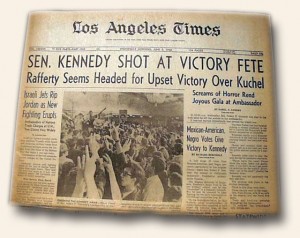 experience utterly lacking in the high school history textbooks I originally studied, or merely looking at images on a computer monitor these days. -Actapublicurist
Yet another, upon discovering the Bobby Kennedy Assassination Report issue shown in the image wrote (in part):
I will never sell this newspaper… I will be 60 in November and lived in Brooklyn when Senator Kennedy was killed. I still shed tears when I think about it all these years later. He left nine children (and a tenth on the way) and a wonderful wife, and we will never know what a difference this magnificent man with a huge heart would have made in the White House. I grieve for him as if he was close friend. I will treasure this newspaper and others in my ample collection of the RFK assassination.
What an incredible hobby!
#19 – Coffee House newspapers: a brief history… (*revisited)
March 28, 2014 by GuyHeilenman · Leave a Comment
 A number of titles on our website are referred to as “coffee house newspapers” with little explanation as to what they are. I think we owe our customers a bit of history on this interesting era.
During most of the 17th century newspaper publishing was very heavily regulated. All printing offices in England were under the control of the Surveyor of the Imprimery, or Press. Roger L’Estrange held the position in the latter half of the century and had the sole privilege of writing, printing & publishing newspapers, being involved in the “Intelligencer”, “The News”, the “City Mercury” and the “Observator“. His monopoly was broken in 1665 with the creation of the “Oxford Gazette”, renamed the “London Gazette” when it removed there after 23 issues in Oxford.
With the arrival of William of Orange in 1689 came a reduction of state control over the press. This new-found freedom gave the independent press a real impetus. Readers’ interests widened. Politics & religion were no longer everyone’s cup of tea, for it was in the post-1689 years that the coffee house as a meeting place for exchanging merchandise & ideas came into its own. Newspapers provided stimulus for conversations and gossip & entertainment became accepted & then demanded.
The London coffee-houses provided a gathering place where any man who was reasonably dressed could smoke his long, clay pipe, sip his coffee, read the newsletters of the day, or enter into conversation with other patrons. At this period when journalism was in its infancy and the postal system was unorganized and irregular, the coffee-house provided a center of communication for news and information. Runners were sent round to the coffee house to report major events of the day, such as victory in battle or political upheaval, and the newsletters and gazettes of the day were distributed chiefly in the coffee house. Most of the establishments functioned as reading rooms. In addition, bulletins announcing sales, sailings, and auctions covered the walls of the establishments, providing valuable information to the businessman who conducted much of his business from a table at his favorite coffee house.
During this era, particularly the early years of the 18th century, newspapers such as the “Tatler“, “Spectator“, “Guardian” “Athenian Mercury” & “Rehearsal” among others were very much in vogue in the coffee houses, and were more dialogue in format with back & forth discussion of a specific topic rather than reporting of news of the day.
By the latter half of the 18th century coffee house culture had run its course, but left in its wake much interesting literary work by some notable names including Daniel DeFoe (wrote for “A Review Of The State Of The Nation“, Joseph Addison & Richard Steele among others. Newspaper format tended more towards reporting news events of the day with presses being established outside the boundaries of London as well as increased activity within the city. One of the more successful titles which flourished in the latter half of the 1700’s was the “London Chronicle“, many issues of which we offer on our website, catalogs and supplements.
—————
*The Fall of 2013 marked the 5th anniversary of the History’s Newsstand Blog by Timothy Hughes Rare & Early Newspapers. We are grateful to have the opportunity to contribute to the newspaper collecting community, and appreciate those who have participated through guest posts, comments, and readership. This year (2014) we are revisiting the top 25 posts (measured by activity), with the number 1 post being re-posted during the first week of 2015. Please enjoy. If you would like to contribute a post for consideration of inclusion on the blog, please contact Guy Heilenman at guy@rarenewspapers.com.
Edward Cave Junior, and his Gentleman’s Magazine…
March 24, 2014 by GuyHeilenman · Leave a Comment
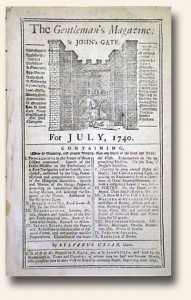 A few months ago we wrote about what is considered by many to be the most successful literary magazine of all time, The Gentleman’s Magazine. While RareNewspapers.com continues to offer many original issues of this title from the 18th and early 29th centuries, few know of the magazine’s or its founder, Edward Cave, Junior. A collector friend recently came across a wonderful posting by The Society of 18th-Century Gentleman which goes into considerable detail concerning both. An excerpt includes:
“…Edward Cave eventually purchased a small print house and shortly after began The Gentleman’s Magazine. The first issue appeared in January of 1731. Cave quickly became a highly respected publisher and businessman, and “a multitude of magazines arose” all over the world. The magazine was soon the most well-known and highly respected publication in the English language. It is widely believed that Mr. Cave was the first person ever to use the term “magazine” to describe a monthly publication of this type…”
If you’ve never perused this little gem, you’ll be pleasantly surprised with its detailed coverage of events of the day.
#20 – Thoughts on the most historic 19th century report… (*revisited)
March 21, 2014 by GuyHeilenman · Leave a Comment
A few weeks ago we had some interesting comments on what collectors thought was the most historic 20th century newspaper report. Let’s try the same with the 19th century. But given the tremendous diversity of events from 1801 thru 1900 I’m going to break the century into three parts: pre-Civil War; the Civil War; and post-Civil War. Let’s work our way backwards and discuss the post-Civil War era first.
There are many ways to approach “most historic”. My approach will be the most life-altering event with emphasis on “event”. One could argue that the second Industrial Revolution dramatically changed the world but it cannot be pinned down to a single date or event.
 Several items come to mind: the first successful Atlantic cable in 1866 was a major step in causing the world to be much smaller–a trend which continues to this day; the completion of the transcontinental railroad in the United States was a major step in the westward expansion & settlement of the United States which changed the country in many ways; and then there is the Battle of Wounded Knee which was the last battle in the American Indian Wars and the official end of the Old West. Not to be omitted would be the invention of the automobile by gentlemen in Germany in 1889.
I’m going to go with the completion of the transcontinental railroad. In thinking of the multitude of events which played off this event and how it changed the fabric of America (pardon the ethnocentrism) I’ll vote for it as the most historic event of the 19th century post-Civil War era.
What are your thoughts?
—————
*The Fall of 2013 marked the 5th anniversary of the History’s Newsstand Blog by Timothy Hughes Rare & Early Newspapers. We are grateful to have the opportunity to contribute to the newspaper collecting community, and appreciate those who have participated through guest posts, comments, and readership. This year (2014) we are revisiting the top 25 posts (measured by activity), with the number 1 post being re-posted during the first week of 2015. Please enjoy. If you would like to contribute a post for consideration of inclusion on the blog, please contact Guy Heilenman at guy@rarenewspapers.com.
The peaceful transfer of power…
March 10, 2014 by GuyHeilenman · Leave a Comment
As we approach President’s Day, there is a part of me which is somewhat sentimental about my childhood memories surrounding Washington’s Birthday. I sure do miss it as a stand alone national celebration. I fondly remember my father bringing home a cardboard version of an ax (with a chocolate-covered cherry hidden within) to present to each of us to commemorate the holiday, and without fail, reminding us to be just like George Washington – that is, to never tell a lie. Was there a bit of lore surrounding this sacred event? Sure. Did it teach us a valuable lesson? Absolutely. Somehow we’ve lost the innocence and value of oral tradition, and I wonder if we are the better for it.
Perhaps Washington never chopped down a cherry tree… and my guess is he probably told a lie at some point, but I challenge anyone to name another political leader who, in the face of such power, tradition, and popularity, was willing to hand over the reigns of power with such humility and grace. The Massachusetts Spy, Or Worcester Gazette for March 15, 1797 records much of the proceedings of this momentous event. The link provides access to considerable details. Of particular note is his response to the Massachusetts’ Representatives of Congress who basically asked him, “What now?” His response is precious (see below). Please enjoy!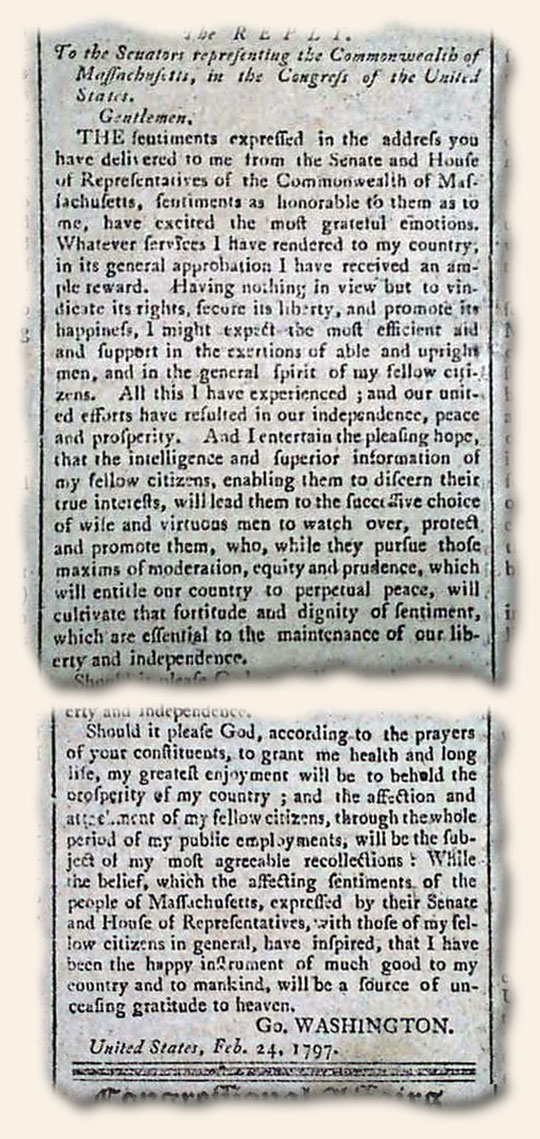
#21 – Pricing newspapers over 30 years ago… (*revisited)
March 7, 2014 by GuyHeilenman · Leave a Comment
 In conversations with people about how I started this business, a common question is, “How did you know how to prices newspapers back then?” Well, the short answer is I didn’t.
This venture started as a hobby with no thought of it turning into a business. But when I started getting too many of a similar title or date, selling off the “unwanteds” became a more common occurrence. My simple thought was, if I had $3 for it, try to sell it for $5. If I did, the price stuck for future issues; if it didn’t, the price dropped to $4.
But this became trickier years later when I was buying for resale but didn’t have enough experience to know what to pay, nor what to price them at. Nor did anyone for that matter, as there were no price guides, nor sufficient auction records to offer a clue.
I was flying by the seat of my pants. If I thought an event was historic, say a major Civil War battle, I would pay the $5 price and increase it by 50% or so. If it sold, then the next time I inched it up a bit more. If it didn’t, I reduced the price a bit. Never knowing how high customers might go for an event, I might have “inched up” the price of an event 15 times over the coarse of 4 or 5 years until there was some resistance. I was careful to keep records of sales through the years–even in the pre-computer days–which was a tremendous assistance in assigning values to the myriad of historical events covering 300 years of history.
 Did I sell some great material too cheaply in the early years? I sure did. Looking at some of my earlier catalogs I gladly pay five times the selling price of many items I sold. But it was part of the process. I remember nce having a volume of a Las Vegas, New Mexico newspaper from 1881. There must have been 30 or 40 issues with a small “Reward” ad for the capture of Billy the Kid. I think I sold those issues for less than $20 each. If I had 40 of them how rare could they be? Certainly I’ve learned through the years, and became smarter as well.
But we are still challenged today with some items. As we continue to find truly rare, almost unique issues it becomes difficult to assign values with no history or prior sales. But these are the fun challenges. As much as you may enjoy finding interesting items in our catalogs, I enjoy finding the unusual to offer.
Although this is a business, I have always gotten more joy from buying newspapers than selling them.
—————
*The Fall of 2013 marked the 5th anniversary of the History’s Newsstand Blog by Timothy Hughes Rare & Early Newspapers. We are grateful to have the opportunity to contribute to the newspaper collecting community, and appreciate those who have participated through guest posts, comments, and readership. This year (2014) we are revisiting the top 25 posts (measured by activity), with the number 1 post being re-posted during the first week of 2015. Please enjoy. If you would like to contribute a post for consideration of inclusion on the blog, please contact Guy Heilenman at guy@rarenewspapers.com.
Whatcha Got? Harry Rinker interviews Tim Hughes…
February 28, 2014 by GuyHeilenman · Leave a Comment
 Many collectors are quite familiar with Harry Rinker’s nationally syndicated radio talk show, “Watcha Got?”. Harry recently interviewed Tim regarding the Rare Newspapers collectible. Please enjoy the interview at (click on the audio mp3 button): Watcha Got?
Note: The interview lasts about 15 minutes and begins at the 28:50 time marker (just slide the bar to this point). Better yet, enjoy Harry’s entire broadcast. 🙂
The Frederick Douglass’ Paper… Solomon Northup…
February 24, 2014 by GuyHeilenman · Leave a Comment
 I absolutely love this collectible!
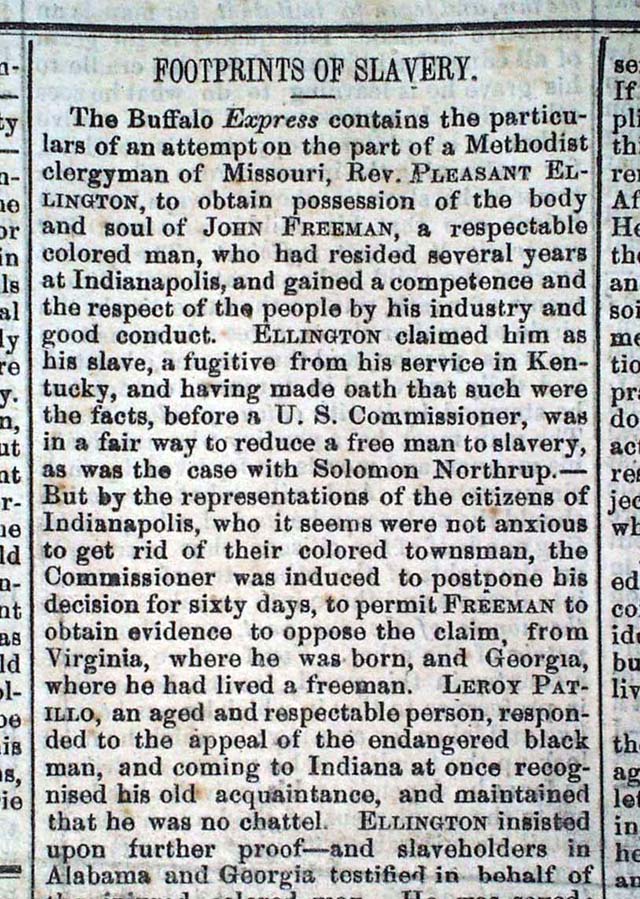
We had in our possession for a number of years an original issue of the Frederick Douglass’ Paper, dated March 17, 1854. It certainly was a grand paper – it being a continuation of Douglass’ North Star. However, while the notoriety of the title was well-established and the angst of slavery oozed throughout, it was a 21st century movie which infused new life into it’s weary 150+ year-old raglinen pages.
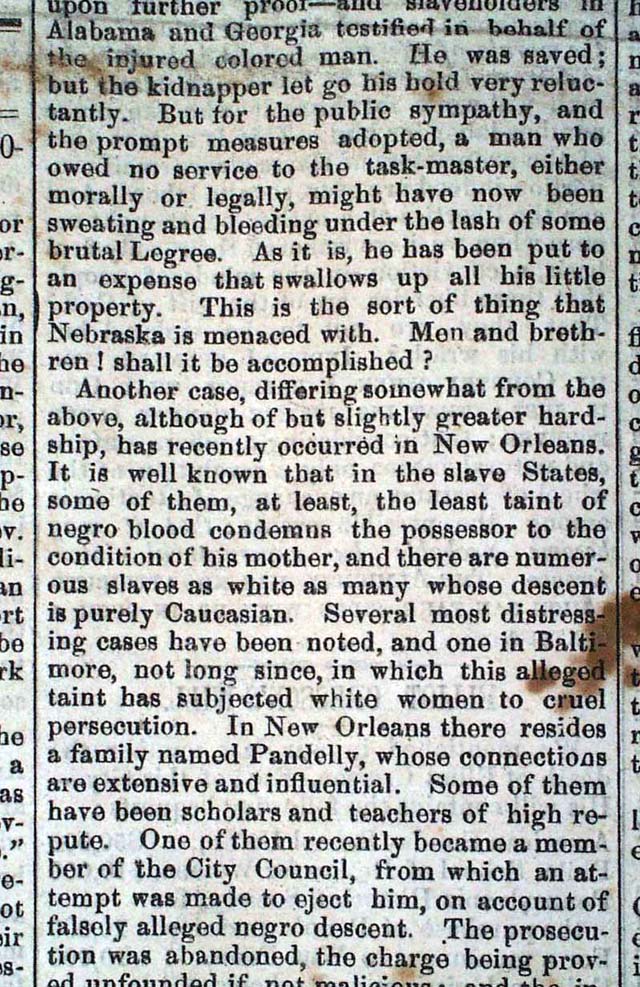
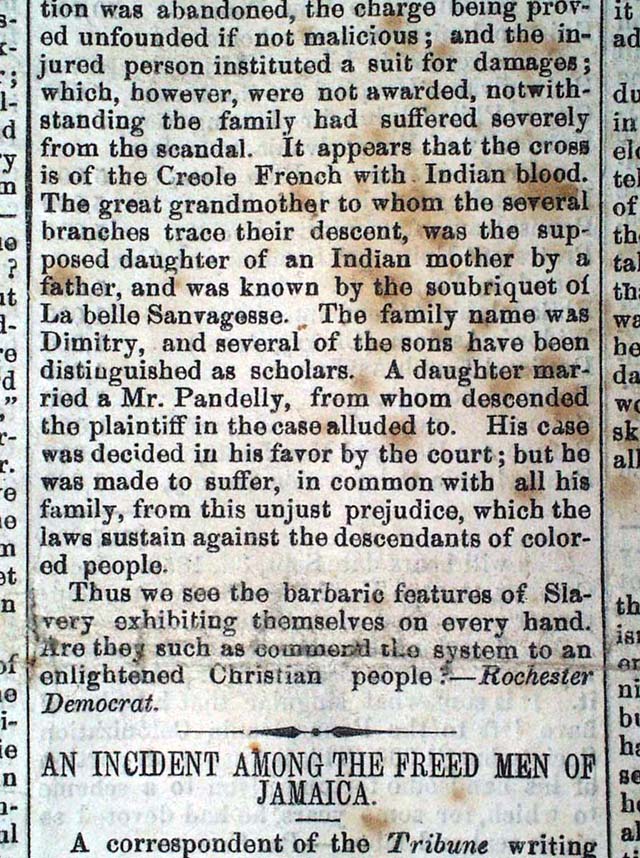
A collector recently went to see the theatrical adaptation of “Twelve Years a Slave – The Memoir of Solomon Northup“, and was moved to visit the Rare & Early Newspapers‘ website to see if we had newspapers with his mention. Searches for his name were unsuccessful – but this collector was not to be deterred. Having previously viewed the Frederick Douglass’ Paper in question, he took the next step and began to go over the corresponding images with a fine-tooth comb. Success. The newspaper was not only noteworthy for its editor and rarity, but it also had an article on the front page with mention of Solomon Northrup (see below). Fantastic.
Like I said, I love this collectible!