

Search
The Rare & Early Newspapers Hobby

Receive the Newsletter

Buy Historic Newspapers

Movie prop newspaper #2… Help needed…
August 18, 2016 by GuyHeilenman · Leave a Comment
 Movie prop newspapers are exactly that – newspapers which have been created for the purpose of being used within a specific movie. e wrote on this in detail at: https://blog.rarenewspapers.com/?p=8860. Over the next few weeks we’ll roll out a series of such issues for which we cannot determine the movie from which it came. Can anyone help? If so, please let us know.
Today’s issue is The New York Chronicle, undated, with the featured headline: “PROHIBITION REPEALED” (see image).
All issues we’ve listed to-date can be found at: Unidentified Movie Prop Newspapers
An August, 2016 stroll back thru time – 50, 100, 150, 200, & 250 years ago…
August 4, 2016 by GuyHeilenman · Leave a Comment
 What news was reported in the month of August – 50, 100, 150, 200, and 250 years ago (1966, 1916, 1866, 1816, 1766)? Such a walk back through time via the eyes of those who read the daily and weekly newspapers of the period can be quite revealing. This is why we often say, “History is never more fascinating than when it’s read from the day it was first reported.” The following links will take you back in time to show the available newspapers from the Rare & Early newspapers website. There’s no need to buy a thing. Simply enjoy the stroll.
The Holocaust… Truth be told…
July 28, 2016 by GuyHeilenman · Leave a Comment
TRUE: The Nazis inflicted unspeakable atrocities on millions upon millions of people.
TRUE: Most of the world was shocked as details of the horrors were revealed after the war.
FALSE: The Nazis’ agenda was a deep-kept secret.
FALSE: Remaining silent and/or turning a blind eye to evil makes it go away.
How could the Hitler-orchestrated holocaust have happened without the world’s knowledge? Since the end of WWII many have distanced themselves from complicity due to inaction. Nations and individuals both often declare they had no idea such atrocities were taking place – stating evidence of Adolph Hitler’s extreme intentions were kept under wraps. However, truth be told, the entire world was not unaware of Hitler’s desire and willingness to do whatever it took to create a so-called “pure” race. Articles regarding his agenda reached American newspapers as far back as the early 1930’s.  This point was recently brought to our attention as we were perusing the New York Times for December 8, 1931. There we found a front page report with the two-column heading: “Nazis’ Would Assure Nordic Dominance, Sterilize Some Races, Ban Miscegenation”, with considerable details to follow. Perhaps the world didn’t realize the extent of the horrors that were occurring, but this article, as well as a score of others, certainly should not have gone unnoticed.
This certainly begs the question: “Are similar atrocities happening today? Are other mass-forms of oppression, brutality, or worse taking place within our reach? We can look away, but a verse from the Bible reminds us: “Remember, it is sin to know what you ought to do and then not do it (James 4:17).” We may put our head in the sand, but we are not without excuse. Hopefully the truth regarding our past mistakes will spur us to proper action today.
If we only new just how close… But what we don’t no won’t hurt us…
July 21, 2016 by GuyHeilenman · Leave a Comment
 Have you ever tried to be ind to someone or to treat them like an ing? Does your house have an itchen and do people need to nock before they enter? Have you ever seen a football player run back an ickoff for a touchdown or a boxer ock-out his opponent with a single punch? Thanks to the impassioned early 19th century arguments in defense of keeping the letter “K” in our alphabet, the answer to all the above is an emphatic “no”. Of course we are left with the tension created by “know” vs. “no” and “knew” vs. “new”, but such stressors are a small price to pay for being able to get down on one knee to propose or to greet a loved one with a kiss. I for one are sure glad we ept it! The complete article may be read at: The Port Folio, May 23, 1801.
Don’t believe everything you read… Hitler rise to power unlikely!
July 14, 2016 by GuyHeilenman · Leave a Comment
One of my favorite quotes regarding the internet, but whose founding warning-principle is rooted in print media is:
“The problem with internet quotes is that you can’t always depend on their accuracy.” -Abraham Lincoln, 1864
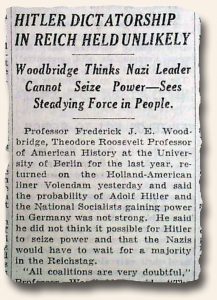 You simply cannot believe everything you read, hear, and in some cases, see. In most instances the misinformation is at least somewhat unintentional. However, sometimes even the well-intended get it wrong – including the so-called experts. Such is the case with a report in the August 16, 1932 edition of the New York Times. The heading in question reads: “Hitler Dictatorship In Reich Held Unlikely“. Just to be sure the heading would not be misinterpreted, a segment of the corresponding text states: “…the probability of Adolph Hitler and the National Socialists gaining power in Germany was not strong…” Let’s just say Frederick J. E. Woodbridge, an esteemed professor of American History at the University of Berlin, was a bit off the mark.
True? Muhammad’s pledge of protection for Christians…
July 7, 2016 by GuyHeilenman · Leave a Comment
 We recently discovered a report from Syria in the New York Observer, September 29, 1881 which had an interesting article discussing the existence of a document, signed by Muhammad, which provided for the protection of Christians. The article in its entirety is shown through the link. One website states:
“During our research with the Greek Orthodox Church, we have located numerous documents hand signed by Muhammad granting permanent protection to Christians and to their churches. These documents have been in existence since the original order given by Muhammad in 628 ACE. We have located several recent documents which sustain the original charter of rights. We question why are these mandates not known to the Muslim world? Why does the media avoid reporting these critical religious instructions?”
Can anyone comment on the authenticity of this covenant as described in the NY Observer?
A July, 2016 stroll back thru time – 50, 100, 150, 200, & 250 years ago…
July 1, 2016 by GuyHeilenman · Leave a Comment
 What news was reported in the month of July – 50, 100, 150, 200, and 250 years ago (1966, 1916, 1866, 1816, 1766)? Such a walk back through time via the eyes of those who read the daily and weekly newspapers of the period can be quite revealing. This is why we often say, “History is never more fascinating than when it’s read from the day it was first reported.” The following links will take you back in time to show the available newspapers from the Rare & Early newspapers website. There’s no need to buy a thing. Simply enjoy the stroll.
More on printing newspapers in the 1700’s (revisited)…
June 27, 2016 by GuyHeilenman · Leave a Comment
This article is primarily taken from the April, 1996 edition of “Collectible Newspapers” edited by Rick Brown, whom we thank for this contribution. It offers some interesting insights into the printing & distributing of newspapers in the colonial and post-colonial era of the United States.
 Newspapers from the latter half of the 18th century were relatively scarce. One factor was that early settlers were busy clearing the land & otherwise making the land habitable & sustaining. Plus only a small percentage of the population had reading skills beyond that of the basic rudiments. Although most towns of any size by 1715 had tracts of land set aside for schools, few actually had schools built & in operation.
Nearly all 18th century newspapers were edited & published by printers that had a general printing business and also printed pamphlets, books, broadsides, lottery tickets, etc. Many also sold merchandise, groceries, patent medicines, and a variety of other goods. Rags, which were used to make the paper , were scarce in the colonies so most of the paper was imported from England.
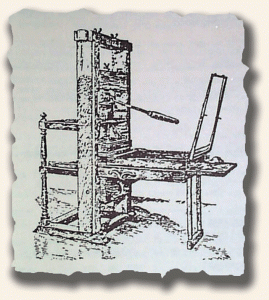
Newspapers were printed on wooden hand presses with each application of ink to paper requiring a pull of by lever and screw. It was not until around 1816 that the new iron Columbian press came into general use. Instead of a screw it used a series of compound levers that multiplied the pull of the operator. But still, all hand presses were slow & laborious. The forms had to be laid by hand and the ink was poor and of uneven quality. Types were frequently old and worn.
After the newspapers were printed, distribution difficulties were encountered. Circulation was confined, for the most part, to the towns in which they were published. They were distributed to the rural areas by post-boys on horseback and by stagecoach drivers. The roads were bad & the postal system was slow. Subscribers were few & the cost of an issue relatively expensive so newspapers were typically handed around from one to another so that a single copy was ready by many. Even those who subscribed often failed to pay for their subscriptions.
It has been estimated that the largest circulation of a single newspaper during the earlier colonial period was about 350 and that only a few reached this high of a number of circulation. By the 1750’s circulation for larger city newspapers reached upwards of 600 of each issue printed and during the Revolutionary War some newspapers boasted circulations in excess of 2000. By 1790 most newspapers were printing less than 1000 copies but the very popular “Columbian Centinel” from Boston was printing over 4000 copies of each printing date.
Despite poor equipment, limited circulation, nonpaying subscribers, poor distribution facilities & the general unprofitability of publishing a newspaper, the number of newspapers being published continued to increase as the years went by. There were numerous failures, but new newspapers were established to replace them. From 1704 to 1820 about 1634 newspapers came to life and died. Of that number only two-thirds of them lived beyond three years.
(originally posted in 2009)
Movie Prop Newspaper… Can you identify the movie (round 1)?
June 23, 2016 by GuyHeilenman · Leave a Comment
Movie prop newspapers are exactly that – newspapers which have been created for the purpose of being used within a specific movie. In some instances they are created using an authentic (actual) newspaper from the period in question, and splice-in content that meets the movie’s needs. In other instances a newspaper if created from scratch. Both are collectible and are typically hard to come by since only a handful were originally printed. We’ve had the privilege of having a few to offer over the years, but a new set of movie-prop issues has us (Rare & Early Newspapers) perplexed. We simply do not know from which movies they came. How do we know they are actually movie-prop issues?
- The actual titles do not exist.
- The paper upon which they are printed does not quite match the era from which they supposedly came.
- They were included as part of the Richard Robinson Collection (see https://blog.rarenewspapers.com/?p=7359), which included several properly identified movie prop issues.
So now the fun begins. Can anyone definitively state the movie from which the movie prop newspaper shown below (The Record Herald) came from?  Note: Since this post was initially published, we’ve posted several additional movie prop issues. These posts may be viewed at: Unidentified Movie Prop Newspapers
“Dear Daughters, Welcome to summer…”
June 16, 2016 by GuyHeilenman · Leave a Comment
A well-known “letter” has been making its rounds for many decades which was supposedly written by a young female college student to her parents, updating them on the recent events that had befallen her. While the letter is fictitious, it certainly encourages us to keep perspective when hearing bad news concerning loved ones. A (modified) form of the letter is as follows:
Dear Mother and Dad:
It has been three months since I left for college. I have been remiss in writing and I am very sorry for my thoughtlessness in not having written before. I will bring you up to date now, but before you read on, please sit down. You are not to read any further unless you are sitting down, okay.
Well then, I am getting along pretty well now. The skull fracture and the concussion I got when I jumped out of the window of my dormitory when it caught fire shortly after my arrival are pretty well healed by now. I only spent two weeks in the hospital and now I can see almost normally and only get those headaches once a day.
Fortunately, the fire in the dormitory and my jump was witnessed by an attendant at the gas station near the dorm, and he was the one who called the Fire Dept. and the ambulance. He also visited me at the hospital and since I had nowhere to live because of the burnt out dormitory, he was kind enough to invite me to share his apartment with him. It’s really a basement room, but it’s kind of cute. He is a very fine boy and we have fallen deeply in love and are planning to get married. We haven’t set the exact date yet, but it will be before my pregnancy begins to show.
Yes, mother and dad, I am pregnant. I know how very much you are looking forward to being grandparents and I know you will welcome the baby and give it the same love and devotion and tender care you gave me when I was a child. The reason for the delay in our marriage is that my boyfriend has some minor infection which prevents us from passing our premarital blood tests and I carelessly caught it from him. This will soon clear up with the penicillin injections I am now taking daily.
I know you will welcome him into the family with open arms. He is kind and although not well educated, he is ambitious. Although he is of a different race and religion than ours, I know that your oft-expressed tolerance will not permit you to be bothered by the fact that his heritage and religion are different than ours. I am sure you will love him as I do. His family background is good too, for although I’ll need to learn my place when I visit, I am told his father is one of the most respected men in his village and is often called upon to help keep order when those from his community step out of line.
Now that I have brought you up to date, I want to tell you there was no dormitory fire; I did not have a concussion or a skull fracture; I was not in the hospital; I am not pregnant; I am not engaged. I do not have a communicable disease, and I am not dating someone from a culture which is oppressive to women. However, I am getting a D in sociology and an F in science; and I wanted you to see these marks in proper perspective.
Your loving daughter,
(unsigned)
It is with the heart of this letter in mind I present a copy of a recent rather-lengthy text my wife and I sent to our young daughters:
Dear Daughters,
As you know, the summer season is nearly upon us and your annual quest to find swimsuits your mama and I are willing (if even reluctantly) to allow you to wear in public is upon us. We know this is about as challenging and frustrating as finding a “mama acceptable” evergreen tree at the start of each Christmas season. Need I say more? However, this year, as your loving parents, we’ve decided to alleviate your stress by purchasing matching suits for all of you. While they have yet to arrive, we were able to download a picture of the ad for the style we selected from the online catalog at AuntieAmysAuspiciousApparel.com:

Okay, we didn’t purchase swimsuits for each of you, but we’re considering doing so next year. Please keep the above in mind as you begin your quest. I’m sure we’ll be pleased with your choices.
Love,
Mom and Dad
PS A special thank-you goes out to the Public Ledger, Philadelphia, June 15, 1893, for this most wonderful advertisement. It’s a bit unsettling to note the ad appears in an issue containing an article on Lizzie Borden.
Full Disclosure: My wife and I are blessed to have 5 daughters with whom we never need to fight this battle. Thank you!