

Search
The Rare & Early Newspapers Hobby

Receive the Newsletter

Buy Historic Newspapers

They Put It In Print – A U.S. President Seeks Permission…
October 27, 2025 by GuyHeilenman · Leave a Comment
In the U.S., only Congress can declare war. So how many wars have Americans actually fought since World War II? You might think of the Korean War, Vietnam, Kuwait, Iraq, or Afghanistan. But here’s the catch: the answer is technically zero.
How can that be? Modern presidents simply avoid the word “war,” using terms like “military engagement” or “conflict” instead. No official declaration, no congressional vote—problem solved.
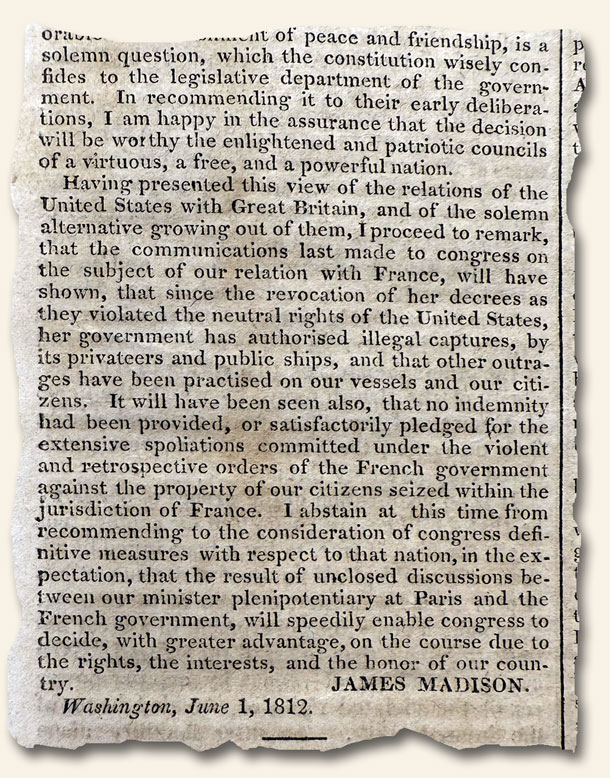
It wasn’t always this way. Take the War of 1812: President James Madison believed the U.S. needed to go to war with Great Britain. Did he send troops under a euphemism like “military operation”? No. He went straight to Congress with a detailed manifesto explaining why war was necessary. That document, printed in The War on June 27, 1812, shows just how seriously Madison took the Constitution’s war powers. The introduction and conclusion of his lengthy plea are shown below.
Today, renaming wars might serve convenience or strategy, but it raises a bigger question: if we can call war by any name we like, what happens to the checks and balances the Constitution set in place?
Do you think this trend is a necessary evolution—or a dangerous bypass of Congress?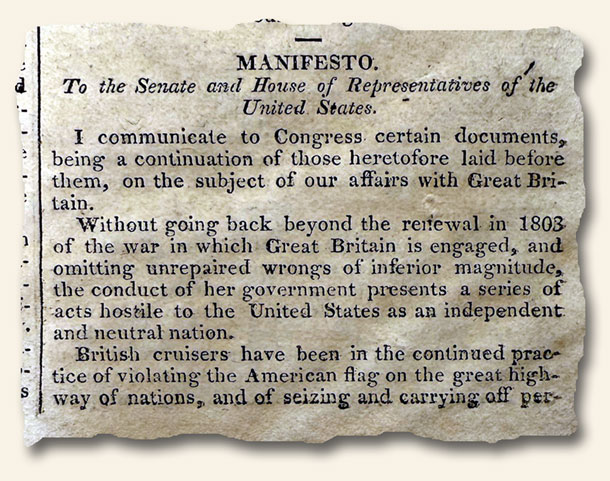
Headlines That Never Happened: Germany’s Loss and Its Lasting Echoes…
October 20, 2025 by GuyHeilenman · Leave a Comment
In April of 1918, a newspaper playfully speculated on what the headlines might have looked like if Germany had won World War I. A century later, we know the opposite outcome set in motion consequences far greater than most could have imagined. Germany’s defeat, and the way the Allies handled it, reshaped not just Europe but the modern world.
 The Ripple Effects of Germany’s World War I Defeat
The Treaty of Versailles (1919) imposed heavy reparations, territorial losses, and strict military limits on Germany. Instead of securing peace, these terms humiliated the nation and destabilized its young democracy. The resentment they bred became fertile ground for Adolf Hitler and the Nazi Party, leading to World War II and the Holocaust.
Europe’s New Order
Britain and France emerged victorious but weakened, while the United States stepped into global leadership. Versailles became a cautionary tale: punish a nation too harshly, and you may guarantee the next war. After World War II, the Allies took the opposite approach—rebuilding Germany through the Marshall Plan and anchoring it in NATO and the European Union. Today, Germany’s central role in both reflects that strategy.
Jews and the Holocaust
Germany’s turmoil fueled dangerous scapegoating. Conspiracy theories like the “stab-in-the-back” myth cast Jews as traitors, intensifying antisemitism that Nazi propaganda later weaponized. The Holocaust destroyed European Jewry and gave new urgency to the Zionist movement, leading to the founding of Israel in 1948.
Redrawing the Middle East
The collapse of Germany’s ally, the Ottoman Empire, allowed Britain and France to carve up the Middle East. Mandates in Iraq, Syria, and Palestine ignored ethnic and religious realities. Britain’s contradictory promises to Jews and Arabs in Palestine set the stage for the enduring Israeli-Palestinian conflict.
Lasting Echoes
The “war to end all wars” did not end conflict—it reshaped it. From NATO and the EU to Israel’s creation and Middle Eastern instability, the ripple effects of Germany’s defeat still define our world.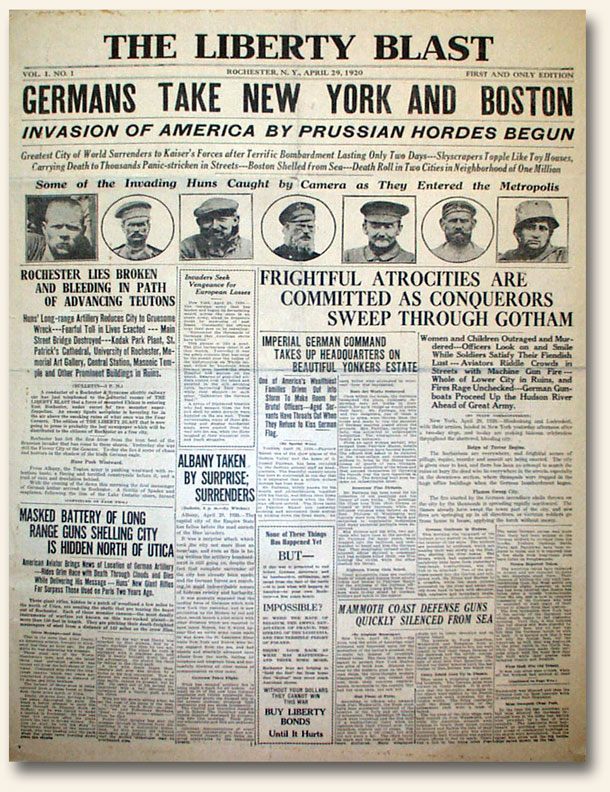
While the two photos above show The Liberty Blast with a dateline of April 29, 1920, this newspaper with “fictious reporting” was actually printed on April 20, 1918 “in the hope that in some small way it may serve to awaken in the hearts & minds of those who read it a realization of those horrors of a great world war, so far from and yet to near to American shores, American life, and American people…”.
October Newsletter (2025) – Timothy Hughes Rare & Early Newspapers…
October 17, 2025 by GuyHeilenman · Leave a Comment
|
|
Who’s Who in Newspapers? Citizen Genêt edition…
October 10, 2025 by GuyHeilenman · 1 Comment
The 10th installment of Who’s Who in Newspapers
Citizen who? While exploring newspapers from the 18th and early 19th centuries over the past few decades, I noticed the name “Citizen Genet” appearing more than once—always tied to some sort of “affair.” As a novice historian at the time (my academic background is actually in mathematics and engineering), and given my aversion to sensationalized “yellow journalism,” I let it pass. With tens of thousands of fascinating topics to explore through our beloved collectible, I never stopped to uncover who he really was or what his “affair” involved.
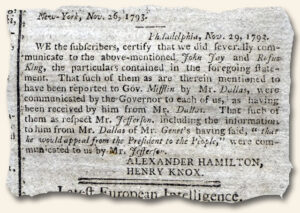 Recently, however, I embraced the old adage that “it’s never too late to learn” and finally took the plunge. What I found was a story worth the effort, one that offered both historical insight and a better appreciation for the newspapers that recorded it. A summary of my discovery is as follows:
Edmond-Charles “Citizen” Genet was a French diplomat sent to the United States in 1793 to gain American support for France’s wars with Britain and other European powers. Instead of observing diplomatic protocol, he jumped right into recruiting privateers to attack British ships and encouraging Americans to take up arms against Spain. These moves directly violated President George Washington’s Neutrality Proclamation of 1793. To make matters worse, Genet bypassed Washington altogether and appealed directly to the American public, an act that came across as both disrespectful and threatening to U.S. sovereignty.
The uproar that followed—known as the “Citizen Genet Affair”—quickly became a defining moment in America’s early history. Washington demanded Genet’s recall, reinforcing both the president’s authority in foreign affairs and the new nation’s commitment to neutrality. At home, the controversy deepened political divisions: Federalists supported Washington’s cautious stance, while Democratic-Republicans sympathized with revolutionary France. In the end, Genet was granted asylum in the United States and lived out his life in New York, but his story left behind a lasting lesson in diplomacy and America’s determination to remain independent from foreign influence.
So much for jumping to conclusions regarding his “affair”. I should have known better.
The photos shown are from two articles within the Columbian Centinel, Dec. 11, 1793. – the above in full, and the below of only an excerpt due to the length of the article. If original newspapers on this topic remain available, they would be found at: CITIZEN GENET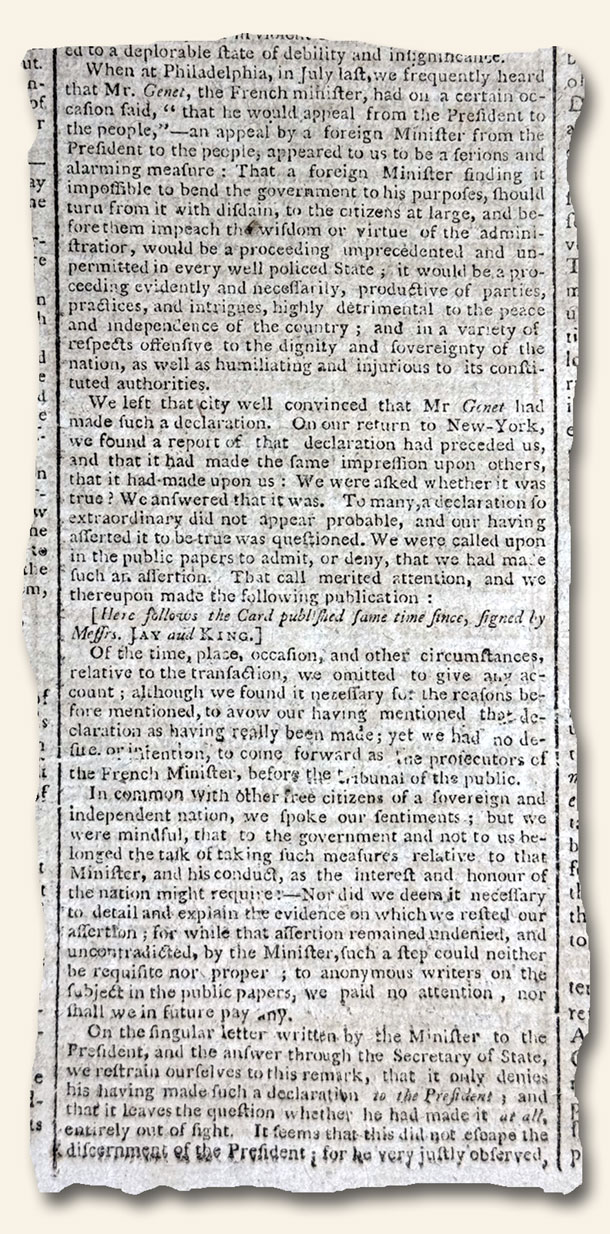
Lead-up to a Nation… as reported in the newspapers of the day (Intro & Sept., 1775)…
October 3, 2025 by GuyHeilenman · Leave a Comment
British News Delayed – Lead-up to a Nation (E5)
Lord Dunmore and Colonial Unrest – Lead-up to a Nation (E6)
Patrick Henry – Lead-up to a Nation (E7)
Benjamin Franklin – Lead-up to a Nation (E8)
We hope you are enjoying this year-long trek to the 250th anniversary of The United States through the eyes of those who were fully engaged, first hand. As mentioned previously, all accounts are rooted in what they read in the newspapers of the day.
“History is never more fascinating than when read from the day it was first reported.” (Timothy Hughes, 1975)
Announcing: Catalog #359 for October, 2025 – Rare & Early Newspapers…
September 30, 2025 by GuyHeilenman · Leave a Comment
|
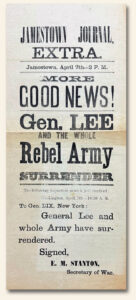 October’s catalog (#359)
|
Is it Patriot Day, Patriot’s Day, or are they interchangeable?
September 11, 2025 by GuyHeilenman · Leave a Comment
Is it Patriot Day? Yes. Is it Patriot’s Day? Yes again. Are they interchangeable? If someone had asked me yesterday, I would have thought they were one and the same; but the answer is: No! So, for those like me who thought they were one and the same, I hope what follows clears things up.
 Patriot Day
Patriot Day is a United States observance held every year on September 11 to honor the nearly 3,000 people who lost their lives in the terrorist attacks on September 11, 2001. Established by a joint resolution of Congress and signed into law in 2002, the day commemorates the victims of the attacks on the World Trade Center, the Pentagon, and United Airlines Flight 93, as well as the first responders who risked and sacrificed their lives. Americans observe the day with moments of silence, memorial services, and the lowering of flags to half-staff as a tribute to national resilience and remembrance.
Shown to the left is a report from the Los Angeles Times, dated Sept. 11, 2001.
Patriot’s Day
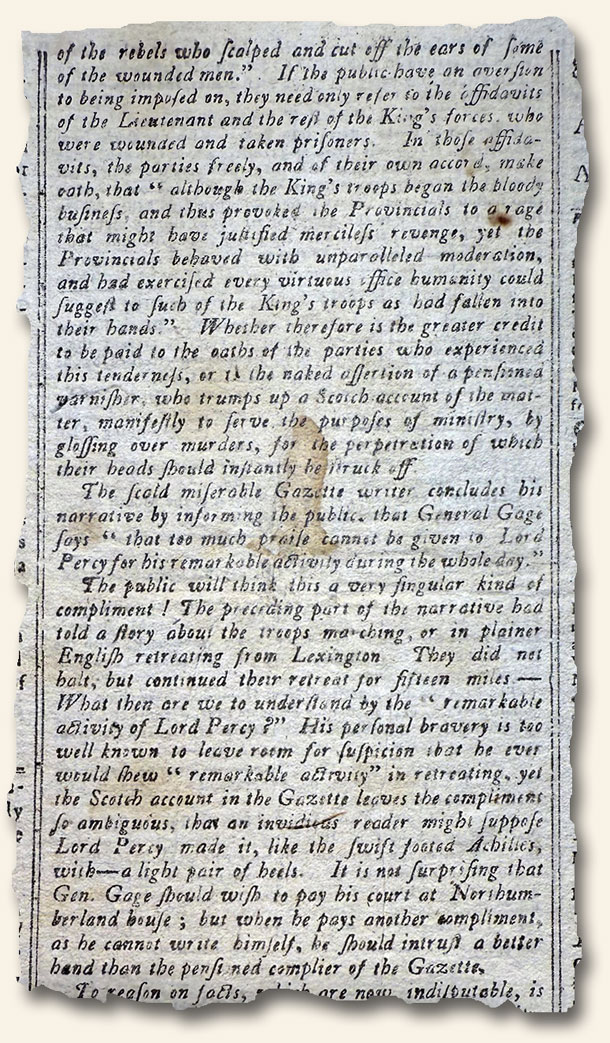
Patriots’ Day is a U.S. holiday commemorating the battles of Lexington and Concord, the first military engagements of the American Revolutionary War, fought on April 19, 1775. It originated in Massachusetts in the late 19th century to honor the bravery and sacrifice of colonial militiamen who resisted British forces. The holiday is observed annually on the third Monday in April, primarily in Massachusetts and Maine, with re-enactments, parades, and athletic events like the Boston Marathon. Patriots’ Day serves as a reminder of the American colonies’ fight for independence and the birth of the United States.
The following is a report from The New England Chronicle dated Sept. 7, 1775.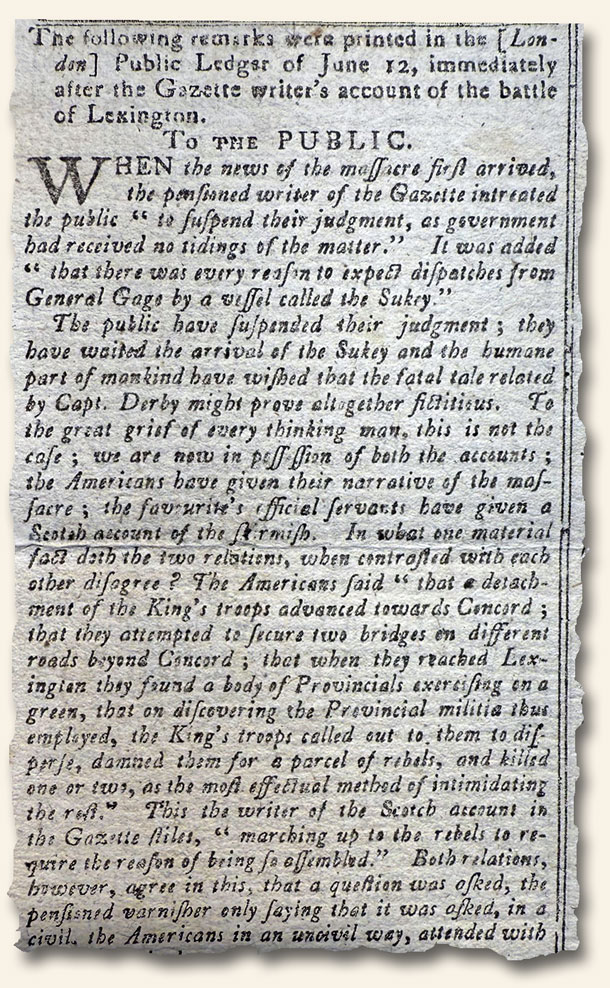
Singers & Songwriters – 1776 edition…
September 8, 2025 by GuyHeilenman · Leave a Comment
Flashback – 1776
“And, the award for the songwriter of the year goes to… ‘wait for it… wait for it…’* … Benjamin Franklin, for his chart-busting mega-hit: “The KINGS own REGULARS, and their TRIUMPH over the IRREGULARS.”
Was there anything this man could not do? I could be wrong, but if those who have explored the life of this amazing forefather were asked to list his talents and accomplishments, I’m guessing that “lyricist” would not make anyone’s list. Yet, although unsigned, the satirical ditty printed in the Pennsylvania Evening Post on March 30, 1776 (shown below) has finally been universally acknowledged as being from his pen (and not just an autopen with his name on it). Furthermore, the fact that it would have likely topped the charts in such an historic year (1776) makes him a shoe-in for eventual entry into the Musicians Hall of Fame and Museum. Sadly, whether through the distraction of competing interests, lack of funding, or perhaps the waning of ongoing inspiration, history has proven him to be classified as a “one-hit wonder”. What a shame; he was off to such a great start.


*Quote borrowed from Ketanji Brown Jackson, honorable Associate Justice of the SCOTUS.
Lead-up to a Nation… as reported in the newspapers of the day (Intro & August, 1775)…
September 5, 2025 by GuyHeilenman · Leave a Comment
Shown below are the first four installments.
The Necessity of Taking Up Arms – Lead-up to a Nation (E1)
The Olive Branch Petition – Lead-up to a Nation (E2)
The Speech of Edmund Burke – Lead-up to a Nation (E3)
England Declares War – Lead-up to a Nation (E4)
We hope you enjoy this year-long trek to the 250th anniversary of The United States through the eyes of those who were fully engaged, first hand. All accounts will be through what they read in the newspapers of the day. After all, as Tim Hughes proclaimed back in 1975: “History is never more fascinating than when read from the day it was first reported.”
Announcing: Catalog #358 for September, 2025 – Rare & Early Newspapers…
August 29, 2025 by GuyHeilenman · Leave a Comment
|
 September’s catalog (#358)
|