

Search
The Rare & Early Newspapers Hobby

Receive the Newsletter

Buy Historic Newspapers

Bad Luck vs. Fate – The Sullivan Brothers…
October 13, 2023 by GuyHeilenman · Leave a Comment
Today is Friday – more specifically, Friday the 13th. I’m not superstitious or a fatalist, and I’m not quite sure what I think about “the luck of the Irish”, and even if it does exist on some level, whether or not Irish-Americans have it (or is it washed away in the salt water of Atlantic during transit. Quite honestly, I try to limit my exposure to bad news. However, a few weeks ago one of our staff brought me a 1943 newspaper containing an article regarding the dreadful story of the Sullivan Brothers during WWII. While the event was immortalized in the movie “The Fighting Sullivans”, and inspired drama “Saving Private Ryan”, there is no better way to capture this horrible moment than reading it as it was reported in 1943. A clip of the article is shown below, and more may be viewed through the link: Five Sullivan Brothers Killed in WWII Action. Was it fate, bad luck (of the Irish?), or something entirely different? Regardless, one thing is for certain, it was horribly tragic!
Who will be the Superpowers of the 22nd century?
October 9, 2023 by GuyHeilenman · Leave a Comment
While Great Kingdoms come and Great Kingdoms go, no one can argue that The British Empire owned the title of Superpower for much of the 1600’s through 1800’s. This is not to disparage Spain, Prussia, France, Russia, Portugal and the entire Asian and African regions, but during this stretch of time, England/Britain had staying power to go with their strength. However, as the writing on the wall began to identify potential challengers to their title, it is interesting to hear who Lord Stanley, the notable British Prime Minister in 1858, had to say would be the major powers of the 20th century. An article with his thoughts which would prove to be prophetic in less than 100 years appeared in the March 22, 1858 issue of The New York Times. I wonder who will be the global force(s) 100 years from today? Bonus question: Will their dominance reach into the heavens… or to the depths of the sea?
Exploring “This Day in History” through Rare & Early Newspapers… Updated!
October 6, 2023 by GuyHeilenman · Leave a Comment
Who among us isn’t a bit curious as to what occurred on our birthday (or today’s date) through time? The concept of exploring a specific day (month/day) through history has always been intriguing, but before the internet, such knowledge was not easy to obtain. However, in the present world of data explosion, websites which explore “This Day in History” do the job quite nicely and have become very popular. One of my favorites is HISTORY.COM maintained by The History Channel.
Of course, as a collector and reseller of old newspapers, this trek is amplified by the capability of holding authentic newspapers containing contemporary reporting of these events – to not only read the articles themselves, but to explore the context of what else was going on as the events unfolded.
Thanks to ongoing requests from collectors, we’ve created an interface on our website which enables the seeker to explore what is available at any given moment for any month/day. Even if you are not looking to add to your collection, perusing through the issues can be fascinating. If you have interest in giving this a try, the steps below are provided to help you get started.
This feature is available at: Explore: “THIS DAY IN HISTORY”
– – –
I tried own birthday and came up with the following: January 2nd Through Time
Don’t forget the “Sort” feature which will give you multiple ways to arrange your search results. Have Fun!

Goodbye Lyndsay… Hello Breck…
October 2, 2023 by GuyHeilenman · Leave a Comment
 It is with both joy and sadness we (the staff at RareNewspapers.com) say goodbye to Lyndsay Miller who served as our office assistant and primary “order fulfillment guru” over the past few years. We are sad to see her go as she was an outstanding member of our staff, and many of those who collect with us were very fond of her pleasant and helpful spirit. However, we are also excited on her behalf as she embarks on her next adventure: a brick-and-mortar store in downtown Williamsport, PA (as a companion venue to her on-line presence) where she has the opportunity to engage in her love for vintage clothing. We wish her the best and are thankful we had her with us for longer than expected.
In typical Lyndsay fashion, she helped us find her replacement, Breck Miller – a young man from Jersey Shore, PA who has a strong work-ethic, solid values, a love for history… oh, and in case you haven’t already guessed, he just happens to be Lyndsay’s brother-in-law. Welcome Breck! The fun has just begun!!!
Announcing: Catalog #335 for October, 2023 – Rare & Early Newspapers…
September 29, 2023 by GuyHeilenman · Leave a Comment
|
 The October catalog (#335) is now available. Shown below are links to various segments of the catalog, our currently discounted
|
[The links above will redirect to the latest catalog in approx. 30 days
upon which time it will update to the most recent catalog.]
From the Vault – Finding those unexpected historical nuggets.
September 25, 2023 by GuyHeilenman · Leave a Comment
Few thrills are greater in the rare newspaper collecting hobby than finding the unexpected historic gem. Those moments of serendipity are the treasures we all hope for at some point in our quest for new additions to our collection.
I have come across many in my years of collecting with two among the more interesting.
Long before the days of the internet I subscribed to the catalogs of the prestigious Sotheby’s auction house in New York City as they occasionally ran Americana sales which included newspapers. One sale offered an  issue of the SOUTH CAROLINA GAZETTE from August of 1776. Trying to assemble one newspaper of all thirteen colonies from the Revolutionary War, this would be a new addition to that set. The lengthy catalog description noted some war skirmishes but nothing significant. But that was not a concern to me as I was only seeking a title from that colony from during the war, and the date of 1776 made it that much better. I placed my bid and was excited to learn I won the issue.
Several weeks later the issue arrived. In preparing it for my collection I casually looked over the content, and you can imagine my shock upon finding on page 2 a complete printing of the Declaration of Independence! I couldn’t imagine the incompetence of the cataloger–employed by Sotheby’s no less–who missed this report.
Not many years ago we purchased the newspaper holding of a public library in Massachusetts which includes a lengthy run of a Springfield newspaper, in fact two truckloads of volumes ranging from the mid-1800’s thru the latter part of the 20th century. Knowing the wealth of historical material which could be culled from this collection we put our attention to those events for several months upon its return to our office & warehouse in Williamsport. Some time later we realized that the sport of basketball was founded in Springfield. Could we be so fortunate to to find a report off the very first game every played? Did the local newspaper even report what is now an extremely significant event in the history of basketball?
Indeed they did. The Springfield Republican, March 12, 1892 issue reported somewhat inconspicuously on page 6 an event headed “Basket Football Game” played the day before (which we now recognize as the first public basketball game), with mention of James Naismith who is recognized as the founder of the sport. It was a thrill to find the report which languished for over 100 years, unbeknown to anyone, in the back shelves of a library. Curiously the curator of the Basketball Hall of Fame didn’t appreciate its significance, however the Smithsonian Institution did as it now is part of their collection.
What historical gems have you discovered serendipitously in issues purchased for another reason, or as part of a collection where nothing special was expected? Feel free to share your stories with other collectors!
(This post was originally published on October 13, 2008.)
Snapshot 1839… Is an atheist’s sworn statement in court valid?
September 22, 2023 by GuyHeilenman · Leave a Comment
Let’s be honest, if a journalist posed this question in a mainstream newspaper today, the pushback for even asking the question would likely go viral within minutes, if not seconds. However, in 1831 the Boston Police Court was wrestling with this very question. In fact, the language used to describe such a situation was not one of validity, but competency. The article is too long to show in full, but for those who may be curious I’ve included 2 photos below – one each of both of the introduction and the conclusion.
Note: Some might also find the slavery-themed content within this same issue rather interesting as well: Daily National Intelligencer, July 2, 1839.

They Put It In Print – Going to extreme lengths to prove another’s innocence…
September 18, 2023 by GuyHeilenman · Leave a Comment
Would you step in front of a moving vehicle to push a small child out of the way of its path? Would you jump into a river to save a drowning family member? Would you kill yourself to prove a stranger’s innocence? If you are anything like me, the answers in order are: “yes”, “Yes”, and “NOT A CHANCE”. However, someone not only said “yes” to the 3rd question, he actually put his “yes” into action. How do we know? The New York Herald dated June 17, 1871 put it in print:

Horace Greeley inadvertently meets a slave trader (1859)…
September 11, 2023 by GuyHeilenman · Leave a Comment
As Kansas began to bleed were slaveholders in Missouri and Kansas selling their slaves to other slaveholders in the South? Did the efforts of the well-intended inadvertently lead to opportunists who “helped” to rid the region of slaves by becoming slaver traders? The article shown below from The Norwalk Experiment (OH) dated June 14, 1859 appears to indicate as much. While the likelihood of the worst of humanity rearing its ugly head under such circumstances is certainly not hard to fathom, our efforts to find documentation of this happening at this particular time has come up dry. If anyone can shed light on whether or not this had become common practice, please respond. If relevant, we will post your comment. Thanks in advance. In the meantime, the complete article is shown below.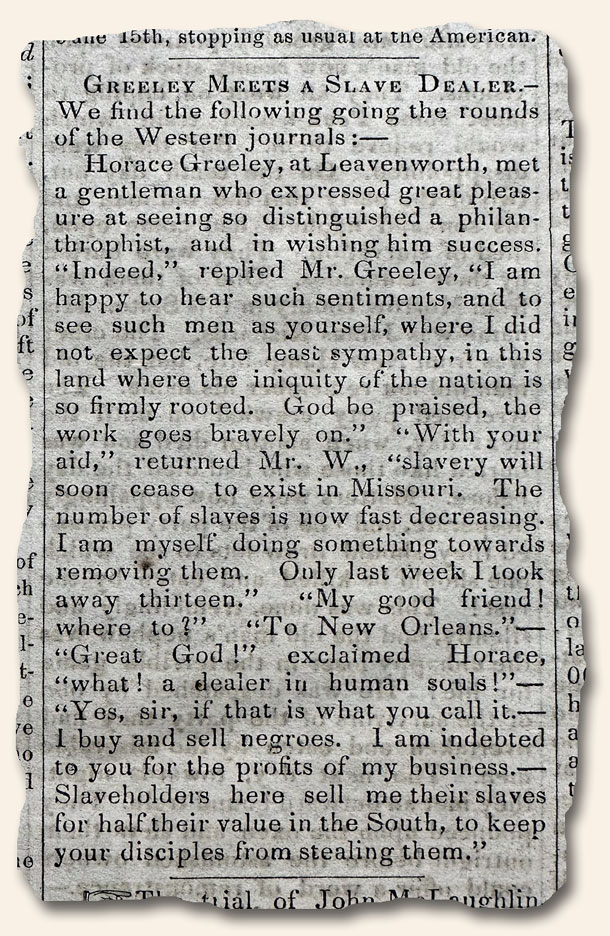
Dramatic Headlines Speak for Themselves… Hitler attacks Poland – WW2 begins!!!
September 8, 2023 by GuyHeilenman · Leave a Comment
The best headlines need no commentary. Such is the case with the New York Journal American, September 1, 1939, which had a pre-death report on the Hitler’s attack on Poland in 1939:
“GERMAN ARMY ATTACKS POLAND…“
