

Search
The Rare & Early Newspapers Hobby

Receive the Newsletter

Buy Historic Newspapers

‘Twas the Night Before Christmas in 1923…
December 24, 2023 by GuyHeilenman · Leave a Comment
Just in from Bethlehem…


Merry Christmas from Bethlehem, Pennsylvania,
compliments of The Globe, December 24, 1923!
(view previous Christmas-themed posts)
“Yes, Virginia, there is a Santa Claus”…
December 13, 2023 by GuyHeilenman · 1 Comment
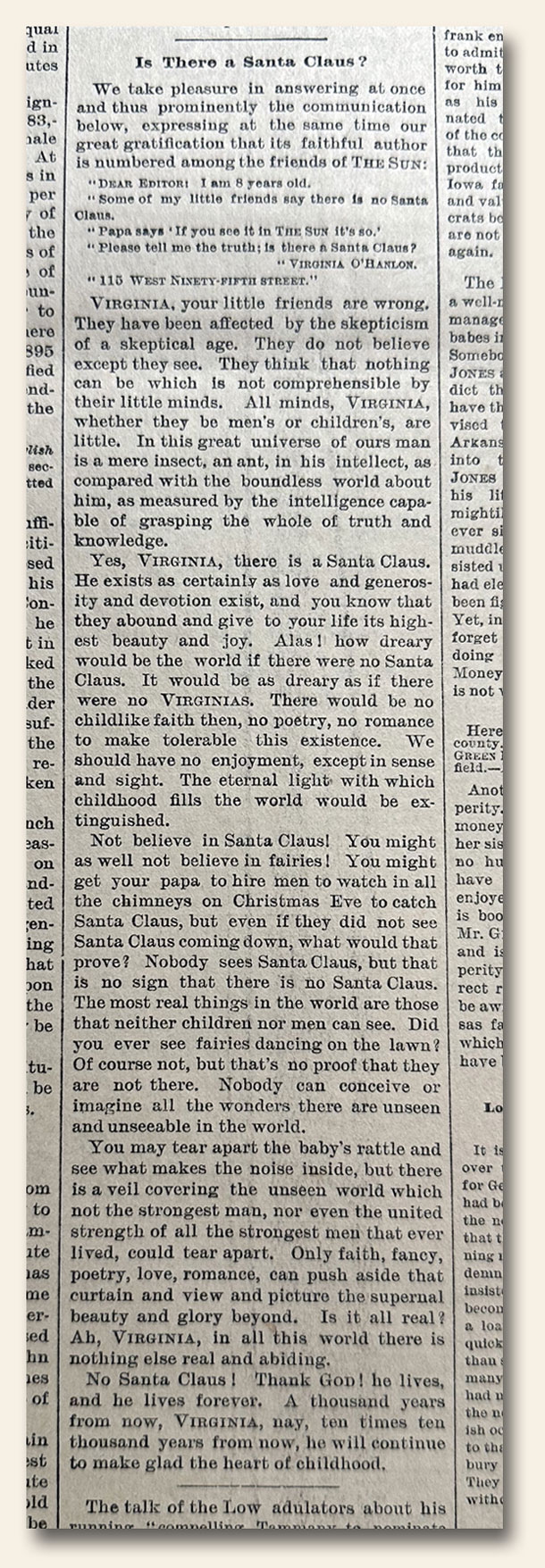
The world-famous article shown below appeared in THE (New York) SUN on September 21, 1897. It is certainly one of the most challenging issues to collect as few are known to exist. It has been said this may very well be the most recognized editorial of all time. Found on page 6 and headed: “Is There a Santa Claus?”, this is the famous “Yes, Virginia, there is a Santa Claus” editorial written by Francis Pharcellus Church, a sardonic Columbia College graduate & veteran Sun writer, he produced a masterpiece in fewer than 500 words.
Although the letter from Virginia and the famous response by Church have become well known (translated into 20 languages), few would know the prefacing paragraph which immediately precedes Virginia’s letter: “We take pleasure in answering at once and thus prominently the communication below, expressing at the same time our great gratification that its faithful author is numbered among the friends of The Sun:…” and then Virginia’s letter and Church’s response.
The famous phrase “Yes, Virginia, there is a Santa Claus…” begins the second paragraph, and the letter closes with: “…No Santa Claus! Thank God! he lives, and he lives forever. A thousand years from now, Virginia, nay, ten times ten thousand years from now, he will continue to make glad the heart of childhood.”
The press tracked Virginia until her retirement as a 70-year-old school teacher, while Church remained anonymous as the author until his death in 1906.
As for Church, he was a hardened cynic and an atheist who had little patience for superstitious beliefs, did not want to write the editorial, and refused to allow his name to be attached to the piece. More than a century later, it is the most reprinted editorial in any newspaper in the English language. This reality is a great reminder to all of us to always give our best effort, even when we don’t necessarily agree with those whom are in authority over us – moral conflicts accepted.
So, for a few brief moments let’s set aside the weight of “enlightenment” which is pressed upon us by virtue of adulthood and attempt to appreciate the sweet exchange between a “cynical” journalist and a curious, yet innocent, young girl. Merry Christmas and Happy Holidays to ALL!
“Collecting Newspapers – The Basics” (Part III) – Newspaper Care…
December 11, 2023 by GuyHeilenman · Leave a Comment
We, (Timothy Hughes Rare & Early Newspapers), have been collecting and offering old and historic newspapers to the collecting community since 1976 (Tim’s first purchase was in 1975). For those who are either unfamiliar with or new to this amazing hobby, today we are kicking off a series of posts, “Collecting Newspapers – The Basics”, to serve en masse as a Primer for those interested in learning more about the collectible. This is the 3rd installment. Enjoy.


Additional information about the hobby can be found through this Blog and on the Rare Newspapers’ website.
November/Thanksgiving Newsletter – Timothy Hughes Rare & Early Newspapers…
November 20, 2023 by GuyHeilenman · Leave a Comment
|
 Welcome to the November/Thanksgiving (2023) edition of our monthly newsletter. Understanding the busyness of the season as Thanksgiving (U.S.) rapidly approaches, I’ll make every effort to be brief. However, please do not miss out on this month’s highlights:
|
Happy Thanksgiving, 2023…
November 17, 2023 by GuyHeilenman · Leave a Comment
Each year as Thanksgiving approaches my thoughts (rightfully) bend a knee in the direction of gratitude which I try to express, for better or worse, in a simple post. In so-doing, while the feedback has been generally positive, on occasion I have been accused of being rather verbose, loquacious, over-talkative, etc., when what I tried to communicate could have been delivered with a higher degree of eloquence with considerably less long-windedness (i.e., I can be a bit wordy). In an effort to reign in this default behavior, in expressing this year’s thoughts I’ve elected to let a series of photos taken from a single issue of Harper’s Weekly from 1900 do the talking. I hope you find them thought-provoking. 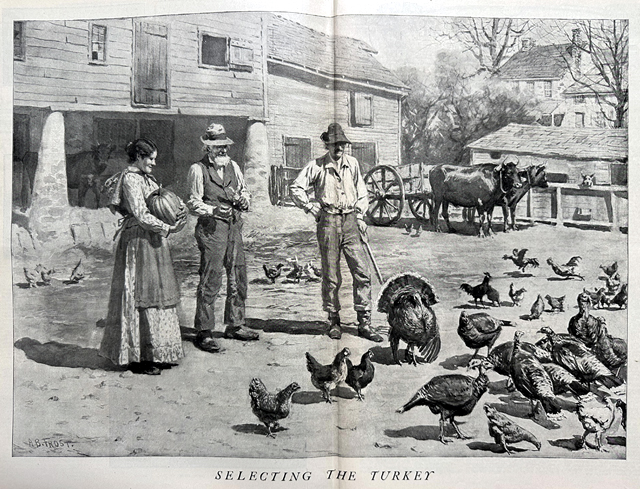
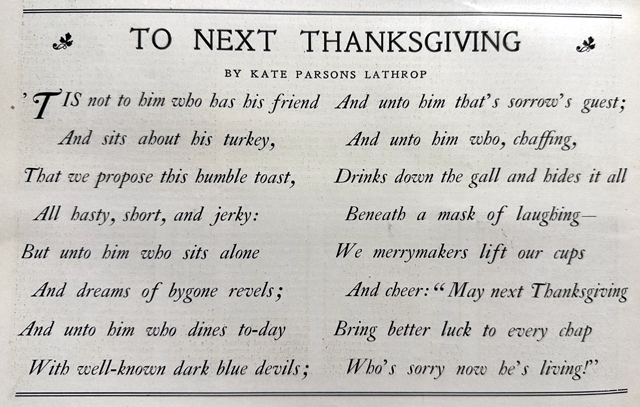
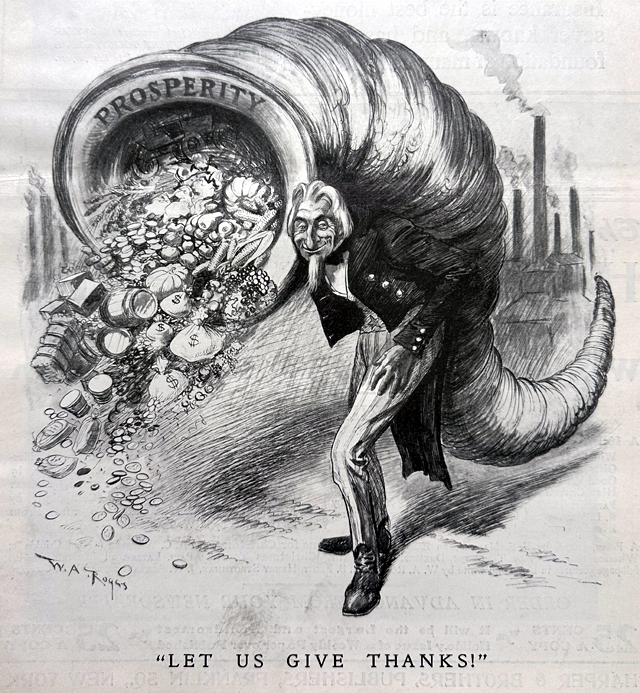

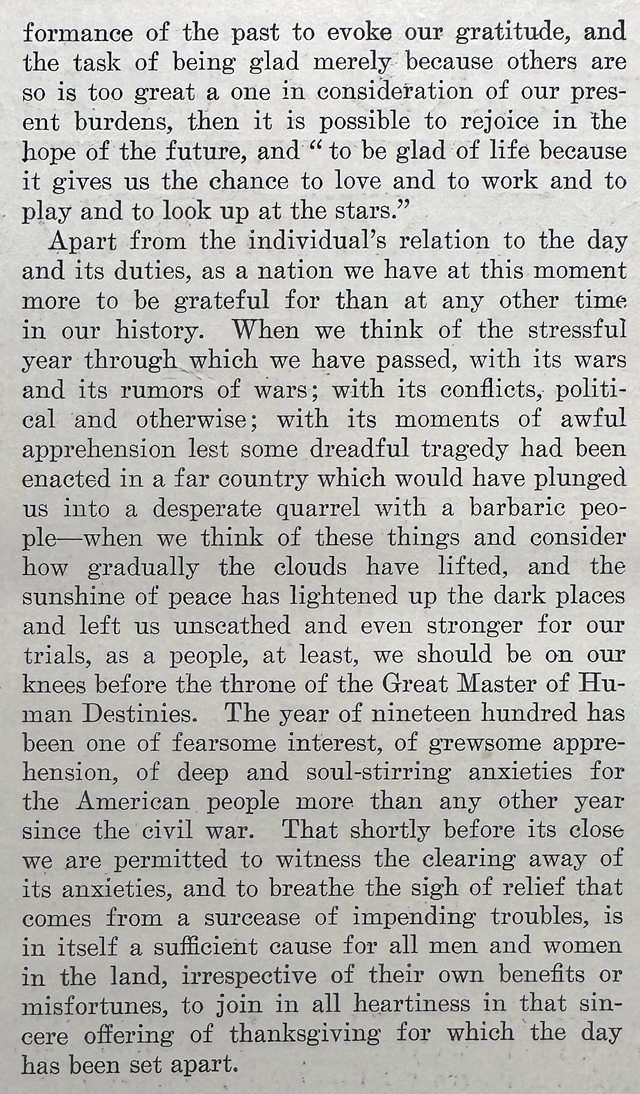
Happy Thanksgiving!
By the way, if pictures really do say a thousand words, success! My verbose, loquacious, over-talkative streak lives on!!!
Reprinted Newspapers – Identified as of 1931…
November 10, 2023 by GuyHeilenman · Leave a Comment
 In 1931, Joseph Gavit, the senior librarian at the New York Public Library, published a list of known newspaper reprints: “A List Of American Newspaper Reprints”. This well-known but seldom found 16 page booklet begins: “This is an attempt to bring together, in one list, notes on all the complete separate reproductions of early or historic issues of American newspapers…”, with more to follow. At the time the list included nearly 150 reprint editions. Although the list has grown to more than 500 editions, most of the more common reprints were identified by Gavit.
We’ve created a listing “For Information Purposes Only” on the Rare & Early Newspapers website which includes photos of his work. We hope you find it useful.
An expanded list of newspaper reprints can be explored at Common Reprints – several which can be explored through this Blog by searching for “reprint“.
Announcing: Catalog #336 for November, 2023 – Rare & Early Newspapers…
November 3, 2023 by GuyHeilenman · Leave a Comment
|
 CATALOG #336
|
[The links above will redirect to the latest catalog in approx. 30 days
upon which time it will update to the most recent catalog.]
If they would only have built it sooner… (Shoeless) Joe Jackson…
October 27, 2023 by GuyHeilenman · Leave a Comment
Even if you are not a fan of baseball, in case you haven’t done so already, the movie “Field of Dreams” is winner. The themes of perseverance, worthwhile priorities, and personal sacrifice are masterfully woven together to create one of the more inspiring movies of the 1980-1990’s. Steering clear of spoilers for those who have yet to see it, I’ll just restate that which is already included in the movie’s trailer: “If you build it, they will come!” Without being overly sappy… honestly, you really need to see it.
So, how does this relate to Rare & Early Newspapers? A few days ago one of our staff found an article from 1913 featuring one of the three main characters – “Shoeless” Joe Jackson (of Black Sox scandal fame), who was given a “2nd chance” at playing baseball – the assumption being he would have jumped at the chance to reengage at the professional level had he been given the opportunity to do so. Without saying more, I’ll let the heading and the 1st few paragraphs of the article do the talking (see below). Oh, and for the record, post-baseball, Joe and his wife (who were a team of their own until his death) eventually moved on from baseball, opened a BBQ restaurant, then “Joe Jackson’s Liquor Store”, and along the way co-raised two of his nephews. For better or worse, even if someone would have built it, I’m not sure he really would have come.
I hope you enjoy a portion of the article:
October Newsletter from Timothy Hughes Rare & Early Newspapers…
October 20, 2023 by GuyHeilenman · Leave a Comment
|
|
October Newsletter from Timothy Hughes Rare & Early Newspapers…
October 16, 2023 by GuyHeilenman · Leave a Comment
|
|