
Search
The Rare & Early Newspapers Hobby

Receive the Newsletter

Buy Historic Newspapers

A rare, colonial “2nd forgery” with an intriguing backstory… Cape Fear (part II)…
December 29, 2025 by TimHughes · Leave a Comment
A few weeks ago we featured a post regarding this same issue: “Snapshot 1775 – North Carolina Declares itself Independent!”
Tim Hughes penned the following related post which provides the backstory:
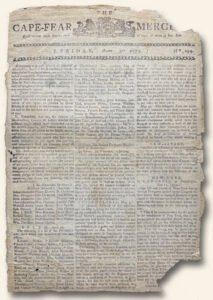
The Cape Fear Mercury, from Wilmington, North Carolina, has a “purported” issue dated June 3, 1775. As the following story informs, this would have to be one of the more interesting colonial newspapers we’ve offered, primarily for being a forgery.
This newspaper began publishing on Oct. 13, 1769, and was suspended for about five months from the fall of 1774 to the spring of 1775. It ceased publication in September, 1775.
As for the intrigue–and this is just a brief explanation–a 1905 article in Collier’s magazine focuses on the existence of a June 3, 1775 issue of the Cape-Fear Mercury which contains on the front page the Mecklensburg Resolves, or a “declaration of independence” from North Carolina some 13 months before what was declared in Independence Hall. This was a hoax, believed to have been perpetrated by surviving document signers many years after the event, in an effort to show North Carolina was first in declaring independence from England. See much more online.
 The following is taken from the well-respected “History & Bibliography of American Newspapers, 1690-1820” by Clarence Brigham. We’ve not seen such text devoted to an avowed forgery as this one in his two-volume reference set, which only speaks to its significance:
“…What purported to be an issue of this paper of June 3, 1775 was exploited in Collier’s of July 1, 1905 by S. Millington Miller, who claimed that he owned the original. The reproduction printed in Collier’s shows only the heading and part of the first and second columns…The paper was immediately believed to be fraudulent & in the ‘American Historical Review’…A. S. Salley and Worthington C. Ford showed the paper to be a forgery with the heading based upon an original issue of Nov. 24, 1769 owned by the American Antiquarian Society. The same defects in type, and even fly-specks in the 1769 issue appear in the spurious 1775 heading.
Miller made up his issue by setting up three columns of new matter, which included the Mecklenburg Resolves…But in giving his issue the date of Friday, June 3, 1775, no. 294, he erred in not knowing that Friday fell on June 2, and that because of a hiatus in publishing, the number of such a paper would be no. 258; also that by June, 1775, the heading [masthead] had been altered and the cut of the royal arms omitted. Later Miller manufactured a better forgery than the one furnished to Collier’s and differing in set-up–for example, the top line of the second column in the first forgery read “ford.—Messirs. Abednego Ramsdell, Dan-“, and in the second forgery: “of Charlestown.—Isaac Gardner, Esq. of.”.
At least 3 copies of this second forgery are now located–in the American Antiquarian Society, the Clements Library at the University of of Michigan, and in the possession of Oliver R. Barreett of Chicago…All of the forgeries were printed on one side of the leaf only, differing from the usual method of printing regular issues of 18th century newspapers.”
This issue we offer is seemingly just the fourth “second forgery” known to exist, unless it is one of the three cited above. The backstory is interesting and attests to what extent some might go to insist upon the greater prominence of North Carolina in early American affairs than what is currently found in history books.
Christmas through the eyes of a newspaper from 1794…
December 25, 2025 by GuyHeilenman · Leave a Comment
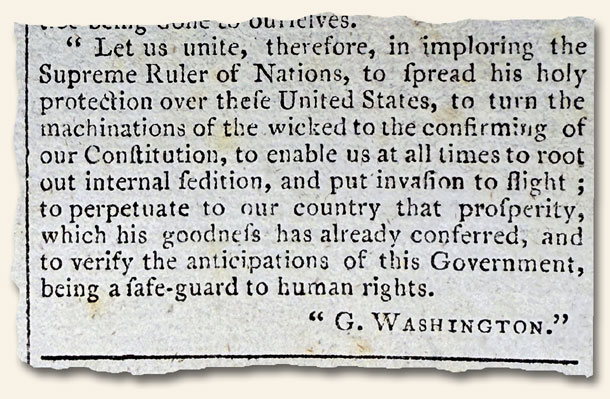
As I was searching through our newspapers published on Christmas from the past in the hopes of finding one which would be potentially meaningful to our collecting friends, I came across a December 25, 1794 London Gazette which seemed to hit the mark. I’d love to know if you agree.
Under the heading “AMERICA” on page three I found the entire text of President George Washington’s State of the Union address. It is quite lengthy, and the entire text can be found online, but I was struck by the first and last paragraph – both of which are shown below. Is it me, or could these words have been penned today? Merry Christmas!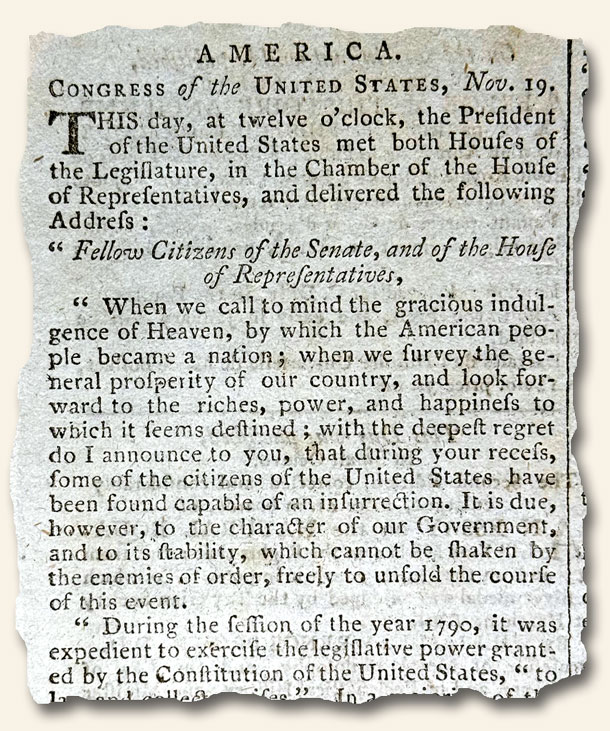
Popcorn, Principle, and the Presidency: JFK’s Quiet Stand for Artistic Courage…
December 22, 2025 by GuyHeilenman · Leave a Comment
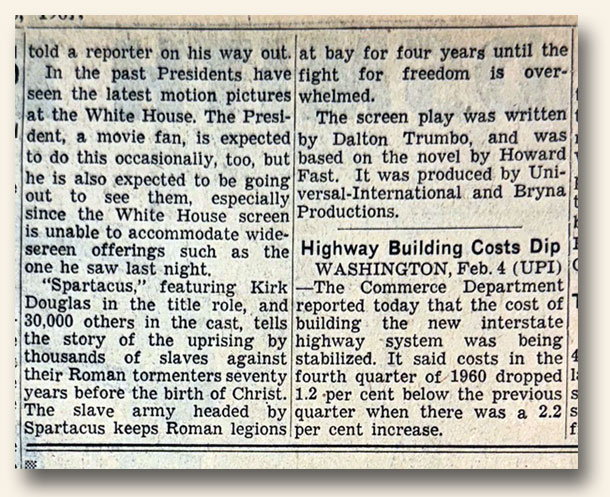
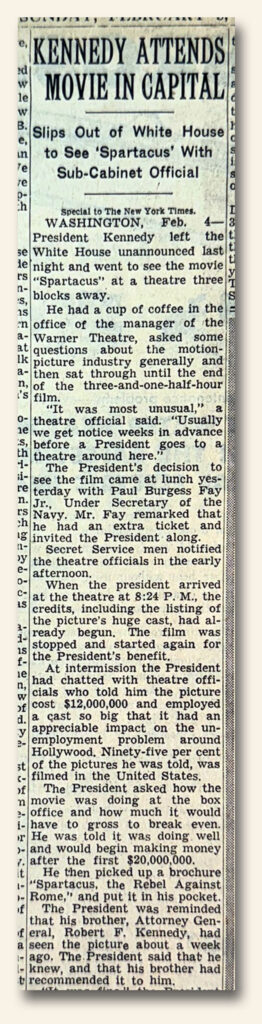 One of the many ways we build our database of key issues comes by way of requests from collectors? Case in point: A client recently asked if we had the February 5, 1961 issue of The New York Times which contained an inside report about President John F. Kennedy attending a movie at a local, D.C., public theater. Could such a report be significant; perhaps even collection-worthy? I immediately turned to the internet to see what I could find regarding this seemingly innocuous event. The following is a summary of what I discovered:
From the Silver Screen to the Oval Office: JFK’s Movie Night That Cracked the Blacklist
On February 3, 1961, just weeks after his inauguration, President John F. Kennedy quietly attended a screening of Spartacus at Washington, D.C.’s Warner Theatre. It may have looked like a simple night at the movies, but the moment carried deep cultural significance—marking the beginning of the end for Hollywood’s infamous blacklist.
At the heart of the story was screenwriter Dalton Trumbo, one of the “Hollywood Ten,” who had been blacklisted during the McCarthy era for refusing to testify before Congress. For years, Trumbo wrote under assumed names, but Spartacus producer Kirk Douglas decided it was time to credit him openly, defying industry fear and government pressure.
Kennedy knew exactly what that meant. By attending the film—and later praising it—he effectively gave a presidential nod to artistic freedom and to those silenced by the Red Scare. That quiet gesture helped dismantle a decade of fear and restored a measure of integrity to Hollywood.
Symbolically, Spartacus’s story of rebellion and freedom echoed the challenges Kennedy himself would face in a world divided by the Cold War and rising civil rights tensions. What began as a night at the movies became a turning point in America’s cultural history—proof that sometimes the most powerful stands for freedom don’t happen on the battlefield, but in the back row of a darkened theater.
So the question remains: Is this newspaper collection-worthy? My vote is yes, but such a call is certainly subjective.
Snapshot 1775 – North Carolina Declares itself Independent!
December 19, 2025 by GuyHeilenman · 1 Comment
According to The Cape-Fear Mercury (from Wilmington, North Carolina) dated June 3, 1775, North Carolina declared itself independent long before the 13 colonies did so in early July, 1776. However, there is a slight problem. The issue containing this announcement was a forgery! Whereas we’ve included a copy of the article below, to grasp the extent of this complex forgery, it would be best to read Tim Hughes’ explanation on the issue’s listing itself: The Cape-Fear Forgery. Enjoy.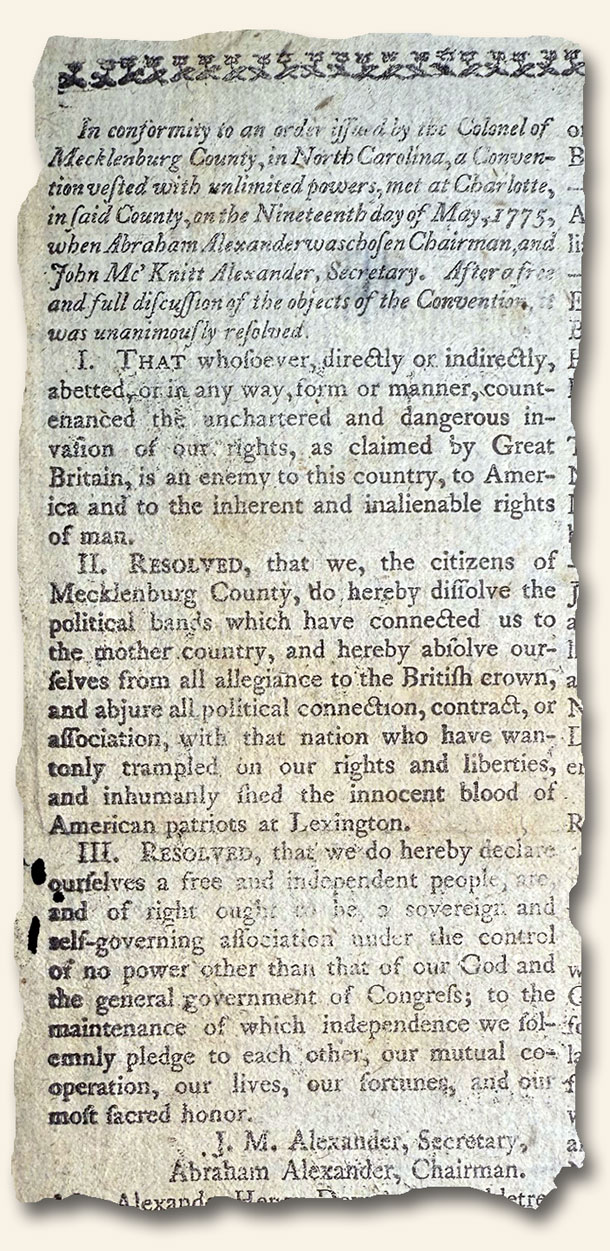
Holiday Newsletter (2025) – Timothy Hughes Rare & Early Newspapers…
December 15, 2025 by GuyHeilenman · Leave a Comment
| Welcome to the Holiday Newsletter from Rare & Early Newspapers. Whereas a number of interesting items are included below, don’t miss out on one of our posts from a few years ago: “Yes, Virginia, there is a Santa Claus“.
This month’s highlights: 1) Newly Listed Catalog Items – The list of items which have been added to our most recent catalog after it went to print continues to grow – including a number of great (highly collectible) issues. These new listings may be viewed at: NEWLY ADDED CATALOG ITEMS 2) Discounted Issues (50% off): 100+ items have been added to last month’s list of discounted issues – each discounted by 50% (as shown) through January 15, 2026! Take a look; you won’t be disappointed: DISCOUNTED ITEMS (50% off) 3) Catalog 361 – Wonderful items from the December catalog still a remain. The available issues may be viewed at: CATALOG 361 4) Holiday-themed content – over 80 collectible newspapers with a Christmas, Hanukkah, or New Year’s theme are available at: ISSUES w/ HOLIDAY-THEMED CONTENT (you may need to view the full description if the “holiday content” is secondary to an historic report) 5) Additional Ideas for Gift Giving:
* Note re: Holiday Shipping – We are sending this newsletter a bit earlier than usual to increase the chance that any item/s ordered will arrive in time for Christmas. If historic/rare newspapers are part of your gifting plans this year, please know we will make every effort to ship incoming orders within 48 business hours. 6) The History’s Newsstand Blog – bi-weekly posts of potential interest to those who collect rare & early newspapers. An aye aye lemur’s handful of recent posts includes:
|
|
Thomas Jefferson helps to codify George Washington’s footsteps…
December 12, 2025 by GuyHeilenman · Leave a Comment
When it comes to collecting rare and early newspapers, those containing the text of presidential annual messages are quite desirable. While a handful are well known (Lincoln’s 2nd annual address, Washington’s 1st, Kennedy’s 1st, etc.), others fly well under the radar. A recently discovered broadsheet (Republican Argus, Extra, Oct. 16, 1808), containing Thomas Jefferson’s final address in 1808 brought this latter group to mind, yet, upon analysis in light of current events, seems to hold its own historically. The summary below, modified from multiple AI sources, is provided so you can draw your own conclusion. Enjoy.
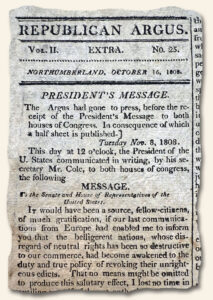
Thomas Jefferson’s Eighth Annual Message to Congress, delivered on November 8, 1808, came at the close of his presidency during a time of international conflict and domestic unrest. He used the address to defend the Embargo Act of 1807, which aimed to protect U.S. neutrality and avoid war with Britain and France by halting foreign trade. Despite its economic toll on American farmers and merchants, Jefferson maintained that economic pressure was preferable to military conflict. The speech also reflected ongoing foreign policy tensions, particularly regarding maritime rights, and the young republic’s efforts to uphold sovereignty amid European aggression.
Jefferson’s speech highlighted the challenges of maintaining neutrality, the importance of strengthening U.S. military defenses, and his vision for internal development, including peace through trade with Native American tribes. It also revealed the political friction of the time, with Jefferson facing criticism from both Federalists and members of his own party over the embargo and proposed federal infrastructure projects. This period of political division underscored deeper questions about the role and limits of federal power in a republic still defining itself.
Most significantly, Jefferson’s 1808 address signaled the end of his presidency and affirmed his decision not to seek a third term. Although he had announced this publicly in 1807, his final annual message served as a symbolic and practical demonstration of his commitment to republican principles. By following George Washington’s example, Jefferson helped establish the precedent that presidents should serve no more than two terms. This voluntary transfer of power reinforced the principle that no individual should hold executive power indefinitely, a safeguard essential to American democracy.
Jefferson’s choice not to pursue a third term, especially during a time of national strain, cemented a critical political norm that influenced every president until Franklin D. Roosevelt. The importance of this precedent lies in its protection against the concentration of power and its promotion of leadership rotation—core values in a constitutional republic. Jefferson’s 1808 address, then, is not just a reflection on policy but a foundational moment in American political tradition, ultimately leading to the formalization of the two-term limit through the 22nd Amendment.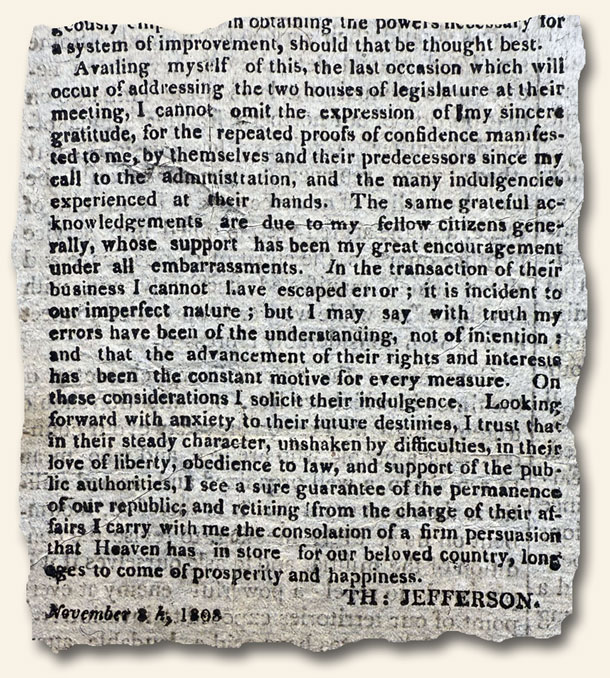
Publishing Under Fire: The Nippon Fijii and the Aftermath of Pearl Harbor…
December 8, 2025 by GuyHeilenman · Leave a Comment
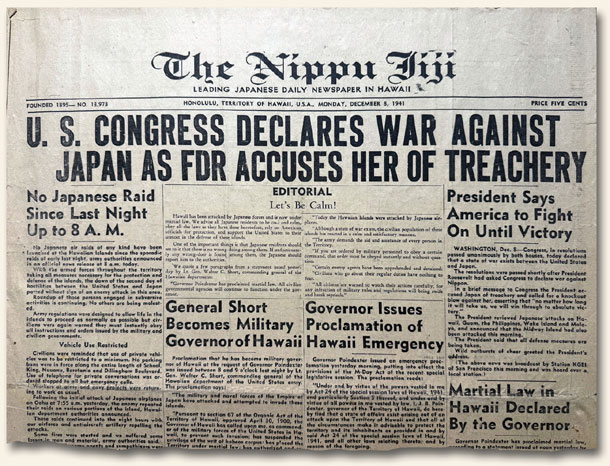
It’s difficult to fathom what it must have been like to be a Japanese-American living in Hawaii at the time of the Pearl Harbor attack. According to the 1940 census, more than 150,000 Japanese-Americans—roughly 35% of Hawaii’s population—suddenly found themselves in an impossible position, caught between loyalty to their home and suspicion from their neighbors.
Fear quickly swept through the islands. While the sheer size of the Japanese-American community made mass internment in Hawaii unfeasible, more than 2,000 individuals were arrested, many later sent to internment camps on the mainland. Their lives—and their trust in the nation they called home—were forever changed.
It was in the midst of this uncertainty and fear that the staff of NIPPON FIJI, Hawaii’s leading Japanese-language newspaper, produced their December 8, 1941 issue. The paper stands today as one of the most striking and rare firsthand publications from that dark and defining moment in American history.
The December, 2025 Catalog (#361): Must-Have Newspapers for the 250th Anniversary of American Independence (1776–2026)
December 6, 2025 by GuyHeilenman · Leave a Comment
 As the United States approaches its semiquincentennial in 2026, collectors, museums, and history lovers are hunting for the most evocative newspapers from the Revolutionary era. This month’s RareNewspapers.com catalog is packed with exactly those treasures—original issues that let you hold the birth of the nation in your hands. Here are the top standouts that speak directly to the 250th anniversary celebration:
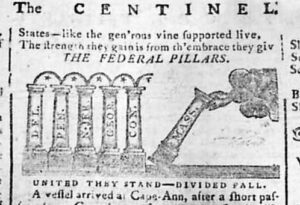
1. #703265 – Massachusetts Centinel, Boston, January 16, 1788 – $5,885
The iconic “Federal Edifice” pillar cartoon showing the 11 ratified states holding up the new Constitution. One of the most famous visual celebrations of the successful Revolution and the founding of the permanent United States government.
2. #687284 – Norwich Packet, Connecticut, December 18, 1783 – $4,275
George Washington’s emotional farewell to his officers at Fraunces Tavern – the moment the Commander-in-Chief resigned his commission and returned power to the people. A perfect “end of the Revolution” companion piece for 2026 displays.
3. #718898 – The Cape-Fear Mercury, Wilmington, North Carolina, June 3, 1775 – $3,995
A rare (and intriguingly forged) Southern colonial newspaper from just weeks after Lexington & Concord. One of the scarcest North Carolina titles from the fateful year 1775.
4. #703479 – The Pennsylvania Gazette, Philadelphia, August 2, 1753 – $3,925
With Benjamin Franklin’s own imprint in the masthead. Franklin, the ultimate Founding Father, printed this very newspaper—making it an ideal pre-Revolutionary artifact leading into the 250th.
5. #703307 – Connecticut Courant, Hartford, February 10, 1777 – $1,485
Prints more than half of Thomas Paine’s legendary “American Crisis” Number 2 (“These are the times that try men’s souls…”). Paine’s words kept the Revolution alive during its darkest winter.
6. #703299 – New-England Chronicle, Cambridge, January 4, 1776 – $895
Major General Charles Lee’s fiery open letter to British General Burgoyne, plus the exposure of Dr. Benjamin Church’s traitorous letter to the British—the first known act of American espionage.
7. #701110 – Boston Gazette & Country Journal, July 9, 1770 – $975
Paul Revere’s famous patriotic masthead engraving of Liberty releasing the dove of peace, combined with fiery coverage of the Non-Importation Agreement in the wake of the Boston Massacre. Pure 1770 resistance spirit.
Also noteworthy in the Revolutionary-era spotlight this month:
• The definitive three-day Battle of Gettysburg coverage is stunning (#705943), but for the 250th focus, the issues above are the true headliners.
If you or your institution are building a 2026 exhibit, creating a museum-quality timeline, or simply want to own the actual newsprint read by Patriots 250 years ago, what remains from the above are viewable HERE.
Which one will be the centerpiece of your America 250 collection? Let us know in the comments!
Lead-up to a Nation… as reported in the newspapers of the day (November, 1775)…
December 5, 2025 by GuyHeilenman · Leave a Comment
Continental Currency – No Power to Tax or Regulate (Lead-up to a Nation – E14)
League of Friendship-Articles of Confederation Underscored National Power (Lead-up to a Nation-E15)
James Rivington – From Impartial to Loyalist (Lead-up to a Nation – E16)
The Liberty Bell – Proclaim Liberty Through the Land (Lead-up to a Nation – E17)
We hope you are enjoying this year-long trek to the 250th anniversary of The United States through the eyes of those who were fully engaged, first hand. As mentioned previously, all accounts are rooted in what they read in the newspapers of the day.
“History is never more fascinating than when read from the day it was first reported.” (Timothy Hughes, 1975)
Announcing: Catalog #361 for December, 2025 – Rare & Early Newspapers…
December 1, 2025 by GuyHeilenman · Leave a Comment
|
|