

Search
The Rare & Early Newspapers Hobby

Receive the Newsletter

Buy Historic Newspapers

Security taken for Kennedy’s visit to Dallas…
May 18, 2012 by TimHughes · 1 Comment
One of the interesting opportunities newspapers present is the ability to read news with hindsight. The early edition of the “Dallas Times-Herald” newspaper of Nov. 22, 1963 (see below), the edition prior to the later edition reporting the assassination, has much coverage of JFK’s visit to Texas and the excitement around his planned visit to Dallas later that day. One ironic headline on the front page reads: “Secret Service Sure All Secure” with the article providing much detail on the security efforts to make for a safe visit to Dallas.
The Civil War… December 7, 1861…
December 7, 2011 by GuyHeilenman · Leave a Comment
This week we return to our reflection upon the Civil War events of 150 years ago… as seen through the eyes of the original readers of the Harper’s Weekly issue printed for December 7, 1861.
Note: The following commentary was written by Dr. James Robertson* as part of a weekly review for the reprint edition of the “Harper’s Weekly” which was done at the 100th anniversary of the Civil War. It provides much insight into the events of the day and scholarly commentary on both the illustrations and reporting found in the original 1861 newspaper.

* The Virginia Tech website provides the credentials of Dr. James Roberson:
“One of the most distinguished names in Civil War history, Dr. Robertson was Executive Director of the U.S. Civil War Centennial Commission and worked with Presidents Truman, Kennedy, and Johnson in marking the war’s 100th anniversary. Today his Civil War Era course at Virginia Tech, which attracts 300 students per semester, is the largest of its kind in the nation.
The Danville, Va., native is the author or editor of more than 20 books that include such award-winning studies as “Civil War! America Becomes One Nation”, “General A.P. Hill”, and “Soldiers Blue and Gray”. His massive biography of Gen. “Stonewall” Jackson won eight national awards and was used as the base for the Ted Turner/Warner Bros. mega-movie, “Gods and Generals”. Robertson was chief historical consultant for the film.”
The Civil War… November 30, 1861…
November 30, 2011 by GuyHeilenman · Leave a Comment
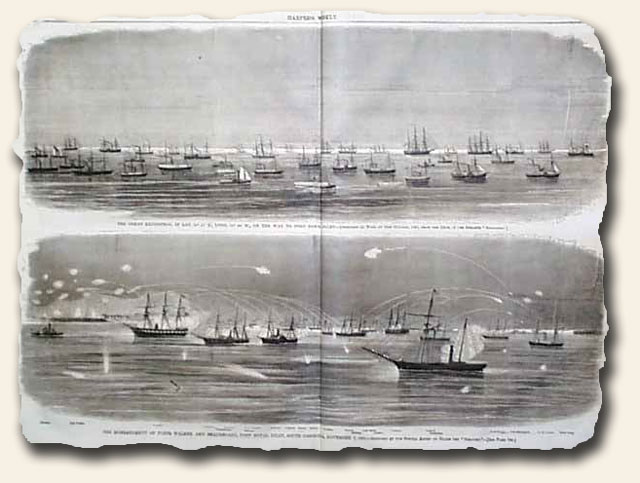 For a little more than 6 months we have reflected upon the Civil War by posting details of the CW era Harper’s Weekly issues which were printed for exactly 150 years prior to the post. This week’s corresponding issue is the HW dated November 30, 1861. Over the past few months we have enjoyed Dr. James Robertson’s* summary of each Harper’s Weekly issue chosen. Unfortunately we do not have access to his summary of the Nov. 30, 1861 issue. If anyone does have access to his summary, please let us know and we will revise this post by including it below (and give credit to the provider). 🙂 In the meantime, the link above will still enable our readers to view an authentic issue for November 30… from exactly 150 years ago today.
Our other posts re: Dr. James Robertson’s summaries may be accessed at: The CW… 150 Years Ago Today.
* The Virginia Tech website provides the credentials of Dr. James Roberson:
“One of the most distinguished names in Civil War history, Dr. Robertson was Executive Director of the U.S. Civil War Centennial Commission and worked with Presidents Truman, Kennedy, and Johnson in marking the war’s 100th anniversary. Today his Civil War Era course at Virginia Tech, which attracts 300 students per semester, is the largest of its kind in the nation.
The Danville, Va., native is the author or editor of more than 20 books that include such award-winning studies as “Civil War! America Becomes One Nation”, “General A.P. Hill”, and “Soldiers Blue and Gray”. His massive biography of Gen. “Stonewall” Jackson won eight national awards and was used as the base for the Ted Turner/Warner Bros. mega-movie, “Gods and Generals”. Robertson was chief historical consultant for the film.”
The Civil War… November 23, 1861…
November 23, 2011 by GuyHeilenman · Leave a Comment
This week we continue with the our reflection upon the Civil War events of 150 years ago… as seen through the eyes of the original readers of the Harper’s Weekly issue printed for November 23, 1861.
Note: The following commentary was written by Dr. James Robertson* as part of a weekly review for the reprint edition of the “Harper’s Weekly” which was done at the 100th anniversary of the Civil War. It provides much insight into the events of the day and scholarly commentary on both the illustrations and reporting found in the original 1861 newspaper.

* The Virginia Tech website provides the credentials of Dr. James Roberson:
“One of the most distinguished names in Civil War history, Dr. Robertson was Executive Director of the U.S. Civil War Centennial Commission and worked with Presidents Truman, Kennedy, and Johnson in marking the war’s 100th anniversary. Today his Civil War Era course at Virginia Tech, which attracts 300 students per semester, is the largest of its kind in the nation.
The Danville, Va., native is the author or editor of more than 20 books that include such award-winning studies as “Civil War! America Becomes One Nation”, “General A.P. Hill”, and “Soldiers Blue and Gray”. His massive biography of Gen. “Stonewall” Jackson won eight national awards and was used as the base for the Ted Turner/Warner Bros. mega-movie, “Gods and Generals”. Robertson was chief historical consultant for the film.”
The Civil War… November 16, 1861…
November 16, 2011 by GuyHeilenman · Leave a Comment
This week we continue with the our reflection upon the Civil War events of 150 years ago… as seen through the eyes of the original readers of the Harper’s Weekly issue printed for November 16, 1861.
Note: The following commentary was written by Dr. James Robertson* as part of a weekly review for the reprint edition of the “Harper’s Weekly” which was done at the 100th anniversary of the Civil War. It provides much insight into the events of the day and scholarly commentary on both the illustrations and reporting found in the original 1861 newspaper.

* The Virginia Tech website provides the credentials of Dr. James Roberson:
“One of the most distinguished names in Civil War history, Dr. Robertson was Executive Director of the U.S. Civil War Centennial Commission and worked with Presidents Truman, Kennedy, and Johnson in marking the war’s 100th anniversary. Today his Civil War Era course at Virginia Tech, which attracts 300 students per semester, is the largest of its kind in the nation.
The Danville, Va., native is the author or editor of more than 20 books that include such award-winning studies as “Civil War! America Becomes One Nation”, “General A.P. Hill”, and “Soldiers Blue and Gray”. His massive biography of Gen. “Stonewall” Jackson won eight national awards and was used as the base for the Ted Turner/Warner Bros. mega-movie, “Gods and Generals”. Robertson was chief historical consultant for the film.”
Actual headlines in 2002…
August 20, 2011 by TimHughes · Leave a Comment
We offer thanks to fellow collector Morris Brill for the following headlines which appeared in 2002:
“Something Went Wrong In Jet Crash, Experts Say”
“Police Begin Campaign To run Down Jaywalkers”
“Panda Mating Fails; Veterinarian Takes Over”
“Teacher Strikes Idle Kids”
“Miners Refuse To Work After Death”
“Juvenile Court To Try Shooting Defendant”
“War Dims Hope For Peace”
“If Strike Isn’t Settled Quickly, It May Last Awhile”
“Red Tape Holds Up New Bridges”
“Typhoon Rips Through Cemetery; Hundreds Dead”
“Kids Make Nutritious Snacks!”
“New Study Of Obesity Looks For Larger Test Group”
(more later!)
The Civil War… 150 years ago today… July 20, 1861
July 20, 2011 by TimHughes · Leave a Comment
We continue our weekly feature of reflecting upon the appropriate 150 year old issue of “Harper’s Weekly” from the perspective of a subscriber in 1861:
 Today’s issue (July 20, 1861) has the front page taken up with two prints on the progress of “Filling Cartridges at the U.S. Arsenal at Watertown, Mass.”, which involves a surprising number of women. There are two interesting pages with a dozen prints of “Scenes About Camp” showing some of the activities while in recreation (dancing & acrobatics!) as well as practicing for warfare. These scenes offer a different view of soldier life; one away from the battle field. I can imagine relaxing & recreation is a welcome diversion.
One print has a scene of soldiers with Hagerstown, Maryland, in the background, and a few other prints have scenes of Harper’s Ferry, just a few years after the John Brown raid. Very impressive is the doublepage centerfold showing “The Navy Yard at Brooklyn…” which shows several massive sailing ships. And yet another print shows that not all soldiers wear the traditional garb, as “Irregular Riflemen of the Alleghanies, Virginia” are in frontier clothing. How can those involved in a fight tell the enemies from their fellow soldiers?
He could cure almost anything…
June 11, 2011 by TimHughes · Leave a Comment
Advertisements for physicians have certainly changed much over the last 270 years. This ad for “Richard Rock, Practitioner in Physick and Surgery” has a curious list of ailments he treats. This ad appears in the March 30, 1734 issue (and others) of “The Country Journal or the Craftsman” from London. Note that he keeps officers hours of 7:00 a.m. until 10:00 p.m…
The Traveler… “The Little Belt Affair”… Bonaparte putting up a “smoke front”…
June 6, 2011 by The Traveler · Leave a Comment
Today’s travels landed on a nice surprise! The Middlesex Gazette dated June 6, 1811 carries a lengthy letter by Commodore John Rodgers to the Secretary of the Navy dated May 23, 1811. This  was referencing a confrontation between his frigate and a Britannic which at first would not identify itself, and then was revealed to be Little Belt. This incident furthered the tension between Britain and the United States which led to the War of 1812.
Also in this issue is the reporting that Bonaparte had established a public Manufactory of Tobacco and Snuff. This would be carried on by “a particular committee for the benefit of the public chest, or in other words for his own benefit, and that no private individual shall in future be concerned in the manufacture of these articles…” He would control what type and where all the tobacco would be purchased, etc. Does it sound a little self-serving??
~The Traveler
The ultimate optimist…
May 7, 2011 by TimHughes · Leave a Comment
I’ve always enjoyed reading the editorial on page 2 of the “Richmond Examiner” newspaper, as the bias shown by the writer was often strongly in favor of the Confederate cause. But in the issue of July 25, 1863 the editor stretched his optimist about as far as it could reach. With the Confederate failure at Gettysburg and their advance into the North stopped, all might have seemed hopeless for the Confederate forces. But the editor tried to put a positive spin on the events by stating:
“…failed by a single accident, by a single mistake–that sad one at Gettysburg…But after all, the depression which its failure produced on the public mind was more than was warrantable. The result was not a defeat, it was not a loss; it was only not a victory, not one of the most brilliant triumphs ever recorded. It was little else than a disappointment of extraordinary expectations…”.
Please enjoy…