
Search
The Rare & Early Newspapers Hobby

Receive the Newsletter

Buy Historic Newspapers

October newsletter from Timothy Hughes Rare & Early Newspapers…
October 16, 2012 by GuyHeilenman · Leave a Comment
 Each mid-month Timothy Hughes Rare & Early Newspapers… History’s Newsstand sends an e-newsletter to their members and collector friends. This month’s edition is shown below. Please enjoy.
|
||||||||||||||||||||||
|


Documenting the Civil War…
September 26, 2011 by GuyHeilenman · Leave a Comment

David Chasanow, at Americollector.com, recently did a post regarding the valuable role rare & historic newspapers play in documenting the events of the Civil War. The post included an interview with Tim Hughes. Please enjoy!
Battle lines: Vintage newspapers documented the Civil War as it happened
The end of the world… false alarm…
August 6, 2011 by GuyHeilenman · Leave a Comment
 A few years ago several collectors contacted us wondering if the end of the Rare & Early Newspapers collectible was at hand. They had just received news about Google’s newspaper digitizing project and wondered if this would lead to an end in people wanting to collect historic newspapers. “Might this be the end of the old newspaper’s collectible world?” We tried to reassure them them that collecting the actual newspaper from the day it was 1st printed/read as compared to reading digitized versions is akin to eating an ice-cream sundae rather than looking at a picture of one. No matter how perfect the picture of the sundae reproduces the look of an actual one, it can never compare to the real deal. Apparently, time has proven this to be so. 2011 brought news from Google announcing the end of the digitizing project. The date of the announcement is rather ironic. Please read:
Google Announces End Of Newspaper Digitizing Project
🙂 🙂 🙂
First newspapers in North Dakota…
March 14, 2011 by TimHughes · Leave a Comment
The Dakota Territory organized in 1861 encompassed both present-day North & South Dakota. It was in 1889 when statehood was gained that the Territory was split into North & South.
 But it was during the Civil War, in 1864 when two solders issued at Fort Union (present-day North Dakota) a newspaper called the “Frontier Scout” Only a few numbers were printed at Fort Union. A bit later it reappeared with a “Fort Rice, D.T.” imprint and a date of June 15, 1865, noted as “vol. 1, No. 1”. It is not known to have continued after 1865.
It was not until July of 1873 when the first permanent newspaper appeared in the Territory, located at the capital of Bismarck and titled the “Tribune“. It started as a weekly but 8 years later became a daily, which it remains to this day. It boasts that it has never missed an issue, although because of a winter blizzard it was forced to reduce its size & one number was printed on wallpaper.
Not long thereafter the second newspaper in North Dakota began, titled the “Express“, printed at Fargo on Jan. 1, 1874. The third newspaper, and in yet a third city, was the “Plaindealer” which published at Grand Forks in 1874 as well.
My collecting story… Graham Dukes…
November 15, 2010 by GuyHeilenman · Leave a Comment
I have been collecting newspapers longer than most fellow enthusiasts, beginning when I was at school in England in 1943. My father went into a small second-hand shop and noticed that the owner, who sold candlesticks, old dinner plates and suchlike, was wrapping up the items in copies of the London evening “Star” for 1818, that he was tearing out of a bound volume. There were about 150 papers left and my father, who was well aware of my budding historical interest, bought the whole volume for threepence (10c).
From there I continued myself, often picking up items from shopkeepers who had no idea what they were. Nearly 70 years later, with several thousand items in store, (particularly London national papers, but also items from many other countries) some of my prize items, going back to the earlier sixteenth century, are still those that I found in the English back streets during my time as a schoolboy and later as a university student!
Graham Dukes
New discovery… Who knows what one might find?
November 8, 2010 by GuyHeilenman · Leave a Comment
We’ve often mentioned that one of the pleasures of the Rare & Early newspaper collecting hobby is finding unforeseen historical nuggets buried deep within the pages of newspapers… just waiting to be unearthed.  This was recently brought to the surface again by a collector/history teacher who purchases 19th century wholesale lots (undescribed as to content) for his students and for personal use . His note is as follows:
This paper (from a wholesale lot) had a reference to a house vote for the “relief” of Susan Decatur, wife of naval hero Stephen Decatur. She had inherited $75,000 from her husband, who was killed in a duel in 1820. This is the equivalent of $1.4 million today. The bill was defeated. One of the nays was cast by Congressman Crockett (David). Minor, but priceless info. Your company does more good than you know.
Feel free to share your own discoveries with the collecting community.
20th century prices realized… revisted…
September 30, 2010 by GuyHeilenman · 2 Comments
The previous post focused on “prices realized” from a sampling of key issues from the 20th century. Fellow collector, Charles Signer, posted a response we thought collectors would appreciate.
These papers (see previous post) are excellent choices for your article. I think the Titanic disaster marked a new era in journalism, since improvements in printing technology and inventions like the facsimile machine made it possible for newspapers all over the United States and the world for the first time to cover the story simultaneously with full coverage and great graphics. Because the Titanic event took place at sea there was no “home advantage” as there would have been for a disaster taking place in a populated area. I don’t have the Rhode Island version of the story that you show, but I have seen others like it from other cities. I am amazed how they could get such good reporting and graphics literally overnight on such an unexpected story.
When I see the Honolulu Star-Bulletin First Extra I think of it as a time capsule marking of an end of an era. The front page of course gives the full first report, but the inside pages were mostly set up before the event, in the last hours of peacetime. The ads for 1941 consumer goods and Christmas sales suddenly fell out of place in the grim new wartime world. I imagine the people shown in the ads floating at the bottom of the ocean where they are all drowned dead but still visible to divers. It’s eerie.
I was going to say that the whole First Extra paper could be seen on the Honolulu Star-Bulletin website, but in trying to test the link as I write this I see that the Honolulu Star-Bulletin and the Honolulu Advertiser merged on June 7, 2010. The combined paper is now the Honolulu Star-Advertiser. There used to be a great story on the Star-Bulletin’s old website about the people who put out those first reports that day. I guess it’s gone now.
I got a copy of the Dewey Defeats Truman paper from Tim Hughes before 2000 for about $850. It was real cherry. I grew up in Chicago where my dad and I would drive down in the evenings to get the first edition of the following day’s Tribune. When you opened up a Tribune for the first time there were tiny holes made in the printing process which made the pages stick together. The copy I got from Tim had those little holes so I knew I was opening that Dewey Defeats Truman paper for the first time ever. It was almost like being there on November 2, 1948, the evening the paper was printed. Yes, it truly is a classic that will be recognized as long as newspapers are remembered, which may be a lot longer than some of them are being published.
Thanks Charles!
One never knows what will be found…
June 7, 2010 by TimHughes · 4 Comments
I suspect I have reflected several times upon the great wealth of interesting information which can be found in a seemingly “generic” issue. Recently I came across an item which was unfound for over 30 years until time permitted a closer look.
I have always touted the value of London’s “Gentleman’s Magazine” as a great periodical, as few world events of the 18th century escaped its pages, including American events from after the Revolutionary War. As a title which has always be somewhat common in a relative sense, when American titles of the 18th century have become almost impossible to find, key issues in “Gentleman’s Magazine” offer an excellent opportunity to add period, historic reports to a collection at a relatively modest cost.
 Admittedly, volumes of this title have become more difficult to come by in recent years, prompting us to take a closer look at some issues which used to go out the door almost as quickly as they came in. The June, 1790 issue was seemingly just another innocuous magazine from the post-war era, and which I suspect we sold dozens of times for $15 to $25 or so. But a week ago I took a more careful look and found an excellent obituary of Benjamin Franklin, taking over 1 1/2 pages, even including is very famous self-written obituary which includes: “The body of Benjamin Franklin, Printer, like the cover of an old book, its content torn out & stript of its lettering & gilding, lies here food for worms…”.
You may have purchased this June, 1790 issue from us in years past. If you have, take a look at pages 571-3 and elevate the status of this issue from generic to significant. Even with this wonderful content, we still offer this issue for less than 1/3 the price of comparable reports in American newspapers.
I wonder how many other significant issues we’ve sold over the past 34 years not fully knowing what was inside? Hopefully you have discovered some gems which escaped my eye….it’s all part of the thrill of collecting!
Uncut newspapers: leave as they are?
March 20, 2010 by TimHughes · 1 Comment
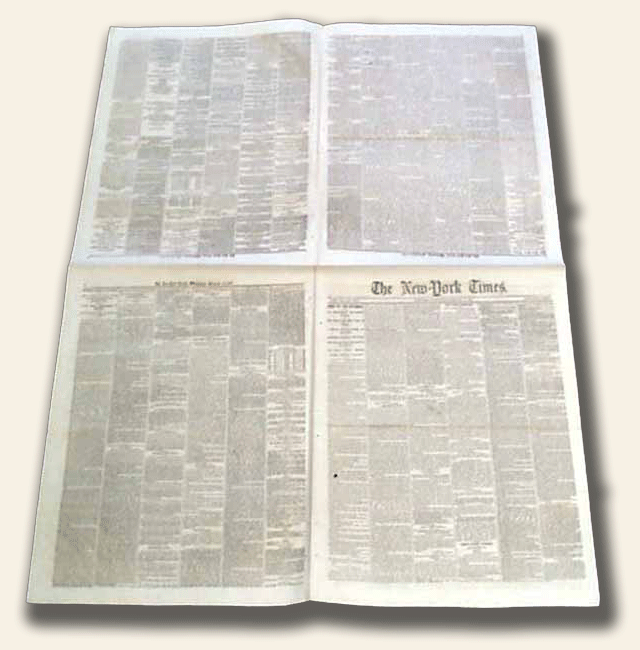 Fellow collector Morris Brill poses an interesting question worth sharing with others, along with my thoughts on the issue.
I suspect we have all encountered “uncut” newspapers from the 19th century, issues which are eight pages in length but which are essentially one large sheet of paper printed on both sides, then folded twice to produce the eight pages. This is how they came off the printing presses . Morris inquires:
“For the sake of maintaining the monetary value of such a newspaper is it best to leave the paper in this one piece condition or is it best to cut the paper so it folds normally like a book and the pages can be turned individually?”
Uncut issues are, for the most part, those which have survived the years by not being bound, kept loose by previous owners and eventually finding their way into the hands of collectors. Given that the vast majority of early newspapers in the collector market came from bound volumes once stored by libraries or other institutions then “disbound” into individual issues, uncut newspapers are relatively few in number. Once bound all margins, save for the spine, are guillotined at the bindery to produce an even, book-like edge thus losing the attachment at the top.
Since uncut issues are newspapers in the original state, as they were sold on the streets, my preference would be to keep them as such. Most collectibles tend to be more desirable in their original state: never clean an old coin; never paint an antique wagon; don’t removed the aged patina from an antique desk, etc. Are such newspapers more clumsy to read? Yes, to some degree. But they can be folded back and all 8 pages read with little difficulty. It’s obviously how it was done years ago as I’ve purchased several boxes of uncut 19th century newspapers which were folded many different ways, left as such by the reader.
They only time I might suggest cutting the top of an uncut sheet is the rare occasion when an issue was bound, causing all four leaves to be attached at the spine, yet the tops have not been trimmed. In such situations the newspaper cannot be folded back because of the attachment at the spine. I would take an exacto knife and cut the very top along the fold. Not much else can be done if the interior pages are to be read.
Collectors may have noticed that we charge a small premium for uncut newspapers. A downside to an uncut issue is they tend to be more worn than those bound as they have not been protected through the years by the bindings, but if one can obtain an issue which is both uncut and in great condition–and contains the Gettysburg Address–there’s a great item for any collection!
Featured websites – TeachHistory.com
March 18, 2010 by GuyHeilenman · Leave a Comment
 Teachers with a love of history, listen up! The following resource can improve your curriculum and make you a stronger educator. Students of history will enjoy the breadth and depth of the historical journey as well.
TeachHistory is a fantastic website (blog), developed and maintained by Ben Edwards, which provides engaging information & a plethora of useful educational resources related to history. It describes itself as:
“a blog dedicated to social studies and history teachers across the United States who use Colonial American history, imagination and multisensory teaching methods to inspire their students. Our goal is to provide a resource where teachers like you can access information about colonial history plus technologies, methods and products that are making a difference in education today.”
While Ben’s experience with teachers and students is varied, perhaps the most useful channel for keeping him in touch with the pulse of teacher/student interests and needs occur via the many intimate conversations had while engaging teachers and students through his Walking Tours of Historic Boston. Combine this with both his (historic) heritage and his natural love of history, and you have the making of a blog which is sure to stay relevant over time. Some of the recent posts include:
Colonel Shaw, Sergeant Carney and the 54th Massachusetts
Remembering Alex Haley and Roots
Black History Month: A Tribute to Phillis Wheatley
Young Ben Franklin and the Silence Dogood Letters
Teachers: Are You Engaging AND Empowering Your Students?
Many of the posts include detailed images and reference accounts of actual Rare & Early Newspapers – most of which come from his personal collection. Ben fully grasps a foundational truth regarding primary sources: “History is never more fascinating than when it is read from the day it was first reported.” Thanks Ben, for your contributions to both the Rare Newspapers and Educational communities.