
Search
The Rare & Early Newspapers Hobby

Receive the Newsletter

Buy Historic Newspapers

Significant Discovery: Horace Greeley’s “views” of Freedmen (1865)…
March 9, 2026 by GuyHeilenman · Leave a Comment
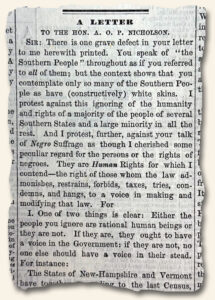
After being heavily engrossed in the rare & early newspapers collectible for over 50 years, encountering “new” discoveries within our own archives has not abated. Case in point: We recently identified a significant letter in the August 26, 1865, issue of the New York Daily Tribune that had previously gone unnoticed. Located on page 4 and signed simply “H. G.” (Horace Greeley), this letter addressed to the Hon. A. O. P. Nicholson offers a profound look into the intellectual climate of the immediate post-Civil War era. Perhaps it was the inconspicuous single column heading, “A Letter”, which was complicit in our oversight. Such “discoveries” are one of the reasons why we love this hobby.
As far as the letter itself is concerned… The exchange occurred during a pivotal window of Reconstruction. With the war concluded and the Thirteenth Amendment in the process of ratification, the nation was gripped by a debate over the “physical, intellectual, and emotional condition” of newly emancipated African Americans. While many, including Nicholson, sought to categorize or question the capabilities of the formerly enslaved through a lens of racial “fitness,” Greeley used his editorial platform to push back against these prejudices.
In this letter, Greeley argues that any perceived deficiencies in the Black population were not inherent traits, but the direct result of the “degradations” of the institution of slavery. By advocating for education and the rights of “Free Labor,” Greeley was effectively laying the groundwork for the so-called “Radical Republican” agenda that would eventually lead to the 14th and 15th Amendments.
For collectors of Civil War, Reconstruction-era, and Black-Americana ephemera, this issue serves as a primary source document and captures the exact moment the country transitioned from a military conflict to a philosophical battle over the true meaning of citizenship – a powerful step towards realizing the founding charge that all (people) are created equal.
I’m New Here…Week Seven
March 29, 2019 by Stephanie Williams · Leave a Comment
- This week I decided to spend some of my hard-earned money on an old (& rare) publication. I’d already processed searches for sports figures and jazz singers and mobsters and indentured servants — so many interests that whizzed past me as I was busy with phone calls and emails and web orders. The only way I could think to appease my conscience about taking a pause to look around a little bit for myself was to become a customer. There is an entire collection —
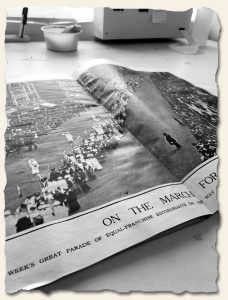 shelves of bound volumes — of publications by women. I want to dig through and “see what’s what”, as my grandmother always said. But that would probably take more research time just orientating myself than I feel easy about spending. Still, that inclination narrowed the scope of this first quest a bit, and a search through notable dates in history led me to the NYC women’s suffrage march of 1912.
“THE REMARKABLE DEMONSTRATION IN NEW YORK LAST WEEK WHEN 15,000 WOMEN OF ALL STATIONS IN LIFE MARCHED THROUGH THE STREETS OF THE METROPOLIS TO EXPRESS THEIR DEMAND FOR THE VOTE”. The headline itself seems shocked by the occurrence, with subsequent captions numbering the onlookers at 500,000. It’s a grand photo spread highlighting the oldest, the youngest, and crediting 619 men with “heroically joining their womenfolk upon the march.” This is the purchase for me.
The Women’s Suffrage movement is just one of the stories for justice and equality well documented through historic publications. Whether an account of invention, discovery, narrative or relationship, these papers are jam-packed with the details of the human experience. Sometimes there is an encouraging perspective of what we’ve learned and how we’ve grown. One hundred years after the push began, the 19th Amendment granted women the right to vote. But, this week I also found an eyewitness account of mob riots in Baltimore — including casualty listings — from 1812. Evidently, much remains to be learned.
My selection (Harper’s Weekly, May 11, 1912) was on the very top shelf, stacked tightly and bound into a volume with Titanic events and many illustrations of William Taft. I chose an issue with a damaged front cover since I am not very interested in then Chairman of the House Judiciary Committee “…whose proposed amendment to the Constitution will limit the President’s tenure of office to one term of six years.”
The cover price of 10 cents doesn’t hold, but since the average age-expectancy has drastically increased as well, it’s a modest expenditure. Taking it home with me, opening it up, and dawdling over the columns as much as I like, seems an indulgent treat. I might even ask the shipping department if they will package it for me…