

Search
The Rare & Early Newspapers Hobby

Receive the Newsletter

Buy Historic Newspapers

Vanguard to Revolution…
March 20, 2026 by Laura Heilenman · Leave a Comment
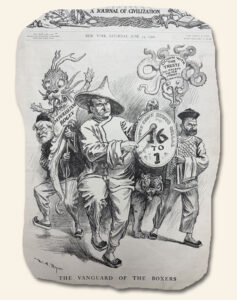 One of the fascinating areas of historic newspaper collecting is the ability to see patterns over time. Last week, I found a Harper’s Weekly for a collector with a fascinating front page print that caught my attention and the caption triggered a deeper search. The Boxer Rebellion of the 1900’s included a group called “Vanguards”. Although familiar with this term, I was curious as to other times this concept had popped up throughout history. The following is an overview of my discovery…
They Put It In Print… The Communist’s Oath from 1848…
May 14, 2019 by GuyHeilenman · 1 Comment
As we were searching through our issues from 1848 looking for early Gold Rush content, we discovered an interesting item in a August 8, 1848 Boston Evening Transcript with content related to Communism. With contemporary material related to early Communism hard to come by, it is nice the B.E.T. decided to put this in print: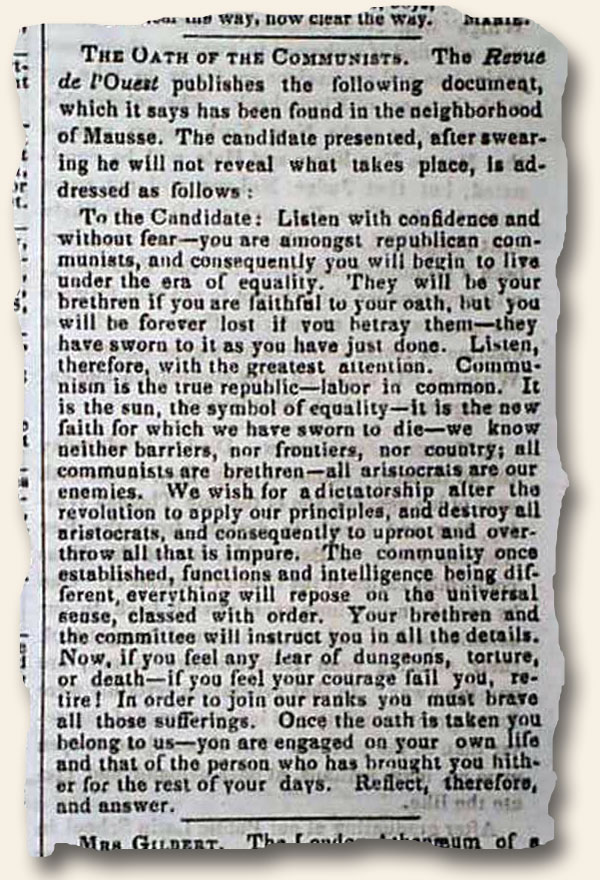
The Traveler… “The Big Dipper” sets NBA record… Communism – the beginning of the end?…
February 15, 2016 by The Traveler · Leave a Comment
Today I traveled to New York City by the means of The New York Times, February 15, 1966. There I found that Wilt Chamberlain, playing for the 76’ers, had scored his 20,884th point to surpassed the record previously set by Bob Pettit.
 The front page also has the reporting of “2-SOVIET AUTHORS ARE CONVICTED” with subheads “Court Finds Works Published Abroad Harmed Regime” and “Sinyavsky Is Given 7 Years, Daniel 5 at Hard Labor”. Andrei Sinyavsky and Yuli Daniel were convicted of writing under pseudonym names and sending the books out of Russia for publication. “…The judgment, considered unprecedented in modern Soviet history, called it a criminal act to put into print beliefs and ideas that could be used profitably by ‘enemies of communism’…”
As historian Fred Coleman writes, “Historians now have no difficulty pinpointing the birth of the modern Soviet dissident movement. It began in February 1966 with the trial of Andrei Sinyavsky and Yuli Daniel, two Russian writers who ridiculed the Communist regime in satires smuggled abroad and published under pen names… Little did they realize at the time that they were starting a movement that would help end Communist rule.” [source: Wikipedia]
~The Traveler
They put it in print… Castro given a year or less…
February 23, 2015 by TimHughes · Leave a Comment
 Historical perspective offers so much as we reflect upon some of the headlines of the past, particularly those proven to be so wrong. With the reestablishing of relations with Cuba currently in the headlines, we dug through out archives and found a headline which history has shown could not have been more wrong. The “Detroit Free Press” of October 20, 1960, in announcing the beginning of the embargo against Cuba, ran a banner headline: “CASTRO COLLAPSE FORESEEN” and one of the subheads noting: “Fidel Given Year or Less“. This is now a newspaper much more interesting today than it was almost 55 years ago.
What a fascinating hobby!
Collecting “bookend” newspapers…
July 22, 2010 by TimHughes · Leave a Comment
When writing up an newspaper on the beginning days of the Berlin Wall–when it was nothing more than barbed wire–it came to mind that we also have issues from Germany on the fall of the Berlin Wall. What a nice pair of issues to have together in a collection; the beginning and end of the Berlin Wall.
 This caused me to think of other “beginnings & endings” which would be nice to keep as pairs within a collection. Let me mention a few:
* wars, from proclamations declaring “war” to “peace” reports at their end
* the first and last games of Joe DiMaggio’s 56 game hitting streak
* the first and last games of Cal Ripken’s 2,130 consecutive game streak
* on a more somber note the first election of Abraham Lincoln and his death report, spanning the scope of his national prominence
* the Wright brothers’ first flight and man landing on the moon (actually not and “end”, but certainly a nice “bookend” issue)
* beginning and end of Prohibition
* beginning and end of the Stamp Act
* arrival of delegates to the Constitutional Convention, and the submission of the final Constitution for ratification
* The stock market at its high point on Sept. 3, 1929, and at it’s Depression low point on July 8, 1932
There must be many more. Offer your suggestions to add to the list!