
Search
The Rare & Early Newspapers Hobby

Receive the Newsletter

Buy Historic Newspapers

Curiosities are fun to collect…
December 4, 2008 by TimHughes · Leave a Comment  Email This Post
|
Email This Post
|  Print This Post
 The strange and the unusual make interesting additions to a newspaper collection, not only in the reports within the newspaper but the newspaper’s appearance as well.
 One issue from our private collection is significant for not only being a desirable title from Deadwood City in the
  “Black Hills” as noted in the dateline, but the front page and back pages have the columns printed alternately in red and blue ink. From what I can gather by the front page text they seem to be celebrating Washington’s birthday in a very creative way. It certainly makes for an unusual presentation. We have found that many newspapers from the Old West included unusual formats, likely due to the difficulties of printing so far from the metro areas of the East Coast.
Have you found some similarly unsual newspapers which are now in your collection? If so, what might they be?
If you liked this post, you may also enjoy...
- One of the more unusual, graphic issues on Lincoln’s death…
- The reason I collected it: Dodge’s Literary Museum…
- Understated caption, or overstated print…
- The reason I collected it: The State, 1892…
- Anything from the election worth saving?
Beginning of the Corvette era…
December 1, 2008 by TimHughes · Leave a Comment Email This Post
| Print This Post
A few weeks ago I did a post concerning cross-over collectibles; newspapers with significant content relating to another hobby.
Recently a terrific item came to light from our inventory which to many may seem interesting, but to the thousands of Corvette enthusiasts would be a cherished addition for their collection and a great display piece for the back seat of their 1953 Chevrolet Corvette.
The newspaper is the July 1, 1953 issue of THE DETROIT NEWS, with page 53 containing a photo captioned: “First fiber glass Corvette–Chevrolet’s first production model fiber glass Corvette sports car rolls off the company’s assembly line.” Plus there is a related article beneath the photo headed: “Production Line Starts: Plastic Corvette Begins to Roll“.
With Detroit being the automobile capital of the country–if not the world at that time–it is likely little if any coverage would have appeared in newspapers elsewhere, making this a particularly interesting issue. Imagine what a great collection of newspapers could be created by a car enthusiast: a Detroit newspaper announcing the beginning of all the classic automobiles so desirable today!
Just another great example of how old newspapers can find their way into many other hobbies.
If you liked this post, you may also enjoy...
- 60 years ago today… the Corvette…
- What is the best way to preserve and store newspapers?
- They put it in print… Nazi generals attempt an escape to Japan…
- From the Vault – What is the best way to preserve & store newspapers?
- Entry point to the Rare Newspapers Collectible… 19th Century…
Weaponry in the 17th century… distant cousin of the modern hand grenade…
November 28, 2008 by Historys Newsstand · Leave a Comment Email This Post
| Print This Post
 One of the key issues featured in our latest catalog is a newsbook of the Mercurius Politicus, from London, dated March 24, 1659. Newsbooks, for those unfamiliar with the term, were the forerunners of newspapers. This particular newsbook measures about 8 1/2 by 6 3/4 inches and has 16 pages. While looking for interesting content to describe, I noticed a report datelined “Marienburgh, March 5”, that contained details about a military engagement. In the report is word that: “..Colonel Drake came with a party back, fetching from hence Morter pieces, Balls, Handgranadoes, and other amunition, and is gone back to the army which lyeth near Rysenburgh…” In reading this passage I was fascinated by the term “Handgranadoes“. I did some research and discovered that the concept of “throwing” grenades may date to the Ming Dynasty in China, although the first known use of grenades occurred during the early to middle part of the 8th century. The research also suggested that some “Medieval petards” were small enough to be considered primitive hand grenades. Later, during the Song Dynasty, Chinese soldiers began to pack gunpowder into ceramic and metal containers, resulting in what one expert determined to be the prototype of the modern hand grenade. Variations of this prototype eventually appeared in Europe during the late 1460’s. About 200 years later,
  “Grenadoes”, according to a Wikipedia source, were used during the English Civil War (1642-1651). The source also says: “The word ‘grenade’ originated in the Glorious Revolution (1688), where cricket ball-sized iron spheres packed with gunpowder and fitted with slow-burning wickets were first used against the Jacobites in the battles of Killiecrankie and Glen Shiel. These grenades were not very effective….and, as a result, saw little use.” Obviously the mention of “handgranadoes” in the newsbook report confirms the use of such a weapon during the mid 1600’s. More importantly, this may be one of the earliest references to a distance cousin of the modern hand grenade to appear in newsprint. Note: The term “grenadier”, which is derived from the word grenade, was a classification given to soldiers in the 17th century with the specific role of throwing grenades. You simply never know what you might find while perusing collectible newspapers (and newsbooks).
If you liked this post, you may also enjoy...
- They put it in print… in two different editions…
- The Battle of Gettysburg… an intimate look…
- Top ten: 16th and 17th centuries…
- How to be a cowboy: The protocol in 1882…
- Double-dated newspapers: the Julian and Gregorian calendars…
Thanksgiving… I time to be thankful…
November 26, 2008 by GuyHeilenman · Leave a Comment Email This Post
| Print This Post
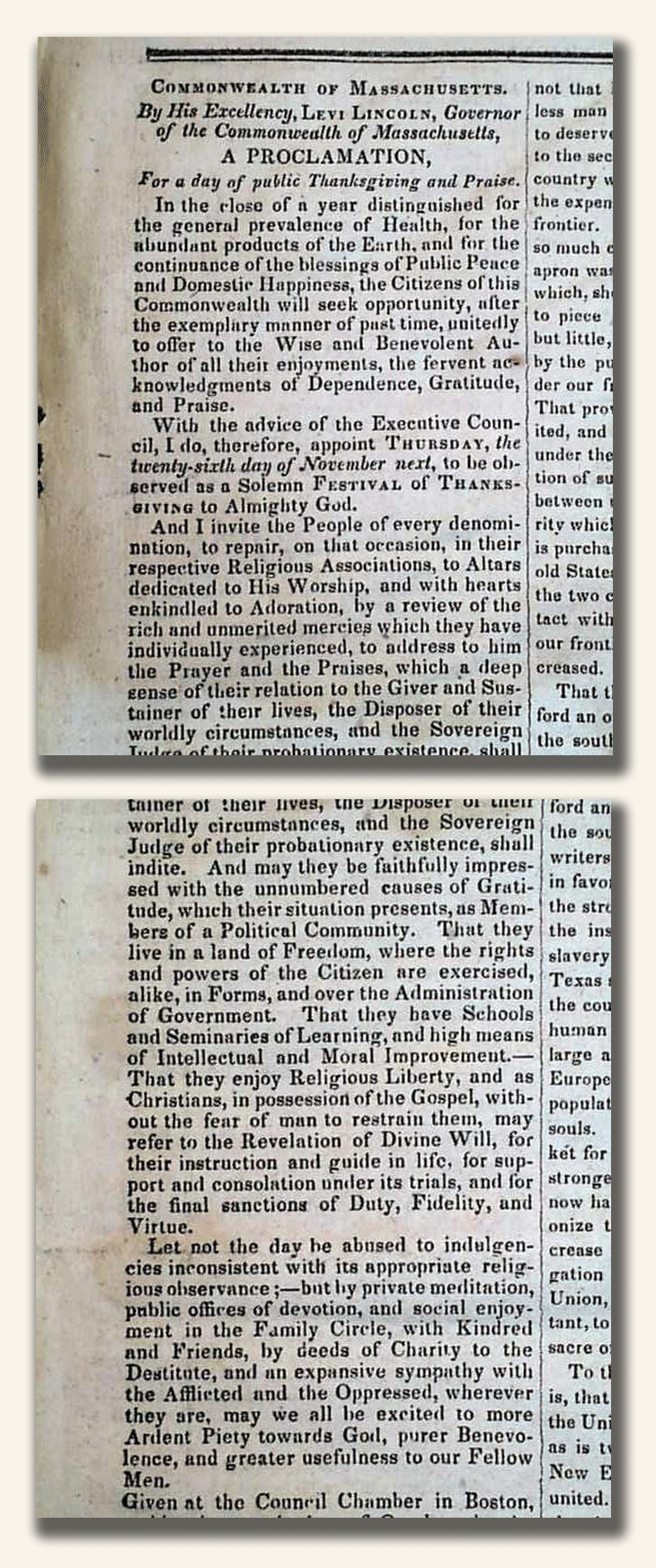
The title seems to be a bit absurd; or is it? In a land of abundance we often take our blessings for granted. Good health, a roof over our head, knowing where our next meal is  coming from, being surrounded by loved ones, having a warm place to stay, safety – all of which we rarely need to question – are before us day in and day out. Our freedoms – of speech, of religion, of the right to bear arms, of political expression, of the pursuit of happiness, etc. – the list of things for which we should be thankful pervade every aspect of our lives. For most of us our greatest concern this Thanksgiving will be deciding on the time we plan to eat and whether we should have dessert before or after the football game. This abundance affords us the luxury to focus on such intellectual discourse as whether or not the Pilgrim story we learned as children actually occurred, or if it occurred in the manner we were taught. There is nothing wrong with this. However, this year, let’s take a respite from our intellectual pursuits and spend time engaging in matters of the heart. George Washington grasped the importance of a thankful heart when he made the first Thanksgiving proclamation:
General Thanksgiving
By the PRESIDENT of the United States Of America
A PROCLAMATION
WHEREAS it is the duty of all nations to acknowledge the providence of Almighty God, to obey His will, to be grateful for His benefits, and humbly to implore His protection and favor; and Whereas both Houses of Congress have, by their joint committee, requested me “to recommend to the people of
the United States a DAY OF PUBLICK THANKSGIVING and PRAYER, to be observed by acknowledging with grateful hearts the many and signal favors of Almighty God, especially by affording them an
opportunity peaceably to establish a form of government for their safety and happiness:”
NOW THEREFORE, I do recommend and assign THURSDAY, the TWENTY-SIXTH DAY of NOVEMBER next, to be devoted by the people of these States to the service of that great and glorious Being who is the beneficent author of all the good that was, that is, or that will be; that we may then all unite in rendering unto Him our sincere and humble thanks for His kind care and protection of the people of this country previous to their becoming a nation; for the single and manifold mercies and the favorable interpositions of His providence in the course and conclusion of the late war; for the great degree of tranquility, union, and plenty which we have since enjoyed;– for the peaceable and rational manner in which we have been enable to establish Constitutions of government for our safety and happiness, and particularly the national one now lately instituted;– for the civil and religious liberty with which we are blessed, and the means we have of acquiring and diffusing useful knowledge;– and, in general, for all the great and various favors which He has been pleased to confer upon us.
And also, that we may then unite in most humbly offering our prayers and supplications to the great Lord and Ruler of Nations and beseech Him to pardon our national and other transgressions;– to enable us all, whether in public or private stations, to perform our several and relative duties properly and punctually; to render our National Government a blessing to all the people by constantly being a Government of wife, just, and constitutional laws, discreetly and faithfully executed and obeyed; to protect and guide all sovereigns and nations (especially such as have shown kindness unto us); and to bless them with good governments, peace, and concord; to promote the knowledge and practice of true religion and virtue, and the increase of science among them and us; and, generally to grant unto all mankind such a degree of temporal prosperity as he alone knows to be best.
GIVEN under my hand, at the city of New-York, the third day of October, in the year of our Lord, one thousand seven hundred and eighty-nine.
(signed) G. Washington
With Washington’s proclamation set before them, governors and elder statesmen have followed his lead ever since (view an example from October 28, 1829). Similar proclamations and the general national attitude of “thankfulness” have revealed themselves in countless historic newspapers.
Finally, on October 3, 1863, Abraham Lincoln’s nearly broken heart led him to make Thanksgiving a National (U.S.) Holiday:
By the President of the United States of America.
A Proclamation.
The year that is drawing towards its close, has been filled with the blessings of fruitful fields and healthful skies. To these bounties, which are so constantly enjoyed that we are prone to forget the source from which they come, others have been added, which are of so extraordinary a nature, that they cannot fail to penetrate and soften even the heart which is habitually insensible to the ever watchful providence of Almighty God. In the midst of a civil war of unequaled magnitude and severity, which has sometimes seemed to foreign States to invite and to provoke their aggression, peace has been preserved with all nations, order has been maintained, the laws have been respected and obeyed, and harmony has prevailed everywhere except in the theatre of military conflict; while that theatre has been greatly contracted by the advancing armies and navies of the Union. Needful diversions of wealth and of strength from the fields of peaceful industry to the national defense have not arrested the plough, the shuttle or the ship; the axe has enlarged the borders of our settlements, and the mines, as well of iron and coal as of the precious metals, have yielded even more abundantly than heretofore. Population has steadily increased, notwithstanding the waste that has been made in the camp, the siege and the battle-field; and the country, rejoicing in the consciousness of augmented strength and vigor, is permitted to expect continuance of years with large increase of freedom. No human counsel hath devised nor hath any mortal hand worked out these great things. They are the gracious gifts of the Most High God, who, while dealing with us in anger for our sins, hath nevertheless remembered mercy. It has seemed to me fit and proper that they should be solemnly, reverently and gratefully acknowledged as with one heart and one voice by the whole American People. I do therefore invite my fellow citizens in every part of the United States, and also those who are at sea and those who are sojourning in foreign lands, to set apart and observe the last Thursday of November next, as a day of Thanksgiving and Praise to our beneficent Father who dwelleth in the Heavens. And I recommend to them that while offering up the ascriptions justly due to Him for such singular deliverances and blessings, they do also, with humble penitence for our national perverseness and disobedience, commend to His tender care all those who have become widows, orphans, mourners or sufferers in the lamentable civil strife in which we are unavoidably engaged, and fervently implore the interposition of the Almighty Hand to heal the wounds of the nation and to restore it as soon as may be consistent with the Divine purposes to the full enjoyment of peace, harmony, tranquility and Union.
In testimony whereof, I have hereunto set my hand and caused the Seal of the United States to be affixed.
Done at the City of Washington, this Third day of October, in the year of our Lord one thousand eight hundred and sixty-three, and of the Independence of the Unites States the Eighty-eighth.
By the President: Abraham Lincoln
 Matters of the heart. It is interesting to note both Washington’s and Lincoln’s historic Thanksgiving Proclamations came in response to war – moments when the citizenry was moved to lay down their differences to come together in unity (similar to what occurred on September 12, 2001 – the day after), and acknowledge the blessings which were common to all.
Being surrounded by historic newspapers, I am constantly reminded of the great & many sacrifices which have been made so my children can live in this land of abundance – in freedom and in safety. I am moved to challenge myself to take time to count my blessings (which are many), and to “come as a child” to the feast which will soon be set before me. I invite you to join with me in reflecting upon life’s simple pleasures, the memories of old, and the joys which warm the heart. It is with this in mind I leave you with:
A Boy’s Thanksgiving Day
by Lydia Maria Child
Over the river, and through the wood,
to Grandfather’s house we go;
the horse knows the way to carry the sleigh
through the white and drifted snow.
Over the river, and through the wood,
to Grandfather’s house away!
We would not stop for doll or top,
for ‘tis Thanksgiving Day
Over the river, and through the wood,
oh, how the wind does blow!
It stings the toes and bites the nose,
as over the ground we go.
Over the river, and through the wood
and straight through the barnyard gate.
We seem to go extremely slow—
it is so hard to wait!
Over the river, and through the wood,
when Grandmother sees us come,
she will say, “Oh dear, the children are here,
bring a pie for every one.”
Over the river, and through the wood—
now Grandmother’s cap I spy!
Hurrah for the fun! Is the pudding done?
Hurrah for the pumpkin pie!
Happy Thanksgiving!
from the staff of Timothy Hughes Rare & Early Newspapers… History’s Newsstand
If you liked this post, you may also enjoy...
- Lincoln establishes a national Thanksgiving Day…
- Lincoln’s “under the radar” proclamation for Thanksgiving…
- Properly Directed Thankfulness – George Washington and the Foundations of a New Nation…
- The Traveler… the Thanksgiving proclamation…
- Thanksgiving – only days away…
Framing newspapers…
November 24, 2008 by TimHughes · 2 Comments Email This Post
| Print This Post

Tim Hughes, founder
One of the joys of collecting newspapers is sharing with others, but sharing can be problematic given the fragile nature of early paper.
Certainly 20th century newspapers offer the largest & most dramatic headlines–some taking the entire front page–but 18th and 19th century issues can be displayable as well. Civil War era newspapers occasionally had large front page maps, and others included graphic devices which draw much attention. And Harper’s Weekly and Leslie’s Illustrated issues of the 19th century offer a wealth of displayable prints. Even some 18th century newspapers have graphically appealing mastheads which make them perfect for display, not to mention many with wide, black “mourning rules” signifying the death of someone of prominence. But smaller headlines–typically just one column wide–and major content often appearing on inside pages do present challenges for proper display, but can be done. Such headlines on inside pages can be creatively folded, matted and framed in such a way to feature a somewhat small yet very significant report.
This relates to one of the common question received from customers: can historic newspapers be framed? The short answer is yes, in fact many of our issues are framed and hanging on walls in our office. But care must be taken to use only archival materials when selecting mat boards and backing boards so no acids transfer from the framing material to the newspaper. Virtually all professional framers use archival material today so this warning is more for those who choose to do their own work.
UV glass is important as well, and again is typically available through professional frame shops. This glass will filter out much of the harmful ultraviolet rays which may, in time, do damage to the newspaper if exposed to sunlight. But just to be sure I take care to hang newspapers in locations where little or no sun will touch the frame throughout the day.
So for those beautiful headlines in your collection which beg to be displayed, feel free to do so–but include some common sense as well.
Do you have newspapers from your collection framed? Feel free to share.
If you liked this post, you may also enjoy...
- Displaying newspapers – Frame to see all four pages…
- Framing and Storing Newspapers… the ongoing story…
- What is the best way to preserve and store newspapers?
- From the Vault – What is the best way to preserve & store newspapers?
- To repair or not to repair?
Most Historic 19th Century post-Civil War Headline… revisited…
November 22, 2008 by Historys Newsstand · Leave a Comment Email This Post
| Print This Post
 Although I think Tim’s choice was a good one (see his post), my choice for the most important event of the nineteenth century, post-Civil War is the invention of the first practical incandescent light bulb by Thomas Edison. His creation of this light bulb as well as his other inventions make him the most recognized inventor of the nineteenth century and perhaps of all time. In fact, reports about his most significant inventions were featured in several nineteenth century issues of Scientific American, more than any inventor of the era.
Newspapers, however, were slow but not reluctant to recognize Edison’s  achievements. As a result, there is no single report that marked his most famous invention. The reports were usually topical ones written by staff writers who visited Menlo Park, witnessed demonstrations of his inventions, or interviewed Mr. Edison. Images and a description were featured in the Scientific American issue dated March 22, 1879. Nevertheless, the impact of Thomas Edison’s incandescent light bulb and his other inventions are immeasurable and far-reaching. They continue to play a role in our daily lives and make the world a better place for all mankind.
I’d love to hear your thoughts.
Note: Images with a supporting article were featured in the March 22, 1879 issue of Scientific American.
If you liked this post, you may also enjoy...
- Who’s Who in Newspapers? Moses G. Farmer edition (1879)…
- Snapshot 1929… Just prior to the “crash” – Thomas Edison’s electric lamp…
- They put it in print… a prophetic statement on “modern technology”…
- Snapshot 1879… Thomas Edison – in defense of his electric light bulb…
- Who’s Who in Newspapers? Lewis H. Latimer edition…
AmeriCollector.com is back at it again…
November 22, 2008 by GuyHeilenman · Leave a Comment Email This Post
| Print This Post
 David Chesanow, at AmeriCollector.com, recently interviewed Tim to obtain his views concerning collecting newspapers related to the recent election. Two of the questions asked:
- Do you think people will start collecting Obama papers beyond the election?
- Do you anticipate this event raising interest in historic newspapers as a hobby (not investment)?
The answers to these questions, and more, may be viewed at AmeriCollector.com. Thanks David, for yet another positive contribution to the Rare Newspapers community.
If you liked this post, you may also enjoy...
- Old news is good news for collectors…
- Old news is good news for collectors…
- Documenting the Civil War…
- Prices of newspapers… How have the changed?
- Collecting Newspapers – The Basics (Part II) – What to Expect…
America’s first newspaper… Check your attics.
November 20, 2008 by TimHughes · Leave a Comment Email This Post
| Print This Post
The very first newspaper printed in the American colonies was published in Boston in 1690 and titled “Publick Occurrences Both Forreign and Domestick”. It was a little paper with three pages of text. The fourth page was left blank for others to write handwritten pieces of news before being passed on to others. It was published by Benjamin Harris who had experience in publishing another newspaper in London several years prior to his arrival in the colonies, titled “Domestick Intelligence, Or News Both from City & Country”.
His Boston effort focused on local news but it also included gossip and unflattering reports. One account notes it contained: “…affections of a very high nature: As also sundry doubtful and uncertain Reports…”. The mixture of doubtful and uncertain reports, as well as a ban on printing without a license which Harris did not have, caused his first issue to also be his last. Reports note that the royal governor had the printing press destroyed and all known issues of that one date of September 25, 1690 confiscated.
To this day only one genuine issue of the newspaper is known to exist, and unfortunately it’s not in the United States: it is in the Public Records office in London. Some years ago it was loaned to The Newseum in Washington, D.C. (then located across the Potomac in Virginia) for a period of time, but I believe it has been returned to London.
The intriguing part of this story is that “all known issues were confiscated and destroyed”. But exactly when did this happen? Was it done several hours since it was printed, or a few days later? It was intended to be a monthly publication. Certainly the possibility exists that a few issues were not found & confiscated, and with the owners knowing of the search they may have purposely hidden them away.
Could an issue or two still exist in a Boston attic somewhere? Is there a private library where an issue was hidden among the pages of a book in hopes of not being confiscated? Could a renovation project to a Boston area home reveal an issue tucked within its walls over 300 years ago? It is fascinating to think that some examples could be found so long after being published. But to this date none have surfaced.
Speculation runs wild as to the value of an issue should it surface. It’s America’s very first newspaper, and none exist in America. What sort of price could be set on such an issue? What should be the future home of an issue should it be found?
Feel free to comment!
If you liked this post, you may also enjoy...
- #18 – America’s first newspaper… Check your attics. (*revisited)
- First newspapers in Massachusetts…
- Archetype Publisher . . . Benjamin Harris
- In the beginning…
- They put it in print… in two different editions…
Most historic Civil War event…
November 18, 2008 by TimHughes · 1 Comment Email This Post
| Print This Post
Continuing with our discussion on the “most historic” reports to be found in newspapers, we have been discussing the events of American history by era, the last being the post-Civil War 19th century. This post will discuss the Civil War era of 1861 – 1865.
Of the many events of the 19th century which changed the course of American history few would argue that the Civil War was the most significant. But what single event during the Civil War would rank as the most significant? If you could only have one newspaper from the Civil War in your collection, what one event would you most desire?
There are a number of events to consider:
1) The election of Abraham Lincoln. Although it happened in late 1860 and not technically from the war, this event would would set the tone of American politics which would lead to the war. What would have happened had he not been elected?
2) The beginning of the Civil War in April, 1861, for obvious reasons.
 3) The Emancipation Proclamation of September, 1862, providing freedom to all slaves in all states, although more in theory than practicality.
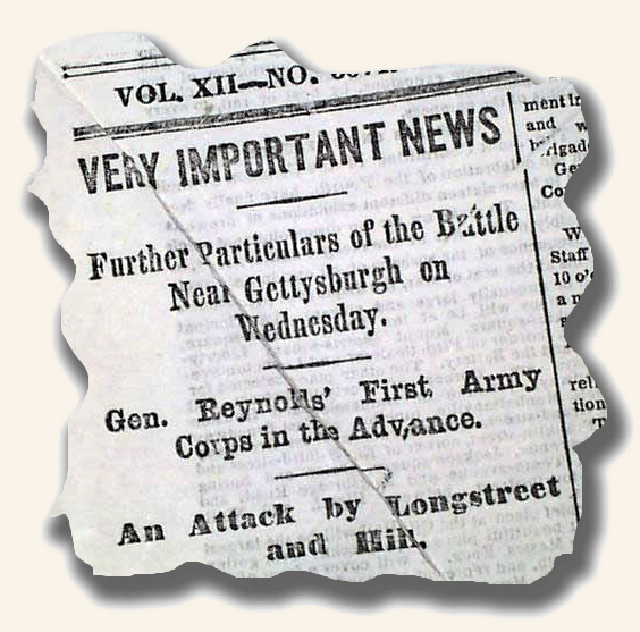
4) The battle of Gettysburg, as the turning point of the Civil War.
5) The assassination of Lincoln: how would the country been different had he not been assassinated and served out his 2nd four year term?
Perhaps other events should be considered as the most historically significant. What are your thoughts?
My vote would be for the battle of Gettysburg. If it was a given that a war was inevitable to settle the political, cultural & economic divide between the North & South, it’s arguable that the war’s end was decided at Gettysburg. The tide had turned in favor of the North and at that point it was just a matter of when it would end and not who would win.
What’s your thought?
If you liked this post, you may also enjoy...
- Most historic Civil War event (revisited)…
- Most historic pre-Civil War 19th century event…
- Gettysburg revisted… 150 years ago…
- Most historic: Pre-Revolutionary War…
- Most historic: 1784 thru 1800…
Rick Brown & HistoryBuff.com – Featured Website!
November 17, 2008 by GuyHeilenman · 1 Comment Email This Post
| Print This Post
Rick’s entry into the hobby took a path similar to Timothy Hughes’. He started collecting historical newspapers in 1965 when he purchased a Philadelphia Inquirer for the capture and death of John Wilkes Booth. As he held his new purchase in his hands, he was suddenly struck by what many since him have come to realize: “History is never more fascinating than when it’s read from the day it was first reported”. He describes this first encounter with historic newspapers himself…
“Reading the emotion-filled accounts from actual witnesses suddenly opened a new door for me. Before, my viewpoint of history was that it was just a series of dates, names and events. Reading the actual eyewitness accounts made the names and events come to life. Imagine, being able to hold something in your hands that was “alive” when the event happened — 100, 200 or even 300 years old. For the next four years I literally purchased every old newspaper I could find. By 1969 I realized that I was running out of storage room…”
By 1969 he became a mail order dealer in historic newspapers. In 1984 he started a publication for newspaper collectors, “Collectible Newspapers”, which featured journalism history articles.
Tim fondly remembers the publication and the extraordinary efforts of Rick to bring together newspaper collectors from all corners of the country–and across the globe as well.
“Rick was a true hobbyist. He expended much effort and money to provide a channel to bring together all collectors under a common banner–the Newspaper Collector Society of America (NCSA). Never was he motivated to profit by the hobby. In more ways then he might admit, Rick did much to help the fledgling hobby grow. Rick’s a terrific guy and remains an extremely valuable resource for the hobby” says Tim.
In 1995 he discovered the internet, and by October 1995, Rick had a small website utilizing articles he had first printed in “Collectible Newspapers.” By January 1997, the site was getting 25,000 hits per month, and he could no longer justify the publishing costs for 25,000 people, so he ceased publishing the print version with the April 1997 issue.
Now, thirteen years later, HistoryBuff.com is reaching nearly 90,000 unique viewers AND 500,000+ PAGE VIEWS monthly. In October 2003, HistoryBuff.com was granted nonprofit status at both the federal and state level. While donations help keep HistoryBuff.com online, Rick fills in with money of his own. As with most nonprofits, financing is always a chore and there is seldom enough to keep it going. He has never taken pay for his work; truly a labor of love.
The HistoryBuff.com website provides a wealth of historical information beneficial to both novice and well-seasoned historians. It describes itself as:
“…a nonprofit organization devoted to providing FREE primary source material for students, teachers, and historybuffs. This site focuses primarily on HOW news of major, and not so major, events in American history were reported in newspapers of the time. In addition, there is information about the technology used to produce newspapers over the past 400 years.”
A sampling of resources provided at HistoryBuff.com includes:
-
- Reference Library (articles from Collectible Newspapers)
- Historic Panoramas (30 and counting)
- Newspaper Collecting
- Online Newspaper Archive
- Newsletter Archives
The most recent addition to the website is panoramas of historic sites in America. Upon entering, you will be treated to a guided tour of more than a dozen well-known historic sites.
Whether your primary interest is history or the collection of “History in Your Hands” via newspapers, the resources available through these links will prove to be invaluable. As a former educator, I particularly appreciate the access to Rick’s Interactive Quizzes. Subscriptions to the monthly EMAILED newsletter are available at no cost.
If you have yet to browse through the pages at HistoryBuff.com, a treat awaits. Warning: Before visiting, make certain you’ve cleared your schedule for a few hours. Walking through history is a trek worth savoring. Thanks Rick!
Feel free to comment on your visit (or more likely… visits) to HistoryBuff.com.
If you liked this post, you may also enjoy...