
Search
The Rare & Early Newspapers Hobby

Receive the Newsletter

Buy Historic Newspapers

Confederate “Extra” with content from two eras…
April 18, 2011 by TimHughes · Leave a Comment  Email This Post
|
Email This Post
|  Print This Post
 Finding oddities from the newspaper world is part of the fun of the hobby, and recently one came our way which I found to be very unusual.
The “Daily Appeal–Extra” newspaper from Memphis, Tennessee dated April 20, 1861, contains content which is over two years apart. This is a “broadside extra” edition meaning the narrow sheet was published to report a specific event, and printed on one side only. But in this case, the reverse is not entirely blank.
First, it’s curious that this is a newspaper from a city which was only “Confederate” until the battle of Memphis, June 6, 1862, after which it was in Yankee control. The front has a very nice graphic devise at the top of the first column showing a cannon and Confederate flag, with heads: “THE WAR NEWS ! ” “Star of the West Taken As A Prize ! “and other related heads & reports.
But the most intriguing aspect of this issue is the back page. Although I am convinced this was issued in 1861 with the reverse blank, it nonetheless has a print of a map of the Vicksburg vicinity, and nothing else. Now, let’s keep in mind that the siege of Vicksburg didn’t happen until mid-May, 1863 thru its fall to the Yankees on July 4, 1863. Note that the heading of the map reads: “Position of the Fleets Above and Below The City” showing the positions of both Porter’s and Farragut’s fleets. Their appearance in the Mississippi did not happen until 1863. I surmise this “Extra” edition was lying around the printing office and since the back side was blank they used it as a test sheet for printing this map, which likely appeared in a the “Memphis Appeal” newspaper at some point in May, June, or July, 1863. Consequently this becomes a truly fascinating curiosity to have printings from two different periods in a single issue, and one being a map.
Do any fellow collectors have another explanation?
If you liked this post, you may also enjoy...
- One newspaper, nine cities…
- Journalists at Their Gritty Best…
- The Civil War… 150 years ago today… July 6, 1861
- This famous Confederate issue, with a contemporary explanation…
- What could have been…
Rare Newspapers found on the National Geographic Channel…
April 16, 2011 by GuyHeilenman · Leave a Comment Email This Post
| Print This Post
 Early this month National Geographic Channel surfers had the opportunity to add an authentic 19th century London Times with a report regarding Jack the Ripper to their personal collection, for no cost. Three issues from the Timothy Hughes Rare & Early Newspapers Archives had been donated for use as prizes in the latest Mission Expedition featured on the National Geographic Channel’s website. Although the “expedition” is over, the website shows great behind the scenes footage of how the project was created. These interactive walks into the past also provide wonderful opportunities to engage young budding historians. To view the footage, go to: National Geographic Channel: Mission Expedition. the next expedition will be in October of 2011.
If you liked this post, you may also enjoy...
- Snapshot 1926… They said she would never make it…
- Golden Nuggets… yet another “find”…
- Before there was the Chunnel…
- Exploring “This Day in History” through Rare & Early Newspapers…
- The Civil War… 150 years ago today… July 20, 1861
The Civil War… 150 years ago today… April 13, 1861
April 13, 2011 by TimHughes · Leave a Comment Email This Post
| Print This Post
We continue our weekly feature of reflecting upon the appropriate 150 year old issue of “Harper’s Weekly” from the perspective of a subscriber in 1861:
“The daily papers today give evidence of what everyone feared: war has begun. Events in Charleston harbor reached a breaking point as both the North and the South claimed the military installations there. But our “Harper’s Weekly” is about two weeks late with reports which I understand is due to the complexity of providing accurate illustrations of the events, certainly a small price to pay for the great benefit of “seeing” the war scenes. I look forward to the end of the month and seeing just what transpired at Charleston.
In the meantime today’s issue has a scene of Point Isabel, Texas, a town apparently on a cliff along the Gulf of Mexico. In the foreground troops are being transported on a paddle-wheeler. Near the back are two military scenes including a boat house at Fort Pickens, Florida, and another the inside of that fort. The cannons they use are huge and the fort’s thick walls seem impenetrable. I had not previously known what the inside of a fort looked like.
I recognize President Lincoln in one of the back page cartoons, his face and stature familiar from an earlier issue on his inauguration. In this cartoon he consults with “Columbia”, who says: “…be sure you’re right, then go ahead!” Yes, our future is in his hands.” With all of the tension in the air, I was surprised to see the double-page centerfold which included various vignettes of American Home Scenes, which seemed in stark contrast to the mood of the day.
To enjoy the images (and some of the text) from this issue, please go to: Harper’s Weekly, April 13, 1861
If you liked this post, you may also enjoy...
- The Civil War… 150 years ago today… April 20, 1861
- The Civil War… 150 years ago today… April 6, 1861
- The Civil War… 150 years ago today… April 27, 1861
- The Civil War… 150 years ago today… July 13, 1861
- The Civil War… 150 years ago today… June 8, 1861
Antebellum American Newspapers… AAS…
April 11, 2011 by GuyHeilenman · Leave a Comment Email This Post
| Print This Post
Vincent Golden of the American Antiquarian Society, recently produced a video which describes the history and characteristics of Antebellum American newspapers. We thought our readers might enjoy this informative piece, from the Curator of the AAS: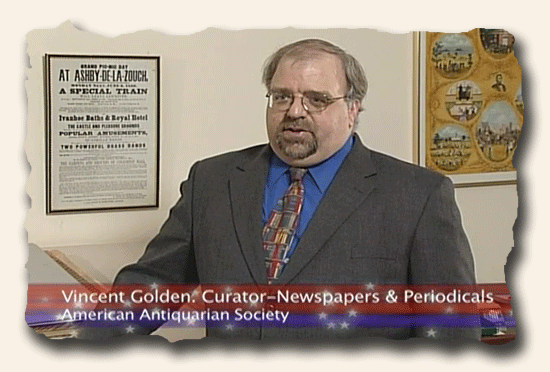
Antebellum American Newspapers from American Antiquarian Society on Vimeo.
If you liked this post, you may also enjoy...
- A gem from the American Antiquarian Society… The Kentucky Spy…
- “Le Bijou” – a gem from the American Antiquarian Society…
- A gem from the American Antiquarian Society…
- A gem in the American Antiquarian Society… “The Royal Danish American Gazette”…
- “Brownsville Gazette” – a gem from the American Antiquarian Society…
The early muckrakers – collecting newspapers that dished the dirt…
April 9, 2011 by GuyHeilenman · Leave a Comment Email This Post
| Print This Post
The following is a guest post submitted by Edward Khoo:
People collecting old and rare newspapers will give you many different reasons for their
hobbies. For some it’s about owning a little piece of history, for others it’s a way of connecting
to important date in their life – say a birthday or marriage – to something real. For some it’s
just that wonderful sense of smell and touch you get from handling something that was meant
to be thrown away – fragile, disposable, but now wonderfully evocative.
But once you get past those initial reasons, many of us newspaper-collectors like to build our
collections around favorite themes, to give us a focus. And there’s a lot to choose from – you
can collect papers just from your local area, where a lot of the stories may have some real
relevance to the people still living in your town or county. Or you can collect on a particular
important news story, or historical theme – I know one guy who has collected editions only on
dramatic murder cases. Though maybe you should avoid that sort of collector, because you
don’t know where it’s going to lead!
For me, though, it’s the history of the newspaper journalism that fascinates me. It’s simply
amazing to be able to see how much has changed, in journalistic style, over the last 200
years – and how much has stayed the same! And the wonderful, and surprising, thing about
collecting rare and old newspapers is the fabulous state of preservation many of these copies
are still in.
You may expect that newspapers older than 50 years would just crumble in your hands –
but you’d be wrong. Although the newspapers we find when we lift the carpet are usually
yellowing and fragile – after just 10 or 20 years – back-in-the-day they made them very
differently. Most of the earlier 19th century papers were made from a type of linen, not paper,
which ages very well – so some very ancient newspapers can look almost pristine!
The period that I’m particularly interested in dates back to that century – those great
champions of newspaper journalism, who set the standard for the humbling of the powerful
– the ‘muckrakers’. That term was coined by a certain Theodore ‘Teddy’ Roosevelt, who
compared those who sought to expose ‘many grave evils’ in the ‘body politic’ to a character
from John Bunyan’s Pilgrim’s Progress : ‘Man with the Muck-rake, the man who could look no
way but downward, with the muck-rake in his hand.’
That, for me, is where journalism shines most bright – when its delving deep into the dirty
underbelly, and exposes it for all to see. We wouldn’t have a true democracy at all without
those guys. So where do you start, if you want to collect some of the finest examples of
exposé-journalism?
Well, one of my favorites is a woman who was a pioneer on several fronts – Nellie Bly. Not
only was she a journalist at a time when the fairer sex was frowned upon for doing anything
except being mothers, and supporting ‘their men’ – she also broke the record for going around
the world, beating Phileas Fogg. Her journalistic exploits were groundbreaking, so owning so
me the newspaper she printed in is to hold onto social history in the making.
She really made her name at Pulitzer’s New York World, with her undercover work in an
asylum. She actually managed to get herself committed, so as to show what really went on in
the mental institutions of the time. The paper had a big circulation, so picking up copies is notinsanely hard (excuse the pun). But some of her more interesting work was on the Pittsburgh Dispatch, on which she worked as a foreign correspondent in Mexico. These papers are rarer – so naturally more valuable.
Another principled muckrakers, on the west coast this time, was Fremont Older. He wrote for
first the San Francisco Bulletin, and then for William Hearst’s San Francisco Call, at the turn
of the last century. He had a knack for getting up the noses of local politicians, such as the
corruption machine of Abe Ruef, just after the San Fransisco quake. We could probably do
with more of his ilk on today’s San Francisco Examiner!
That’s the wonderful thing about this hobby. Whatever slice of real life you’re interested in, the
rags and hacks of the past will have covered it in one way or another. By collecting those thin
sheets of typeset from the past, you’re opening a window onto how the world has changed –
and yet is still very much the same.
Edward Khoo is a writer who is proud of his language and based in one of the exotic and
tropical islands of Malaysia.
If you liked this post, you may also enjoy...
- Media Transformation…
- My collecting story… J. W. in Stow, MA…
- This Day Through History (as reported in authentic newspapers)…
- Featured websites – The Boston Journalism Trail…
- You can’t always believe what you read – even when penned with good intentions…
The Traveler… Madison Square Garden being sold… big shoes to fill…
April 7, 2011 by The Traveler · Leave a Comment Email This Post
| Print This Post
 Today I traveled to Boston, Massachusetts, by means of the Christian Science Monitor dated April 7, 1911. I was very surprised to find a photo headline “View In Madison Square Garden, Just Sold” with the article “Dispose of Madison Square Garden for Big Skyscraper Site”. Since I have personally visited Madison Square Gardens in my travels, I had to do some Googling for more information on this matter. I have found that there have actually been four Madison Square Gardens!! This was the second location and was located where the current New York Life Insurance building is located.
A second page article entitled “No ‘Famous Man’ for Princeton” caught my eye. “Princeton University has been searching the country for some ‘famous man’ to succeed Governor Wilson as president, but most of the famous ones ‘are already taken up.'” I guess when succeeding the Governor [and yet to become the US President!] those are big shoes to fill…
~The Traveler
If you liked this post, you may also enjoy...
- Were you there – 1981? The Kinks perform at Madison Square Garden…
- The Traveler… a hatchet and… a slap in the face…
- The Traveler… A commuted sentence… the angry mob and more…
- The Traveler… war declared…
- The Traveler… early Sodoku?…
The Civil War… 150 years ago today… April 6, 1861
April 6, 2011 by Historys Newsstand · Leave a Comment Email This Post
| Print This Post
With the 150th anniversary of the outbreak of the Civil War just days away, we begin today a weekly feature of reflecting upon the appropriate 150 year old issue of “Harper’s Weekly” from the perspective of a subscriber in 1861.
The success of “Harper’s Weekly” was in presenting illustrations of the war, as visual presentations–today commonplace in almost all forms of media–were almost unknown in the mid-19th century. The subscriber in 1861 could now “see” rather than just read about the battles and the famous names who lead the war effort. We hope to share with our blog readers that novel experience and how those in 1861 would have reacted as they opened their issue of “Harper’s Weekly” .
I always look forward to my “Harper’s Weekly‘ issue in the mail as this new type of newspaper provides the graphics of everyday life which my daily newspapers don’t provide. What a treat it is to see what is happening rather than just read about events of the day!
 Today I received the April 6, 1861 issue, and as per usual, the prints were outstanding. The front page is a nice illustration of the “Hon. William H. Seward, Secretary of State” about whom I’ve heard much as a key member of the new Lincoln Administration. He looks much younger than his 60 years the article mentions. Other prints inside provide military scenes concerning the inevitable crisis between the North and South, with a print of Fort Pickens in Florida, another of Pensacola Harbor, a nice doublepage spread of various “Virginia Sketches” one showing the huge Richmond Armory & another the frigate Merrimac–a mammoth ship which would be a formidable foe in any naval conflict. A full page is taken up with the “Coats of Arms of the Several States of the Union” which make a fascinating display with their various themes and mottoes. How many will still be part of our Union if war breaks out?
With rumblings of war noted in the daily newspapers I suspect more war-themed prints will find their way into my future editions of “Harper’s Weekly“. I look forward to the illustrations which will put a “face” on the news reports.
To enjoy the images (and some of the text) from this issue, please go to: Harper’s Weekly, April 6, 1861
If you liked this post, you may also enjoy...
- The Civil War… 150 years ago today… June 8, 1861
- The Civil War… 150 years ago today… July 27, 1861
- The Civil War… 150 years ago today… May 11, 1861
- The Civil War… 150 years ago today… April 27, 1861
- The Civil War… 150 years ago today… June 22, 1861
Collecting Ideas: Charles Dickens…
April 4, 2011 by GuyHeilenman · 2 Comments Email This Post
| Print This Post
An area of collecting interest which continues to draw interest is collecting newspapers with Charles Dickens related content. Whether one’s passion is Harper’s Weekly Illustrated issues containing serialized versions of his writings, issues published by him directly (All the Year Round & Household Words) , or newspapers with news concerning his travels and/or his thoughts on various topics, there certainly are a host of ways to enjoy this particular area of newspaper collectability.
Although not directly related to the hobby, we recently came across a post we thought our Dickens-collecting friends might enjoy: 15 Things You Never Knew About Dickens, by Emma Taylor. Feel free to share your Dickens knowledge with the collecting world via responses to this post.
If you liked this post, you may also enjoy...
- Hidden Gems – What’s that above the story by Charles Dickens?
- Charles Dickens on newspapers…
- Videos regarding the hobby… Private Collections…
- Oddball collecting ideas – advice columns through time…
- Rick Brown’s Primer on Collecting Old & Historic Newspapers…
War makes “sad havoc” among the newspapers…
April 2, 2011 by TimHughes · Leave a Comment Email This Post
| Print This Post
This item provides some interesting facts on what war does to newspaper publishing. It appeared in the “Daily Richmond Examiner” issue of February 4, 1864.
If you liked this post, you may also enjoy...
- Minister needed to be clever to say only nice things…
- The editor shows his bias…
- General Butler… “The Beast”…
- Discretion was the better part of valor…
- It’s all relative…
Rare Newspapers… What to collect?
March 31, 2011 by GuyHeilenman · 1 Comment Email This Post
| Print This Post
There are an infinite number of ways to approach collecting rare newspapers. The History’s Newsstand Blog is pregnant with suggestions. Over the course of the next several months we will  begin to explore the topic in earnest. For those who are new to the hobby, and are anxious to explore what has been written to-date, the following links are to help bring you up to speed:
Feel free to share your thoughts on ideas for collecting rare and early newspapers: themes, eras, topics, etc.
If you liked this post, you may also enjoy...
- Collecting Newspapers – The Basics (Part I) – Eras, Topics, and Titles…
- A video look at Rare & Early Newspapers – revisted…
- Videos regarding the hobby… Private Collections…
- More than what meets the eye – categories on the RareNewspapers.com website…
- “Collecting Newspapers – The Basics” (Part III) – Newspaper Care…