
Search
The Rare & Early Newspapers Hobby

Receive the Newsletter

Buy Historic Newspapers

A new experience proves frighteningly realistic…
July 8, 2013 by TimHughes · Leave a Comment  Email This Post
|
Email This Post
|  Print This Post
In today’s world, being so accustomed to action events on television, movie theaters, and even our computers, it can be difficult to realize that those who first experienced wide screen action in the early years of movie-making might react as these children did in London. This report is found in the “New York Tribune” issue of May 24, 1923. Is there a comparable experience awaiting us?
If you liked this post, you may also enjoy...
- Movie prop newspaper #2… Help needed…
- They Never Saw it Coming… The Sinking of the Titanic.
- Hatfields & McCoys…The media drives interest in historical newspapers…
- A political cartoon from 1776 themed on the Revolutionary War…
- Snapshot 1932 – Babe Ruth’s famous “called shot”…
The Traveler… the bloodiest battle in the Civil War…
July 5, 2013 by The Traveler · Leave a Comment Email This Post
| Print This Post
 Today I traveled back 150 years to the battlefields of Gettysburg, Pennsylvania, through the means of the reports of the Confederate broadside newspaper, the Daily Dispatch — Extra dated July 5, 1863. The headlines read “LATEST FROM THE NORTH” and “GREAT BATTLE AT GETTYSBURG”. “The Yankees claim not to be defeated and to have captured 6,0oo prisoners — The Confederates hold the field — Yankee Generals Reynolds and Paul killed — Heavy Loss of the Federals — The grand battle expected Friday, &c., &c.”. This broadside carries in great detail the battles of Wednesday, July 1st, and Thursday, July 2nd.
As we know, this was the bloodiest battle (non-single day) in the Civil War with the loss of over 51,000 lives and is known as the war’s turning point.
~The Traveler
If you liked this post, you may also enjoy...
- The Battle of Gettysburg… an intimate look…
- An oddity from 1863 – The Battle of Gettysburg…
- The Traveler… laying the cornerstone… a time to remember…
- Gettysburg revisted… 150 years ago…
- The ultimate optimist…
60 years ago today… the Corvette…
July 1, 2013 by GuyHeilenman · Leave a Comment Email This Post
| Print This Post
Chevy rolls out the 2014 Corvette Stingray today, just in time for the 60th anniversary. How much has changed in 60 years? The following link will take you back to a newspaper report of the first release. Please enjoy this walk down memory lane. It’s hard to imagine the initial cost was only $3,250!
1953 Chevy Corvette
If you liked this post, you may also enjoy...
- Beginning of the Corvette era…
- Old Newspapers – Music to My Ears…
- The Civil War… 150 years ago… February 15, 1862…
- The Civil War… April, 1865
- St. Patrick’s Day…
Gettysburg revisted… 150 years ago…
June 28, 2013 by GuyHeilenman · 2 Comments Email This Post
| Print This Post
 Since the birth of the United States, there may not be a single more formative event than The Battle of Gettysburg. Authentic newspapers containing first-hand accounts continue to be one of the most sought after within the collectible. Over the years several History’s Newsstand posts have been written about these contemporary reports. A sample of a few are:
The ultimate optimist…
Beyond the big, historic headline…
The Civil War…
The “top ten”: 19th century…
Most historic Civil War event…
The following are the currently available original newspapers with reports related to the Battle of Gettysburg. Please enjoy a brief walk into the heart of “America in crisis” (arranged in chronological order): Battle of Gettysburg
If you liked this post, you may also enjoy...
- Most historic Civil War event (revisited)…
- Most historic Civil War event…
- 19th century newspapers… revisited…
- Where History Comes Alive (Part 2)… Gettysburg…
- Thoughts on the most historic 19th century report…
Must have been a terrifying funeral…
June 24, 2013 by TimHughes · Leave a Comment Email This Post
| Print This Post
The “Richmond Enquirer” newspaper from Virginia, issue of December 8, 1821, included this very interesting article titled: “Resurrection From The Grave”. While the inking makes it a bit difficult to read, please… enjoy?
If you liked this post, you may also enjoy...
- Discretion was the better part of valor…
- Under the Radar (June, 1921 Edition) – “Abe, The Newsboy”…
- It caught my eye…
- There must be a man in the moon…
- Maryland’s first newspapers…
Who is Toussaint L’Ouverture?
June 21, 2013 by GuyHeilenman · Leave a Comment Email This Post
| Print This Post
 Every now and then we’ll come across an article which either illustrates a different side of a well-known historic figure, or provides a glimpse of someone whom we wonder why they have not received more recognition over time. Every now and then we’ll try to bring some of these to light. In this instance, our attention is drawn to Toussaint L’Ouverture. While he may be known to historians, the average person has most likely never heard of him. However, there was a time when this was not the case. In the mid-1800’s, his influence was known world-wide, and the ripple effects of his actions continue to be felt today. If you desire to know more, a lengthy biographical sketch by the often-verbose Wendell Phillips printed in the April 3, 1863 issue of The Liberator might be an excellent launching point. The entire article may be viewable at: The Liberator, April 3, 1863.
Wikipedia also does a pretty good job of providing additional details regarding his fascinating life. While most are no longer available, a few additional tidbits may be gleaned from other newspapers of the period: Toussaint L’Ouverture
Enjoy!
If you liked this post, you may also enjoy...
- The meanderings of those who collect Rare & Early Newspapers…
- Featured websites – The Liberator Files…
- The Civil War… 150 years ago… February 22, 1862…
- Happy Thanksgiving, 2023…
- Ford’s Theater… then and now…
The Traveler… a giant step for woman-kind…
June 17, 2013 by The Traveler · Leave a Comment Email This Post
| Print This Post
Today I traveled to Springfield, Massachusetts, via The Springfield Union, June 17, 1963 . There I found the Soviet Union had launched the first woman into space. 26 year-old Valentina Tereshkova, a former factory worker, became the first female space pilot when they launched into orbit the day prior. Although she would not physically walk on the moon or even spacewalk, this truly was a giant step for women.
~The Traveler
If you liked this post, you may also enjoy...
- America stunned by Soviet success in the space race…
- The Traveler… taking important steps…
- Great Headlines Speak for Themselves… The First Moon Walk…
- The Traveler… the battling suffragist… for the Irish…
- The Traveler… a great loss…
Niles’ Weekly Register documented the first half of the 19th century…
June 14, 2013 by TimHughes · 2 Comments Email This Post
| Print This Post
 Of the many notable newspapers published in the history of the United States there are a few stand-outs for different eras. Of the colonial era the “Pennsylvania Gazette” came to prominence under the guidance of publisher Ben Franklin, and in the latter decades of the 1700’s the “Gazette of the United States“, and the “Columbian Centinel” were two of the more significant titles which informed the American populace for many years. Of the 19th century the “National Intelligencer” and the “New York Times” were certainly among the more prominent, but a title which did as much as any other to bring the news into the households of America was “Niles’ Weekly Register“.
Considered by some a magazine due to its small size, I like to consider it a small newspaper, as its content was more aligned to presenting the politics & other news of the day rather than the literary content more associated with magazines. But of curious note is that it was devoid of advertising, relying entirely upon the strength of its subscription base for its existence.
Hezekiah Niles edited and published his newspaper in Baltimore from 1811 until 1836, making it into one of the most widely-circulated periodicals in the United States and himself into one of the most influential journalists of his day. Devoted primarily to politics, “Niles’ Weekly Register” is considered an important source for the history of the period. It continued beyond his demise until 1849.
Given its close proximity to the nation’s capital it was in an excellent position to print political reports but also the wealth of other news from all corners of the then-growing country which would eventually find its way to Washington, D.C. Having collected early newspapers for over 37 years I can attest to the quality of reporting–very in depth–in comparison to the physically larger newspapers of the day.
Founded just a year before the outbreak of the War of 1812 and lasting through the early period of the California Gold Rush, a great wealth of American history was printed within each of its 16 weekly pages, and a nice spectrum of America in the first half of the 19th century can be gathered by simply focusing on this one title.
 Early in its publication the battle of Tippecanoe brought the name William Henry Harrison to prominence with his victory over the Indians, the details of which made the pages of “Niles’ Weekly Register“. Then all the event of the War of 1812, from President Monroe’s war proclamation to the war-ending Battle of New Orleans led by Andrew Jackson (actually fought after the treaty ending the war was signed) with the host of naval battles of 1812-1815.
There is hardly a topic or event from American history not found in Niles’ Weekly Register. Much Judaica content, the creation of the Mormon Church and their journey west, much on the historic Maryland Jew Bill, and even mention of Abraham Lincoln and Robert E. Lee long before they would be names known to the American public were found in this newspaper.
The slavery issue was certainly not side-stepped, as reports on Nat Turner’s Rebellion and the Denmark Vesey case were two of the more notably events which received much coverage. The Amistad affair–not found in every newspaper of the day–was reported in many issues of Niles’ as the events & trial unfolded. Certainly the issue is slavery was ever-present in congressional reports, and was a factor in the Missouri Compromise, also published in this newspaper.
As the country continued to expand, the westward march was documented in many reports including the development & opening of the Erie Canal, the exploring of the Yellowstone region, and the creation of the Santa Fe Trail being just a few. Several states joined the union during the years of Niles’ and as they did even the alterations to the United States flag were documented by the newspaper. Names such as Daniel Boone, infamous pirate Jean LaFitte, Samuel Morse, Daguerre and Eli Whitney are a few which were featured as their actions and inventions made news.
The Texas war for independence made the news in 1835 and 1836 and many of the notable battles were reported. There is even mention of Davy Crockett leaving Congress and heading to Texas to fight for their cause, where he would meet his end at the famous Battle of the Alamo.
With politics as a focus it is no surprise that elections and inaugurations were all documents in “Niles’ Weekly Register“, including the short term of President William Henry Harrison who just one month after being inaugurated would die in office.
 There is so much more history to be found within the pages of Niles’. Our troubling (and often disgraceful) relationship with the Native American Indians, including the Black Hawk War & Trail of Tears, was covered in much detail. The Mexican War and all its events was the last of the military encounters to appear in this newspaper, the treaty ending that war being signed in 1848, just one year before the demise of the newspaper.
The ironic same-day deaths of Presidents Thomas Jefferson and John Adams, and on the 50th anniversary of the Declaration of Independence, received much coverage; the Monroe Doctrine and the curious efforts of Mordecai Manuel Noah to create a Jewish settlement on an island in the Niagara River are just two of the fascinating events of American history documented. And it was not just American history that was reported, as world-wide events, as their significance would dictate, would make the pages of Niles’ as well, not the least of which was the historic battle of Waterloo which spelled the doom of Napoleon’s efforts in Europe.
It was a pint-sized newspaper with a powerful impact upon the documentation of American history in the first half of the 19th century. It is a title every collector should not overlook as they consider the best newspapers for reporting some of the major events in history. They all will be found in “Niles’ Weekly Register“.
If you liked this post, you may also enjoy...
- Hidden gems within Niles’ Weekly Registers…
- Niles’ Weekly Register, a newspaper rich in history…
- “New Series” of a newspaper…
- I’m New Here: Week Thirty (gasp!)
- The Traveler… treaty ratified…
Reporting the world of sports…
June 10, 2013 by TimHughes · Leave a Comment Email This Post
| Print This Post
 One of the passions held by many is sports, and each season provides a new opportunity to cheer on one’s favorite teams as they follow their efforts through to a hopeful championship. It is not coincidence that “fan” is a diminutive form of the word “fanatic”. The hobby of collecting early newspaper adds an opportunity to broaden support for a team by including an historical perspective possible only through all this hobby has to offer.
Baseball, football, basketball, tennis, golf, horse racing, soccer, and on and on. You name the sport and reports can be found in newspapers going back to the very beginning of the sport, or the beginning of newspapers. We once offered a newspaper from Springfield, Massachusetts—where basketball was founded—reporting the very first public game ever played. It is the holy grail of newspaper reports on basketball, and now resides in the archives of the Library of Congress. Similar gem items can be found for other sports as well.
If a report cannot be found on the very beginning days of a sport, finding reports as old as possible is a quest which never ends. Baseball traces its history back to 1839 (although exactly when & how it was founded is up for some discussion) so finding a newspaper with a bonafide baseball report as close to this year is a worthy goal. We have some issues back to 1855 on our website, and game reports become more frequent during and just after the Civil War.
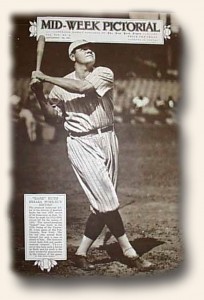 But with baseball it’s often the golden era that attracts the most attention, from when Babe Ruth, Lou Gehrig and other standouts from the 1920’s and 1930’s were making headlines. Just following Ruth’s standout career can create a formidable collection, from early mention of him in the majors (how about 1914?), his first Major League game appearance, his first home run, a report of him being sold to the Yankees, and then his stellar career as a home run record-setter. All were reported in newspapers.
And there was a host of notable ball players from a generation before, including Nap Lajoie, Branch Rickey, Henry Chadwick, Honus Wagner, Walter Johnson, Ty Cobb, Joe Jackson, & Christy Mathewson to name a few. In fact baseball had its own daily newspaper from the 1880’s titled the “Official Record” which chronicled nothing but baseball reports of the day.
Illustrations of baseball players are a special treat and add a graphic & displayable dimension to any collection. The popular illustrated newspaper “Harper’s Weekly” (and other well-know illustrated issues of the day) had many issues which featured half page or full page baseball prints, as well as a few doublepage centerfolds and front page prints which are particularly desirable.
There are some ancillary items which are intriguing, several found in the scientific-themed periodical “Scientific American”, which featured a new electric scoreboard dating back to the 1800’s, and a  novel invention of a “mechanical baseball pitcher”. There are baseball reports of Jim Thorpe, who, although was more famous for his Olympic and football prowess, was a notable baseball player as well. Newspapers with reports involving Jesse Owens are equally noteworthy. And just a focus on World Series games would result in a sizable collection, with the goal of owning the championship report for every World Series from 1903 to the present. The “Black Sox” scandal of 1919, which involved members of the Chicago White Sox team being accused of throwing the Series, made headline reports for the next two years as the case was investigated and brought to a painful conclusion.
Although the most collectible of sports, baseball is by no means the only. Football reports became common in the 1890’s and into the early 20th century. Again, “Harper’s Weekly” did much to provide a graphic account of the sport, with both illustrations and photos of players and action, showcasing the minimal amount of protection that was worn in comparison to what’s found in the game today.
Collecting by team makes for even more focused collection. Among the more popular would have to be the Yankees in baseball, and Notre Dame in collegiate football. But any team name for any sport can be  searched out of our website, whether it be collegiate football, the NFL, or nearly any other sport you can think of. Even something as obscure as pre-1800 boxing reports and ballooning can be found within collectible newspapers. Give it a try.
With golf it was Bobby Jones who gave the sport some prominence with his accomplishments which culminated in the “triple crown” victory, after which he left the sport to pursue a movie career. But again “Harper’s Weekly” put many golf themed prints in its pages, several done by noted artist A.B. Frost, which make for displayable items for any golf enthusiast.
Tennis was another sport which made the pages of “Harper’s Weekly” and those that are framed make great display items for any den. Track and field, bowling, bicycling, curling, fishing (with prints by A.B. Frost and Frederic Remington), hunting, sailing (including the America’s Cup), skiing, automobile racing, archery, and even surfing are a portion of a lengthy list of sporting events found in newspapers of the day.
Whatever sport you follow and whatever the era, the world of rare & early newspapers has much to offer. Add an historical dimension to your hobby. There is much from which to choose.
If you liked this post, you may also enjoy...
- Finding those unexpected historical nuggets.
- From the Vault – Finding those unexpected historical nuggets.
- They put it in print… Cheating in baseball predates the “Black Sox” scandal of 1919…
- The Traveler… NCAA champions breaks new barrier…
- Nothing Stops Football Season… 1929 edition…
Beyond the big, historic headline…
June 6, 2013 by TimHughes · Leave a Comment Email This Post
| Print This Post
Some of the better & more fascinating items found in old newspapers are not the most historic or significant, but rather the casual appearance of seemingly innocuous reports which excite collecting interest beyond the historic headline or dramatic presentation which are the more usual draw.
Much of what intrigues collectors can be lost within the body of reports, yet they tell a story of their own, such as the patriotic fervor of some colonist during the Revolutionary War. I recall an issue of the Edinburgh Evening Courant of June 17, 1776 reporting on American soldiers: “…Their uniform is a dark grey coarse linen frock, which covers the whole body…with the words, ‘Death or Liberty’  marked in large red letters on the right sleeve; and many of them are so enthusiastic as to have them marked with their own blood…“. This report is almost lost on page 3 yet its message is very telling of the spirit which caused the Americans to win the war against a world power despite insurmountable odds.
Some reports are fascinating by their bias. A Richmond newspaper’s (Daily Examiner for July 13, 1863) reporting on the Battle of Gettysburg notes: “…The Confederates did not gain a victory, neither did the enemy. He succeeded in defending himself & we failed in some portions of an attack…We killed more of the enemy than we lost; we took very many more prisoners than lost. The Confederate army did not leave the enemy until it had tried every link of his armour…” Another newspaper notes: “ ..Information, certainly authentic, is in the hands of the Government, which leaves no doubt of the safety & triumph of the noble army. General Lee was victorious in all the combats which have taken place. He has been engaged with the whole force of the United States & has broken its backbone…”, Perhaps the most extraordinary example of optimism appeared in the Richmond Examiner of July 25: “…The result was not a defeat, it was not a loss; it was only not a victory…It was little else than a disappointment of extraordinary expectations…”. What a precious statement as an example of Confederate optimism.
Other little gems were very prophetic in their reporting, particularly when read with an historic perspective. A Scottish newspaper from 1775 (EDINBURGH EVENING COURANT, October 7, 1775) sensed a lasting war with America as it reflected on the Battle of Bunker: “…The mischiefs which have already arisen & the greater calamities which are threatened from the unnatural war excited in America…It is impossible we can see, without the utmost alarm, preparations making for the prosecution of an expensive & ruinous war with our own Colonies…”. Some can be very recent, like the New York Times comment on rookie Mickey Mantle in 1951 (NYT, April 5, 1951): “…Mantle, who gives every promise of developing into an outstanding baseball star, was ordered to report to his draft board next Wednesday…” An editorial comment in the Army & Navy Journal of November 28, 1863, just after the Gettysburg Address opined: “…a dedicatory speech by President Lincoln, which we give in full, as decidedly the best feature of the occasion, as well as one of the most felicitous utterances of its author.” How true.
 Some were prophetic even when the reports were simply wrong, like the Illustrated American article of 1898 reporting on “A New Flying Machine That Flies”–five years before the Wright brothers–when it said: “…It is impossible to imagine without terror the day when these mechanical birds, these flying apparitions, will be able to rain upon armies, hostile towns and escalating parties most deadly and most destructive explosives…”. How true it would become.
There can be much to be found in newspapers beyond the headline. What a thrill it is to discover such hidden gems; reports that have escaped hundreds of years of history only to rediscovered with new-found relevance today. Such are just some of the joys of collecting early newspapers.
If you liked this post, you may also enjoy...