

Search
The Rare & Early Newspapers Hobby

Receive the Newsletter

Buy Historic Newspapers

20th century newspapers… revisited…
January 4, 2010 by GuyHeilenman · Leave a Comment
Over the past month, Timothy Hughes has explored his thoughts concerning what he believes to be the top ten newspapers from each of the pre-18th, 18th, 19th, and 20th centuries (see below), the most recent being the latter. Some of his thoughts concerning historic newspapers from the 1900’s were captured in the following video:
Collecting authentic rare and historic newspapers from the 1900’s can be exciting, rewarding and surprisingly affordable. From the Wright brothers inaugural flight in 1903…to today’s routine shuttle hops to the orbiting space station, no other period in history bore greater witness to man’s capacity for brilliance, innovation, depravity, strife, compassion and technological ingenuity…than the 20th Century. And with this ingenuity came remarkable visibility into the daily lives of our parents and grandparents, through newspapers.
Each single page from the vast 20th Century archive of Timothy Hughes Rare & Early Newspapers brings this amazing century to life: from World War I, Prohibition, the Great Depression, World War II, onward… newspapers of the 20th century bring it all to daily account, from those who lived it!
Of course, many original newspapers documenting this century’s “turning-points” command premium prices (Titanic, Crash of 29, P. Harbor, V-E/V-J Day, Dewey Def Truman, Oil Strike, San Franc Earthquake, etc.)… but most other original and historical 20th century newspapers remain available for much less than you might think. At Timothy Hughes Rare & Early Newspapers, you can still own original editions recounting key events of the gangster era of the 20’s and 30’s, World War II, the industrial revolution, Korean War, the automobile, the golden age of Hollywood and beyond.
We also offer obscure original editions that are perfect gifts to commemorate a friend or loved-one’s birthday, marriage, graduation, or other event. They’ll love reading about what else was in the news back on their special day!
Whether your interest is in World War I, World War II, the Korean War, the golden age of Hollywood, the gangster era, a view of how life looked on the day you were born, etc., original newspapers provide an excellent view of history in context. History is never more fascinating than when when it’s read from the day it was first reported. If you love history… you deserve to have it in your hands. Rare newspapers make this possible. Please enjoy.
Top ten newspapers: “20th century”…
Top ten newspapers: 19th century…
Top ten newspapers: 18th century…
Top ten newspapers: 16th and 17th centuries…
Top 10 lists…
December 3, 2009 by GuyHeilenman · Leave a Comment
Top 10 lists are always fun to consider. Their strength is in their ability to generate thought, reflection, and opinion. We all acknowledge that no two top ten lists are the same, and whereas going to experts in the field may add a certain level of credibility to a list, even an amateur/novice can bring food for thought to the discussion. Everyone has an opinion, and each and every opinion has some some value. In the end, the greatest benefit may well be in the journey traveled as we formulate and consider both our own views as well as the views of others.
It is with this in mind we plan to offer 4 top ten lists over the course of the next four Mondays. The focus will be on giving thought to the top ten most historic newspapers from each of the following eras: 17th century and earlier (12/7/2009), 18th century (12/14/2009), 19th century (12/21/2009), and 20th century & beyond (12/28/2009). In some cases we may choose a specific newspaper title (any date), realizing that having any issue of the title is of note. In other instances we may focus on a specific title and date of a newspaper – these being the “holy grails” of the hobby. Yet in other cases we’ll include a more general top ten entry, focusing on the event itself, acknowledging that finding any newspaper coverage of the event is noteworthy.
As we proceed through the month, we invite both reactions to our lists and the submission of your own “top tens”.
 In an effort to help kick-start your walk into the past, we invite you to enjoy a recent post which appeared on OnLineSchool.net titled, “100 Great Moments in American History You Can Catch on YouTube”, by Amber Johnson: (http://onlineschool.net/2009/11/18/100-great-moments-in-american-history-you-can-catch-on-youtube/).
When the story is as good as the newspaper…
November 30, 2009 by TimHughes · Leave a Comment
Over the last 33 years we have come across newspapers in many different ways. Typically they have been mundane: auction sales or library deaccessionings can be a bit sterile of “excitement’ or intrigue. Some obtained from private holdings often have an interesting story behind them as to how they came into the owner’s possession.
 One prized newspaper, now a part of our private collection, stands out as having a story behind it as interesting as the newspaper. It is the “Teheran Times” of November 5, 1979. Those who know their history will recall that November 4 was the day when Muslim students in Iran stormed the U.S. embassy in Teheran taking 66 American hostages.
It was on November 5 when long-time collector and friend Mort Bryer was returning from Europe and met a woman in the London airport who had just escaped from Iran. She was American but was married to an Iranian. Mort noted that she was visibly shaken as he spoke to her about what she went through. She felt she escaped death. Upon leaving she turned to Mort and said “would you like a souvenir” and gave him the newspaper. It was the “Teheran Times” with front page coverage of the embassy takeover, purchased by her in Teheran earlier that day as is typically done by travelers to pass the time on the plane.
Mort kept the newspaper since 1979 then gave it to me a dozen years later when I visited with him at his home. It remains in our private collection as a treasured piece, as much for the story of how it came to America as for the historic content in contains. It is currently on loan to the Newseum in Washington, D.C. where it is on display.
A look back at the past’s look into the future…
November 14, 2009 by GuyHeilenman · Leave a Comment
 One of the many pleasures of the Rare Newspaper collecting hobby is often quoted within our material:
“History is never more fascinating than when it’s read from the day it was first reported”. In fact, this look back is the impetus for the name of this blog, “History’s Newsstand”. However, occasionally these excursions can also provide us with a glimpse of just how far we’ve come in comparison to the expectations of those who lived in the past. It is such a look into the future, from exactly 100 years prior to today’s posting, that is available to us through an old newspaper section we found within our archives pulled from the Cleveland Leader, November 14, 1909. Please enjoy this look back at the past’s look into the future: The Cleveland Leader, 11/14/1909. The link will take you to a brief description of the article in question, with images of the entire article. Did we surpass their expectations? We’d love to know your thoughts.
Twenty years later: revisiting an international event…
November 5, 2009 by TimHughes · 1 Comment
Those of us who may reluctantly fall into the category of the “middle aged” can reflect upon a number of historic events and our thoughts on when they happened. For me John F. Kennedy’s assassination and its announcement when I was in elementary school was the first major historic event I lived through, and experiences relating to it are still etched in my mind.
 Some events seem impossible to be reaching notable anniversary status as they seem to have happened in the recent past. Man walking on the moon is one–it recently passed its 40th anniversary–and the Nixon/Watergate mess is now over 35 years in the past.
The fall of the Berlin Wall is now at it’s 20th anniversary. It seems impossible. I clearly recall the considerable news coverage of the event and the following actions that would lead to German unity less than one year after the walls came down. Back then I had a customer from Berlin and was able consummate a purchase of various Berlin newspapers covering those events, knowing that newspapers from where the news was being made would always be the best to have in a collection.
I recently dug out several titles and editions and share with you perhaps the best, being an “Extra” edition of “Der Tages Spiegel” (translates to “The Daily Mirror”) of November 10, 1989. The entire front page of this folio-size newspaper is taken up with a huge photo of people climbing onto, and celebrating, at the Berlin Wall with the Brandenburg Gate in the background. the banner headline–and the only text on the front page–translates: “The Night They Opened The Border In Berlin”. The remaining 3 pages of this four page newspaper are taken up with various articles and many photos of the celebration.
It was a joyous and memorable event for the world, and yes, it really was 20 years ago.
Some more prices, then and now…
October 6, 2009 by TimHughes · 1 Comment
Some months ago I reflected upon the value of newspapers we have sold years ago compared to more current values for the same title and event. Having published catalogs since 1977 it is interesting to pull out some of the early editions and see what we sold newspapers for many years ago.
Although we are careful to never recommend early or historic newspapers as investments, many have done well over the years. Not surprisingly, those which are most historic and less common have appreciated the best, while others—particularly titles which tend to come available from time to time—have appreciated but not at an exceptional pace. A few examples:
Within our catalogs created in 1980, twenty-nine years ago, are several entries which we still are able to keep in inventory such as “Harper’s Weekly” of July 22, 1876 with coverage of the Custer massacre. We sold it then for $32, and offer it today for $112. Using an inflation calculator the $32 would have inflated to $82.57 today. Also in “Harper’s Weekly” we sold Oct. 4, 1862 with a printing of the Emancipation Proclamation for $52 ($134.28 in today’s dollars), while today we sell it for $125. The same title for March 22, 1862 on the Monitor vs. the Merrimack sold then for $38 ($98.05 in today’s dollars) and for $113 today.
 Although “Harper’s Weekly” remains a very desirable title and has most certainly become more scarce as the years have gone by, I would not consider it a rare title. Consequently some prices have exceeded inflation while some have not.
But somewhat less common titles, and more significant events, have had more interesting price changes. In 1980 we sold the “New York Tribune” of April 4, 1865 which reported the fall of Richmond and had a huge eagle engraving on the front page, for $48 ($123.85 in today’s dollars). Not long ago we sold the same issue for $477. And in 1980 we sold the “Gazette of the United States” of March 2, 1791 on the creation of the Bank of the United States, for $19 ($49.03 in today’s dollars) and a more recent sale was for $775.
Of courses naivete (or perhaps stupidity) was the reason for many low prices years ago. Back in the “early years” I simply didn’t have the experience of knowing how desirable some events would be for collectors. If I bought an item for $20 and sold it for $30 I was happy.
Pricing has become much more sophisticated the last ten years or so, but I’m sure we still offer some interesting gems of history at relatively low prices which will take on much greater desirability as the years progress. Part of the fun of the hobby is seeking them out.
Wrappers and no wrappers…
October 1, 2009 by TimHughes · 1 Comment
 As regular customers have noticed, our only foray into the world of magazines is pretty much limited to 18th century titles. Magazine collecting of the 19th and 20th centuries is a world onto itself and there are many other dealers who make such items their specialty. I never felt a need to venture there.
Occasionally one will see our listings of magazines which note “with original wrappers” and perhaps wondered what this meant. Most magazines which were sold “on the street” came with a wrapper, or front and back cover, which was in addition to the typical title page of the magazine. Typically the wrapper would have a blue or blue-green tint. Some wrappers had a decorative embellishment and some had the table of contents. The reverse side of the front wrapper and both sides of the back wrapper commonly had advertisements, often for books or other publications offered by the printer.
But magazines with wrappers are rarely found. At least 98% of the 18th century magazines on the market today came from bound volumes. The volumes were created when libraries–whether personal or institutional–had an entire year’s edition of a title bound into book form for efficient storage & display on a bookcase. And many magazine publishers set aside extra copies of each month’s edition for binding and sale to patrons at the conclusion of each year. Since wrappers were considered superfluous they were almost always removed from the issues before being bound. The binding process also involved trimming the three exposed margins for a neater appearance. Consequently when loose issues became available to collectors centuries later through library deaccessionings, they were lacking the wrappers.

Those fortunate enough to find a magazine which survived the last several centuries without being bound may experience the great pleasure of having a magazine “as issued”, or with the wrappers intact and without the margins trimmed. Such find are quite rare.
I have discovered many over the course of the last 33 years, and have even had the pleasure to find an occasional bound volume of an 18th century title with the wrappers bound in, either with each of the monthly issues or grouped collectively at the back of the volume. Such wrappers would have trimmed margins, which is less then ideal, but wrappers with trimmed margins are far better than no wrappers at all. And perhaps in just one or two instances I encountered a volume with wrappers bound in and margins untrimmed.
In any case, magazines with wrappers intact are the goal for serious collectors of 18th century magazines. Not surprisingly such issues command a premium price, but their rarity also creates a high level of desirability.
Before they became famous…or “infamous”…
September 19, 2009 by TimHughes · 2 Comments
 A special desire for many collectors is to find a newspaper mentioning a name which would not become famous for many years, such as the “Lincoln & Herndon” attorney advertisements from Springfield, Illinois in 1857, or a newspaper ad noting John Wilkes Booth appearing in a play in 1863.
The item shown in the photo fits this category, appearing on the front page of the “Detroit Free Press” in its November 1, 1959 newspaper. If a Kennedy assassination plot existed, the plans may have begun as early as…
What’s the best newspaper to have?
August 27, 2009 by TimHughes · 2 Comments
Most collectors of historic newspapers would agree that the best newspaper to have for an historic event is the city where it happened. Among the more notable would be the Boston Gazette reporting the Boston Massacre, the Honolulu issue on the bombing of Pearl Harbor, the Dallas newspapers on JFK’s assassination, and a Chicago newspaper covering the St. Valentine’s Day massacre. Stock market or finance related events are best in the Wall Street Journal, and when events happened in small towns which had no newspapers, the closest major city might be the next best thing.
But some events can’t be had—or can very rarely be had—from the city where “it” happened. What are the best issue in those situations? What’s the best issue for man landing on the moon? Or the atomic bomb dropping on Hiroshima & Nagasaki? Or the first manned flight around the earth? Or the discovery of the North Pole? Or Edison’s invention of the phonograph? What would be the best newspaper for the sinking of the Titanic?
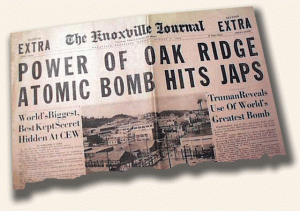 There are many answers; perhaps as many as there are collectors. But I’ll offer a few thoughts. Actually what brought all of this to mind was an issue I recently wrote up for a future catalog. It announced the dropping of the atomic bomb on Hiroshima and was from Knoxville, Tennessee. The headline reads: “Power Of Oak Ridge Atomic Bomb Hits Japs”. Keeping in mind that Oak Ridge, Tenn., the home of the Manhattan Project which developed the bomb, is less than 20 miles from Knoxville, it is not surprising that they localized the headline with mention of the role Oak Ridge played. I suspect no other newspaper in the country mentioned Oak Ridge in their headline on the atomic bomb drop. Outside of finding a Japanese newspaper from the day after, I suspect this Knoxville newspaper could be the best issue on this event.
Any space flight issue might best be from the Cape Canaveral area. Or perhaps the hometown of one of the astronauts involved. We offer a Wapakoneta, Ohio, newspaper on man walking on the moon as it’s Neil Armstrong’s hometown, and their headline is localized by: “NEIL STEPS ON THE MOON” while most newspapers reported “MAN WALKS ON THE MOON”.
The graphic appeal of the front page is a major factor as well and in the eye of many is always the deciding factor in determining the “best” for that event. We price Titanic issues almost entirely on the “wow” effect of the front page, as the larger the headline and more dramatic the look the better, regardless of where the newspaper was printed. This holds true for many 20th century events, such as D-Day, V-E Day, V-J Day and and any other military event. Some might argue that the “Stars And Stripes” would be the best paper for a military event, or perhaps newspaper from Washington D.C., home of the Pentagon.
We’d like to hear what you think on the best issues for historic events which can’t be found from the city involved. I’m sure your thoughts will spark other collectors to refine their holdings with better or more appropriate newspapers for notable events. Let us here from you!
Not quite a portable hairdryer…
August 15, 2009 by TimHughes · 1 Comment
 So how would you like to pack this hairdryer in the suitcase for a weekend trip? It might have been a great devise in 1900 but I’m sure it didn’t travel well. This ad appeared in the “Ladies’ Home Journal” issue of August, 1900.