
Search
The Rare & Early Newspapers Hobby

Receive the Newsletter

Buy Historic Newspapers

Thankfully no arboreal collaborators…
May 22, 2010 by TimHughes · 1 Comment
The following brief item appeared in “The Daily Picayune” of March 4, 1845. I’m not sure what the last sentence is meant to imply but it adds a comical note for the modern reader:
Featured websites – The Liberator Files…
April 22, 2010 by GuyHeilenman · Leave a Comment
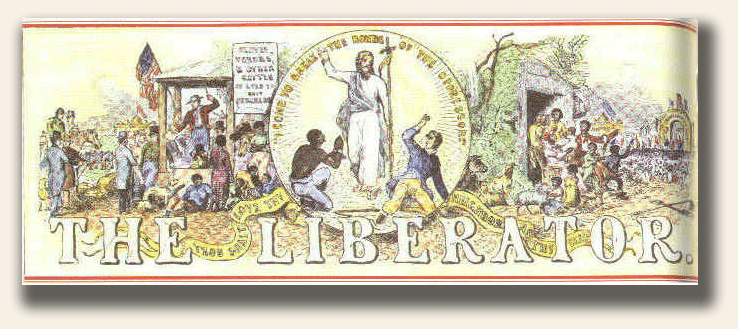 Within the past few months, three members of Timothy Hughes Rare & Early Newspapers each recommended the same website, The Liberator Files, as a great resource for exploring this well-known abolitionist title from the early/mid 1800’s. This Boston paper was published by William Lloyd Garrison, and provides wonderful context for this formative period in U.S. history – from the early 1830’s through the end of the Civil War. The Liberator Files, developed and maintained by Horace Seldon, includes a wealth of abolitionist related commentary in conjunction with a host of scanned Liberator images from William Lloyd Garrison’s own collection, which are currently held at the Boston Public Library. Thanks Horace, for your significant contribution to the world of rare & historic newspapers. Please enjoy!
Feel free to share with the rare newspapers community other historical and/or rare newspaper oriented websites you’ve found to be of use.
First newspapers in Louisiana…
April 19, 2010 by TimHughes · Leave a Comment
 Being a French settlement from the early 1700’s, it would be of no surprise that the first newspaper in present-day Louisiana was French: “Moniteur de la Louisiane” which began in New Orleans on March 3, 1794. Three years later it became the official mouthpiece of the government, and continued to print until the publisher’s death in July, 1814.
Louisiana’s first newspaper done by a publisher of English or American extraction was the “Union: New Orleans Advertiser and Price Current” by James Lyon, of Vermont, which began on Dec. 13, 1803. Just one day later Louisiana’s third newspaper began–a French publication–“Le Telegraphe, et le Commercial Advertiser“. Both these latter two endeavors began just a few months after the Louisiana Purchase. Actually “Le Telegraphe” began as a French publication but later changed to both French and English, a tradition which held true for many Louisiana newspapers at least through the Civil War.
Food for thought… a little humble pie…
April 10, 2010 by GuyHeilenman · Leave a Comment
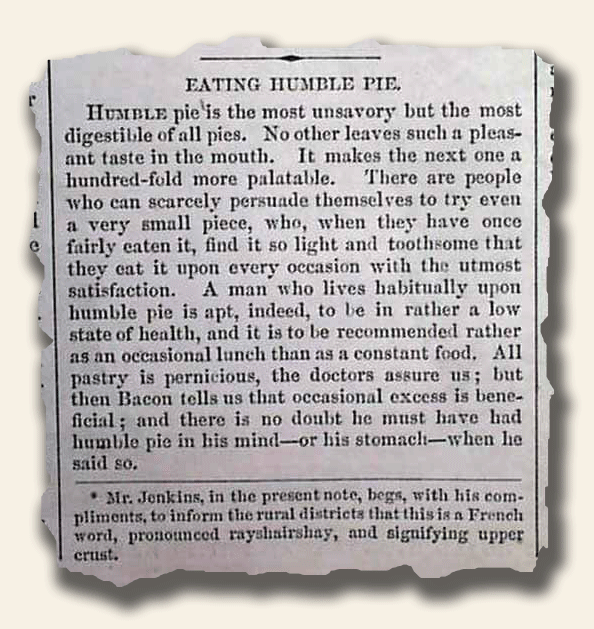
While looking for content on the death of General William Walker in an October 6, 1860 issue of Harper’s Weekly, I came across an interesting morsel I thought everyone might enjoy. Just a little something to chew on (sorry):
James Gordon Bennett and his New York Herald…
April 8, 2010 by TimHughes · Leave a Comment
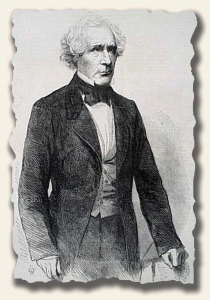
A book I am currently reading, “An Empire of Wealth” by John Steele Gordon, has a page or two concerning newspapers, mostly focused on the innovations of James Gordon Bennett (image to the left is from the Harper’s Weekly dated July 10, 1858) and his “New York Herald“, offering some insights new to me and likely new to you. It is a bit lengthy but has some interesting information I felt was worthy of sharing:
 “The biggest difference between the newspapers of the pre-industrial world and those of today was politics. Most general-interest newspapers were the instruments of political factions, praising one party and excoriating all others. They were, in reality, little more than an editorial page wrapped in some highly tendentious news.
A Scots immigrant to New York, James Gordon Bennett, changed all that. Born in 1795 into one of Scotland’s few Catholic families, Bennett was always a man apart, which can be an asset for a journalist. He was also remarkably ugly, with severely crossed eyes. When a young journalist interviewed him in the 1850’s at his office across from New York’s City Hall, he reported that Bennett ‘looked at me with one eye, while he looked out at the City Hall with the other.’
Well educated in Aberdeen, he wrote his first piece of journalism about the Battle of Waterloo, when he was twenty, and four years later, sensing greater opportunity, immigrated to the United States. He worked at a series of newspapers from Boston to Charleston before settling in New York where, three times, he tried to found a newspaper that would expound Jacksonian principles. Each attempt was a failure.
Steam, however, was changing the newspaper business as it was changing everything else by the 1830’s. The new rotary presses, powered by steam, could turn out thousands of copies of a newspaper a night and at a much lower price than had been possible before. Bennett decided to try something new. On May 6, 1835, with $500 in capital, an office in a dank cellar, and himself as the only employee, Bennett began publishing the “New York Herald“.
Bennett made the Herald nonpartisan in its news articles, sought always to be the first with the news, and sold it to a mass audience by having it hawked on the streets at a penny a copy by the armies of newsboys that would quickly become a feature of the American urban scene for more than a hundred years. None of these ideas was original with Bennett. But it was he who put them all together for the first time. He also introduced a dazzling array of other journalistic innovations. He was the first to print a weather report and to cover sports regularly. He was the first to cover business news and stock prices in a general-interest newspaper. And while ‘respectable’ papers weren’t supposed to notice such things, when a beautiful prostitute was murdered in one of New York’s more fashionable brothels, Bennett played the story for all it was worth.
The “Herald’s” circulation soared, and other papers were forced to follow suit as the city, and then the country, became transfixed with the story. Within a few years the ‘Herald” was among the city’s most successful papers. Bennett traveled to Europe, where he signed up correspondents in London, Rome and Paris to supply the “Herald” with exclusive copy, the world’s first foreign correspondents. He fought Congress to establish the principle that out-of-town newspapers had as much right to the congressional press galleries as the local papers, the beginning of the Washington press corps. He even coined the use of the world ‘leak’, to refer to the stores slipped to reporters by politicians for their own purposes.
As the telegraph began to spread across the country, Bennett exploited it to the hilt. When the Mexican Was broke out, only two years after Morse’s successful demonstration, Bennett organized a consortium of newspapers to fund a pony express from New Orleans to Charleston, which was connected to New York by telegraph. The reports the New York papers published were often days ahead of the official reports arriving in Washington.
By the time of the Civil War the “Herald” was, by far, the largest and most influential newspaper in the country, and all other major papers had followed its model, profoundly transforming the newspaper business. Its daily circulation during the war reached as high as 400,000, many times the total circulation of all American newspaper combined fifty years earlier.”
The first newspapers in Kansas…
March 30, 2010 by TimHughes · Leave a Comment
The first permanent settlement in Kansas was made at Fort Leavenworth in 1827, but until 1854 when the Kansas-Nebraska Act was passed by congress the region remained a part of the somewhat indefinitely bounded Indian Territory.
Early in 1834, missionary Jotham Meeker set up his printing press–the first press to be used west of the Missouri River–at the Shawnee Baptist Mission in present Johnson County. That year he published hymns, religious tracts, and other materials that were the first items printed in Kansas.
 On February 24, 1835, Meeker printed at the Shawnee Mission the first number of the “Shawnee Sun” (Siwinowe Kesibwi), the first periodical publication in Kansas, and the first printed entirely in a Native American language. The paper was issued at irregular intervals from 1835 to as late as 1844, probably in limited editions of 150 or 100 copies. Measuring about 6 3/4 inches by 10 3/4 inches, the paper had two 8 1/2-inch columns of text per page.
The “Shawnee Sun” circulated among the Indians at and near the mission settlement. Today only one copy of one issue is known to have survived–the issue for November 1841, now in the library of the University of Missouri at Kansas City.
The “Kansas Weekly Herald” was established at Leavenworth on Sept. 15, 1854 by William Osborn and William Adams. It was a truly pioneer enterprise as is evidenced by the fact that the town site was occupied only by four temporary tents. The editor in his first number noted: “Our editorials have been written and our proof corrected while sitting on the ground with a big shingle for a table.”
Another newspaper was begun in Kickapoo, Kansas, in 1854 titled the “Pioneer“, and a year later the first newspaper at Topeka was established, the “Kansas Freeman“.
The first newspapers in Iowa…
March 22, 2010 by TimHughes · 1 Comment
The state of Iowa had various “owners” over the last 300+ years. It became a French possession in 1682, in 1762 was ceded to Spain, in 1800 it was returned to France, who in 1803 passed ownership to the United States under the terms of the Louisiana Purchase.
 In 1804-5 as part of the District of Louisiana it was under the government of the Indiana Territory. During the next seven years it was in the Missouri Territory, and from 1821-34 it was a part of the unorganized territory of the United States. From 1834-6 it was part of the Michigan Territory, and from 1836-8 a part of the Wisconsin Territory. In 1838 the Wisconsin Territory was divided & the western portion was named the Iowa Territory, which in 1846 was admitted as a state.
The first printing in the district was in 1836 when John King, who moved from Ohio to Dubuque, believed the town should have a newspaper and on May 11, 1836 began printing the “Visitor“, the first newspaper in Iowa. A year later the name changed to the “Iowa News“, and 4 years later to the “Miners’ Express“. Iowa’s second newspaper was the “Western Adventurer and Herald of the Upper Mississippi” (not sure how they fit that in the masthead) begun by Dr. Isaac Galland on June 28, 1837 in Montrose. It lasted for just a few months when the equipment was sold to James Edwards who took it to Fort Madison & on March 24, 1838 the first issue of the Fort Madison “Patriot” was published.
Indiana’s first newspapers…
March 15, 2010 by TimHughes · Leave a Comment
Indiana was the first state to be named after America’s original inhabitants, meaning “land of Indians”. When the Indiana Territory was created in 1800 it encompassed all of the present states of Illinois & Wisconsin, nearly all of Indiana, and parts of Ohio, Michigan, and Minnesota.
 In Vincennes in 1804 Elihu Stout, a Virginian, printed the first number of the “Indiana Gazette“, the first newspaper in Indiana. It continued until 1806 when the establishment was destroyed by fire. Stout purchased a new printing outfit and on July 4, 1807 he resumed publication under the new name of the “Western Sun“.
It was the custom, and a natural one, for printers, in seeking new locations, to choose towns with promise of a prosperous future. In the undeveloped western wilderness such towns were believe to be only those located on navigable rivers. Such towns as Madison saw the start of the “Western Eagle” in 1813, and tow town of Corydon had its “Indiana Herald” begin in 1816; Vevay had the “Indiana Register” by 1816, and Brookville had the “Plain-Dealer” also by 1816.
First newspapers in Illinois…
March 8, 2010 by TimHughes · 1 Comment
Kaskaskia, a thriving town on the Mississippi River and the territory’s first capital, was the place of the first printing done in Illinois while it was still a territory.  Mathew Duncan, a printer who had moved from Kentucky, began publication of Illinois’ first newspaper, the “Illinois Herald” in 1814. The name would change to the “Western Intelligencer” in 1816, and again to “Illinois Intelligencer” in 1818. Two years later it would be moved to Vandalia which had become the capital of the state.
The second newspaper in Illinois was the “Illinois Emigrant” which began on June 13, 1818 at Sawneetown. A year later the title was changed to the “Illinois Gazette”.
The first newspaper in Chicago was a weekly paper titled the “Chicago Democrat“, which began on Nov. 26, 1833.
First newspaper in Idaho…
March 1, 2010 by TimHughes · Leave a Comment
Idaho’s name was adapted from the Shoshone Indian call, “Ee-dah-how!”. Its literal translation is “Look! The sun is coming down the mountain.” It was a part of the “Oregon Country” claimed by Spain until 1819 and by Russia until 1824. Great Britain and the United States held it jointly until Britain relinquished her claim to the United States by treaty in 1846.
 In 1839 the American Board of Foreign Missions brought back from Hawaii the printing outfit that had been sent there in 1821 (see our post for Feb. 22: “Hawaii’s first newspapers…”) and transferred it to Idaho. In 1862 in Lewiston, named after explorer Meriwether Lewis, Idaho’s first newspaper, the “Golden Age”, was established by A. S. Gould who hasd previous printing exerience in California and Oregon. The “Golden Age” was discontinued in 1865 when the printing press was moved to Leesburg. In 1867 the “Mining News” was established but the printer was able to keep it going for only eight months.
The first newspaper in southern Idaho (3nd in the territory), the “Boise News” was started on Sept. 29, 1863 at Idaho City, and the fourth newspaper, the “Idaho Tri-Weekly Statesman” began printing on July 26, 1864 in Boise.