

Search
The Rare & Early Newspapers Hobby

Receive the Newsletter

Buy Historic Newspapers

Don’t believe everything you read…
April 21, 2016 by TimHughes · Leave a Comment
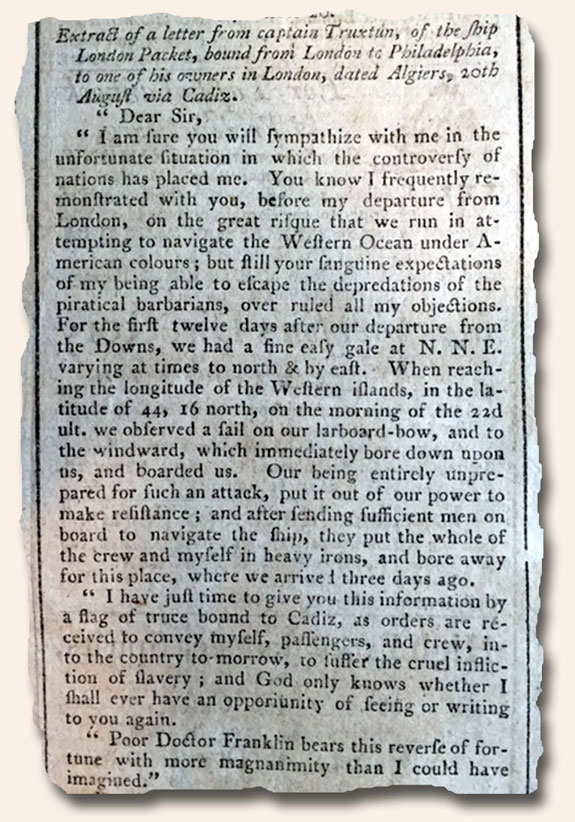 The Pennsylvania Packet issue of November 22, 1785 contains a curious report which puzzled me, for although admitting my knowledge of American history is far from where it should be, I do not recall reading of Ben Franklin being captured by Barbary pirates upon his return from France as Ambassador.
Page 2 of this newspaper has a letter from Captain Thomas Truxtun, later of Constellation fame, dated August 20, 1785 from Algiers–with Ben Franklin as a passenger no less–mentions an encounter with Barbary pirates: “…Our being entirely unprepared for such an attack, put it out of our power to make resistance, & after sending sufficient men on board to navigate the ship they put the whole of the crew and myself in heavy irons & bore away for this place…to suffer the cruel infliction of slavery, and God only know whether I shall ever have an opportunity of seeing or writing to you again. Poor Doctor Franklin bears this reverse of fortune with more magnanimity than I could have imagined.”
Ben Franklin taken away in irons? Really??
I turned to our friend/long-term customer/naval expert George Emery for some explanation of this report. He relates that in Eugene Ferguson’s biography of Trustun, “Truxtun of the Constellation” (1956) he mentions this rumor while explaining Truxtun’s decision to arm the London Packet (to be renamed the Canton) for a forthcoming voyage to China. And the source of this rumor was this very newspaper: the Pa. Packet of Nov. 22, 1785. Apparently some enterprising reporter, “confusing ” Truxtun’s reasoning for arming the Canton to rewrite the “future” as a scary & perilous event of the past, all–perhaps–to sell more copies of the newspaper. Or perhaps Truxtun himself was responsible for this letter’s presence in the Pennsylvania Packet to bolster support for arming American merchant vessels then sailing to Europe, and particularly the Mediterranean.
Ferguson goes on to mention in his book: “…while he was yet bringing Franklin home during the last voyage, it was rumored in London that Captain Truxtun’s ship had been captured by the Barbary corsairs and that all aboard, including the great Franklin, were consigned to slavery in Algiers…”.
The capture never happened.
The Traveler… finally the end…
April 4, 2016 by The Traveler · Leave a Comment
 Today I traveled to New York City by the way of The World (NY) dated April 3, 1866. The “Proclamation by the President of the United States” was presented on the front page of the issue. “…Therefore, I, Andrew Johnson, President of the United States, do hereby proclaim and declare that the insurrection which heretofore existed in the States of Georgia, South Carolina, North Carolina, Virginia, Tennessee, Alabama, Louisiana, Arkansas, Mississippi, and Florida is at an end, and henceforth to be so regarded. In testimony whereof I have hereunto set my hand and cause the seal of the United States to be affixed…”. This marked the official end to the American Civil War.
~The Traveler
They put it in print… A life-preserving mattress?
March 28, 2016 by TimHughes · Leave a Comment
It is always interesting to peruse back issues of “Scientific American” as some inventions of the 1800’s were more comical than practical. Note the “Life-Preserving Mattress” invented by a man from Springfield Massachusetts, as reported in the March 6, 1875 issue.
Publius Lentulus’ 1st century description of Jesus Christ…
March 24, 2016 by GuyHeilenman · Leave a Comment
The February 3, 1787 issue of The Pennsylvania Packet and Daily Advertiser contains an 18th century translation of a letter self-described as being from Plubius Lutulus’ [Publius Lentulus’] to Caesar Tiberius (reg. 14-37 AD) which supposedly provides a contemporaneous description of Jesus Christ. Historians have spent countless hours trying to discover whether or not the letter is authentic. After more than a century of research, since there does not appear to be record of a Lentulus serving as Governor of Judea (which this letter suggests), most have come down on the side of it not being legitimate. Sadly, a 15 minute dig into the Bible could have saved them a considerable amount of energy.
The letter (see below) indicates the appearance of Jesus, with his long flowing hair, was quite a sight to behold. However, 1 Corinthians 11:14 makes it clear his hair could not have been long, and Isaiah 53:2 states: “He had no form or majesty that we should look at Him, and no beauty that we should desire Him.” End of discussion. Case closed.
Thankfully, whether or not Jesus is God’s Son… the Messiah… the deliverer of all who might believe, according to the Bible, is not dependent on such works of man. He either is who He says HE IS, or he is not who he said he was – and the proof will be in the pudding. Still, the letter does make for interesting reading. Happy Easter.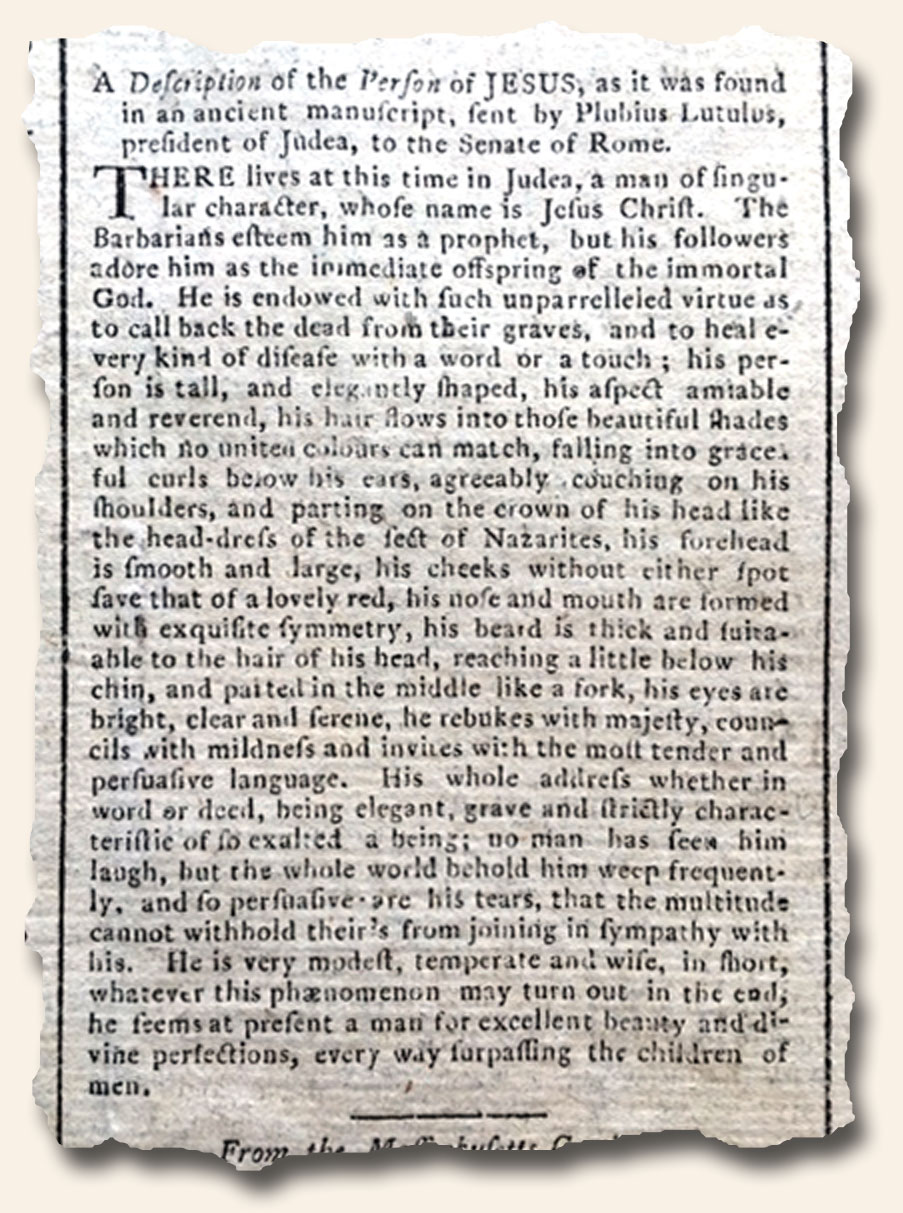
Before there was the Chunnel…
February 22, 2016 by TimHughes · Leave a Comment
 For over twenty years now the English Channel Tunnel, of the “Chunnel” has carried passengers, by train, between England and France. Although being the first such connection to come to fruition, it was not the first proposed.
Such a connection between England and the continent has been proposed since 1802 but none, obviously came to reality. The November 30, 1889 issue of “Scientific American“ reports on a bridge that was conceived as a viable effort, detailed in the article: “The Proposed Bridge Over The English Channel” and illustrated with a caption: “The Proposed Railway Bridge Between England and France.”
It is difficult to imagine the success of an elevated railway stretching over 30 miles, which might explain why this concept never became reality, but in hindsight it is interesting to perceive the vision of engineers over 100 years ago.
Newspaper Museums abound… Looking for input…
January 28, 2016 by GuyHeilenman · Leave a Comment
 Newspapers have been one of the main means of community communication for several centuries. While many newspaper publishers have closed their doors as on-line access has increased, one would still be hard-pressed to find a city without its own printed newspaper. However, as the number of newspaper publishers gradually decrease, the number of newspaper museums appear to be on the rise. Current news may be best viewed within a moment of its occurrence via the internet, news of the past (history) seems to be best viewed first-hand – either by reading a historic newspaper first-hand, or by visiting one of the hundreds of newspaper and print-shop museums. Collecting rare newspapers satisfies the first, but what about the second? The Newseum and the American Antiquarian Society (think Isaiah Thomas) are great place to start, but what about museums with a more local or historical bent? A favorite for some is the relatively new Edes & Gill Print Shop attached to The Old North Church in Boston, but what about others? If you have visited a newspaper museum and/or historic print shop which you found interesting, please share by commenting with the name, location, and a brief mention of what you enjoyed.
America stunned by Soviet success in the space race…
January 25, 2016 by TimHughes · Leave a Comment
 It can be difficult to appreciate how stunning the event of the Soviet Union’s success with the Sputnik launch was given the phenomenal success of American space exploration in the 1960’s, but at the time this headline in the “Los Angeles Times” issue of October 5, 1957: “RUSS SATELLITE CIRCLING EARTH” was terrifying for many (see first few moments of October Sky).
The Soviet Union had taken the lead in what became known as the “space race”, with fears of what havoc Soviet domination of the heavens could mean to the United States. Early American attempts to reach outer space were plagued with failures before a string of successes would cause America to be the first to put man on the moon. Today there are joint American-Russian space efforts with the Space Station, a situation which could not have been imagined in 1957.
One of the icons of Hollywood… Marilyn Monroe…
January 11, 2016 by TimHughes · Leave a Comment
 Death reports have always been of prime interest among newspapers collectors. Not that morbidity is an issue for those of us who collect, but rather newspapers of the day remain the single best document to remember the heroes, villains, famous, and infamous of the past.
Icons of Hollywood are a particular focus among collectors and the death of Marilyn Monroe remains among the most desired newspaper reports of any from the world of television and movies.
We share today the report of the death of Marilyn Monroe in the “Los Angeles Times” (August 6, 1962), the city where she died. It is difficult to image that she would have been 89 years old today had she lived.
The start of a new year…
January 4, 2016 by GuyHeilenman · Leave a Comment
 The start of each new year typically brings a sense of promise – a certain newness of hope and expectation which drives us to peel off bad habits and at least seek to develop new ones. Of course this new refreshed outlook is often quickly squashed once we grab the morning paper and allow the events all around us to cast a wet blanket on our hopes and dreams for the new year. Perhaps a bit jaded – but all too true.
Of course, it doesn’t need to be this way. I’m convinced part of the antidote is for us to practice counting our blessings throughout the year – day-in and day-out. Sound like a plan? For those of us who are “all in”, let’s put our resolution for 2016 to the test and look through the news reports of the first week of January through time and see if we can come out the other end with a sense that life is truly good – after all, we could be living in the past when technology, medicine, the average standard of living, and life-expectancy were not what they are today: 1st Week of January thru Time
How things have changed…
December 28, 2015 by TimHughes · Leave a Comment
 In today’s society when Sunday has become no different than any other day of the week in terms of work, play, and daily behavior, it can be difficult to realize that “blue laws” once existed which prevented–legally–many activities from happening on Sunday.
This article from the October 15, 1883 issue of the “Norristown Register“, Pennsylvania, reports a particularly harsh enforcement of the blue laws near New Haven, Connecticut, noting in part: “A score of people …were arrested on the Old Foxon Road….Sabbath breaking was their crime, and the form of their offending was traveling on the Sabbath…” with details of the law and how the offenders were nabbed, including: “…Many of the people out for a ride stopped under the trees & gathered up the scattered nuts. Each person that stopped was arrested. the nuts lay as a trap…” (see images).