
Search
The Rare & Early Newspapers Hobby

Receive the Newsletter

Buy Historic Newspapers

Earliest Lincoln letter published in a newspaper?
December 14, 2020 by TimHughes · Leave a Comment
Finding the earliest mention of notable people in period newspapers, long before they would become national figures, is a quest of many. Such nuggets–when found–can become treasured pieces for any collection.
We recently discovered what, by our research, is the earliest letter signed by Lincoln to appear in a newspaper. The “New York Weekly Tribune” of July 8, 1848 printed a letter signed A. Lincoln from when he was a representative from Illinois in the national legislature (see photos).In our 44 years of experience this is the earliest we have encountered. One would think letters may have appeared in his local Springfield, Illinois newspaper but lacking the holdings to do such research we can only speculate.
Are any collectors out there aware of an earlier published letter signed by Lincoln? Let the collecting world know!

My Collecting Story… G.F. in Lexington, Virginia…
December 3, 2020 by GuyHeilenman · Leave a Comment

Continued below in the next installment in our series in which we post the “stories” graciously submitted by our collecting friends during the pandemic which began in 2020.
I love US history and as soon as I earned a permanent salary, I started visiting historical sites and eventually turned to collecting items of interest, particularly US Civil War. I collected many of my Harper’s from numerous civil war shows; my favorite is a Richmond Examiner, 23 June 1864 (long before I knew about the RareNewspapers.com website); it talked of Sherman’s campaign and how it would end like Napoleon’s in Russia! Great reading. Years went by and I am a docent at the Stonewall Jackson House in Lexington, VA (come by when this contagion is past and we’re open again). I prepared a presentation on Jackson in the Mexican War; I came across your site and ordered a “National Intelligencer,” 16 Nov 1847 and “The Union,” also dated 1847. Future Civil War luminaries their exploits abound. Finally, and not about the Civil War, my wife loves to explore Scottish roots and your site had several papers regarding the Scottish rebellion of 1746, referencing the battle of Culloden – yep, I bought it as a Christmas gift for her. Your site piques my curiosity and I’ll remain a customer!
As additional “stories” are posted they will be available at: MY COLLECTING STORY. We did this many years ago as well – and their posts are also included.
You know of Molly Pitcher. Do you know of Betsy Doyle?
November 5, 2020 by TimHughes · Leave a Comment
On November 22, 1812 the British, at Fort George, were cannonading the Americans at Fort Niagara. George McFeeley was the American commander and several days later made his official report to Brigadier General Smyth.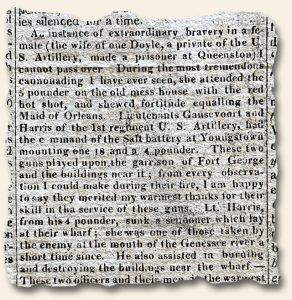 Within the report McFeeley noted: “…An instance of extraordinary bravery in a female (the wife of one Doyle, a private in the United States Artillery, made a prisoner at Queenston,) I cannot pass over. During the most tremendous cannonading I have ever seen, she attended the six-pounder on the mess-house with red hot shot, and showed fortitude equal to the Maid of Orleans…”.
In an act of female heroism during combat, much like the work of Molly Pitcher (although considered folklore by many historians), Betsy Doyle played a notable role. A mother of four whose husband was captured at the Battle of Queenston & held as a prisoner by the British, after some gunners were wounded Betsy stepped in to help. The Americans were loading “red hot shot” into their guns to fire at Fort George. Betsy helped bring the shot from the fireplaces downstairs to the guns.
The December 16, 1812 issue of the “Boston Patriot” is one of few newspapers which reported this event.
Acts of female involvement in combat are rarely reported. Here is a nice one.
First women’s brokerage firm on Wall Street opens its doors…
October 15, 2020 by TimHughes · Leave a Comment
 In the 19th century world of Wall Street investment firms it was a male-dominated world. So it was with considerable “excitement” that two sisters–the notable Victoria Woodhull and Tennessee (Tennie) Claflin–would have the audacity to open an investment firm for women.
The New York Times issue of February 6, 1870 reported the event.
Under the headlines: “WALL STREET AROUSED” “The Female Brokers–The First Day’s Operations–Manner of Their Reception by the ‘Street’–A Word or Two Concerning the Adventurers” is the report of Victoria Woodhull (nee Claflin) and Tennessee (Tennie) Claflin being the first woman to open a brokerage firm on Wall Street.
As the website “Bumped” notes, Cornelius Vanderbilt helped Victoria and Tennessee with the finances needed for them to open Woodhull, Claflin, & Co., the first for-women-by-women brokerage firm in the United States.
On February 5, 1870, Victoria and Tennessee, then 31 and 24, officially opened the doors of Woodhull, Claflin, & Co. for business. Despite a sign stating, “Gentlemen will state their business and then retire at once,” most of the estimated four thousand visitors on that first day were men, presumably shocked by the women now working in their midst. Opening a successful brokerage wasn’t the whole plan. As Victoria later said, “We went unto Wall Street, not particularly because I wanted to be a broker…but because I wanted to plant the flag of women’s rebellion in the center of the continent.”
And in some ways, that’s exactly what she did. Later in 1870 the sisters used the profits from the brokerage firm to launch Woodhull & Claflin’s Weekly, one of the country’s first publications published by women.
Woodhull, Claflin, & Co. proved to be a huge success. According to some versions of the story, Victoria and Tennessee supposedly made $700,000 in the first six weeks (that’s more than $13 million today).
Harper’s Monthly & The Self-Made Man – Still Learning…
October 12, 2020 by Stephanie Williams · Leave a Comment
By natural inclination, I spend a fair amount of my spare time delving into the “women’s publications” within the Rare & Early Newspapers collection. Consequently, the title of the Editor’s Table of an 19th century issue of Harper’s New Monthly dragged me in, and in the spirit of fair play I decided to dissect and disseminate the contents, using the writer’s three questions.
Who is the Self-Made Man? In the author’s view, this is not the man who achieved much because of education, as education is an outside influence that detracts credit from the man. However, a self-made man can be educated. The one who is not educated, but rises to success in spite of the lack, is not necessarily self-made, as success does not equal the morality required in a self-made man.
What is the Self-Made Man? Again, this is not the one who commits good deeds, although a self-made man will be characterized by them. “The difference between the two characters is a moral one. It springs from the presence or absence of the humanitarian spirit. It is all the difference between the pure love of truth and the love of opinion.”
What is his true position for good or for evil among the powers of the age? Finally, all the negatives are set aside and the author clearly promotes a man who is driven to find truth — not in new discoveries or insights, but in the wisdom of the ages that has been tested by time, and continues to be trustworthy. Ultimately, the author highly esteems the members of the Protestant Reformation, and the things they accomplished. “It was an age where old truths were brought to light and re-established as old truths. It was a most serious age; it was a modest age; and in all these respects, especially in the latter, it differed widely from our own.”
The final condemnation of the modern era, male and female, is contained in the author’s closing remarks:
All the writings of every kind during that remarkable period, and, we may even say, the century that followed it, would not present so much of this frothy self-laudation, as may be heard in one Hope Chapel meeting of ‘strong-minded women’ and ‘self made’ men.
My collecting story… P.S. from City of Industry, CA…
October 8, 2020 by GuyHeilenman · Leave a Comment
Below we continue our series in which we post the “stories” graciously submitted by our collecting friends during the pandemic of 2020.
The Workman and Temple Family Homestead Museum in the City of Industry, California, east of Los Angeles, interprets the region’s history from 1830 to 1930 and, among the approximately 30,000 artifacts in the artifact collection are hundreds of historic newspapers, most dating to the 1870s, a key time period in our interpretation. Among the more unusual of the papers is the first of twelve issues of the “Willow Dale Press,” an amateur paper published by 13-year old Florence Carter and her 10-year brother, Arthur, children of rancher and developer Nathaniel Carter. The family migrated in 1874 from Lowell, Massachusetts to the San Gabriel Valley east of Los Angeles for a reason many others did: health. Nathaniel Carter suffered from serious pulmonary issues and the temperate climate of the valley proved to be a balm for his ailments. The Carters, who bought their 17-acre spread from George Stoneman, a Union Army general during the Civil War and future California governor, and christened it “Willow Dale.” Widely known for its picturesque location, fine home, and its landscaping, Willow Dale was photographed by Carleton Watkins, famed for his images of Yosemite. The site is in today’s city of San Marino, very near the Huntington Library, Art Galleries and Botanical Gardens.
The Carter siblings were provided with a small foot-treadle operated press with a self-inking action made in Boston and which produced a dual-column sheet measuring 6 inches by 9 inches. The duo’s sheet was among many so-called “juvenile papers” published throughout the nation as literacy rates skyrocketed. This first issue, for January 1879, appeared late the following month, as one of the major dailies in Los Angeles, the Herald, noted in its Christmas 1878 edition that “we are indebted to our editorial confreres of the Willow Dale Press for a handsome chromo of the ‘Village Mill’,” this chromolithograph produced on their press being a free gift with a subscription, a savvy marketing tool for the young entrepreneurs, who were appealing “to our young friends” in making their “editorial bow.”
In fact, Florence and Arthur felt compelled to state “one of us has hardly reached, while the other has just entered our teens, and so our readers as they look over the paper will please pass judgment accordingly.” They intended “to present each month, a good selection of reading matter, with articles which will be written expressly for this paper.” They also added that “we will be glad to receive communications from any of the young folks, also charades, enigmas or conundrums which are original.” Moreover, the Carters expressed a willingness to exchange with other like publications and made the offer to “each month present for THE OLD FOLKS a column which we hope they will find interesting and profitable, as we find it the most profitable to us.” Another promotion was that a person who secured the most subscribers would get 500 cards with more than 200 types to choose from and room for up to three names, while the second and third highest producers would receive 300 and 100 cards, respectively. Elsewhere, the pair advertised for the “latest styles” in New Year’s presentation cards.
Humor, or the attempt at, proved to take up much of the space in the issue, including this example: a small store about ten feet by twelve in East Los Angeles [a neighborhood now known as Lincoln Heights] has three large signs—MARKET—upon it, which nearly cover the building. Florence said we rode along, she did not think they need “Mark-It” any more. Another bit of humor was reprinted from the popular Youth’s Companion, and told of a woman who got chills from sitting on a rock until she learned that it was a block of ice covered with carpets to delay its melting. For the “Old Folks Column,’ that consisted of an ad for a local doctor, a nearby nursery, and for the well-known resort, the Sierra Madre Villa, which was north of the Carter’s place.
Though the paper moved up in summer to a larger size of 9 ¼ x 7 ¼ with three columns and a new masthead with an increase in the subscription rate to 25 cents per year, at which time the Herald acknowledged receipt of the sixth issue and called the Press “a spicy, readable sheet,” the Carters only kept the journalistic endeavor going to the end of 1879. Two issues were produced by their father because Florence and Arthur took a long trip to see their maternal grandmother in Northern California. When the paper folded, the  explanation was that the closure was due to “school work, baseball and archery,” these being childhood concerns that made eminent sense for the practical business decision reached by the young proprietors.
Just after the shuttering of the paper, the Carters moved to a new 103-acre tract known as “Carterhia,” while Nathaniel developed another 1000 acres and developed the town of Sierra Madre at the base of the chain of mountains once known by that name and later changed to the San Gabriel range. Florence later married a prominent Y.M.C.A. official in Los Angeles and raised a family. After she was widowed, she worked as a librarian and a Christian Science practitioner. Arthur, who remained at Sierra Madre, became a ranger in the newly created national forest in the mountains above the town and ran the Carter’s Camp resort in Big Santa Anita Canyon above Sierra Madre. Later, he was an orange grower in town, where he and his wife raised their family.
So, while the Willow Dale Press was short-lived, it was significant in that it was the first amateur or juvenile paper in greater Los Angeles and, in fact, was the first paper at all in the western San Gabriel Valley, as even the new town of Pasadena did not have one until the early 1880s.
As additional “stories” are posted they will be available at: MY COLLECTING STORY. We did this many years ago as well – and their posts are also included.
My collecting story… B. C. in Trion, Georgia..
October 5, 2020 by GuyHeilenman · Leave a Comment
Below we continue our series in which we post the “stories” graciously submitted by our collecting friends during the pandemic of 2020.
I am the published author of over a dozen books of fiction and nonfiction. A few years ago, my publisher suggested that I write a book about Kathryn Kelly, the wife of “Machine Gun” Kelly and also the “brains” behind the crimes they committed over several years. What little I could find about K athryn was interesting, but since no other books had ever been written about her, research was difficult. I turned to the FBI Vault of historical documents and personally interviewed people who lived during the Great Depression and the “Gangsta” Era. And then I came across “Timothy Hughes: Rare & Early Newspapers.” It was like finding a gold mine. I was able to access the newspapers from that time period that followed the crimes and eventual arrest of Kathryn Kelly and Machine Gun Kelly. With this information, along with the other research I had gathered, I wrote the book, Kathryn Kelly: The Moll behind Machine Gun Kelly. It was recently optioned for a major film. The newspaper I have saved for my collection is “The Bethlehem Globe-Times” – Tuesday, September 26, 1933. On the front page is the headline: “Machine Gun” George Kelly Is Captured. The sub-headline reads: Desperado Surrenders Without Resistance – Wife Is Also Taken Into Custody.
As additional “stories” are posted they will be available at: MY COLLECTING STORY. We did this many years ago as well – and their posts are also included.
The Woman’s Journal & Literary Notices… I’m Still Learning…
September 11, 2020 by Stephanie Williams · Leave a Comment
The Woman’s Journal (1872 and more), out of Boston, is the publication I am happiest to pull for any reason. It is well-organized, with clear headings and a clean layout. If I have research to do, I save it for last as I am frequently inclined to ramble through the columns, and lose track of time. With that said, it’s a splendid thing to be assigned an opportunity to focus on this paper. Each instance of opening it brings me to a new regular feature, and this one brought me to the Literary Notices where I discovered a special treat.
In the first place, the professional tone and straightforward language convey an instant sense of intelligent discussion. This is serious scholarship being presented. The selections that follow only serve to deepen that impression, as listed here:
The Sphinx’s Children and Other People’s, Reason and Revelation Hand in Hand, A Study of Dante, A Tale of a Lonely Parish, Tokology, A Book for Every Woman, Evolution of To-Day
 Each title precedes a 200-word thoughtful review, with summary and critique included. The style is witty and educated, and I was wondering which of these might still be available –as they were so very interesting– when I spotted a last review occupying five times as much space as any of the others. To my delight, it was headed as follows:
Henry Wadsworth Longfellow: With Extracts from His Journals and Correspondence. Edited by Samuel Longfellow
It’s a great thing to be able to read someone else’s evaluation of a work with which you are yourself familiar, most particularly if their review was written 134 years ago. There is much to recognize and much to learn in the details of this piece. Interestingly, I looked up the author’s name and found it to be the only one of the editorial and contributor staff to be listed by initials, rather than first name. Further research showed that H.B. Blackwell was really “Henry Brown Blackwell” and the only male member of the staff. The entire review closes with the “last words he [Wordsworth] ever wrote were these:
O Bells of San Blas, in vain,
Ye call back the past again;
The past is deaf to your prayer;
Out of the shadows of night
The world rolls into the light;
It is daybreak everywhere.
The very last interesting bit in this excursion of mine is an item in the adjacent Gossip and Gleanings column which reads, “Rev. Samuel Longfellow has the gratification knowing that the 4,000 copies of his brother’s life composing the first edition, are all sold.”
Still Learning… Scientific American & Lupines…
September 4, 2020 by Stephanie Williams · Leave a Comment
We continue the “Still Learning” series by our former office manager, Stephanie, who relocated to another sate:
Lovers of children’s literature know the book Miss Rumphius by Barbara Cooney, the sweet tale of a little woman who brought the bloom of lupine to the coast of Maine. It was an act that flowed from a desire to be content in her circumstances, and even make a masterpiece of her life. Cooney’s artwork is memorable, as is the lesson she -illustrates, so the word “lupine” caught my eye as I skimmed through a The Scientific American issue of the late 1800’s.
I have been immediately aware of the inventions featured in this publication, without taking in the additional material in these journals. Directly following an expected “The Properties of Iron and its Resistance to Projectiles at High Velocities” came the surprising, “Character, Cultivation and Use of the Lupine.” The full page report begins, “We continue this week our valuable extracts from the agricultural office of the Patent Office Report for 1861 by publishing in full the article on the Lupine, by Louis Schade, of Washington, D.C. –“, exciting my interest with the promise of other content in preceding issues.
 This one is so well-written that I, science and math challenged as I am, followed the explanation and proposal. It seems Mr. Schade studied the extensive use of these plants in European countries, particularly Germany and Prussia, where they served the dual purpose of providing cattle fodder as well as fertilizing the ground. It seems the lupine creates more energy than usual in its absorption of soil minerals, and it “dissolves the the chemical constituents of minerals by the evaporation of its root, which is impossible for other plants,” which in turn enriches the soil. Within two years the physical change can even be seen in the changed color of the land.
The point of this piece is a plea that farmers adopt this crop as an economic solution to the very real challenge of favorable soil. Species of lupine are compared and rated/recommended, and sowing methods and seasons are meticulously described. I appreciate a bit more how vital this publication was to the successful establishment of the strong agricultural system we have today. And I am looking forward to a little more digging through the botanical titles, particularly those that stretch my gardening interests into the realm of the science of growing food.
Being firmly convinced that the lupine, if introduced by our farmers into this country, will be a Godsend to all those who have either light, sandy or exhausted soil, I consider it a matter of the highest importance that some trials with the same should be made, particularly on the sand lands of New Jersey, and the worn-out lands in Pennsylvania, Maryland, Kentucky and other States.
Still Learning…Womankind & Celibacy v. Matrimony
August 24, 2020 by Stephanie Williams · Leave a Comment
As Womankind is less serious, less political, than its contemporary publications it seems the perfect thing to pick up on a sunny morning when the deepest thoughts I want to have concern the temperature of my morning cup of coffee. In this frame of mind I turned pages until the following words caught my eye:
Nature has planted deep in the constitution of either sex an impulse toward one another. Around this impulse, which nature simply bestows as part of her economy of self preservation, we have thrown a great deal of  romantic drapery and pretty sentiment; have buried it in thickness of roses and lilies; have drowned its voice in songs and nightingales and tinkle of lutes and mandolins; have called upon the stars to witness to its loftiness…in fact, we have deified ourselves and our natural desires into some sort of impossible creation quite unfit for this mundane sphere.
Well, this unexpected phrasing led me to further examine the article, which spills into most of a fourth column on page 6 of the January 1893 issue. The heading was even more startling, “Mrs. Frank Leslie Says Sensible Marriages Lead to Atrophy, Romantic Marriages to Murder and Suicide, Single Blessedness to Melancholy Madness.”
Collectors of newspapers will know the name “Frank Leslie“, many better than I do. As it turns out, this was indeed authored by the second wife of Frank Leslie, subsequent heir to his publishing enterprises. She was a noted feminist and suffragist, editor and author. According to Wikipedia, Miriam Squier received a business with $300,000 debt upon Leslie’s death, and turned it into a profitable enterprise.
Based on further commentary within the article that led me to this little discovery, I cannot imagine that Frank and Miriam knew great joy with one another. But whatever the level of bliss, the impact that they made on the world of publishing cannot be denied. In case you never have the opportunity to peruse this diatribe yourself, the following conclusion summarizes the whole:
Which then is better–or to put it a little more cynically, which is the lesser evil–the Scylla of matrimony or the Charybdis of single loneliness? And if one decides for matrimony, which is the blacker gulf–that of a marriage de convenance, which we have styled a sensible marriage, or that of a marriage of romance and delusion, sure to end in bitter disillusion? I do not pretend to answer. Like the sphinx, I only ask and wait for a reply.