

Search
The Rare & Early Newspapers Hobby

Receive the Newsletter

Buy Historic Newspapers

Introducing: RareNewspapers.com – The Revolutionary War…
September 22, 2016 by GuyHeilenman · Leave a Comment
Collectible Revolutionary War Era Newspapers
 “History is never more fascinating than when it’s read from the day it was first reported.”
First-hand Accounts of the American Revolution
What is now American history was once current news. Revolutionary War newspapers produced daily reports mentioning political leaders such as George Washington, Thomas Jefferson, Benjamin Franklin, John Adams, John Hancock, plus military leaders (both American & British) including Gates, Gage, Carleton, Howe, Clinton, John Paul Jones, Burgoyne, and the infamous traitor, Benedict Arnold, along with other noteworthy names, such as Paul Revere and Thomas Paine.
Follow The Stuggle Against Tyranny
We offer an opportunity to own complete, genuine newspapers from the era of America’s founding fathers. Read first-hand battle reports from including Lexington & Concord, Bunker Hill, Saratoga, Ticonderoga, and Valley Forge. Immerse yourself in significant political events, such as the Declaration of Independence, the “Causes and Necessity for Taking Up Arms,” Articles of Confederation, the Stamp Act, and other historical happenings. Read of soldiers protecting the liberty of their families; the British taking over our prized cities of Boston, Philadelphia, and New York; and the struggle of the 13 colonies as they fought to be freed from the tyranny of British rule and taxation.
The Relationship Between Great Britain and the Colonies
It’s always interesting to get a glimpse into how the British newspapers reported news about “her charter colonies in America.” The London Chronicle published some terrific content on that topic in April 1774, and another article about taxing the American colonies containing the quote: “Might not America, under tax masters thus interested in their oppression, be deemed in a state of abject slavery?”
Hold History in Your Hands
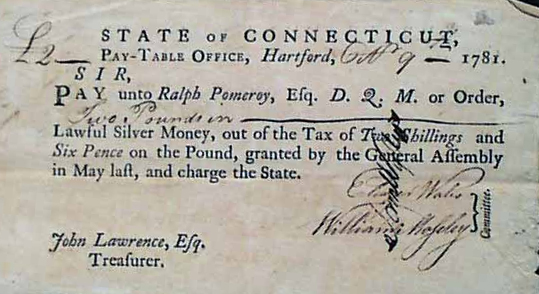
It comes as a surprise to many that newspapers from the Revolutionary War that are 200-plus years-old are available for purchase, and are reasonable priced and well preserved. The reason that 18th century newspapers have held up so well is mostly because they were printed on durable rag linen. Rag linen was a common type of paper that was made from pulping linen rags often from ship sails or clothing.
The Traveler… being “turn’d off”…
September 19, 2016 by The Traveler · Leave a Comment
Today my journey took me to London, England, by the means of The Post Boy dated September 20, 1716. There I found the Ottoman-Venetian War was going strong with little relief for the Turks. Even their truce request of a couple hours in order to bury dead had been denied. Then only to be faced with coming into  battle with nails and iron and iron spikes being hidden in the sand and planks at the Communication Bridge which lamed their horses and then to be fired upon by cannon and small shot, killing more men.
I found an interesting article on the back page. “…Last Wednesday night, a Man being at the Gallows, about to be hang’d, was pardon’d; and the Friday following, another being just ready to be turn’d off, the Duchess of Berry pass’d by that Place to the Opera, and ask’d what was the Matter. Being told, she order’d the Lieutenant-Criminal to deferr Execution, while she went back, and interceded for him to the Duke-Regent. Having obtain’d his Pardon, she sent one of her Pages with it; whereupon, the Cord was cut from about his Neck, and he with much ado brought down the ladder…”
~The Traveler
Introducing: RareNewspapers.com – The 1600’s and 1700’s…
September 15, 2016 by GuyHeilenman · Leave a Comment
Collectible 1600s & 1700s Newspapers
 “History is never more fascinating than when it’s read from the day it was first reported.”
It might not be your first thought, but newspapers from the 1600s and 1700s are very similar content-wise to modern newspapers. Early newspapers contained reports on wars, natural disasters, listed items for sale, and published death notices. Sound familiar? Newspaper content hasn’t changed drastically in 300-plus years. It is interesting to read accounts from this era and realize how similar we modern folk are to our ancestors. It seems that people at their core are mostly the same, and to this day, want to read news covering similar topics. That being said, some aspects of newspapers definitely have changed.
What has changed are the dimensions (smaller then, larger now), the number of pages (fewer then), paper quality (higher quality rag linen then), and the format. Newspapers of this period typically had an inflexible format, meaning that if page three was dedicated to foreign news, even if the most amazing foreign event occurred, it would appear on page three, not page one—period.
Due to the time it would take to typeset and print an issue, breaking news of major events would often be printed on a separate sheet called an “Extra” or an “Extraordinary” that was delivered with the daily issue or sometimes was not distributed until the following day.
Much more can be said regarding newspapers from the 1600’s and 1700’s, but for now, please enjoy the Rare Newspapers dedicated page dedicated to original and historic issues from this era:
The 1600’s and 1700’s
Announcing: The 250th Catalog from Rare Newspapers…
September 8, 2016 by GuyHeilenman · Leave a Comment
Catalog 250 is now available. This latest offering of authentic newspapers is comprised of nearly 350 new items. Some of the noteworthy content includes: a printing of the Constitution of the United States, an issue of The Royal Gazette from Charleston (1782), a 1659 newsbook we’ve never offered before, Winslow Homer’s famous “Snap The Ship”, an issue with the British response to the Declaration of Independence, coverage of Cornwallis surrenders at Yorktown, and more. Key items which include the remaining items from the above may be viewed at: Noteworthy Catalog 250
Whereas the entire catalog is shown at Catalog 250, the following links are intended to aid in quickly finding items from the catalog based on era:
• 1500-1799 (full view OR quick-scan “compact” view)
• 1800-1899 (full view OR quick-scan “compact” view)
• 1900-2015 (full view OR quick-scan “compact” view)
To view items from both the current and the previous catalog, go to: Combined Catalogs
A September, 2016 stroll back thru time – 50, 100, 150, 200, & 250 years ago…
September 1, 2016 by GuyHeilenman · Leave a Comment
 What news was reported in the month of September – 50, 100, 150, 200, and 250 years ago (1966, 1916, 1866, 1816, 1766)? Such a walk back through time via the eyes of those who read the daily and weekly newspapers of the period can be quite revealing. This is why we often say, “History is never more fascinating than when it’s read from the day it was first reported.” The following links will take you back in time to show the available newspapers from the Rare & Early newspapers website. There’s no need to buy a thing. Simply enjoy the stroll.
The Articles of Confederation formally united the 13 colonies (revisited)…
August 29, 2016 by GuyHeilenman · Leave a Comment
An oldie, but a goodie…
The following post was originally published in 2008:
For a collector of historic American documents as printed in period newspapers a printing of the “Articles of Confederation” would be a very significant issue. With much credit to Wikipedia, the creation & importance of this document provides some fascinating reading:
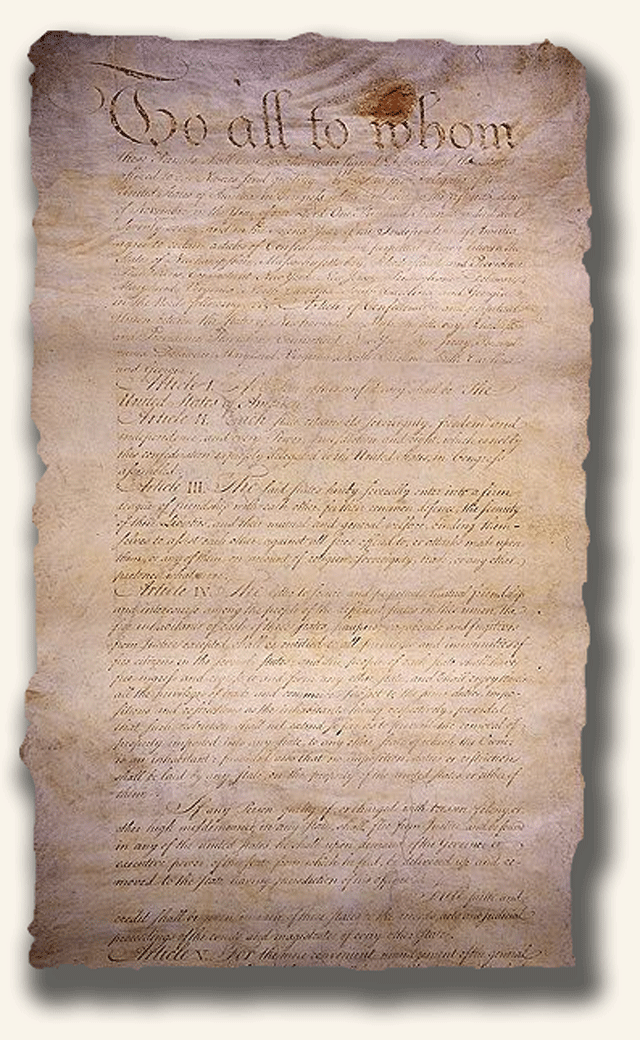 The Articles of Confederation was the governing constitution of the alliance of thirteen independent and sovereign states known as the “United States of America.” The Articles’ ratification, proposed in 1777, was completed in 1781, legally uniting the states by agreement into the “United States of America” as a union with a confederation government. Under the Articles (and the succeeding Constitution) the states retained sovereignty over all governmental functions not specifically deputed to the central government.
The last draft of the Articles was written in the summer of 1777 and adopted by the Second Continental Congress on November 15, 1777 in York, Pennsylvania after a year of debate. The Articles set the rules for operations of the “United States” confederation. The confederation was capable of making war, negotiating diplomatic agreements, and resolving issues regarding the western territories; it could not mint coins (each state had its own currency) nor could it borrow money, whether inside or outside the United States. An important element of the Articles was that Article XIII stipulated that “their provisions shall be inviolably observed by every state” and “the Union shall be perpetual”.
The Articles were created by the chosen representatives of the states in the Second Continental Congress out of a perceived need to have “a plan of confederacy for securing the freedom, sovereignty, and independence of the United States.” Although serving a crucial role in the victory in the American Revolutionary War, a group of “federalists” felt that the Articles lacked provisions for a sufficiently effective government. The key criticism by those who favored a more powerful central state (the federalists) was that the government lacked taxing authority; it had to request funds from the states. Another criticism of the Articles was that they did not strike the right balance between large and small states in the legislative decision making process. Due to its one-state, one-vote structure, the larger states were expected to contribute more but had only one vote. The Articles were replaced by the United States Constitution when created in 1787.
Our issue of the Pennsylvania Ledger dated March 11, 1778 contains the complete printing of the Articles of Confederation. The many photos will allow you to enjoy the significance of the newspaper and to appreciate how those who held this actual edition some 230 years ago might have felt knowing the independent colonies were joining together for a common cause–to not only provide a foundation for a united country which might some day–hopefully–become a world player, but for more immediate purposes, to survive the incursions of the British during the ongoing Revolutionary War. In 1778 no one knew how either effort might turn out.
Enjoy the issue!
An August, 2016 stroll back thru time – 50, 100, 150, 200, & 250 years ago…
August 4, 2016 by GuyHeilenman · Leave a Comment
 What news was reported in the month of August – 50, 100, 150, 200, and 250 years ago (1966, 1916, 1866, 1816, 1766)? Such a walk back through time via the eyes of those who read the daily and weekly newspapers of the period can be quite revealing. This is why we often say, “History is never more fascinating than when it’s read from the day it was first reported.” The following links will take you back in time to show the available newspapers from the Rare & Early newspapers website. There’s no need to buy a thing. Simply enjoy the stroll.
A July, 2016 stroll back thru time – 50, 100, 150, 200, & 250 years ago…
July 1, 2016 by GuyHeilenman · Leave a Comment
 What news was reported in the month of July – 50, 100, 150, 200, and 250 years ago (1966, 1916, 1866, 1816, 1766)? Such a walk back through time via the eyes of those who read the daily and weekly newspapers of the period can be quite revealing. This is why we often say, “History is never more fascinating than when it’s read from the day it was first reported.” The following links will take you back in time to show the available newspapers from the Rare & Early newspapers website. There’s no need to buy a thing. Simply enjoy the stroll.
More on printing newspapers in the 1700’s (revisited)…
June 27, 2016 by GuyHeilenman · Leave a Comment
This article is primarily taken from the April, 1996 edition of “Collectible Newspapers” edited by Rick Brown, whom we thank for this contribution. It offers some interesting insights into the printing & distributing of newspapers in the colonial and post-colonial era of the United States.
 Newspapers from the latter half of the 18th century were relatively scarce. One factor was that early settlers were busy clearing the land & otherwise making the land habitable & sustaining. Plus only a small percentage of the population had reading skills beyond that of the basic rudiments. Although most towns of any size by 1715 had tracts of land set aside for schools, few actually had schools built & in operation.
Nearly all 18th century newspapers were edited & published by printers that had a general printing business and also printed pamphlets, books, broadsides, lottery tickets, etc. Many also sold merchandise, groceries, patent medicines, and a variety of other goods. Rags, which were used to make the paper , were scarce in the colonies so most of the paper was imported from England.
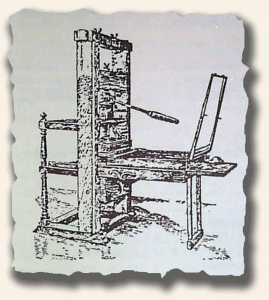
Newspapers were printed on wooden hand presses with each application of ink to paper requiring a pull of by lever and screw. It was not until around 1816 that the new iron Columbian press came into general use. Instead of a screw it used a series of compound levers that multiplied the pull of the operator. But still, all hand presses were slow & laborious. The forms had to be laid by hand and the ink was poor and of uneven quality. Types were frequently old and worn.
After the newspapers were printed, distribution difficulties were encountered. Circulation was confined, for the most part, to the towns in which they were published. They were distributed to the rural areas by post-boys on horseback and by stagecoach drivers. The roads were bad & the postal system was slow. Subscribers were few & the cost of an issue relatively expensive so newspapers were typically handed around from one to another so that a single copy was ready by many. Even those who subscribed often failed to pay for their subscriptions.
It has been estimated that the largest circulation of a single newspaper during the earlier colonial period was about 350 and that only a few reached this high of a number of circulation. By the 1750’s circulation for larger city newspapers reached upwards of 600 of each issue printed and during the Revolutionary War some newspapers boasted circulations in excess of 2000. By 1790 most newspapers were printing less than 1000 copies but the very popular “Columbian Centinel” from Boston was printing over 4000 copies of each printing date.
Despite poor equipment, limited circulation, nonpaying subscribers, poor distribution facilities & the general unprofitability of publishing a newspaper, the number of newspapers being published continued to increase as the years went by. There were numerous failures, but new newspapers were established to replace them. From 1704 to 1820 about 1634 newspapers came to life and died. Of that number only two-thirds of them lived beyond three years.
(originally posted in 2009)
Fly ’em high and fly ’em proud…
June 14, 2016 by The Traveler · Leave a Comment
Today, June 14th, is Flag Day, which is based on the Continental Congress’ adoption of the 1st version of the American flag on June 14, 1777:
“Resolved, That the Flag of the Thirteen United States, be Thirteen Stripes, alternate Red and White; That the Union be Thirteen Stars, White in a Blue Field, representing a new Constellation.” signed in by the Secretary: Charles Thomson (as reported in the May 29, 1783 issue of The Connecticut Journal).
A major revision of the flag began on July 4, 1817:
“The flag of the United States is to be altered. — The Stripes are to be reduced permanently to their original number of thirteen; but the stars are to be constantly increased in number, equal to the number of the States in the Union. The first change to take place on the 4th of July next, and the change of every additional star after that to take place on the succeeding 4th of July and not before.” (as reported in the January 16, 1817 issue of the Boston Commercial Gazette).
Of course other more minor alterations have occurred as states have been added, but regardless of its exact form, today we are reminded to Fly ’em high and fly ’em proud!