
Search
The Rare & Early Newspapers Hobby

Receive the Newsletter

Buy Historic Newspapers

So what’s the earliest “London Gazette”?
May 21, 2009 by TimHughes · Leave a Comment
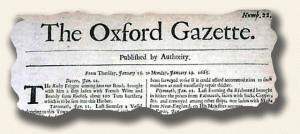 The world’s oldest continually published newspaper was begun in 1665 and still prints today, a staggering 345 year history which likely will never be broken by any other single title. Indeed, the newspaper still publishes today so it sets a more unbeatable record as each year passes.
The newspaper is titled “The London Gazette“, but collectors have occasionally seen issues of “The Oxford Gazette” and wondered about the connection.
First, the most convincing derivation of the term “gazette” is from “gaza”, the Greek word for a treasury or store. That newspapers are a “treasury or store” of information would allow for a plausible adoption of the term “gazette”.
In 1665 the Royal Court had been removed from London due to the Plague which had been ravaging the city. The smaller towns in the country seemed less susceptable to the contagion. So with a newspaper serving as a mouthpiece of the Royal Court it was logical that it would set up shop in Oxford, calling itself “The Oxford Gazette“.
But when the affects of the Plague seemed to have abated sufficiently for the Court to return to London, so did the newspaper. Twenty-three issues were published in Oxford, and with issue number 24 was the first with the title “The London Gazette“, a title which has remained unchanged for over three centuries.
So there might be a bit of a debate as to what the earliest issue is of “The London Gazette“. The earliest with this title would be issue #24, dated February 5, 1665 (1666 by today’s calendar), but argument certainly could be made that the first issue of “The Oxford Gazette” would qualify, it dated November 16, 1665.
Given its short life under the earlier title of “The Oxford Gazette”, such issues are extremely elusive. We have sold many over the past 33 years but rarely find them today.
Baseball fans… can you help?
May 11, 2009 by TimHughes · Leave a Comment
 A customer was requesting a newspaper with a report of Nap LaJoie, one of the more notable names in baseball in the early 20th century, ending the 1901 season with a .422 batting average. He was one of only a few to do so in the 20th century (there’s been a 67 year dry spell since Ted Williams was the last to do so, in 1941).
Finding reports of batting averages in 1901 is very difficult, but I did find a report at the end of the season which notes: “Lajoie…took part in 131 games. He was at bat 554 times, made 226 singles, 48 doubles 12 triples and 13 home runs…”.
Never mind that the numbers are slightly off from the official record book, which notes 543 games, 229 singles, 48 doubles (only one correct), 13 triples and 14 homers, as such errors might be understandable. But even given the accurate numbers, in calculating his average one comes up with a sum of 304 successful at bats, divided by the number of games (543) giving an average of .560. But curiously, if you just took his 229 singles divided by 543 the result is exactly his recorded batting average: .4217, rounded out to .422.
Should I surmise that the term “singles” actually means “hits” by today’s terminology ? Was this the common practice back then, to call any type of “hit” a “single”? If so, when did they make the switch?
Thanks for your help !
Tim
Sharing My Story… How I got started…
May 7, 2009 by TimHughes · 1 Comment

Tim Hughes, founder
Invariably there is the quizzical stare I get from anyone who asks “what do you do?” and I answer by saying, “I sell old newspapers.” The typical response is, “…what??” Any follow-up to the inquiry usually leads to, “How did you get started?”
We all have our own stories of what lead us to early newspapers, and mine may not but much different from yours.
I have always collecting something. I guess I was always intrigued by what was old, and coin collecting captured my interest when I was in 3rd or 4th grade, a hobby which still gets my attention but on a dramatically smaller scale. Collecting coins lead to old books, which lead to old bottles, which lead to old radios; and perhaps a few other items which struck my interest through the years.
I eventually found coin collecting a bit frustrating, as the rarities I needed to fill some holes in my collection were way beyond my budget. Coin collecting has always been a well exploited hobby so rare items were almost impossible to find at reasonable prices as the “heavy hitters” kept the prices quite high. I always dreamed of finding a collectible which few people knew about, where truly rare & historic items could be found at reasonable prices.
One day while browsing a local flea market I cam across an 1846 Philadelphia newspaper for $3. I was intrigued. I knew an 1846 coin in nice condition would be ten times that amount. I bought it, took it home and read all four pages and was fascinated by the content. I had found my new collectible and was hoping my dream had come true.
I expended much effort over the next several years looking for more newspapers and found several sources for 18th & 19th century issues at what I thought were amazingly low prices given my coin collecting experience.
Then one day I asked a source from whom I had been buying issues for $3 each if I could get a better price if I bought more than one. His response was fateful and set the course for the rest of my life: he said, “If you take 100 issues you can have them for $1 each”.
Although $100 was likely half of my net worth at the time, I sent the check, received my 100 issues, and starting advertising the issues for sale at $3 each (plus 25 cents for postage; which actually covered the cost).
As I sold the issues I bought more, and found more sources for different titles and different time periods. I eventually found several auction halls which regularly listed newspapers, and established contacts in England for early British material. In time I would travel not only throughout the Middle Atlantic & New England states but went to London each year to to search the back roads for antique & book shops which had material I could use.
Those were very exciting days, as material was plentiful and I bought voraciously. Buying today is more of a challenge so I take great comfort in knowing my appetite some 30 years ago was justified as much of our inventory of over 2 million newspapers was purchased long ago.
Good material still comes our way. Having our name in the marketplace for over 30 years and maintaining considerable Internet presence has allowed much great material to end up at our doorstep, a trend which–hopefully–will continue as we allow my dream to be realized by our customers: rare, historic material at reasonable prices.
In the coming months we will be posting the stories of other collectors as well. Details are forthcoming.
A reference book for your shelves…
March 30, 2009 by TimHughes · Leave a Comment
 There are very few reference books which are exclusive to newspapers, so some of the better ones are about printing in general, peppered with historical accounts of newspaper publishing as well.
One of my favorites is such a book, titled “Printing In The Americas” by John Clyde Oswald. Done by the Gregg Publishing Company in 1937 it unfortunately is out of print, however copies can be found on book dealer shelves across the country. With the broad scope of internet sites abebooks.com and alibris.com I suspect it would not be difficult to find a copy.
There are 91 chapters totaling over 560 pages but it can essentially be considered to have three parts. first: a general history of printing in colonial America which includes much on early newspapers; second: a state by state review of the their first printing efforts, most of which were newspapers rather than books or pamphlets; and third: printing history in other countries of the Western hemisphere including Canada, Central America, South America and the West Indies, typically not dealt with in most printing history efforts.
I find the Midwest and Western states to have the most intriguing histories, filled with stories of tragedy & hardship in trying to operate a printing establishment in the wilds of America. There were far more failures than successes. Early printers must certainly have come from hearty and optimistic stock.
This is a title I would suggest you pursue. Given its format it doesn’t have to be read cover to cover, but rather chapters of interest stand alone as little histories in just a few pages.
Rare newspaper collector’s inspiring story…
February 26, 2009 by GuyHeilenman · Leave a Comment
Over the years we have had the opportunity to establish relationships with many wonderful people within the rare newspapers community. On occasion, we are blessed to hear about the story behind the voice on the other end of the phone. One such person is Robert (Bob) Cassidy, of Pekin, Illinois. He is one of those individuals whom always has something positive to say, and who manages to make everyone he speaks with feel important. What a gift. This gift is especailly noteworthy considering the health issues he must hurdle in order to communicate. It is obvious he is a man of strong character, and of even stronger faith. It is the combination of both traits which provide the backdrop for… his story:
Disease inspires man to paint…
(Source: The Journal Star by Elise Zwicky)
“For some, a diagnosis of Parkinson’s disease might end an art career; for Bob Cassidy, it was the catalyst for getting started. ‘God, in his infinite wisdom, gave me Parkinson’s to see if I still had a sense of humor. And I did, thank God,’ said the 73-year-old retired speech specialist. Cassidy is planning an open house at the end of February or early March at his new art studio…” (read more)
Thanks Bob. You are an inspiration to us all.
An Interview with Timothy Hughes…
February 16, 2009 by GuyHeilenman · 1 Comment
 BakerTowne Collectibles recently filmed an interview with Tim Hughes on their Collectibles Corner TV website. Tim appears about midway through the show at the 4:38 time stamp. Once the program fully loads you can drag the time tracker to this spot; however, if you have the time, Tammy’s (the host) entire program is enjoyable to view.
The interview may be found at: http://www.collectiblescornertv.com/?p=114; even better, view the interview below.
Thanks Tammy for your addition to the Rare Newspapers Community.
Waiting to be discovered…
February 9, 2009 by TimHughes · Leave a Comment
The History Channel has sparked much interest in events of the past which otherwise have gone unnoticed through the years. Whether it’s a biography of notable name, a little-known yet significant war battle, or a political event which had notable consequences years later, it’s not uncommon for us to receive calls from hopeful collectors wanting a period account of the event. Many times we are successful in the search, other times not.
Occasionally present-day events noting an anniversary or discovery spark similar interest. We have noticed a significant interest in Abraham Lincoln material with the approach of the 200th anniversary of his birth. And the very recent discovery of the British ship “H.M.S. Victory” got even us intrigued about the possibility of finding a 1744 newspaper or magazine reporting its loss.
As a bit of background, a report dated February 5, 2009 from the “Best Syndication News” service brought this event into the 21st century with its breaking news reading:
“The HMS Victory ship sunk in stormy seas back in 1744 but it wasn’t until this week, when an American company called Odyssey discovered what they call “the most significant shipwreck discovery in history.” The HMS Victory was a warship that had a crew of around 1,100 that died when it went underwater. The estimated treasures with gold coins and artifacts could be worth potentially $1 billion. The Odyssey company is undergoing a legal battle to allow them to recover the treasures and artifacts. Because the HMS Victory is a military ship she is the property of the British government according to the laws of marine salvaging.”
As luck would have it we were successful. Keeping in mind that there were no survivors, details were obviously sketchy back then, but both the October and November issues of the “Gentleman’s Magazine” reflected upon the disaster.
All of us, as collectors, literary keep history on our shelves. Who knows when the next discovery might relate to an innocuous report in one of your newspapers. Have you discovered in one of your issues an item brought to light by present-day events? Such finds are always fascinating–it’s part of the intrigue of the hobby.
Campaign newspapers: a hobby within a hobby…
January 19, 2009 by TimHughes · Leave a Comment
Before the days of television, radio and certainly the internet, how did Presidential candidates get their platforms across the the electorate? Daily newspapers could not be counted upon as most were politically aligned with one of the parties so reporting had an obvious bias.
“Campaign newspapers” were one vehicle for candidates. Rather than rely on the ethics of the local publisher, parties produced their own newspapers during the campaign with the emphasis on the platform of the candidate. Logically such newspapers were short-lived and are relatively rare today as a result.
William Miles did a book titled: “The People’s Voice: An Annotated Bibliography of American Presidential Campaign Newspapers, 1828-1984” which lists chronologically and by party over 700 titles. The following is excerpted from his Preface:
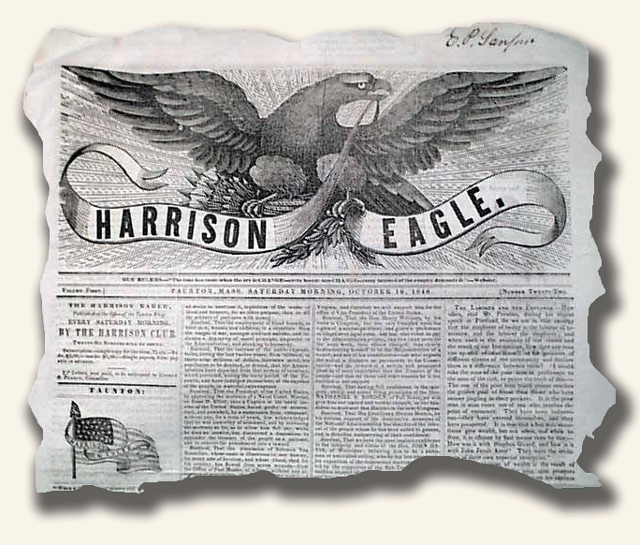 “Every four years since at least 1828 the campaign newspaper, like the campaign biography, song, poster, and similar election paraphernalia, has reappeared as a familiar part of the American presidential electoral process. Unlike the general party or partisan newspaper, these sheets were published specifically to support the cause of an aspiring candidate or an officially nominated ticket. Usually issued only during the period of the campaign itself, they were the campaign documents that emphasized the strengths and the importance of political organization at all levels; and to attack, generally in vitriolic language, the opposition. No matter if established and issued by party committees or by committed private individuals, or as “extras” and subsidized papers by already established partisan journals, the purpose was the same: organize the party faithful to work on behalf or electing the national, and by extension, the state and local tickets.”
Such elusive titles do provide an interesting array of titles including “Hickory Sprout” “Coon Hunter” “Harry Of The West” “Rebel Youth” “Hickory Tree” “On Our Way” “Rail Splitter” “Sober Second Thought” “Soup-Spiller” “Magician” “Grape Shot” “Rough & Ready” “Barnburner” “Dirty Shirt” “Kickapoo” and “Straight-Out Harrisonian” to name but a few.
Collecting campaign newspapers can be a fascinating hobby within a hobby, if only for the variety of titles available. Do you have any great-named campaign newspapers in your collection? Feel free to share.
A little monkey business… and food for thought…
December 30, 2008 by GuyHeilenman · Leave a Comment
 About a week ago we “unveiled” our office manager, Doreen Mileto, for the world to see. The feedback received was greatly appreciated. In the post we mentioned one of her talents – adviser to Paula Dean (or was it Betty Crocker? or Susie Homemaker?). Today she blessed us with another opportunity for personal growth – Monkey Bread. In an effort to share the wealth, we’ve included a link to the recipe recipe for your personal enjoyment.
Monkey Bread: http://www.momswhothink.com/easy-recipes/monkey-bread-recipe.html
A healthy portion (or two) goes well with a fresh cup of coffee while digesting the hidden nuggets within a 19th century newspaper. The combination will help you reminisce about days gone by (or at least the past year). Perhaps you have a classic recipe to share with the Rare Newspapers community??? Regardless, enjoy the Monkey Bread. Happy New Year from the staff of Timothy Hughes Rare & Early Newspapers. Good wishes for a healthy and blessed 2009.
Merry Christmas… and good wishes to all…
December 22, 2008 by GuyHeilenman · 1 Comment
 It is always a bit tricky when acknowledging certain holidays from a business platform. Christmas is certainly one day which fits this bill. Some might be offended if the acknowledgment is too “religious”. Others might have the same reaction if the holiday is spoken of too lightly. This debate has gone mainstream with a vengeance as various retail stores have advised (or mandated) that their employees not mention Christmas in verbal exchanges with customers. To me, this reeks of political correctness gone wild. There was a time when we would focus on the interests of others as opposed to ourselves. Although I might not be Jewish, if I knew someone was, I would certainly wish them a Happy Hanukkah (at the appropriate time)… and they would do the same for me at Christmas. I’ve even had British associates wish me a Happy 4th of July! The focus was on an appreciation for the person being spoken to. Their holiday might not be special to me, but it was to them; therefore, acknowledging what was important to them was in order. Whether we called this behavior public decorum, others focused, or simple civility, it created a harmonious atmosphere we all appreciated. It is with this harmony in mind, and with tongue firmly planted in cheek, I share the following 2007 “Yuletide Greeting” from one of our friends, Vincent Golden:
December 2007 ( a year ago)
Dear [Friends],
Happy holidays, Christmas/Kwanza/Hanukah/Pagan Feast Day/Tuesday (Circle one).
Once again another year has come and almost gone and none of us managed to keep our New Year’s resolutions. By May I was back to submitting fake garage sales ads in the local newspaper for neighbors that annoyed me. In August I was creating new books of the Apocrypha and burying them in caves in the Middle East region. I thought I could make it to the end of the year on my last one, but once again I failed and as a result have to wait a year before I can donate blood.
As usual it has been a busy year. One of my big projects was helping little Jimmy get his Cub Scout merit badges. We spent a lot of time on the whittling badge. He did a marvelous job following my instructions. Unfortunately he didn’t get the badge. I tried to argue that the handbook does not prohibit what can be whittled. I thought the point was it should look realistic. Still thanks to the publicity generated by the controversy (and the bomb squad), Jimmy’s project brought over $1200 on eBay.
Work at the library was not that exciting. The high point was the uncovering of Thomas Jefferson’s personal copy of Slavery for Dummies. His annotations in the margins of chapter 9 strengthen the historical and controversial issue about Sally Hemmings. We also acquired the rare 1752 Boston printing of The Lighter Side of Puritanism. Did you know they were the first to bring a piñata from Mexico? Or the first to leave flaming bags of poo outside wigwams?
Since moving to Massachusetts I’ve explored the many historical sites of New England. At Mystic Seaport I saw the replica of the ship, La Zapata, which introduced psoriasis to the New World. Near Portland, ME a historical society has restored a series of houses from the 1830s designed by architects with severe head injuries. Some have features that have no vocabulary that begins to describe them. The closest I can think of is “wonky.” In the fall I drove up to Vermont. Most people go up there during a two-week period for leaf peeping. I ended up with a group of die hards that go leaf stalking. I think they discovered the secret of fermenting maple syrup to make “wacky pancakes” before they begin the day.
So what is new with the family? My parents continue to keep busy. They are becoming experts at rehabilitating circus elephants and releasing them into the wild. Unfortunately they release them into the wilds of Illinois. They tend not to survive the winters. My older brother is applying new techniques of quantum physics to agriculture. I’m not sure the Heisenberg Uncertainty Principle is the best way to go when harvesting corn. Little sister is still pursuing her dream as an artist. Her attempt at creating counter-intuitive theatre did not get an NEH grant, but the CDC is interested in her performance.
I plan on doing a little re-gifting this year. The politically correct term is environmentally responsible recycling of inert compounds. I use the term inert, but it really means the crap that stays in the garage. I don’t remember who gave what. Please let me know what you gave last year from this list so I’ll make sure you don’t get it back.
1. Singing bass plaque with the voice of Celine Dion.
2. Scented tennis raquet.
3. Hawaiian-print bandages.
4. Hybrid-fuel roller skates.
5. Ultimate fighting lessons.
6. Fruit fly cake.
I’m keeping the cattle prod. The more I have to go to worthless meetings, the more ideas I come up with for it.
As you remember, every year I have a holiday trivia competition. Since I’m sure you saved the letter from last year, here are the answers:
1. Red
2. Blood red
3. Venison
4. Senator Fred Thompson was once burgermeister meisterburger.
5. Gimpy was the third string reindeer.
And now to this year’s holiday trivia questions.
1. What strategies do Santa and WalMart use in common to keep their employees from unionizing?
2. Which battle was started because of a fruitcake and ended by bad egg nog?
3. In the song, “The 12 Days of Christmas”, how many health violations are broken if the recipient lived in Chicago? In New Jersey?
4. What percent of family holiday gatherings end with a psychotic episode? End with pie?
5. When did the tradition end of Queen Elizabeth finishing her annual Christmas broadcast by saying, “keep cool my posse?”
And so as the year draws to a close, please raise a glass to toast the new year. To 2008. May we elect someone who can walk and chew gum this time.
Vincent
As for those looking for a little more traditional cheer, feel free to consider other poems (or newspapers) about the Christmas season:
“A Visit from Saint Nicholas” by Clement Clark Moore (or Henry Livingston)
“Christmas Bells” by Henry Wadsworth Longfellow
“Noël” by Anne Porter
“Christmas” by John Betjeman
“Christmas Trees” by Robert Frost
“The Shivering Beggar” by Robert Graves
“Christ Climbed Down” by Lawrence Ferlinghetti
“The Savior must have been a docile Gentleman” by Emily Dickinson
“Christmas at Sea” by Robert Louis Stevenson
“A Hymn on the Nativity of My Savior” by Ben Jonson
“Old Santeclaus” by Clement Clark Moore
“Prologue of the Earthly Paradise” by William Morris
“Ecce Puer” by James Joyce
“The Thread of Life” by Christina Rossetti
“Dust of Snow” by Robert Frost
“At Christmas” by Edgar Guest
“The Oxen” by Thomas Hardy
“Come, bring with a noise” by Robert Herrick
“On the Morning of Christ’s Nativity” by John Milton
“A Christmas Carol” by Christina Rossetti
“Heigh Ho, The Holly” by William Shakespeare
“The Burning Babe” by Robert Southwell
“Ring Out, Wild Bells” by Lord Alfred Tennyson
“The Mahogany Tree” by William Thackeray
“A Christmas Carol” by George Wither
“Skating in Harlem, Christmas Day” by Cynthia Zarin
Merry Christmas to all! Guy