

Search
The Rare & Early Newspapers Hobby

Receive the Newsletter

Buy Historic Newspapers

A look back at the past’s look into the future…
November 14, 2009 by GuyHeilenman · Leave a Comment
 One of the many pleasures of the Rare Newspaper collecting hobby is often quoted within our material:
“History is never more fascinating than when it’s read from the day it was first reported”. In fact, this look back is the impetus for the name of this blog, “History’s Newsstand”. However, occasionally these excursions can also provide us with a glimpse of just how far we’ve come in comparison to the expectations of those who lived in the past. It is such a look into the future, from exactly 100 years prior to today’s posting, that is available to us through an old newspaper section we found within our archives pulled from the Cleveland Leader, November 14, 1909. Please enjoy this look back at the past’s look into the future: The Cleveland Leader, 11/14/1909. The link will take you to a brief description of the article in question, with images of the entire article. Did we surpass their expectations? We’d love to know your thoughts.
Celebrating 150 years since Arizona’s first newspaper…
November 2, 2009 by TimHughes · 2 Comments
The history of Arizona, an Indian word meaning “place of small springs”, goes back some 10,000 years B.C. with the arrival of the first Native Americans, while its history as recorded by Europeans dates to 1539 when the first white an, Marcus de Niza, a Franciscan friar arrived. It was organized as a territory in 1863 and admitted as a state in 1912, the last of the 49 contiguous states to join the Union.
Arizona’s first newspaper was the “Arizonian”, started at Tubac in March, 1859. Tubac lies about midway between Tucson and the Mexican border. For the following we credit Megan Thomas and the Chronkite News Service:
“For visitors at Tubac Presidio State Historic Park, (volunteer James) Pagels rolls ink and presses paper to metal to demonstrate a Washington Hand Press that was used to print the state’s first newspaper, “The Weekly Arizonian”. It still provides visitors with replicas of the paper.
“It’s living history,” Pagels said.
Arizona State Parks is preparing to celebrate the 150th anniversary of the arrival of the press in Arizona. Brought by ox cart from the Mexican port of Guaymas for William Wrightson of the Santa Rita Mining Co., the press turned out the first copy of the Arizonian on March 3, 1859, promoting the mining company and its agenda.
The “Arizonian” published out of Tubac for several months before moving to Tucson. According to an account by the late Douglas C. McMurtrie, a historian of printing in the U.S., the newspaper apparently ceased publication in the summer of 1860, resumed briefly in 1861 and resumed once again in 1867 – both times under different ownership – before finally folding for good in 1871. The press wound up in Tombstone, printing the Nugget newspaper for a time, and, according to McMurtrie, passed to the Arizona Historical Society in 1913.
Back home in Tubac and on permanent loan to Arizona State Parks, the press is a point of pride, said Joe Martinez, manager of the park.
“I think it’s amazing that the press came here in 1859 can still function today and we can show it to people and give them copies of the first edition,” Martinez said.
That edition describes attacks by Native Americans and crimes including horse thefts. It notes that stagecoaches were charging 40 cents to $1 per pound for extra baggage on runs between El Paso and San Diego. A section is devoted to the obituary of James Gadsden, who brokered the purchase from Mexico of nearly 30,000 square miles that are now part of southern Arizona and New Mexico.”
Collectible themes… additional thoughts…
September 28, 2009 by GuyHeilenman · Leave a Comment
There is an endless variety of ways to collect early newspapers.
- The vast array of newspaper dates, titles, sizes and content would seem almost formidable should one decide to collect newspapers without a theme or focus. Even a small percentage of every newspaper title published would not only be a formidable task to assemble but would be too cumbersome to organize and store.

- But collecting by theme offers a fascinating challenge to cut through the forest of available titles to add only those issues to a collection which fit the scope of a special interest. And the areas of interest can be endless.
- Whatever one’s interest might be a newspaper collection can be assembled as an interesting complement. You like old radios? Collect newspapers reporting the development of the radio and its antecedents from the telegraph to satellite radio. Or collect newspapers with advertisements of the radios in your collection. You like military history? Collect newspapers reporting major battles of each of America’s conflicts from the French & Indian War to the Gulf War. Politics? Collect issues covering the elections, or inaugurations of each president from George Washington to the present. Or collect at least one of each of the annual state-of-the-union addresses beginning with Washington (yes, he started the tradition which continues today). Or perhaps presidential deaths, or significant policy pronouncements.
- The Wild West, 20th century gangsters, sports heroes, the weird & bizarre, major tragedies, scientific developments are just a few themes. More specific topics can result in a very focused collection themed on just the Civil War or World War II or Western exploration or 19th century baseball to name a few.
- Less event-focused collections can also result in an intriguing variety of issues, such as one newspaper from every decade from the 1650’s to the present showing the progression & evolution of newspaper publishing from its infancy to the internet. Huge headlines of any event can provide for a very dramatic & displayable collection, or erroneous reports (Dewy Defeats Truman” is the most famous, but there are many more), printing errors (wrong dates, upside-down type, misspelled headlines, etc.) can result in an interesting collection.
- Given the tens of thousands of titles and the 400 year span of newspaper publishing the themes of collecting are virtually endless. Explore and widen your interest by adding newspapers to your collection. A fascinating world of collectibles awaits you.
Note: If you are still having trouble deciding on a theme upon which to begin centering your collection, consider the History’s Newsstand Store’s or the Rare & Early Newspapers’ list of categories as potential starting points. Many collectors began their collections by amassing a low-end (low priced) issue from each decade from the mid-1700’s through the mid-20th century. A basic issue from each U.S. President’s term of office is also a popular theme.
The list of collecting strategies is endless. Feel free to contribute ideas of your own.
Alaska’s first newspapers…
September 24, 2009 by TimHughes · 2 Comments
The very first newspapers published in a state or territory–particularly those west of the Allegheny Mountains, have always been of interest to me and I suspect others as well. To share the wealth of information found John C. Oswald’s “Printing In The Americas” I will, from time to time, reflect upon the first newspaper or newspapers in many of the United States. Alaska’s interesting history will be first.
 The first periodical issued for distribution in Alaska was in handwritten form. It was a monthly “published” for the information of a force of men laying a telegraph line connecting Alaska with Siberia. Its name was the “Esquimeaux” (we now spell ‘Eskimo’), begun Oct. 14, 1866 and continued for twelve numbers, ten done at Libbysville, Port Clarence, Russian America, and two at Camp Libby, Plover Bay, Eastern Siberia. The completion of the Atlantic cable having put an end to the telegraph project, the manuscript of the “Esquimeaux” was taken to San Francisco & issued in printed form beginning Oct. 31, 1867.
The first formal newspaper which circulated in Alaska was actually printed in San Francisco beginning March 1, 1868, shortly after the purchase of Alaska by the United States, titled the “Alaska Herald“. It was semi-monthly & printed in both Russian & English.
The “Alaska Times” started at Sitka on May 1, 1869 and continued there until 1870 when it was moved to Seattle where–according to Oswald–just two numbers were published. But our inventory shows at least 20 numbers having been published in Seattle.
“News Rooms”: a curiosity of the past…
September 21, 2009 by TimHughes · Leave a Comment
One last excerpt from Clarence Brigham’s book “Journals & Journeymen” is worthy of sharing with follow collectors as it explores a part of newspaper history of which most are unaware. The chapter is titled “News Rooms”:
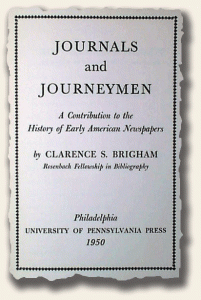 An interesting custom in newspaper history was the establishment in the early 1800’s of news rooms at nearly all of the larger towns. Somewhat akin to this idea was a project carried out at a much earlier day at Bridgeton, New Jersey. Here in December 1775, & continuing for two months, a weekly paper called “The Plain Dealer”, consisting of essays but with topics relating to the problems of the colonies, was written out in manuscript and posted up in Matthew Potter’s tavern. It enabled readers to gather at a central meeting place and peruse a weekly publication, which they would not trouble, or perhaps could not afford, to purchase.
Soon after 1800 reading rooms sprang up in several towns. In Boston the Anthology Reading Room was established in 1806, with 160 subscribers, and making available all the leading newspapers of the country. In 1808 Samuel Gilbert established at Boston what may have been the first commercial news room in the country. It was located in the Exchange Coffee House, erected in 1808, with its “Reading Room and Marine Diary” on the entrance floor where newspaper files could be consulted.
In New York, John H. Payne in 1811 opened a reading room where could be found the most important newspapers and magazines of the day. Charleston had a newsroom in 1813 where the terms were ten dollars for subscribers and strangers one dollar a month. In fact, almost every city and larger town before 1820 had its news room where leading newspapers were regularly filed. To enumerate them would require a lengthy chapter and necessitate an exacting study of early newspaper advertisements. Unfortunately there is no record of a new room proprietor preserving his files for posterity.
The Next Must-Read Book for Newspaper Collectors
September 14, 2009 by admin · 9 Comments
 Mott, Emery, Thomas, Tebbel and Brigham are household authors on the bookshelves of most newspaper collectors, but another name needs to be added to the list. Eric Burns.
Burns is the author of Infamous Scribblers: The Founding Fathers and the Rowdy Beginnings of American Journalism.
Most of us have read — on more than one occasion — about the history of Public Occurrences, The Boston News-Letter, Zenger’s New York Weekly Journal and Franklin’s Pennsylvania Gazette. But how often do we get to read these stories and many distinct others from a book published in the 21st century?
Perhaps what thrilled me the most about this book was its style. To me, Burns was masterful at marrying the story-telling flair of David McCullough with the newspaper history acumen of Mott, Emery and others. More so, I enjoyed learning several fun facts and exciting stories about many of the newspaper titles I see for sale at rarenewspapers.com or even hold in my own collection.
The Boston Gazette, according to Burns’ C-SPAN presentation on his book, is the most influential newspaper this country has ever known. He says the Gazette got us into the Revolutionary War, sped up the course of the war and may have even determined the outcome of the war. A good chunk of Infamous Scribblers is dedicated to supporting this thesis.
“Almost certainly the war would not have ended with an American victory in a period of seven years — from first shot to signed treaty — had not the newspapers constantly reminded the colonists of the cause they shared, thereby inspiring the valor of soldiers, and the patience and support of civilians,” Burns said.
He points out that newspapers were the only form of media at the time and served as the great unifier of our nation during a time when America “needed unity as much as we needed ammunition.”
Here are a few fascinating excerpts from Infamous Scribblers:
On a printer’s disincentive to publish a newspaper: “Despite a New World population of more than 300,000 by 1700, there were not enough customers of newspapers — too few English speakers in America, too few towns and villages that were too widely scattered to allow for news to be gathered efficiently and a paper to be distributed economically.”
On a newspaper’s role in the Revolutionary War: “It was Franklin, though, who most succinctly and accurately assessed the role of the media in the days leading up to the war. It was he, astute as ever, who pointed out that the press not only can ‘strike while the iron is hot,’ but it can ‘heat it by continually striking.'”
On Sam Adams: “The least ethical newsman of the entire colonial era, if not the entire history of American journalism.”
On 18th century journalism: “As a rule, newspaper publishers of the time did not chase after interviews or hustle to the scenes of events with their juices flowing and pen fingers twitching. For the most part, they were denizens of the print shop, preferring that the news be spoken in their ears or slipped under their doors — that it be delivered to them, in other words, as spices were delivered to the grocer or bolts of clothes to the tailor.”
On reporting and publishing during the Revolutionary War: “The Revolutionary War was not an easy one to cover. For one thing, once the fighting started there was more news than ever but no more shipments of ink or type or spare parts for the presses coming into American ports. There were no more shipments of paper either, and, as for the quantities still available or smuggled into the colonies from a friend in the motherland or a trader in another European nation, there were higher priorities for it than journalism.”
On an unlikely spy embedded as a printer: “Jemmy Rivington’s Tory newspaper, the Royal Gazette, was extremely critical of George Washington. However, Rivington was also a spy who passed along secrets of the British navy to colonial leaders. On one occasion, Rivington helped break a British code that almost surely saved American lives during one of the war’s earlier battles.”
On printing business diversification: “Colonial printers did not just publish newspapers… they continued to publish documents for agencies of government and various other materials such as sermons, speeches, and contracts, for private clients… they turned out pamphlets, Sunday supplements of a sort, commentaries on the news of the day…”
On the importance of 18th century newspapers: “Perhaps the importance of the press to the outcome of the war can be exaggerated, but not easily and not by much. It was newspapers that kept the colonies informed of the progress of the fighting in a way that letters and patterers could not have done, and in the process united the colonies in a way that was beyond the ability of the jerry-built wartime government.”
This post was authored by Todd Andrlik, a collector of rare and historic newspapers that you can follow at toddand.com and raglinen.com. Todd recently launched the Historic Newspapers Network for the newspaper collecting community.
The “Carrier’s Address”…
August 27, 2009 by TimHughes · Leave a Comment
Credit for portions of the following must be given to Clarence Brigham & his work “Journals & Journeymen”, as well as to the Bentley Historical Library at the University of Michigan.
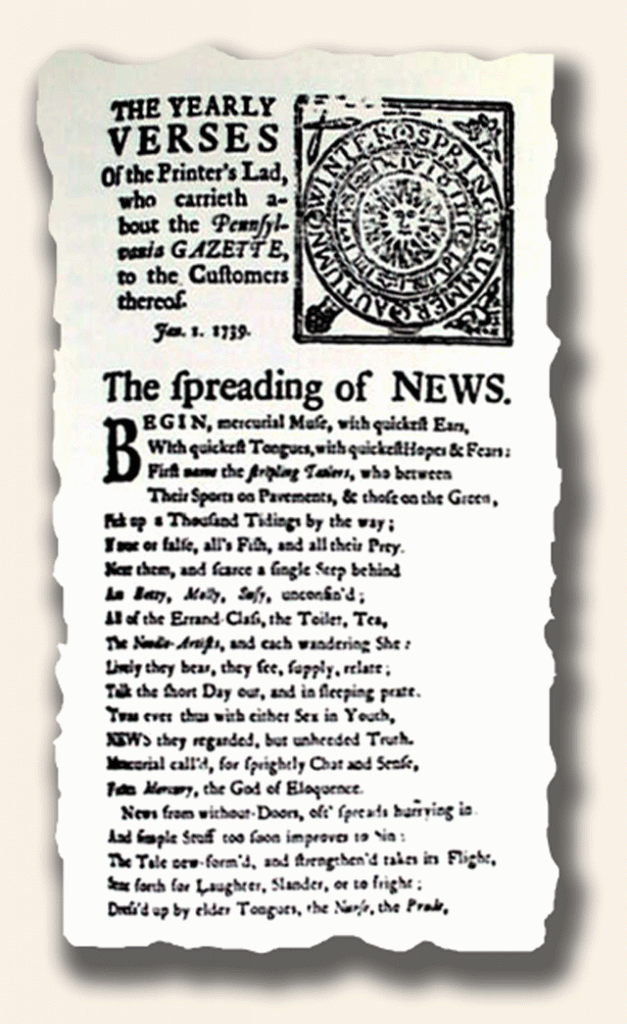 During the nineteenth century, newspaper carriers were often not paid by the publishers of the papers. They typically depended upon donations from patrons at the end of the year. To remind the public that the carriers depended on their donations, newspaper publishers issued poetic broadsides or booklets for New Years Day. These poems often recounted the major news stories of the previous year, but always closed with a plea to pay the carrier.
They were rarely saved since they contained no news reports and as a result are rather rare today. Although many Carriers’ Addresses were contained within the body of the first newspaper issue in the new year, the most sought after are the broadside editions, printed on one side of a sheet of paper typically with ornate lettering, decorative borders, etc. The more decorative the Address the more collectible. The “New York Weekly Museum” address for 1790 had an engraving of a boy delivering a paper at a doorway, one of just a few with such an illustration.
The earliest known examples were done for the “American Weekly Mercury” of Philadelphia in 1720, 1721 and 1723 although none have been found. The earliest located for the American Antiquarian Society is that of January 1, 1735. Benjamin Franklin included them in his “Pennsylvania Gazette” as early as 1739 (see photo).
The amount of the donation expected by the carrier was generally left to the customer. Many of the verses concluded with such a sentiment as “Remember the poor printer’s Devil” or “Be bounteous to the Printer’s boy”. Sometimes the sentiment was more definite, such as “I won’t Refuse a six pence” and “Please keep the cents and–give the silver”.
By the 1870’s the custom began to fall off, likely due to the beginning of more commercial & larger influential newspapers which considered such a custom undignified, also falling away in favor of the distribution of Christmas or New Year’s cards by the end of the 19th century. The latest located for the American Antiquarian Society is dated 1904.
More on printing newspapers in the 1700’s…
August 24, 2009 by TimHughes · 3 Comments
This article is primarily taken from the April, 1996 edition of “Collectible Newspapers” edited by Rick Brown, whom we thank for this contribution. It offers some interesting insights into the printing & distributing of newspapers in the colonial and post-colonial era of the United States.
 Newspapers from the latter half of the 18th century were relatively scarce. One factor was that early settlers were busy clearing the land & otherwise making the land habitable & sustaining. Plus only a small percentage of the population had reading skills beyond that of the basic rudiments. Although most towns of any size by 1715 had tracts of land set aside for schools, few actually had schools built & in operation.
Nearly all 18th century newspapers were edited & published by printers that had a general printing business and also printed pamphlets, books, broadsides, lottery tickets, etc. Many also sold merchandise, groceries, patent medicines, and a variety of other goods. Rags, which were used to make the paper , were scarce in the colonies so most of the paper was imported from England.
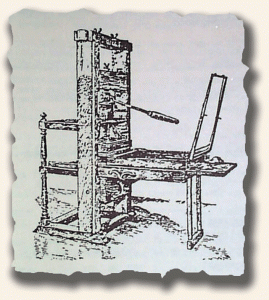
Newspapers were printed on wooden hand presses with each applicatoin of ink to paper requiring a pull of by lever and screw. It was not until around 1816 that the new iron Columbian press came into general use. Instead of a screw it used a series of compound levers that multiplied the pull of the operator. But still, all hand presses were slow & laborious. The forms had to be laid by hand and the ink was poor and of uneven quality. Types were frequently old and worn.
After the newspapers were printed, distribution difficulties were encountered. Circulation was confined, for the most part, to the towns in which they were published. They were distributed to the rural areas by postboys on horseback and by stagecoach drivers. The roads were bad & the postal system was slow. Subscribers were few & the cost of an issue relatively expensive so newspapers were typically handed around from one to another so that a single copy was ready by many. Even those who subscribed often failed to pay for their subscriptions.
It has been estimated that the largest circulation of a single newspaper during the earlier colonial period was about 350 and that only a few reached this high of a number of circulation. By the 1750’s circulation for larger city newspapers reached upwards of 600 of each issue printed and during the Revolutionary War some newspapers boasted circulations in excess of 2000. By 1790 most newspapers were printing less than 1000 copies but the very popular “Columbian Centinel” from Boston was printing over 4000 copies of each printing date.
Despite poor equipment, limited circulation, nonpaying subscribers, poor distribution facilities & the general unprofitability of publishing a newspaper, the number of newspapers being published continued to increase as the years went by. There were numerous failures, but new newspapers were established to replace them. From 1704 to 1820 about 1634 newspapers came to life and died. Of that number only two-thirds of them lived beyond three years.
Number of titles, and where held…
August 17, 2009 by TimHughes · Leave a Comment
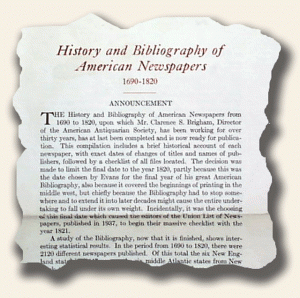 A four page promotional piece announcing the completion of a 30 year project titled: “History and Bibliography of American Newspapers 1690 – 1820”, now commonly referred to simply as “Brigham”, its creator, includes some statistical information which might be of interest.
Brigham notes that from 1690 to 1820, there were 2120 different newspapers published. Of this totals the six New England states had 447; the six middle Atlantic states from New York to Maryland had 1023; the ten Southern states from Virginia to Louisiana had 425; and the seven Western states had 225. The city which from the beginning to 1820 had the most newspaper was New York with 138, followed by Philadelphia with 107, and Boston with 73.
Also, the six largest collections of newspapers before 1820 are:
1)American Antiquarian Society with 1492 titles
2) Library of Congress with 936 titles
3) Harvard with 732 titles
4) New York Historical Society with 634 titles
5) New York Public Library with 480 titles
6) Wisconsin Historical Society with 415 titles
More on the time lag in news reporting…
August 10, 2009 by TimHughes · 2 Comments
 Some weeks ago I commented on the time lag between a news event and its appearance in newspapers of the day, focusing on the publication dates of the Declaration of Independence in various newspapers.
Because time lag is a major factor in looking for news reports prior to the use of the telegraph in the mid-19th century, I thought more discussion should be given to the issue. Again I turn to Brigham’s “Journals and Journeymen” for much valuable information.
Obviously the delay in receiving news of world events was beyond the control of newspaper publishers. The news of the death of Queen Anne on August 1, 1714 arrived in America on September 15. George I died June 14, 1727 but his subjects in America did not learn of it until August 13. George II died October 25, 1760 and it was two months later before the news arrived at Boston. Even the significance of the Treaty of Versailles at Paris which ended the Revolutionary War was first heard of at Boston on October 22 and not published in a newspaper until October 30 despite the event happening on September 3.
Ocean travel was dangerous & speed was dependent on the weather. Foreign wars & privateering also made voyages quite hazardous. The first issue of the “Boston News-Letter” of April 24, 1704 carried London reports of December 20, 1703. It was common for ships to load their passengers & their London newspapers and then wait around in the Channel for up to 3 weeks or more before sailing. During the first two years of newspaper publication there were exceptional voyages of five weeks, but the average was about two months.
After the Revolution & before 1820 merchants began building larger vessels which meant improved speed. In 1820 there were frequent sailings of 28 to 30 days, but there was no dependable time schedule.
Noting the diaries of some famous travelers we gain some insight. In 1722 Samuel Johnson traveled from Boston to England in 39 days. Benjamin Franklin in returning from England to Philadelphia in 1726 did so in 67 days. William Beverley sailed from Virginia to Liverpool in 37 days. Abigail Adams, whose story of a voyage is one of the most detailed on record, sailed from America to England in 30 days in 1784.
Postriders took a week to travel from New York to Boston, and at least two days from Philadelphia to New York. When stagecoaches came into use around 1785, the delivery of letters & newspapers was quicker & more consistent.
But by the establishment of the magnetic telegraph in 1844 and the laying of the Atlantic cable in 1858 (but not perfected until 1866) news was transmitteed from country to country instantaneously.