
Search
The Rare & Early Newspapers Hobby

Receive the Newsletter

Buy Historic Newspapers

First newspapers in South Dakota…
February 13, 2012 by TimHughes · Leave a Comment
The very first printing of any kind to be done in present-day South Dakota wasn’t until Sept. 20, 1858, relatively late for that section of the country. It was an election notice, and less than a year later the first newspaper appeared on July 2, 1859 titled the “Democrat“, printed in Sioux Falls. It published on an irregular schedule for less than a year when it was discontinued for lack of support. Reports are that the newspaper was revived as the “Northwestern Democrat“, however no copies under that name have survived. The press was destroyed by a band of hostile Sioux Indians in 1862.
 The second newspaper in South Dakota was the “Weekly Dakotian” begun in Yankton on June 6, 1861, by Frank Ziebach. A year later it was absorbed by its rival, the “Press“, becoming the “Press and Dakotan“, and a bit later the “Dakota Union“.
Note: Images are not currently available for any of the above… but will be added if/when they are available.
Perhaps the most famous 19th century title is “The Black Hills Pioneer” which was printed in Deadwood City beginning in 1876. It would be an issue in early August of that year that would report the death of Wild Bill Hickok while playing cards that would be one of the most sought after newspapers for any collection.
Interesting items on the Underground Railroad…
February 11, 2012 by TimHughes · 1 Comment
The “Supplement to the New-York Daily Tribune“, May 11, 1849, has the following at the top of the front page. Note the incredibly strong pro-slavery bias in the first paragraph:
The Civil War… 150 years ago… February 8, 1862…
February 8, 2012 by GuyHeilenman · Leave a Comment
An ongoing reflection on the Civil War… 150 years prior to this post…
 150 years ago today, citizens, from both the north and the south, sat down over a cup of coffee (if they were lucky) to read newspapers telling of the capture of Fort Henry, the Battle of Mill Spring, the available (advertisement) speech by Frederick Douglass, and more, while perhaps looking over large detailed maps of related regions. The daily newspaper was their connection to the events touching nearly every household in America. Enjoy a glimpse of the issues printed for the day:
Original Newspapers Read On February 8, 1862
“History is never more fascinating than when it’s read from the day it was first reported.”, Timothy Hughes, 1976
The Traveler… on the rails… one more time…
February 6, 2012 by The Traveler · Leave a Comment
 I traveled today to the Valley Sentinel in Carlisle, Pennsylvania (February 6, 1912) where I encountered an interesting article entitled “Hobos In Convention” which was being presided by “Millionaire Hobo” James Eads How. This intrigued me to see if there was further information about Mr. How. I found that he truly was a
  millionaire who dedicated his life to the homeless and migrant workers, published the Hobo News, organized the International Brotherhood Welfare Association, hobo colleges and hobo conventions.
Another article is of a man who had died at the Homeopathic hospital and then taken to the city morgue. As he was about to be embalmed, he emitted a groan and tried to turn on his side. Every effort was taken to keep him alive, but signs of life faded away again. Now the dispute is going on between the police and the hospital as to when he really died.
~The Traveler
“Bigfoot” in 1831…
February 4, 2012 by TimHughes · Leave a Comment
This article appeared in the “New Hampshire Gazette“, Portsmouth, on February 15, 1831. Apparently “bigfoot” legends have been around for many years:
The Civil War… 150 years ago… February 1, 1862…
February 1, 2012 by GuyHeilenman · Leave a Comment
An ongoing reflection on the Civil War… 150 years prior to this post…
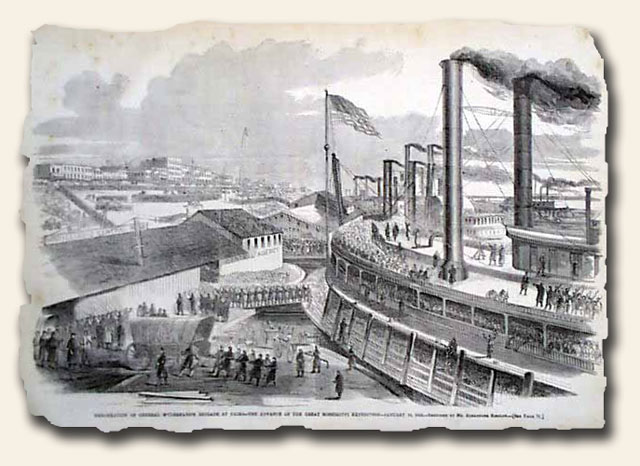 On February 1, 1862, the following issues were all held… and read… by those living during the American Civil War. Feelings of fear, sorrow, and uncertainty were prevalent as readers searched for news which would provide a glimmer of hope that loved ones would be safe, the greater good would prevail, and soon all would be well. Experience a glimpse of their world as you browse through the following:
Original Newspapers Read On February 1, 1862
“History is never more fascinating than when it’s read from the day it was first reported.”, Timothy Hughes, 1976
John Wilkes Booth appears at Ford’s Theater, in 1863…
January 30, 2012 by TimHughes · Leave a Comment
The November 4, 1863 issue of the “Daily National Intelligencer” contains a curious and ironic bit of reporting, page 2 containing a lengthy report on the appearance of the distinguished son of Junius Brutus Booth–John Wilkes–at the new Ford’s Theatre in Washington. The next column contains an innocuous letter signed in type by the President: A. Lincoln.
The facing page includes an advertisement for “Ford’s New Theatre!” noting the appearance for the: “…first and only time…the distinguished tragedian, MR. J. WLKES BOOTH in Schiller’s great master piece, the Robbers…”.
Of course no one could have suspected the tragic connection between these two famous names which appeared on the same page in the same newspaper, some one and one-half years before fate would find their names on the same page once again:
“Snake oil” advertisements…
January 28, 2012 by TimHughes · Leave a Comment
Various patent medicine advertisements were all the rage in the late 19th century, and it seems they were more prevalent in Western rather than Eastern newspapers. This one (below) appears in the July 7, 1880 issue of “The Deseret News” from Salt Lake City:
The Civil War… 150 years ago… January 25, 1862…
January 25, 2012 by GuyHeilenman · Leave a Comment
Today we continue our look back on the Civil War as reported within the newspapers held by those living during the Civil War… 150 years ago to-date (of this post). While many of the issues shown below are no longer available for sale, reading a snap-shot of what was printed for the given day will hopefully provide a glimpse of life during the critical period in American history. Each link shown will take you to the full description w/ images of authentic issues which were held by those living during the Civil War. Today’s selections are:
HARPER’S WEEKLY, NY, January 25, 1862 This issue features a nice full frontpage illustration entitled ‘Little Mac Out Again’ which shows McClellan on horseback. A fullpage features two halfpage illustrations ‘Fort Holt, Kentucky, Opposite Cairo’ and ‘Commodore Foote’s Gun-Boate Flotilla on the Mississippi’. A fullpage “Bird’s-eye View of the Vessels Composing the Burnside Expedition at Fortress Monroe, and Showing Norfolk and Its Approaches”. A halfpage “Map Showing Pamlico and Albemarle Sounds, and the Approaches to Norfolk From the South”. A very nice double page centerfold ‘Grand Reception at the White House, January, 1862’ shows Lincoln & many from the military. A half page “Embarkation of Part of General Burnside’s Expedition at Annapolix, on Board the ‘Hussar'” and a nearly half page “Execution of private Lanahan, of the Regular Army, for Murder, at Washington”. A full page “Birds-Eye View of Bowling Green, Kentucky, and Its Approaches”. A 1/3 page “War Map, Showing the Theatre of Operations of the Mississippi Expedition and General Buell’s Army. The back page features two political cartoons.
The Traveler… wanted for murder… new regulations established…
January 23, 2012 by The Traveler · Leave a Comment
Today I journeyed to The Post Boy dated January 24, 1712 where I found there was a “wanted” man. The back page of this singlesheet newspaper was clearing the air on the false reports of the escape of Mr. Mackartney to Holland, “for he has never been on that side of the  Water since the Murder he committed…” This continued with a Royal Proclamation being issued for his capture along with the a 300 pound reward as he had been found to have committed the murder of James Duke of Hamilton and Brandon, and also with aiding and assisting the Lord Mohun to commit the murder of the Duke.
While researching this incident further, I found the following information through Wikipedia… “In 1712, two years after Mohun’s Whig party had been heavily defeated in an election, the Duke of Hamilton was given the post of special envoy to Paris. Also at this time Mohun’s legal dispute with Hamilton over his inheritance of the Macclesfield estate was going badly. Shortly before Hamilton left for France, Mohun challenged him to a duel which was fought on 15 November in Hyde Park. Hamilton was killed during the fight by Mohun’s second, George MacCartney, after he had mortally wounded Mohun during the duel; Mohun died from his wounds shortly afterwards. This bloody duel was made immortal by William Makepeace Thackeray in his novel The History of Henry Esmond. The injuries suffered by the two men were so horrific that the government passed legislation banning the use of seconds in such duels. Also as a result swords were replaced as the weapons of choice in duel by the pistol, which tended to result in shorter and less bloody fights.”
Enjoy!
~The Traveler