
Search
The Rare & Early Newspapers Hobby

Receive the Newsletter

Buy Historic Newspapers

Washington’s first newspaper…
June 11, 2012 by TimHughes · Leave a Comment
Interest by historians in Washington’s first newspaper may well be eclipsed by the press upon which it was printed, as it had a fascinating history.
The “Ramage Press” was well traveled. It originated in Boston, was sold to a printer in Hawaii only to never be used as the printer purchased another press before its arrival, then was sold to California where it was transported to Monterey to Sonoma and then back to Monterey where it printed California’s first newspaper, the “Californian”, on Aug. 15, 1846. Both the press and the newspaper moved to Yerba Buena where the newspaper continued printing, moved then to Sacramento City where it printed the first issue of the “Placer Times” in 1849. It then moved to San Francisco, then to Stockton, then to Sonora, eventually becoming the first press on which printing was done in Oregon, and then the same for the state of Washington.
 During the 1850’s Washington was part of the Oregon Territory. The old Ramage press made its way to Olympia and on September 11, 1852 the first issue of the “Columbian” was printed, Washington’s very first newspaper. Just six months later in 1853 the Washington Territory was created causing the printers, James Wiley and Thorton McElroy, to change the name of their newspaper to the “Washington Pioneer”. After another name change the paper continued until 1861.
The second newspaper in Washington was the “Puget Sound Courier” which began on May 19, 1855 at Steilacoom but the newspaper lasted for just a year. Steilacoom was the location of Washington’s third newspaper, done by Charles Prosch and titled the “Puget Sound Express”, which began on March 12, 1858.
The Traveler… Ismay on “speed”… war of the roses…
June 4, 2012 by The Traveler · Leave a Comment
I traveled today to Pawtucket, Rhode Island, by means of The Evening Times dated June 4, 1912. There I found that (J.) Bruce Ismay has been providing justification to the British court of inquiry on the speed possibilities of the Titanic. He was the chairman and managing director of the White Star Line and a survivor of the sinking of the Titanic.
Another front page article is entitled “Says Husband Sent Her Poisoned Roses”. Mrs. Rose Ebeling received poisoned roses from her husband one afternoon, this was after she had filed a bill for divorce against her husband, Fred. The fumes of the poison had overpowered the servant who opened the package. So to quote Shakespeare from Romeo and Juliet “…that which we call a rose by any other name would smell as sweet…”
~The Traveler
Atmosphere versus Events – which newspaper-collecting path to tread?
May 28, 2012 by GuyHeilenman · Leave a Comment
 The following is a guest post by blogger Chee Seng:
Newspaper-collecting is something of an oddity in the collectibles and antiques scene. That’s because it’s not the printing house – or the paper/ink – which makes a newspaper valuable to the collector. It is something more ephemeral. It’s the very words that are printed on those yellowing sheets (or not so yellowing for pre-1875 issues), and how they connect to the unfolding story of the times. In other words, it is content, not the vessel, that can elevate one newspaper above all others, in the eye of the collector.
It’s also true to say that, because that collection of news-stories, articles, pictures and adverts are a snapshot of the very essence of an historical epoch – its life-and-times, its mores and outlook – that collectors can be looking at the same newspaper with very different eyes. Some want plenty of local interest, some are fixated on a great news story, some collect certain types of coverage religiously – and some are even looking for specific writers or illustrators.
But while no two-collectors are alike, you can split approaches to newspaper-collecting into two great camps. Those who are chasing after ‘events’, and those who want to steep themselves in the ‘atmosphere’. If you want to understand the sorts of newspapers you should be collecting,
you’d do well to try and understand the different viewpoints of these two camps. It’s not just a philosophical point – chasing ‘atmosphere’ versus ‘event’ can help decide whether a paper is worth one dollar, or a hundred.
It’s fair to say that ‘event’ collectors are hanging their collecting coats, first-and-foremost, from those real big hooks in the historical calendar. Those unforgettable and universal events that are remembered long after they have happened – and often very far from their point of origin. Good examples of these mega-events include the assassination of John F Kennedy or Abraham Lincoln,
the landing on the Moon, or the sinking of the Lusitania.
The reason these big events are so important is that, for many people, who would otherwise not come close to buying a historic newspaper, they resonate a strong chord with them. Having such a bold historical headline, framed and on the wall, is a way of displaying this strong emotional connection. And because so many people are seeking out these original ‘event’ newspapers, the pent-up demand drives up the value.
And of course, much of the interest in collecting newspapers, then, inevitably follows this money. Indeed, many people are drawn into the hobby purely to see if if they can reap big rewards from the ‘events’ held in that stack of newspapers, found stored in the attic. There is nothing wrong with taking such a monetary-influenced path – after all, it sustains many collectible hobbies. But it would
be sad if your newspaper-collecting was restricted to only these mammoth events – which can be counted on fingers and toes for most countries.
This is where the second path of newspaper collecting may be found to be ‘enriching’, on a different level: collecting for ‘atmosphere’. The starting point for the atmosphere collector is usually a personal interest in a particular era. Some people are drawn to the life-or-death drama of the World Wars – where even local news-stories are set against a backdrop of that wider struggle. Others are
find the moral contrasts of Prohibition-era America, for example, with its gangsters and raids and flighty fashions, irresistible.
Following this atmospheric path gives you a lot more scope to learn a little from history’s lessons. However, this is not the history taught in the dry words of the history text books – but in the often vivid and colorful language of the local news-hack. You may also find nuggets of historical interest that other collectors may also find fascinating – and so another route to a higher-than-normal
valuation can open up.
For example, there was a particular buzz, recently, over ‘frontier rags’ – newspapers that rolled out across the frontier, as the West was opened up. Some of these papers had short printing runs, and even shorter lives, as towns boomed and bust. That makes them pretty rare and exotic, and so a lively market grew up around these.
Of course its impossible to predict trends in atmospheric collecting such as these. Far better is to follow your instincts, and build a collection around what interests you. That way a labor of love will provide its own rewards, and any financial boon will come as a pleasant surprise. And that motto makes sense whichever path – event or atmosphere – your choice to take.
The Traveler… a presidential nomination… a bit buggy…
May 21, 2012 by The Traveler · Leave a Comment
 Today’s travels took me to Baltimore, Maryland, through The Weekly Register (Niles”) of May 23, 1812. There I found the “Presidential Nomination” had occurred “…For JAMES MADISON, 82 — No other person being voted for… On motion of Mr. Campbell of Ten. it was then Resolved, As the sense of this meeting, that JAMES MADISON, of the state of Virginia, be recommended as a proper person to fill the office of President, for four years from the third day of March next:…”. Additional information is within that article as well as additional articles pertaining to “The Nomination” and “Presidential Election”.
“The Locusts of Africa” article is interesting as it states that that “…when they visit a country it behooves every individual to lay in a provision against a famine; for they are said to stay three, five, or seven years…”. I can’t begin to image dealing with those bugs for a portion of a day let alone for years!
~The Traveler
Security taken for Kennedy’s visit to Dallas…
May 18, 2012 by TimHughes · 1 Comment
One of the interesting opportunities newspapers present is the ability to read news with hindsight. The early edition of the “Dallas Times-Herald” newspaper of Nov. 22, 1963 (see below), the edition prior to the later edition reporting the assassination, has much coverage of JFK’s visit to Texas and the excitement around his planned visit to Dallas later that day. One ironic headline on the front page reads: “Secret Service Sure All Secure” with the article providing much detail on the security efforts to make for a safe visit to Dallas.
Newsies… a tough life…
May 11, 2012 by GuyHeilenman · Leave a Comment
While movies and stage shows such as Newsies show the life of a 19th century newsboy to be a difficult one, we still walk away with a somewhat romanticized view of their daily struggle. In contrast, the following article from The New York Times, September 1, 1868, helps us to better understand the conditions under which many of these young boys (barely) survived. As an integral part of the subculture of nearly every major city of the period, it is interesting to see a contemporary glimpse of the conditions under which they existed. To better grasp the perils under which they lived, click on the link any of the links to view both “The Newsboys Lodging House” and “A Sheep in Wolves Clothing” .
The Traveler… going through withdrawal… setting an example…
May 7, 2012 by The Traveler · Leave a Comment
Today I found myself in London with the London Gazette dated May 8, 1712. I found that they had a reward for the apprehension of a gentleman by the name of Charles Guill. Mr. Guill “has belonged to the Bank of England, from whose Service he withdrew himself on the 3d Instant, with several Exchequer-Bills and the following Bank Notes…”. The article also provides a very interesting detail of his appearance and attire as well as the reward for his apprehension.
Another brief article is of the punishment a Robert Kingston received from pretending to be two other persons. He was sentenced to stand in the Pillory (stockades) on Tower-hill, which is where the executions were held. He was “to deter others from the like Practices”. He may have been setting an example for others, but I bet he was thinking that he was grateful that he had not received the punishment of those on Tower-hill!
~The Traveler
Believe it or not…
May 4, 2012 by GuyHeilenman · Leave a Comment
While posting an October 31, 1804 issue of THOMAS’S MASSACHUSETTS SPY, OR WORCESTER GAZETTE, Massachusetts, onto the Rare Newspapers website due to the presence of two letters from George Washington (written before 1800) and another from Thomas Jefferson, another item caught our interest. Under “Deaths” we found an obituary which seems unbelievable. Which is harder to believe, that newspapers from 1804 containing 3 Presidential letters are still available, or, that the details within the shown obituary are true? Fact or fiction? You decide.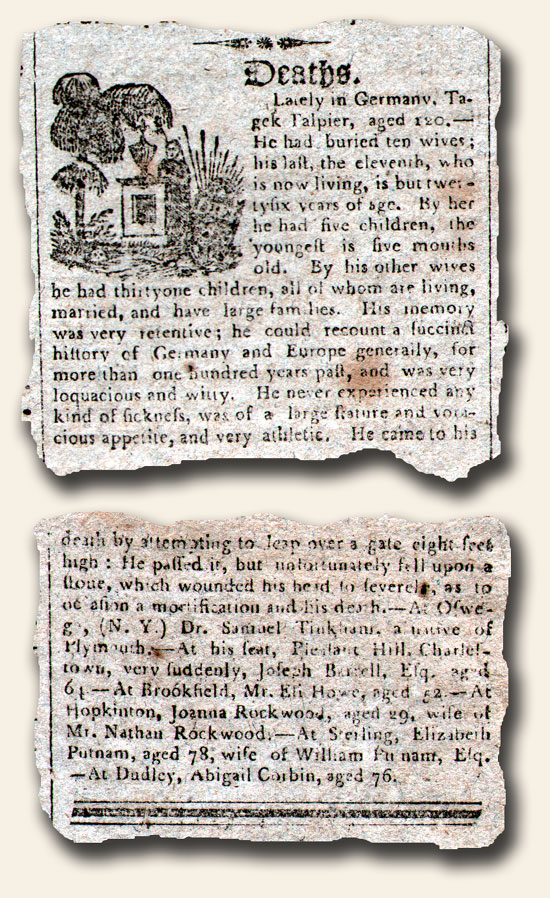
Period printing… Did you ever notice…?
April 30, 2012 by GuyHeilenman · 1 Comment
A few months ago we received an inquiry from one of our friends wondering why pre-1900 newspapers included a period after the newspaper’s title in the masthead. While I hold hundreds of such issues in my hands each week, I had never taken notice of this. Wondering if this was in fact the case, I quickly began searching through our 19th and 18th century archives, and low and behold, every title ended with a period. Searching through our 20th century inventory I discovered that none of the issues did. I asked Tim Hughes his thoughts on the matter, and his response was as follows:
Regarding the query about periods at the end of 19th century titles, I don’t believere there is a reason beyond it simply being the grammatical style of the  period. In fact the practice goes back to the 17th and 18th centuries as well. It was just the way newspapers (and magazines) were laid out, perhaps following some sort of grammatical “rule” of the day. There was also–compared to today–an excessive use of commas within text, which again was just the style of the day.
Perhaps the more interesting question would be when & why was the period eliminated at some point in the 20th century? I would suspect one paper just made the decision and everyone else eventually followed, as there was much competition and copying among newspapers. Sorry I don’t have a more intriguing answer!
If any of our readers have additional information in regards to this, feel free to respond.
Robert E. Lee… a touching tribute…
April 27, 2012 by GuyHeilenman · 3 Comments
Buried deep within a September 3, 1868 issue of The New-York Times is a touching tribute to Robert E. Lee. This, along with several other articles from throughout the newspaper, provide a glimpse of this difficult post-Civil War period – with Nathan Bedford Forrest’s interview, the tension over support for Ulsysses S. Grant’s run for the Presidency, and reports from both the Republic and Democratic Party’s conventions providing the backdrop for this almost overlooked intimate letter from the editor of the Fredericksburg News.