

Search
The Rare & Early Newspapers Hobby

Receive the Newsletter

Buy Historic Newspapers

One newspaper, nine cities…
December 27, 2010 by TimHughes · Leave a Comment
“The Memphis Daily Appeal” newspaper was one with a fascinating history during the years of the Civil War. Memphis was a Confederate stronghold up through the Battle of Memphis on June 6, 1862, at which time the Yankees moved in and it became a Yankee city. The “Appeal“, very much dedicated to the Southern cause rallying both civilians & soldiers, was the most important newspaper of the region & was soon famously known as the “Moving Appeal.”
On June 6, 1862, the presses and plates were loaded into a boxcar and moved to Grenada, Mississippi, where it stayed for a few months until approaching Federal troops threatened again, forcing a move in November 1862 to Jackson, Mississippi, where it published until May 1863, when Federal troops again arrived. By this time, the “Appeal” had gained notoriety among Union forces as a rebel sympathizer while it remained on the run. The next stop was Meridian, Mississippi, from where, one issue and two days later, the wandering journalists moved on to Mobile, Alabama, then to Montgomery, and ultimately to Atlanta, the economic heart of the Confederacy. Publication from Atlanta began in June 1863 and continued through July 1864, when it returned to Montgomery, where it published from September 1864 to April 1865. Its final move was to Columbus, Georgia, where Federal forces finally caught up with it. It resumed publication following the war in Memphis on November 5, 1865. During just a four year period this newspaper published in nine different cities. (credit: Tennessee State Library & Archives)
“Go West, young man…”
December 20, 2010 by TimHughes · 2 Comments
I know there is dispute over who first used the oft-cited phrase: “Go West, young man…” widely attributed to Greeley. The following provides some background:
“…That is a question that is still being argued more than a century later. Horace Greeley (1811-72), founder of the New York Tribune, has long been quoted for his line in a July 13, 1865 editorial. The authorship was disputed, however, in the 1981 book, The People’s Almanac, by David Wallechinsky & Irving Wallace. They were not the first to dispute the parentage, but they certainly popularized the argument. They claimed that John B. Soule (1815-1891) penned the line 14 years earlier, in 1851, in an editorial in the Terra Haute, Indiana, Express.
That was not the end of the argument and all its permutations, however, because in September, 2004, author Thomas Fuller confused the matter even further when he published an article in the Indiana Magazine of History in which he claimed that he could not find any such quote by Soule. In fact, he could not even find a published claim for Soule’s parentage before 1890. That revelation intrigued us because we have always noticed how odd it is that a date in 1851 has never been supplied. The lack thereof always rings an alarm and suggests that the writer is merely quoting someone else. So, let us look at the evidence.
Hal Gordon wrote this summary of Greeley’s editorial:
Greeley’s editorial in the New York Tribune in 1865 was addressed specifically to young civil servants in Washington, D.C. who were complaining that the government didn’t pay them enough, given the high cost of living in the nation’s capital. Greeley had scant sympathy for them. He wrote: “Washington is not a place to live in. The rents are high, the food is bad, the dust is disgusting and the morals are deplorable. Go West, young man, go West and grow up with the country.”
Despite the controversy, there seems to be a general consensus among the many citations on the internet that Greeley used the phrase in his July 13, 1865 editorial, as noted above. I have the Tribune of the 13th and scoured through the issue yet never found the quote. The closest I could come is in “The Homestead Law” piece, page 4 col. 4, where he mentioned: “…We earnestly urge upon all such to turn their faces Westward and colonize the public lands…” (see below).
Am I missing something? Does the phrase actually exist somewhere in this newspaper? Could one erroneous citation many years ago have been cited again and again without anyone actually checking the newspaper to verify? Perhaps some collectors have this issue, or perhaps another edition with this famous quote. I would appreciate hearing from anyone who might be able to offer some helpful information.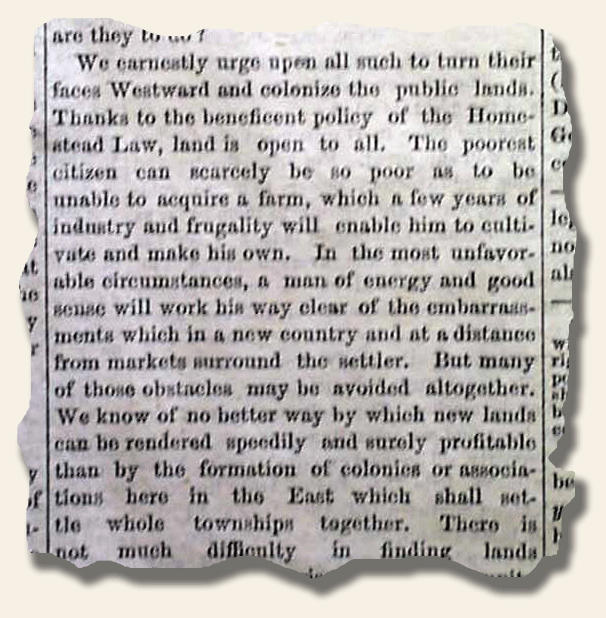
Cigarettes do not cause cancer…
December 18, 2010 by TimHughes · 1 Comment
Hindsight means everything when it comes to history, and browsing through the pages of newspapers from years ago can often turn up reports which now are almost humorous in their inaccuracy. One item: “Clears Cigarettes As Cancer Source”, which appeared in the July 10, 1928 issue of the “New York Times“, provides some interesting reading in light modern scientific research about the effects of cigarette smoking and cancer.
The Traveler… West Florida and fencing…
December 16, 2010 by The Traveler · Leave a Comment
 This weeks travels brought me to the Connecticut Mirror dated December 17, 1810 where I found the second page to contain numerous articles pertaining to the independence of West Florida. Included is President James Madison’s message including the proclamation in which a portion states “Now be it known, that I, JAMES MADISON, President of the United States of America in pursuance of these weighty and urgent considerations, have deemed it right and requisite, that possession should be taken of the said territory, in the name and behalf of the U. States…” Letters from both the Florida and West Florida’s are in this issue as well.
This issue carries numerous advertisements – one being illustrated. It is an unusual one of a Fencing Exhibition being held by Mr. P. Thomas with an admission price of 37-1/2 cents!
~The Traveler
What could have been…
December 13, 2010 by TimHughes · Leave a Comment
One might wonder how some significant events in history might have been responded to had reaction been different from what the history books note. During the Civil war the “Albany Atlas” decided to fool with history a bit following the Emancipation Proclamation, and supposed a “Counter Proclamation” by the Confederate President, Jeff Davis. The article shown–which appeared in the Confederate newspaper “Memphis Daily Appeal” of January 23, 1863 (while printing in Jackson, Mississippi at the time)–makes for some interesting reading on what could have happened in history (see below).
A collector sells bound volumes in 1878…
December 11, 2010 by TimHughes · Leave a Comment
This advertisement appeared in the “Scientific American” issue of June 22, 1878, noting a collector who has various bound volumes of the title, selling for $1 each. How prices have changed.
What could happen to a rumor…
December 9, 2010 by TimHughes · Leave a Comment
“The Daily Journal” newspaper of August 20, 1861 from Wilmington, North Carolina, a Confederate publication, printed an interesting series of dispatches of a fictitious assassination attempt upon President Lincoln (see below). They provide an interesting perspective on how a dramatic event could be much less so once more trustworthy news reports found their way to the press.
The reliability of news reports was a big problem in the 18th & 19th centuries during the pre-telegraph, pre-wire service days when word of mouth was often the source of what made it into the newspaper. This somewhat comical piece illustrates a quandary likely dealt with by most newspaper publishers of the day.
First use of the term “Columbia”…
December 6, 2010 by TimHughes · 2 Comments
Finding “first” mentions of significant, people, places and terms is always a delight for the rare newspaper collector, and with the internet–and the time required–many fascinating items can be found.
The term “Columbia” as a reference to America, very commonly used through the 19th century in both print & image, was first used in the London publication “Gentleman’s Magazine” in 1738. Because the printing of Parliamentary debates was illegal in England, they appeared under the thinly veiled heading of “Debates in the Senate of Lilliput” or similar heading, with names & places often fictitious or taken from Johnathan Swift’s famous work, which was the literary sensation at that time. The term Columbia was coined by the famed Samuel Johnson, a regular contributor to the “parliamentary” reports found in “The Gentleman’s Magazine“.
In the June issue of 1738, the debates from Parliament note: “…It is observable that their conquests and acquisitions in Columbia (which is the Lilliputian name for the country that answers our America,) have very little contributed to the power of those nations…”.
A significant “first use” of a very popular poetic name for the United States of America.
Lamenting the handwritten word…
December 4, 2010 by TimHughes · Leave a Comment
In today’s world of email, instant messaging, and twitter, there are many who lament the “old days” when people took the time to type out a letter, sign it, and use a stamp & envelope to get it to its destination. This item, found in “The Townsend Messenger” of Montana, issue date of March 18, 1892, takes that “lament” back one step further when the typewriter replaced the handwritten note.
The Traveler… up the canal… ready to sign on the dotted line…
December 2, 2010 by The Traveler · Leave a Comment
 It is so hard to believe that I am now traveling into the journals for December already. I found The Christian Science Monitor of December 2, 1910 to be very interesting, but I’ll highlight only two articles. The front page reports the sailing of the first vessel up the Panama Canal. This was a three-masted steam 17-foot yacht, Visitor II, owned by Commodore W. Harry Brown of Pittsburgh, which sailed to the Gatun lock and returned.
 The other article is found on the sports page, “Soon to Sign Contracts for New N.Y. Stadium”. This was to be a $500,000 stadium which President Frank J. Farrell of the New York Americans plans to build at Kingsbridge. After doing quite a bit of internet researching, it isn’t quite certain if this may have been a stadium that existed prior to the earlier Yankee Stadium or not. It is noted that Mr. Farrell and William S. Devery were the first owners of the New York Highlanders, now the New York Yankees.
~The Traveler