
Search
The Rare & Early Newspapers Hobby

Receive the Newsletter

Buy Historic Newspapers

One newspaper, nine cities…
December 27, 2010 by TimHughes · Leave a Comment
“The Memphis Daily Appeal” newspaper was one with a fascinating history during the years of the Civil War. Memphis was a Confederate stronghold up through the Battle of Memphis on June 6, 1862, at which time the Yankees moved in and it became a Yankee city. The “Appeal“, very much dedicated to the Southern cause rallying both civilians & soldiers, was the most important newspaper of the region & was soon famously known as the “Moving Appeal.”
On June 6, 1862, the presses and plates were loaded into a boxcar and moved to Grenada, Mississippi, where it stayed for a few months until approaching Federal troops threatened again, forcing a move in November 1862 to Jackson, Mississippi, where it published until May 1863, when Federal troops again arrived. By this time, the “Appeal” had gained notoriety among Union forces as a rebel sympathizer while it remained on the run. The next stop was Meridian, Mississippi, from where, one issue and two days later, the wandering journalists moved on to Mobile, Alabama, then to Montgomery, and ultimately to Atlanta, the economic heart of the Confederacy. Publication from Atlanta began in June 1863 and continued through July 1864, when it returned to Montgomery, where it published from September 1864 to April 1865. Its final move was to Columbus, Georgia, where Federal forces finally caught up with it. It resumed publication following the war in Memphis on November 5, 1865. During just a four year period this newspaper published in nine different cities. (credit: Tennessee State Library & Archives)
“Go West, young man…”
December 20, 2010 by TimHughes · 2 Comments
I know there is dispute over who first used the oft-cited phrase: “Go West, young man…” widely attributed to Greeley. The following provides some background:
“…That is a question that is still being argued more than a century later. Horace Greeley (1811-72), founder of the New York Tribune, has long been quoted for his line in a July 13, 1865 editorial. The authorship was disputed, however, in the 1981 book, The People’s Almanac, by David Wallechinsky & Irving Wallace. They were not the first to dispute the parentage, but they certainly popularized the argument. They claimed that John B. Soule (1815-1891) penned the line 14 years earlier, in 1851, in an editorial in the Terra Haute, Indiana, Express.
That was not the end of the argument and all its permutations, however, because in September, 2004, author Thomas Fuller confused the matter even further when he published an article in the Indiana Magazine of History in which he claimed that he could not find any such quote by Soule. In fact, he could not even find a published claim for Soule’s parentage before 1890. That revelation intrigued us because we have always noticed how odd it is that a date in 1851 has never been supplied. The lack thereof always rings an alarm and suggests that the writer is merely quoting someone else. So, let us look at the evidence.
Hal Gordon wrote this summary of Greeley’s editorial:
Greeley’s editorial in the New York Tribune in 1865 was addressed specifically to young civil servants in Washington, D.C. who were complaining that the government didn’t pay them enough, given the high cost of living in the nation’s capital. Greeley had scant sympathy for them. He wrote: “Washington is not a place to live in. The rents are high, the food is bad, the dust is disgusting and the morals are deplorable. Go West, young man, go West and grow up with the country.”
Despite the controversy, there seems to be a general consensus among the many citations on the internet that Greeley used the phrase in his July 13, 1865 editorial, as noted above. I have the Tribune of the 13th and scoured through the issue yet never found the quote. The closest I could come is in “The Homestead Law” piece, page 4 col. 4, where he mentioned: “…We earnestly urge upon all such to turn their faces Westward and colonize the public lands…” (see below).
Am I missing something? Does the phrase actually exist somewhere in this newspaper? Could one erroneous citation many years ago have been cited again and again without anyone actually checking the newspaper to verify? Perhaps some collectors have this issue, or perhaps another edition with this famous quote. I would appreciate hearing from anyone who might be able to offer some helpful information.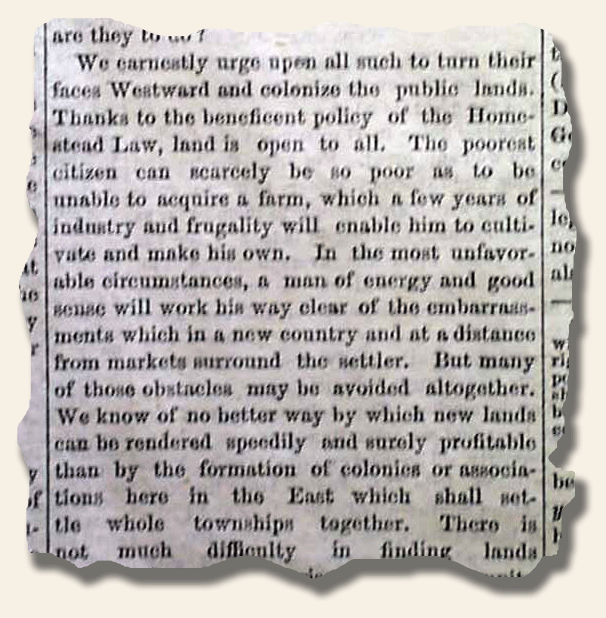
What could have been…
December 13, 2010 by TimHughes · Leave a Comment
One might wonder how some significant events in history might have been responded to had reaction been different from what the history books note. During the Civil war the “Albany Atlas” decided to fool with history a bit following the Emancipation Proclamation, and supposed a “Counter Proclamation” by the Confederate President, Jeff Davis. The article shown–which appeared in the Confederate newspaper “Memphis Daily Appeal” of January 23, 1863 (while printing in Jackson, Mississippi at the time)–makes for some interesting reading on what could have happened in history (see below).
What could happen to a rumor…
December 9, 2010 by TimHughes · Leave a Comment
“The Daily Journal” newspaper of August 20, 1861 from Wilmington, North Carolina, a Confederate publication, printed an interesting series of dispatches of a fictitious assassination attempt upon President Lincoln (see below). They provide an interesting perspective on how a dramatic event could be much less so once more trustworthy news reports found their way to the press.
The reliability of news reports was a big problem in the 18th & 19th centuries during the pre-telegraph, pre-wire service days when word of mouth was often the source of what made it into the newspaper. This somewhat comical piece illustrates a quandary likely dealt with by most newspaper publishers of the day.
First use of the term “Columbia”…
December 6, 2010 by TimHughes · 2 Comments
Finding “first” mentions of significant, people, places and terms is always a delight for the rare newspaper collector, and with the internet–and the time required–many fascinating items can be found.
The term “Columbia” as a reference to America, very commonly used through the 19th century in both print & image, was first used in the London publication “Gentleman’s Magazine” in 1738. Because the printing of Parliamentary debates was illegal in England, they appeared under the thinly veiled heading of “Debates in the Senate of Lilliput” or similar heading, with names & places often fictitious or taken from Johnathan Swift’s famous work, which was the literary sensation at that time. The term Columbia was coined by the famed Samuel Johnson, a regular contributor to the “parliamentary” reports found in “The Gentleman’s Magazine“.
In the June issue of 1738, the debates from Parliament note: “…It is observable that their conquests and acquisitions in Columbia (which is the Lilliputian name for the country that answers our America,) have very little contributed to the power of those nations…”.
A significant “first use” of a very popular poetic name for the United States of America.
Amazing Stories… The Loch Ness Monster…
November 29, 2010 by GuyHeilenman · 2 Comments
Today we begin a series of “Amazing Stories” found within original newspapers. We’ve always stated, and newspaper collectors agree, “History is never more fascinating than when it is read from the day it was 1st reported”. Over the course of the next several months we are going to highlight some of the more interesting and/or amazing stories/reports to be found within historic newspapers. Today’s installment: the printing of the photograph and the corresponding report of… The Loch Ness Monster (see below). The article and photograph shown appeared in The New York Times dated April 22, 1934. Additional images are available at: Loch Ness Monster. Enjoy.
A rare report… Wild Bill Hickok…
November 22, 2010 by TimHughes · 3 Comments
Some reports have gained greater notoriety long after the event happened, particularly those of the Old West which have been romanticized by television, movies and countless books on the era. The gunfight at the O.K. Corral is one, and the report of the killing of Wild Bill Hickok is another. Neither are commonly found in newspapers of the day with the Hickok report being one of the more difficult to find, and typically on a brief report when found.
We recently came across the “New York Herald” of August 13, 1876 with the report & thought it worth sharing: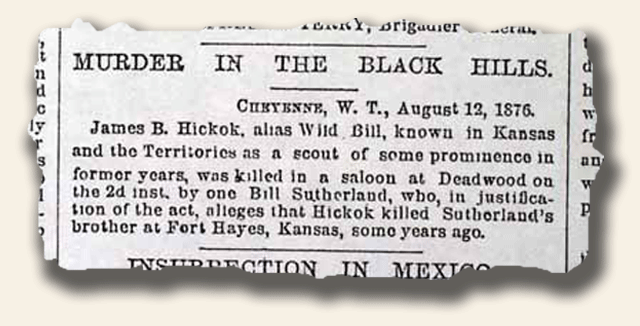
Mission to Mars… Climb aboard…
November 6, 2010 by GuyHeilenman · Leave a Comment
 As China, Russia, and the U.S. (among others) begin to enter a new space race – a manned mission to the Red Planet, we are reminded of the early days of flight when dreams were high and understanding was… perhaps a bit lacking. While early film fueled the excitement, it wasn’t until knowledge of Robert Goddard’s work became widespread that the thought of space travel made the leap from dream to real possibility. These dreams took a hit on January 13, 1920 when the NY Times printed an editorial (unsigned) which scoffed at the proposal. However, on February 4, 1920, the President of the Aviator’s Club of Pennsylvania, Captain Claude R. Collins, restored the public’s hopes of space travel when he volunteered to be a passenger on a Mars bound rocket, if ever developed. Ironically, this “offer” was published on the front page of the of the February 5, 1920 NY Times (see image), alongside of the announcement from the Smithsonian Institution stating Goddard had invented and tested a rocket that might have the potential to reach the moon. This battle between nay-sayers and dreamers continues to this day. I wonder how we will be looked upon 100 years from now?
April 15, 1865 New York Herald reprints… revisited…
November 1, 2010 by GuyHeilenman · 10 Comments
 A previous post by guest contributor Rick Brown detailed how one can identify whether or not their April 15, 1865 New York Herald is authentic. One of the most notable differences between an authentic issue (which is quite rare) and one of the reprints (which are rather common) is that the common reprint has an image of President Lincoln on the front page, whereas, the original does not. We recently came across a photo of the Lincoln image (as shown to the right). If your issue has it… unfortunately, your’s is not an original.
A great rarity comes into our inventory…
October 7, 2010 by TimHughes · Leave a Comment
 One of the more rare items in the world of early newspaper collecting has come into our inventory: a collection of the very first newspaper in Hawaii, including the volume one, number one issue.
Hawaii’s first newspaper was essentially a student newspaper, titled “Ka Lama Hawaii” (The Hawaiian Luminary), done by Protestant missionaries at their school at Lahainaluna on the island of Maui. The missionaries transported a printing press some 18,000 miles around Cape Horn to Hawaii, setting up what would become the very first newspaper building west of the Rocky Mountains. The newspaper was printed in the Hawaiian language on the manually operated flatbed press which could turn out 100 sheets per hour. Content included articles on government, Christian teachings, and in keeping with the educational element, illustrations of exotic animals like the lion, elephant and zebra. The very first issue, dated Feb. 14, 1834, was dominated by an essay on the habits & habitats of the lion.
This newspaper lasted for just these 25 issues printed in 1834, then did not print for several years only to resurrect itself to print just two final issues in January, 1841. Not only is it the first newspaper in Hawaii, but it also predates any newspaper in North America west of the Rocky Mountains.
We felt these rare issues were worth sharing with fellow collectors.

