
Search
The Rare & Early Newspapers Hobby

Receive the Newsletter

Buy Historic Newspapers

A Christmas wish… 2013…
December 23, 2013 by GuyHeilenman · Leave a Comment
While Christmas is certainly a time when many who would not normally do so reflect on the spiritual, historic newspapers reveal a time when the lines between the spiritual and the physical were not nearly so distinct. Religion, while largely stripped from the currently public square, was part and parcel of daily conversation in the not to distant past. An example would be the following report of the importance of religion in the lives of Civil War soldiers found in the Hammond Gazette (Point Lookout, MD) of September 22, 1863. My Christmas wish is that we would regain our previous understanding of the role of true religion in everyday life, minus the driving harsh conditions of the past. Please enjoy.


A good reason to stand & fight…
December 20, 2013 by TimHughes · Leave a Comment
The “Hammond Gazette” hospital newspaper from the Civil War, dated August 25, 1863, has an interesting front page item concerning the “Gray Beard Brigade” (see below) and why they are inclined to stand & fight. And also a likely reason why one of their elderly members joined the army.
A lament of a dying soldier…
December 13, 2013 by TimHughes · Leave a Comment
Occasionally the human side of war comes through in the newspapers of the day, giving hard evidence of the tragedy of lost life and how it affects those back home. The front page of the: “Hammond Gazette” from Point Lookout, Maryland, Jan. 27, 1864, contains a poem titled “Who Will Care for Mother Now?” (see below) It reflects the sorrows & concerns of a dying soldier, and obviously attracted much attention as the internet is full of references to this poem, which at some point was to music as well.
Soldier gets a “Dear John” letter…
December 9, 2013 by TimHughes · Leave a Comment
The tragedies of the Civil War touched many facets of life, from the pain & hardships of the soldiers to dealing with the loss of loved ones. The war affected the love lives of many as well, as evidenced by this letter found in the “Hammond Gazette” hospital newspaper from Point Lookout, Maryland, September 15, 1863.
What about three wrongs making a right?
December 6, 2013 by GuyHeilenman · Leave a Comment
 Finishing out our month-long tribute to the memory of John F. Kennedy, today we look at what may have been the closing chapter of the tragic death-sequence which began on November 22, 1963 with the assassination of JFK, advanced to November 23, 1963 with the shooting and death of Lee Harvey Oswald, and culminated on January 3, 1967 with the passing of death-row inmate, Jack Ruby. Many to this day are convinced that all three deaths are rife with conspiracy. Perhaps time will prove them to be correct.
Finding newspapers on the death of Ruby are quite difficult as the event was not deemed significant by most, and many institutions were no longer saving their newspapers for year-end binding – choosing instead to store them on microfiche to conserve precious storage space. However, every now and then one turns up. Please enjoy (?) the January 3, 1967 report as it appeared in The Parsons Sun (Kansas): The Death of Jack Ruby
Civil War era reflections on Thanksgiving…
November 28, 2013 by GuyHeilenman · Leave a Comment
 Since we are in the midst of the 150 anniversary of the Civil War, we thought some might enjoy exploring the mention of thanksgiving (holiday and otherwise) within CW era issues arranged in chronological order. The issues may be viewed at:
Thanksgiving through the Civil War
Happy Thanksgiving!
Guy Heilenman
The Gettysburg Address… What did he actually say?
November 19, 2013 by GuyHeilenman · 1 Comment
“Four score and seven years ago…”
150 years ago this month, President Abraham Lincoln delivered what we now consider to be one of the greatest speeches of all time. Interestingly enough, since 5 different manuscripts exist, there is some disagreement amongst historians concerning what he actually said. Might original newspapers of the day with eye witness accounts provide the answer? If the speech had been long we probably wouldn’t have a high degree of confidence in the newspaper reporters’ accounts, but the brevity of the speech certainly increases the probability of an accurate transcription. Original reports may not have the definitive answer to this question, but they certainly provide reasonable evidence regarding what was actually spoken. Once again, “History is never more fascinating than when it is read from the day it was first reported.“
View Authentic Newspapers with Gettysburg Address Coverage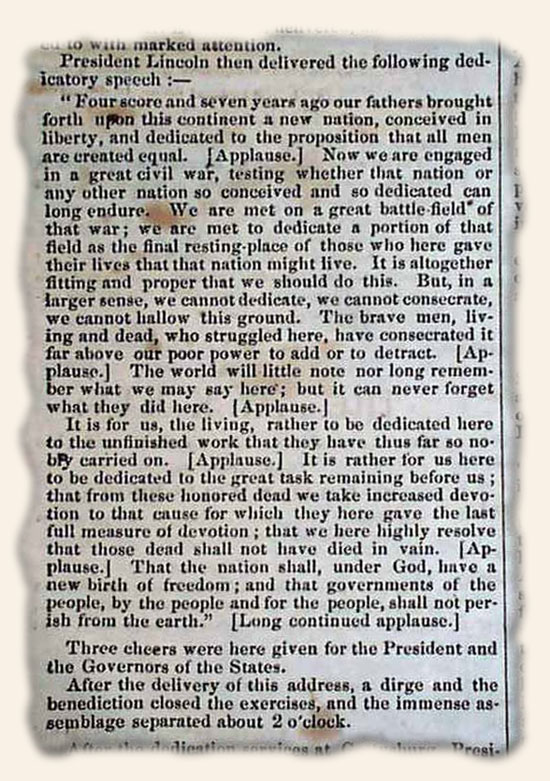
Where has all the time gone?
November 18, 2013 by GuyHeilenman · Leave a Comment
 Fifty years ago this week my older sister and I came in from carving Matchbox-car-sized roads through the previously well-manicured turf of our backyard to find our mother staring at the semi-snowy, partially visible screen of our black and white television with tears streaming down her face. Not being prone to such outward displays of emotion, her anguish screamed to us that something tragic had happened. This moment was emblazoned in our minds for life… and was reinforced days later when she took us by the hand to lead us on the long trek to the railroad overpass a few miles from our home to peer over the edge to watch a train draped with a flag pass under our feet. President John F. Kennedy was dead! While at the time my sister and I had no idea whether or not he was a good president (for to a child, all presidents are good), one thing we knew for sure, something vanished from people’s eyes which has yet to return – American innocence.
 As we reflect on this snap-shot of innocence lost, we wonder where it all began – that is, the overwhelming common-man devotion which inspired many to “Ask not what your country can do for you…”. When did the admiration of the crowd begin? Was it when he was proclaimed a WWII hero as the Captain of PT-109, or did it spring-forth from his impact as a Massachusetts Representative with his first political election victory? While it may be hard to sort out how he had become so beloved, one thing is certain: a split-second in time along a Dallas street changed everything.
Feel free to share your “memory” of November 22, 1963.
To commemorate this historic moment (November 22, 1963), we’ve assembled a host of “assassination-report” newspapers from all over the country. They are viewable at: JFK Assassination.
Discovering the eloquence of Washington…
October 14, 2013 by TimHughes · Leave a Comment
One of the benefits of collecting notable newspapers is not only the joy of finding an historically significant report–like Washington’s proclamation announcing the formal end of hostilities with England–but appreciating the eloquence of our leaders of years past. With all our modern intelligence & computer-enabled resources at our fingertips, it seems like the simple skill of writing has been lost with our generation.
The referenced event was recently discovered in the “Pennsylvania Journal & Weekly Advertiser” newspaper of April 30, 1783. Page two contains this very historic report, but of equal fascination is the wording of the document. He congratulates the Army, noting that those who have performed the “…meanest office…” have participated in a great drama “…on the stage of human affairs…For these are the men who ought to be considered as the pride and boast of the American Army; And, who crowned with well earned laurels, may soon withdraw from the field of Glory, to the more tranquil walks of civil life…Nothing now remains but for the actors of this mighty Scene to preserve a perfect, unvarying, consistency of character through the very last act; to close the Drama with applause; and to retire from the Military Theatre with the same approbation of Angels and men which have crowned all their former virtuous actions.” There is evidence of Washington’s less formal and more pedestrian side as well as he ends the document with: “An extra ration of liquor to be issued to every man tomorrow, to drink Perpetual Peace, Independence and Happiness to the United States of America.” See this hyperlink for the full text (or the text of the actual newspaper below).
What a thrill to find such a document which has rested on our shelves for many years just waiting to be discovered. What a thrill to be involved in such a fascinating hobby.
The first newspapers in Vermont…
October 4, 2013 by TimHughes · Leave a Comment
Vermont was the first state to join the union outside of the original thirteen colonies, although in a sense they were always a part of the federal union. The territory of present-day Vermont was previously divided among the states of Massachusetts, New Hampshire, and New York.
 The first newspaper in Vermont was the “Vermont Gazette, and Green Mountain Post-Boy” done in Westminster, first published on February 12, 1781. Only one of this issue exists and is in the Vermont Historical Society. Its first newspaper began later than all of the other first newspapers of the original 13 states. The weekly newspaper only lasted until 1783, published by Judah Spooner and Timothy Green, the latter of the famous family of printers from New England.
It is notable that Vermont’s first newspaper was printed on the famous “Daye Press”, brought from England by Stephen Daye in 1638 and set up in Cambridge, Massachusetts. The press came into the possession of Harvard College in 1656, and in 1714 it became the property of Timothy Greene, who took it to New London, Conn., later set up in Norwich, Conn. by Alden Spooner, and in 1781 it was moved to Westminster, Vermont.
The second newspaper in Vermont was founded on August 7, 1783 titled the “Vermont Journal & the Universal Advertiser” printed in Windsor by the partnership of Alden Spooner and George Hough. The newspaper continued publishing into the 20th century.
Other 18th century Vermont titles included “Herald of Vermont“, Rutland, 1792; “Rutland Herald“, 1794; “Fair Haven Gazette“, 1795; “Farmer’s Library“, Fair Haven, 1795; “Burlington Mercury“, 1796; and “Federal Galaxy“, Brattleboro, 1797.