

Search
The Rare & Early Newspapers Hobby

Receive the Newsletter

Buy Historic Newspapers

The reason I collected it: Predicting the 21st century from a perch in 1929…
June 12, 2023 by TimHughes · Leave a Comment
Who hasn’t given some thought to what life would be like in 50 years, or 75 years. A few enterprising newspaper publishers have as well, and the Daily Mail of London, January 1, 2000 is a great–and quite rare–example.
You see, this is actually a newspaper published in 1928. This is a futurist newspaper. We’ve handled a few, but they are exceedingly scarce. It was printed based on their perception of what life, news, entertainment, politics, and culture would be like 72 years in the future. What is most intriguing is that this future date is already in our distant past, so it is interesting to see what people in 1928 thought life would be like in 2000. In general, their hopes would prove to be disappointing to any reader who might have lived until 2000.
From beginning to end, this 24-page tabloid-size newspaper is all about the future. It had to be an exhausting project, but it certainly resulted in a most intriguing addition to any newspaper collection. 
The reason I collected it: Freeman’s Journal & Philadelphia Mercantile Advertiser, Oct. 21, 1812…
May 1, 2023 by TimHughes · Leave a Comment
Some 47 years ago when I (Tim Hughes) started collecting and selling early newspapers, the collector part of me want to keep any issues I found intriguing, unusual, and historic. I really just wanted the “business” side of the hobby to support my “collector” side.
Once a month I will highlight one of the saved issues and will explain why. Not all will be rare, not all will be valuable, and some will be simply bizarre. But they intrigued me, and so I share with all of you.
An eagle motif in mastheads is rather common, most rather small & proportional to the type used for the title. But the Freeman’s Journal & Philadelphia Mercantile Advertiser (the Oct. 21, 1812 issue is shown below) has perhaps the largest eagle I have found, with a wingspread of nearly 7 inches. I’m glad I saved one many years ago as I haven’t seen this title in quite some time.
Recalling Paul Revere’s ‘midnight ride’…
March 4, 2021 by TimHughes · 2 Comments
As newspaper collectors we relish the opportunity to find newspaper accounts of the intriguing moments in American–if not world–history.
But many events simply did not make it to print.
An account of the pealing of the Liberty Bell in 1776, a detailed account of Washington’s crossing of the Delaware, Nathan Hale’s boast ‘I only regret I have but one life to lose for my country’, and Patrick Henry’s bold pronouncement ‘Give me liberty or give me death!’ are but a few.
Accounts of Paul Revere’s midnight ride rank among them. In our 45 years in the hobby we can recall only two newspapers having but a very brief reference to the ride. It was not until Longfellow’s poem ‘Paul Revere’s Ride’, written in 1860, did the world become familiar with the daring and patriotic mission.
We recently discovered a fascinating nugget on Revere’s ride.
A 1795 issue of the Boston newspaper Columbian Centinel (December 5, 1795) has a supportive letter from when Paul Revere was running for the vacated post of Town Treasurer. The writer makes rather derailed reference to the event in 1775, far more detailed than any account previously found despite being 20 years after it happened. See the photo for the full report.
Such little gems, typically buried inconspicuously among the political reports, advertisements, and varied notices of the day, are what thrill those in the search of notable events in history.
Is this the earliest Presidential portrait in a newspaper?
February 4, 2021 by TimHughes · 5 Comments
We recently discovered the November 23, 1844 issue of the iconic “Illustrated London News” from England, featuring on the front page portraits of James K. Polk and Henry Clay, both candidates for the Presidency.
 Knowing this was a very early of a portrait of a President in a newspaper, I did a little digging to see if it might be, in fact, the earliest.
I could not confirm an earlier one. Research did note that the issue of April 19, 1845 of the same newspaper has a print showing the inaugural ceremonies and the procession to the Capitol, but that was 5 months later.
Given that most of the illustrated newspapers would not begin until the mid-19th century (Gleason’s Pictorial began in 1851), none of the more well-known American illustrated periodicals existed in 1844. Even Harper’s New Monthly, which had a wealth of small prints in each issue, did not begin until 1850.
Any collectors out there aware of an earlier print of a U.S. President in a periodical? It would be great to document the earliest, whether it’s this Nov. 23, 1844 issue or another.
The Titanic orphans: the rest of the story…
December 21, 2020 by TimHughes · Leave a Comment
One of the advantages of reading a newspaper with fascinating reports from long ago is the ability to investigate and see how the “event” came to a conclusion.

Such is a case with a Detroit newspaper dated six days after the Titanic’s sinking which had a front page photo of the: ” ‘Orphans Of The Titanic:’ Parents Gone and Even Names Unknown“, the caption noting in part that the: “…two little orphans, who were found clasped in each others’ arms in one of the lifeboats…thought to be the children of an unknown…French couple…The little ones speak only French…all efforts to establish their identity have so far failed…”.
And there the story ends for readers of that April 21, 1912 issue of the Detroit News-Tribune. One wonders what became of the unfortunate children.
Well, they were part of an intriguing story with a good ending.
This link has the details, but in short, the children’s father absconded from France with the boys after losing custody of them in a divorce settlement. The father died on the Titanic, and photos of the boys in newspapers were identified by the mother in France, who would soon be reunited with them.
Did you ever read a news report from a century ago and wonder how it finished out? The internet makes it possible to find out!
Earliest Lincoln letter published in a newspaper?
December 14, 2020 by TimHughes · Leave a Comment
Finding the earliest mention of notable people in period newspapers, long before they would become national figures, is a quest of many. Such nuggets–when found–can become treasured pieces for any collection.
We recently discovered what, by our research, is the earliest letter signed by Lincoln to appear in a newspaper. The “New York Weekly Tribune” of July 8, 1848 printed a letter signed A. Lincoln from when he was a representative from Illinois in the national legislature (see photos).In our 44 years of experience this is the earliest we have encountered. One would think letters may have appeared in his local Springfield, Illinois newspaper but lacking the holdings to do such research we can only speculate.
Are any collectors out there aware of an earlier published letter signed by Lincoln? Let the collecting world know!

You know of Molly Pitcher. Do you know of Betsy Doyle?
November 5, 2020 by TimHughes · Leave a Comment
On November 22, 1812 the British, at Fort George, were cannonading the Americans at Fort Niagara. George McFeeley was the American commander and several days later made his official report to Brigadier General Smyth.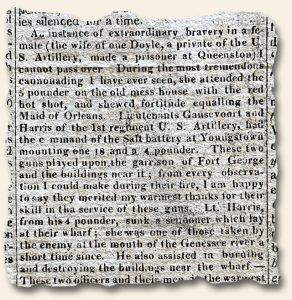 Within the report McFeeley noted: “…An instance of extraordinary bravery in a female (the wife of one Doyle, a private in the United States Artillery, made a prisoner at Queenston,) I cannot pass over. During the most tremendous cannonading I have ever seen, she attended the six-pounder on the mess-house with red hot shot, and showed fortitude equal to the Maid of Orleans…”.
In an act of female heroism during combat, much like the work of Molly Pitcher (although considered folklore by many historians), Betsy Doyle played a notable role. A mother of four whose husband was captured at the Battle of Queenston & held as a prisoner by the British, after some gunners were wounded Betsy stepped in to help. The Americans were loading “red hot shot” into their guns to fire at Fort George. Betsy helped bring the shot from the fireplaces downstairs to the guns.
The December 16, 1812 issue of the “Boston Patriot” is one of few newspapers which reported this event.
Acts of female involvement in combat are rarely reported. Here is a nice one.
First women’s brokerage firm on Wall Street opens its doors…
October 15, 2020 by TimHughes · Leave a Comment
 In the 19th century world of Wall Street investment firms it was a male-dominated world. So it was with considerable “excitement” that two sisters–the notable Victoria Woodhull and Tennessee (Tennie) Claflin–would have the audacity to open an investment firm for women.
The New York Times issue of February 6, 1870 reported the event.
Under the headlines: “WALL STREET AROUSED” “The Female Brokers–The First Day’s Operations–Manner of Their Reception by the ‘Street’–A Word or Two Concerning the Adventurers” is the report of Victoria Woodhull (nee Claflin) and Tennessee (Tennie) Claflin being the first woman to open a brokerage firm on Wall Street.
As the website “Bumped” notes, Cornelius Vanderbilt helped Victoria and Tennessee with the finances needed for them to open Woodhull, Claflin, & Co., the first for-women-by-women brokerage firm in the United States.
On February 5, 1870, Victoria and Tennessee, then 31 and 24, officially opened the doors of Woodhull, Claflin, & Co. for business. Despite a sign stating, “Gentlemen will state their business and then retire at once,” most of the estimated four thousand visitors on that first day were men, presumably shocked by the women now working in their midst. Opening a successful brokerage wasn’t the whole plan. As Victoria later said, “We went unto Wall Street, not particularly because I wanted to be a broker…but because I wanted to plant the flag of women’s rebellion in the center of the continent.”
And in some ways, that’s exactly what she did. Later in 1870 the sisters used the profits from the brokerage firm to launch Woodhull & Claflin’s Weekly, one of the country’s first publications published by women.
Woodhull, Claflin, & Co. proved to be a huge success. According to some versions of the story, Victoria and Tennessee supposedly made $700,000 in the first six weeks (that’s more than $13 million today).
The magic of old newspapers, in 1844…
May 24, 2018 by TimHughes · Leave a Comment
 An 1844 issue of the “Adams Sentinel” (Oct. 14th) from Gettysburg, Pennsylvania, has an interesting front page item concerning the fascination of reading old newspapers, noting in part: “…few preserve them…brings up the very age, with all its bustle…marks its genius & its spirit more than the most labored description of the historical…” with more (see). An interesting perspective on the value of collecting old newspapers, written 174 years ago.
Women and baseball… Have things changed?
January 29, 2018 by TimHughes · Leave a Comment
 Even when when baseball was in its infancy the connection between women and baseball was worthy of comment in the “Porter’s Spirit of the Times” newspaper of Sept. 6, 1856.
Under the heading “Base Ball” which has much on a game played, are comments: “…and the attendance at each was not only very large, but made brilliant by great gatherings of ladies, whose interest in the sport seemed to be not at all short of that experienced by the most occupied observers of the other sex. We are inclined to think too, that this feature of these occasions has no little effect in inspiring the players in the games, and that the last energy of every contestant is taxed by the consciousness that he must win or lose in the minds of an exceedingly keen and scrutinizing class of lookers on. We are much pleased to see the beautiful and fair of this city lend the charm of their presence to the healthful out-door sports and exercises, and we have a shrewd opinion that more than one of them attends to ground with the view of sharply measuring among the players the qualities of what might make a serviceable future husband…”.