

Search
The Rare & Early Newspapers Hobby

Receive the Newsletter

Buy Historic Newspapers

Male chauvinism has its drawbacks…
June 13, 2009 by TimHughes · 1 Comment
 The newspaper with a curious title of “The Tickler” from Philadelphia, January 22, 1812, contains a comical little item at the bottom of the back page. Little “treats” such as these may be found throughout old newspapers. See the photo.
In the beginning…
June 8, 2009 by TimHughes · 1 Comment
 Some collectors like to pursue a newspaper from each of the original thirteen colonies, and ideally one dated as close as possible to the beginning of that colony’s first newspaper. For those active in this pursuit, we offer this list of the earliest in each.
Although the first newspaper in America was published in Boston in 1690, Benjamin Harris’ “Publick Occurrences Both Forreign & Domestick” lasted by a single issue before being suppressed by the Royal authorities. The first successful Massachusetts newspaper–and the first in all of the colonies–started 14 years later in 1704, also in Boston, titled “The Boston News-Letter” which continued until the British occupation of the city in 1776.
Here are the remaining colonies and the newspaper titles. As you see, originally in titles was not a strength among the newspaper publishers:
American Weekly Mercury (Penna.), 1719
The New York Gazette, 1726
The Maryland Gazette, 1728
The Rhode Island Gazette, 1732
The South Carolina Gazette 1732
The Virginia Gazette, 1736
The North Carolina Gazette, 1751
The Connecticut Gazette, 1755
The New Hampshire Gazette, 1756
The Newport Mercury (Rhode Is.), 1758
The Georgia Gazette, 1763
The New Jersey Gazette, 1777
It may seem curious that New Jersey was the last of the colonies to have its own newspaper, however given its location between the major metro areas of New York and Philadelphia there likely wasn’t an incentive to create its own until much later than the others.
Reducing old maids and increasing the population…
June 6, 2009 by TimHughes · Leave a Comment
 The Connecticut Courant issue of Hartford dated October 18, 1790 contains a curious piece taken from a Virginia newspaper, noting that:
“…a serious petition is now drawing up…stating arguments in favour of polygamy, from the plain principles of reason: and praying that a man may legally marry two wives. This, it is thought, will be the most effectual means to extirpate the numerous race of old maids, and increase the population of the United States…”
Editors take note: be mindful of photos accompanying headlines…
June 4, 2009 by TimHughes · 1 Comment
 The “Second Extra” of the Atlanta Journal newspaper of November 22, 1963 has a curious–if not macabre–combination of headline and photo. As would be expected of an “Extra” of this date, the large & bold headline proclaims: “KENNEDY KILLED” but immediately beneath it is a photo of a street sweeper pushing his bucket which has a pair of trousers & boots protruding from the top, with the caption: “Sweeper Means What He Says”.
One might excuse the editor, for I’m sure that in rushing this edition to the streets as quickly as possible the planned headline was removed and the Kennedy death report quickly inserted with little thought as to what else was scheduled for top half that day’s edition. But it serves as an important lesson to budding newspaper editors everywhere: be mindful of what what might accompany an article or photo.
Extensive list of reprinted newspapers…
June 2, 2009 by TimHughes · Leave a Comment
 The Library of Congress, as we previously discussed, maintains a web listing of the eighteen mostly commonly found reprinted newspapers. Most reprints which turn up today will be found in this list, however many others do exist.
Rick Brown, who maintains the “historybuff.com” website and who edited the journal “Collectible Newspapers” for many years, created a master list of some 567 reprinted newspapers. Should you encounter a newspapers and you are suspicious of its genuineness, check the list of titles and dates on “American Newspapers Known to Have Been Reprinted” which can also be accessed from the home page of our website. If the title & date appear on this list your suspicions many be justified.
If you care to take an additional step towards determining genuineness, Rick offers a more detailed “Annotated Index of Newspapers Editions Known To Have Been Reprinted…” for a modest charge, which offers additional details for each entry.
Although reprinted editions are exeedingly rare in the hobby of early newspapers—and most common reprints are easy for even a novice to spot—having access to such a list is of much value to the hobby and can provide some comfort when pursuing historic newspapers for one’s private collection.
Census with a bit of flair…
May 23, 2009 by TimHughes · Leave a Comment
“The Alaska Times” newspaper from Seattle, W.T. (Washington Territory), May 14, 1871, contains a very colorful front page article with a simple heading: “Alaska” which reports a census for Sitka. Enjoy reading how the inhabitants were categorized.

So what’s the earliest “London Gazette”?
May 21, 2009 by TimHughes · Leave a Comment
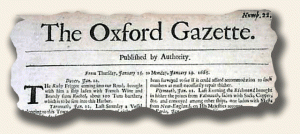 The world’s oldest continually published newspaper was begun in 1665 and still prints today, a staggering 345 year history which likely will never be broken by any other single title. Indeed, the newspaper still publishes today so it sets a more unbeatable record as each year passes.
The newspaper is titled “The London Gazette“, but collectors have occasionally seen issues of “The Oxford Gazette” and wondered about the connection.
First, the most convincing derivation of the term “gazette” is from “gaza”, the Greek word for a treasury or store. That newspapers are a “treasury or store” of information would allow for a plausible adoption of the term “gazette”.
In 1665 the Royal Court had been removed from London due to the Plague which had been ravaging the city. The smaller towns in the country seemed less susceptable to the contagion. So with a newspaper serving as a mouthpiece of the Royal Court it was logical that it would set up shop in Oxford, calling itself “The Oxford Gazette“.
But when the affects of the Plague seemed to have abated sufficiently for the Court to return to London, so did the newspaper. Twenty-three issues were published in Oxford, and with issue number 24 was the first with the title “The London Gazette“, a title which has remained unchanged for over three centuries.
So there might be a bit of a debate as to what the earliest issue is of “The London Gazette“. The earliest with this title would be issue #24, dated February 5, 1665 (1666 by today’s calendar), but argument certainly could be made that the first issue of “The Oxford Gazette” would qualify, it dated November 16, 1665.
Given its short life under the earlier title of “The Oxford Gazette”, such issues are extremely elusive. We have sold many over the past 33 years but rarely find them today.
Pricing newspapers over 30 years ago…
May 18, 2009 by TimHughes · 22 Comments
 In conversations with people about how I started this business, a common question is, “How did you know how to prices newspapers back then?” Well, the short answer is I didn’t.
This venture started as a hobby with no thought of it turning into a business. But when I started getting too many of a similar title or date, selling off the “unwanteds” became a more common occurrence. My simple thought was, if I had $3 for it, try to sell it for $5. If I did, the price stuck for future issues; if it didn’t, the price dropped to $4.
But this became trickier years later when I was buying for resale but didn’t have enough experience to know what to pay, nor what to price them at. Nor did anyone for that matter, as there were no price guides, nor sufficient auction records to offer a clue.
I was flying by the seat of my pants. If I thought an event was historic, say a major Civil War battle, I would pay the $5 price and increase it by 50% or so. If it sold, then the next time I inched it up a bit more. If it didn’t, I reduced the price a bit. Never knowing how high customers might go for an event, I might have “inched up” the price of an event 15 times over the coarse of 4 or 5 years until there was some resistance. I was careful to keep records of sales through the years–even in the pre-computer days–which was a tremendous assistance in assigning values to the myriad of historical events covering 300 years of history.
 Did I sell some great material too cheaply in the early years? I sure did. Looking at some of my earlier catalogs I gladly pay five times the selling price of many items I sold. But it was part of the process. I remember nce having a volume of a Las Vegas, New Mexico newspaper from 1881. There must have been 30 or 40 issues with a small “Reward” ad for the capture of Billy the Kid. I think I sold those issues for less than $20 each. If I had 40 of them how rare could they be? Certainly I’ve learned through the years, and became smarter as well.
But we are still challenged today with some items. As we continue to find truly rare, almost unique issues it becomes difficult to assign values with no history or prior sales. But these are the fun challenges. As much as you may enjoy finding interesting items in our catalogs, I enjoy finding the unusual to offer.
Although this is a business, I have always gotten more joy from buying newspapers than selling them.
Davy Crockett survived the Alamo?
May 16, 2009 by TimHughes · 1 Comment
 The report shown appeared in the “Staunton Spectator” newspaper of Virginia, May 5, 1836. Accuracy in reporting the news certainly wasn’t any better back in 1836. Have you ever found similar inaccurate reporting?
Baseball fans… can you help?
May 11, 2009 by TimHughes · Leave a Comment
 A customer was requesting a newspaper with a report of Nap LaJoie, one of the more notable names in baseball in the early 20th century, ending the 1901 season with a .422 batting average. He was one of only a few to do so in the 20th century (there’s been a 67 year dry spell since Ted Williams was the last to do so, in 1941).
Finding reports of batting averages in 1901 is very difficult, but I did find a report at the end of the season which notes: “Lajoie…took part in 131 games. He was at bat 554 times, made 226 singles, 48 doubles 12 triples and 13 home runs…”.
Never mind that the numbers are slightly off from the official record book, which notes 543 games, 229 singles, 48 doubles (only one correct), 13 triples and 14 homers, as such errors might be understandable. But even given the accurate numbers, in calculating his average one comes up with a sum of 304 successful at bats, divided by the number of games (543) giving an average of .560. But curiously, if you just took his 229 singles divided by 543 the result is exactly his recorded batting average: .4217, rounded out to .422.
Should I surmise that the term “singles” actually means “hits” by today’s terminology ? Was this the common practice back then, to call any type of “hit” a “single”? If so, when did they make the switch?
Thanks for your help !
Tim