

Search
The Rare & Early Newspapers Hobby

Receive the Newsletter

Buy Historic Newspapers

Related collectibles… carrier & newsie memorabilia…
October 8, 2009 by TimHughes · 1 Comment
The world of rare newspaper collecting need not be limited to just newspapers. I’ve ventured into peripheral collectibles which I find interesting, and I’m wondering if any of you have as well.
 I’ve picked up several “paper bags” as we used to call them, and which are rarely seen today. They are the cloth “slings” newspaper carriers wore over the shoulder in which newspapers we held when being delivered (does anyone remember them?).
I’ve also purchased two of the newspaper wagons used in the earlier part of the 20th century in which carriers pulled the day’s edition as he made his deliver rounds. They make decorative pieces today and look much like other early children’s wagons but often had higher side rails. And they were distinguished by the newspaper name & logo painted on the sides.
I’ve also collecting little nick-knack figurines which include a newspaper in some way, and my, have I been amazed how many exist! There is at least one Hummel piece, a few Precious Moments, and a number of more “generic” brand figurines which feature a newspaper in a variety of ways. And those who collect Christmas pieces will encounter numerous miniature print shops and newsstands if they browse in any mall gift or specialty shop. I’ve also found a few framed prints which show someone reading a newspaper, or perhaps a newspaper print shop, a news carrier, etc.
What related newspaper collectibles do you pursue? Feel free to respond and share with others.
Some more prices, then and now…
October 6, 2009 by TimHughes · 1 Comment
Some months ago I reflected upon the value of newspapers we have sold years ago compared to more current values for the same title and event. Having published catalogs since 1977 it is interesting to pull out some of the early editions and see what we sold newspapers for many years ago.
Although we are careful to never recommend early or historic newspapers as investments, many have done well over the years. Not surprisingly, those which are most historic and less common have appreciated the best, while others—particularly titles which tend to come available from time to time—have appreciated but not at an exceptional pace. A few examples:
Within our catalogs created in 1980, twenty-nine years ago, are several entries which we still are able to keep in inventory such as “Harper’s Weekly” of July 22, 1876 with coverage of the Custer massacre. We sold it then for $32, and offer it today for $112. Using an inflation calculator the $32 would have inflated to $82.57 today. Also in “Harper’s Weekly” we sold Oct. 4, 1862 with a printing of the Emancipation Proclamation for $52 ($134.28 in today’s dollars), while today we sell it for $125. The same title for March 22, 1862 on the Monitor vs. the Merrimack sold then for $38 ($98.05 in today’s dollars) and for $113 today.
 Although “Harper’s Weekly” remains a very desirable title and has most certainly become more scarce as the years have gone by, I would not consider it a rare title. Consequently some prices have exceeded inflation while some have not.
But somewhat less common titles, and more significant events, have had more interesting price changes. In 1980 we sold the “New York Tribune” of April 4, 1865 which reported the fall of Richmond and had a huge eagle engraving on the front page, for $48 ($123.85 in today’s dollars). Not long ago we sold the same issue for $477. And in 1980 we sold the “Gazette of the United States” of March 2, 1791 on the creation of the Bank of the United States, for $19 ($49.03 in today’s dollars) and a more recent sale was for $775.
Of courses naivete (or perhaps stupidity) was the reason for many low prices years ago. Back in the “early years” I simply didn’t have the experience of knowing how desirable some events would be for collectors. If I bought an item for $20 and sold it for $30 I was happy.
Pricing has become much more sophisticated the last ten years or so, but I’m sure we still offer some interesting gems of history at relatively low prices which will take on much greater desirability as the years progress. Part of the fun of the hobby is seeking them out.
Could have been worded better…
October 3, 2009 by TimHughes · Leave a Comment
The following appeared in “The Daily Courant” newspaper from London, January 2, 1705:
“This day is publish’d, Her Majesty’s Head finely Engrav’d upon a Copper Plate fifteen Inches square, and Adorn’d after the manner of Penmanship. Price 6d. Sold by J.Nutt near Stationers-Hall. “
Wrappers and no wrappers…
October 1, 2009 by TimHughes · 1 Comment
 As regular customers have noticed, our only foray into the world of magazines is pretty much limited to 18th century titles. Magazine collecting of the 19th and 20th centuries is a world onto itself and there are many other dealers who make such items their specialty. I never felt a need to venture there.
Occasionally one will see our listings of magazines which note “with original wrappers” and perhaps wondered what this meant. Most magazines which were sold “on the street” came with a wrapper, or front and back cover, which was in addition to the typical title page of the magazine. Typically the wrapper would have a blue or blue-green tint. Some wrappers had a decorative embellishment and some had the table of contents. The reverse side of the front wrapper and both sides of the back wrapper commonly had advertisements, often for books or other publications offered by the printer.
But magazines with wrappers are rarely found. At least 98% of the 18th century magazines on the market today came from bound volumes. The volumes were created when libraries–whether personal or institutional–had an entire year’s edition of a title bound into book form for efficient storage & display on a bookcase. And many magazine publishers set aside extra copies of each month’s edition for binding and sale to patrons at the conclusion of each year. Since wrappers were considered superfluous they were almost always removed from the issues before being bound. The binding process also involved trimming the three exposed margins for a neater appearance. Consequently when loose issues became available to collectors centuries later through library deaccessionings, they were lacking the wrappers.

Those fortunate enough to find a magazine which survived the last several centuries without being bound may experience the great pleasure of having a magazine “as issued”, or with the wrappers intact and without the margins trimmed. Such find are quite rare.
I have discovered many over the course of the last 33 years, and have even had the pleasure to find an occasional bound volume of an 18th century title with the wrappers bound in, either with each of the monthly issues or grouped collectively at the back of the volume. Such wrappers would have trimmed margins, which is less then ideal, but wrappers with trimmed margins are far better than no wrappers at all. And perhaps in just one or two instances I encountered a volume with wrappers bound in and margins untrimmed.
In any case, magazines with wrappers intact are the goal for serious collectors of 18th century magazines. Not surprisingly such issues command a premium price, but their rarity also creates a high level of desirability.
Desperate spy tactics…
September 26, 2009 by TimHughes · 1 Comment
 This interesting item found in the Confederate newspaper “The Daily Delta” from New Orleans, Feb. 20, 1862, speaks for itself.
Alaska’s first newspapers…
September 24, 2009 by TimHughes · 2 Comments
The very first newspapers published in a state or territory–particularly those west of the Allegheny Mountains, have always been of interest to me and I suspect others as well. To share the wealth of information found John C. Oswald’s “Printing In The Americas” I will, from time to time, reflect upon the first newspaper or newspapers in many of the United States. Alaska’s interesting history will be first.
 The first periodical issued for distribution in Alaska was in handwritten form. It was a monthly “published” for the information of a force of men laying a telegraph line connecting Alaska with Siberia. Its name was the “Esquimeaux” (we now spell ‘Eskimo’), begun Oct. 14, 1866 and continued for twelve numbers, ten done at Libbysville, Port Clarence, Russian America, and two at Camp Libby, Plover Bay, Eastern Siberia. The completion of the Atlantic cable having put an end to the telegraph project, the manuscript of the “Esquimeaux” was taken to San Francisco & issued in printed form beginning Oct. 31, 1867.
The first formal newspaper which circulated in Alaska was actually printed in San Francisco beginning March 1, 1868, shortly after the purchase of Alaska by the United States, titled the “Alaska Herald“. It was semi-monthly & printed in both Russian & English.
The “Alaska Times” started at Sitka on May 1, 1869 and continued there until 1870 when it was moved to Seattle where–according to Oswald–just two numbers were published. But our inventory shows at least 20 numbers having been published in Seattle.
“News Rooms”: a curiosity of the past…
September 21, 2009 by TimHughes · Leave a Comment
One last excerpt from Clarence Brigham’s book “Journals & Journeymen” is worthy of sharing with follow collectors as it explores a part of newspaper history of which most are unaware. The chapter is titled “News Rooms”:
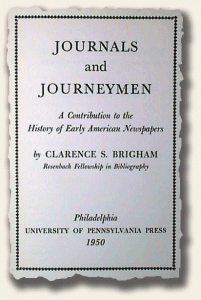 An interesting custom in newspaper history was the establishment in the early 1800’s of news rooms at nearly all of the larger towns. Somewhat akin to this idea was a project carried out at a much earlier day at Bridgeton, New Jersey. Here in December 1775, & continuing for two months, a weekly paper called “The Plain Dealer”, consisting of essays but with topics relating to the problems of the colonies, was written out in manuscript and posted up in Matthew Potter’s tavern. It enabled readers to gather at a central meeting place and peruse a weekly publication, which they would not trouble, or perhaps could not afford, to purchase.
Soon after 1800 reading rooms sprang up in several towns. In Boston the Anthology Reading Room was established in 1806, with 160 subscribers, and making available all the leading newspapers of the country. In 1808 Samuel Gilbert established at Boston what may have been the first commercial news room in the country. It was located in the Exchange Coffee House, erected in 1808, with its “Reading Room and Marine Diary” on the entrance floor where newspaper files could be consulted.
In New York, John H. Payne in 1811 opened a reading room where could be found the most important newspapers and magazines of the day. Charleston had a newsroom in 1813 where the terms were ten dollars for subscribers and strangers one dollar a month. In fact, almost every city and larger town before 1820 had its news room where leading newspapers were regularly filed. To enumerate them would require a lengthy chapter and necessitate an exacting study of early newspaper advertisements. Unfortunately there is no record of a new room proprietor preserving his files for posterity.
Before they became famous…or “infamous”…
September 19, 2009 by TimHughes · 2 Comments
 A special desire for many collectors is to find a newspaper mentioning a name which would not become famous for many years, such as the “Lincoln & Herndon” attorney advertisements from Springfield, Illinois in 1857, or a newspaper ad noting John Wilkes Booth appearing in a play in 1863.
The item shown in the photo fits this category, appearing on the front page of the “Detroit Free Press” in its November 1, 1959 newspaper. If a Kennedy assassination plot existed, the plans may have begun as early as…
Politicians can state the obvious…
September 12, 2009 by TimHughes · Leave a Comment
 The little tidbit shown in the photo appears in “Harper’s Weekly” of January 22, 1876.
Early printing in the New World…
September 10, 2009 by TimHughes · Leave a Comment
Another book I find very useful, although out of print, is “Printing In The Americas” by John Clyde Oswald, 1937. From time to time I will print excerpts from it which hopefully will be of interest to collectors, including the following which touches upon the very earliest years of printing in the “new world”.
 “Printing in the English colonies began during the first half of the 17th century, at which time the art was at a low ebb in Europe, and it is therefore not surprising that the printers who came to the western shore of the Atlantic Ocean were not of outstanding ability; they were but representative of the class from which they sprang.
The first person to print in what is now the United States was a boy 18 years of age, upon whose immature shoulders had unexpectedly been thrown a heavy burden of responsibility. This boy, Matthew Daye (later in life he dropped the final ‘e’), began to print in a newly built house on the bleak shore of New England, on the edge of the forbidding wilderness that surrounded it on all sides but that which faced the sea. The year was 1638, just 18 years after the Pilgrims landed.
A new nation was in the making, in which life eventually came to embrace everything worth while, but in which in the beginning, as was to be expected, artistic accomplishment & progress were almost wholly absent. The settlers were too much occupied with the immediate necessity of clearing away the forests, harnessing the water power, building homes, founding towns and setting up local governments, to be able to find time to devote to the refinements of daily living. The primal wants had first to be satisfied. Then came the Revolutionary War, with its strain upon their resources, and later the need of facing and solving the world problems that accompanied the birth of the new nation.
The scarcity of great printers in Europe during the 17th century is to be ascribed to the fact that printing, controlled by Church and State, had ceased to be a means of art expression and had become merely a vehicle for the transmission of information (and misinformation). In England the number of printers and type founders was limited, and they were licensed and operated under strict surveillance. Restrictive measures of a somewhat similar nature were enforced in other countries.
The ruling powers endeavored to stretch a restraining army across the Atlantic to the colonies newly planted there, and they were at first partly successful because they were represented by governors subservient to their whims. the oft-quoted remark of Sir William Berkeley, governor of Virginia, will be recalled:
But, I thank God, there are no free schools nor printing, and I hope we shall not have these hundreds years; for learning has brought disobedience, and heresy, and sects into the world, and printing has divulged them, and libels against the best government. God keep us from both.”
King James II, on ascending the English throne in 1685, sent this instruction to Governor Dongan, in New York:
“And for as much as great inconvenience may arise by the liberty of printing within our province of New York; you are to provide by all necessary Orders that noe person keep any press for printing, nor that any book pamphlet or other matters whatsoever bee printed without your special leave & license first obtained.”
For 40 years thereafter this paragraph appeared in the instructions to colonial governors. Great was the respect paid by the common people of Europe to constituted authority. The bowed head and bended knee were therefore attitude familiar to the colonists; but contact with this constituted authority came to them only through the local governors and their minions, and often the closeness of the contact disclosed the fact that the supposed gods were in reality made of clay. Respect, reverence even, might for a time be publicly shown for a governor in gold lace, who proved on acquaintance to be vain, shallow, and incompetent, but it could not be privately felt, and under such circumstances the public showing was certain in time to come to an end.”