
Search
The Rare & Early Newspapers Hobby

Receive the Newsletter

Buy Historic Newspapers

There must be a man in the moon…
October 12, 2012 by TimHughes · Leave a Comment
The “Bellows Falls Intelligencer” newspaper from Vermont, issue of May 10, 1824 has an interesting article reporting evidence of life on the moon (see). It’s interesting that astrological science was so rudimentary in 1824 that this report was to be believed by those who read it, although providing some humor when read today.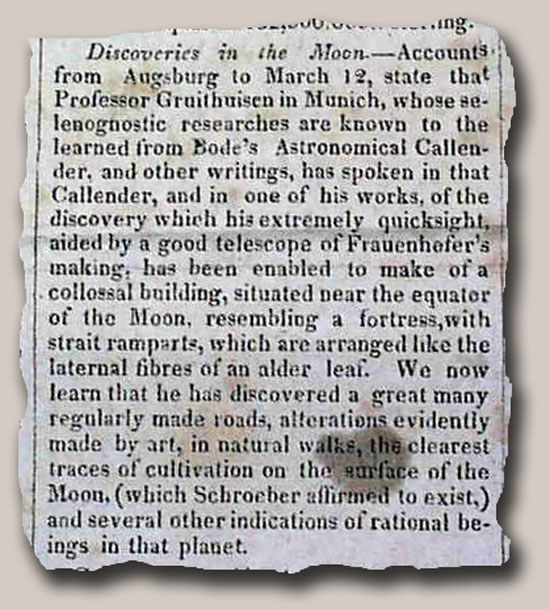
Newspaper Confederate bank note creates a crisis…
October 1, 2012 by TimHughes · 2 Comments
Having recently come across the Feb. 24, 1862 issue of “The Philadelphia Inquirer” (see photo) it reminded me of what this innocent looking front page image of the Confederate five dollar note did in creating a crisis in the Confederate Treasury.
Several months ago the “Opinionator” blog of the New York Times did a very nice piece on the fascinating history of this note and its consequences, which we share with our collectors:
 In March 1862, an unusual ad began appearing in Northern newspapers. Among the shops selling pianos and patent medicines, sheet music and sewing machines, this one stood out: it promised “perfect fac-similes” of Confederate currency. There were seven kinds of notes for sale, and testimonials from The New York Tribune and others praising the replicas for their high quality and low prices. Five cents bought you one. Two dollars bought a hundred. Fifteen dollars bought a thousand. The word “counterfeits” never appeared. These were “Mementos of the Rebellion,” sold by a Philadelphia shopkeeper named Samuel Curtis Upham.
Upham didn’t look like a counterfeiter. He didn’t hide out in the woods or perform daring jailbreaks. He didn’t run from the police. He was a respectable small-business owner and devoted Northern patriot. He ran a store that sold stationery, newspapers and cosmetics. But he was also an entrepreneur with an eye for easy profit, and the Civil War offered the business opportunity of a lifetime: the ability to forge money without breaking the law. Confederate currency, issued by a government that was emphatically not recognized by the Union, had no legal status in the North, which meant Upham could sell his “fac-similes” with impunity.
Over the next 18 months he built the most notorious counterfeiting enterprise of the Civil War — one that also happened to be perfectly legal. His forgeries flooded the South, undermining the value of the Confederate dollar and provoking enraged responses from Southern leaders. He waged war on the enemy’s currency, serving his pocketbook and his country at the same time.
Upham first got the idea the month before, on Feb. 24, 1862. That day, customers kept coming into his shop to buy The Philadelphia Inquirer. Puzzled, he asked one of them what made that particular edition so popular. The answer was on the front page: the Inquirer’s editors had printed a copy of a five-dollar Confederate note. Philadelphians had never seen Rebel money before and were fascinated by it.
Upham saw a chance to cash in. He raced to the Inquirer’s offices, bought the plate of the note, and printed 3,000 copies on French letter paper. They sold extremely well. Along the bottom of each bill, he included a thin strip that read, in small print, “Fac-simile Confederate Note,” with his name and address. The tags could easily be clipped off, transforming the “fac-simile” into an excellent counterfeit.
After his first print run, Upham rapidly expanded his inventory. He took out ads in newspapers, promising to pay in gold for more specimens of Southern money. At first, it seemed possible that he sincerely thought of his reproductions as souvenirs. In early 1862, most Northerners still expected the war to be brief and glorious. They wanted “mementos of the Rebellion” before the Union crushed it. By the time Upham launched his publicity campaign in March, however, his business had clearly evolved from a modest retail operation into a high-volume wholesaling enterprise. No one needed 1,000 souvenirs: people were clearly using his products for a less innocent purpose.
By April, Upham’s fakes began appearing in Richmond, the Confederate capital. They caused a sensation at the Confederate Treasury Department, and a Treasury officer persuaded the editors of the Richmond Daily Dispatch to inform the public about the new threat. “This note is well calculated to deceive, and in nearly every particular is a fac-simile of the original,” they wrote, condemning the forgeries as “Yankee scoundrelism.” In May, the Dispatch discovered one of Upham’s notes with the margin bearing his name and address still attached. “Who is this man Upham?” they asked. “A knave swindler, and forger of the most depraved and despicable sort.”
By then, Upham had grown his business considerably. In an advertisement published in late May, he claimed to have sold half a million notes in the past three months. He now offered 14 varieties of Confederate notes, postage stamps, and “shinplasters” — fractional bills worth anywhere from 5 to 15 cents — and printed his fakes on real banknote paper. Ingeniously, he even fulfilled orders through the mail. For 50 cents, plus 18 cents for postage, customers throughout the Union could have a hundred of Upham’s notes delivered.
Southerners responded with outrage. They became convinced that Upham belonged to a covert Union plot to devalue the Confederate dollar. For the Philadelphia shopkeeper to be able to advertise his counterfeits openly and send them through the mail meant the authorities must have given him permission or, possibly, material support. Moreover, Union troops spent counterfeit Confederate cash in large quantities — evidence of “a deep laid scheme on the part of the thieving, counterfeiting North … to undermine the Confederate currency,” in the eyes of the Daily Richmond Examiner.
In the summer of 1862, Upham’s notes inundated northern Virginia, brought by Union forces marching south from Washington. A Southern journalist observed men “fortified with exhaustless quantities of Philadelphia Confederate notes,” which they used to buy everything from horses to sugar to tobacco. When one of the soldiers ended up a prisoner in Richmond, the Confederates found one of Upham’s advertisements on him. The shopkeeper’s counterfeits appeared “wherever an execrable Yankee soldier polluted the soil with his cloven foot,” fumed the Richmond Daily Dispatch.
By the summer of 1862, as fake cash flowed across the border in ever greater quantities, the Confederate leadership took notice. On Aug. 18, President Jefferson Davis discussed the threat in a message to the Confederate Congress. Counterfeit Confederate notes were “publicly advertised for sale” and furnished to “the soldiers of the invading army” with the full “complicity” of the Union government, Davis declared. Later that day, Confederate Treasury Secretary Christopher Memminger submitted a report to the House of Representatives that reiterated Davis’s concerns and singled out Upham’s role in the crisis: “[P]rinted advertisements have been found stating that the counterfeit notes, in any quantity, will be forwarded by mail from Chestnut street, in Philadelphia.” By then, forged bills had been found far from the Union border, in Atlanta, Savannah, Montgomery and other cities of the Deep South. There was “no means of knowing to what extent they have been circulated,” the Richmond Daily Dispatch warned.
Hamstrung by a disorganized government and mounting logistical challenges, the Confederacy couldn’t stanch the surge of counterfeit currency. Despite Southern claims, however, it’s unlikely that the Union government ever actively promoted the forging of Confederate money. Federal authorities most likely found it easier to ignore the forging of Southern bills than to take a position either for or against it. They certainly never interfered with Upham, who freely continued forging Confederate cash until August 1863. By that time, the value of the Southern dollar had fallen so low that it was hardly worth counterfeiting. During the 18 months that Upham operated his venture, the purchasing power of the Confederate dollar disintegrated. Between February 1862 and August 1863, the value of Confederate paper money fell by ninety percent.
Upham wasn’t the only reason behind this collapse. Fake cash plagued the Confederacy from the beginning, supplied by Northern and Southern counterfeiting gangs. Gross mismanagement of Southern finances led to runaway inflation, which posed an even greater danger to the Confederate dollar. But Upham’s impact was significant. He later estimated that he had produced $15 million worth of Confederate bills. If all of that ended up in the South, it would have made up almost 3 percent of the total money supply — a large amount for a single counterfeiter. In March 1862, his business had only just begun. Over the next year and a half, he would become one of the strangest success stories of the Civil War: a legal counterfeiter, driven by patriotism and personal gain, who struck at the financial heart of the Confederacy from the safety of downtown Philadelphia.
Concern for preserving newspapers in 1849…
September 11, 2012 by TimHughes · 1 Comment
 Over 160 years ago the New York legislature had the foresight to be concerned about the future holdings of newspapers, and more importantly the loss of the unique perspective of history which can only be obtained through newspapers of the day. Their cause remains as relevant today as it was in 1849.
The photos show the entire editorial as found in the “Vermont Chronicle” of Windsor, May 2, 1849, but portions include: “…No historical monument that has ever been devised has half the value for future reference that belongs to a newspaper, & no record can be made of current events nearly as truthful, as minute, as systematic, or as accessible, as the ‘happy pages which no critics criticise’ of a periodical journal…” and “…De Tocqueville…has somewhere spoken of the difficulty to be anticipated at some future day of those who may wish to trace the history of our people for the want of durable monuments or records of their current life & achievements…that the newspaper was almost our only historical repository & that was usually destroyed as soon as its contents were glanced at…” and much more.
A fascinating article on the need to preserve newspapers; something which all of us in this hobby continue to do in some small way.
The entire text of this intriguing article may be viewed at: “Vermont Chronicle” of Windsor, May 2, 1849
Before the Jane Fonda video…
August 24, 2012 by TimHughes · Leave a Comment
The “Scientific American” issue of Nov. 18, 1911 offers this interesting solution for “…reducing abdominal weight”. I don’t think this one caught on…
He’ll be singing the blues…
August 17, 2012 by TimHughes · Leave a Comment
The “Omaha Bee News” issue of Sept. 16, 1932 has this interesting report of a a singer destined for jail…
Tired of fishing him out of the well…
August 3, 2012 by TimHughes · Leave a Comment
This tidbit from the “Olive Branch“, Boston, Nov. 19, 1853, expresses one Californian’s frustration.
Not sure this one worked…
July 27, 2012 by TimHughes · Leave a Comment
Before the days of plastic surgery or rhinoplasty, here is how problems with the nose were supposedly “cured”. While subscribers were on the hunt for great baseball news, this ad is in the “Baseball Magazine” issue of June, 1923. 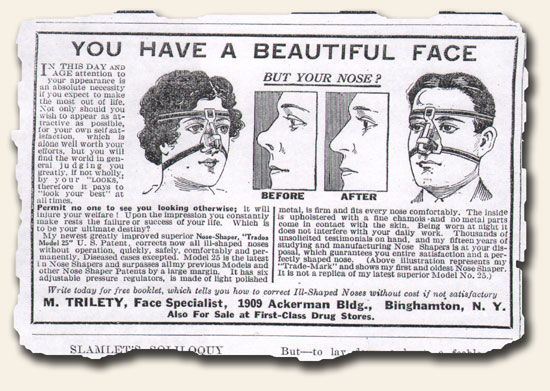
Print date for the Gentleman’s Magazine…
July 23, 2012 by TimHughes · Leave a Comment
 Actual printing dates of monthly magazines have always been difficult to establish, but some times dated news reports will give some indication. An advertisement for the Gentleman’s Magazine in the “Daily Post-Boy” of London, September 4, 1732, provides a valuable clue for the earliest issues of this title (it began publishing in 1731). Note that the advertisement has at the top: “September 2 was published…The Gentleman’s Magazine…for August, 1732…”. So at least during the early years of this magazine’s existence it printed a few days after the end of the month.
Another interesting tidbit is provided in this advertisement as well. We knew that the first several issues of the first year of “Gentleman’s Magazine” printed at least six editions, as some were noted as such on the title/contents page, but we never knew when they were reprinted. Note the very bottom of this advertisements mentions: “…Where may be had, The former Numbers, except Numb 1 and Numb. II which will be republished a 4th Time in a few days.” This indicates that the fifth edition of the January and February, 1731 issues were printed in the first week of September, 1732.
Constitution for the “Philadelphia Dueling Club”…
July 13, 2012 by TimHughes · Leave a Comment
“The Courier” newspaper of Norwich, Connecticut has in its July 2, 1800 edition an apparently tongue-in-cheek report detailing the constitution for the “Philadelphia Dueling Club”. The fact that it was approved on May 32, 1800, and signed by “William Blood, President’ and “Charles Bullet, Secretary” seems to render this less than real, the content is nonetheless interesting reading.
Its preamble notes that dueling has become: “…the fashion to the infinite satisfaction of all men of true honor, & whereas the opinion that this practice is improper & Immoral being only held by old women, or men who ought to wear petticoats…” with more. See the photo for the full 1st article… and the link above for the full text.
Wyoming’s first newspapers…
July 9, 2012 by TimHughes · 1 Comment
Wyoming has the interesting distinction of having once been part of four principal annexations: the Louisiana Purchase, the Oregon Territory, the Mexican Cession and Texas Annexation. It became a territory in July, 1868 and gained statehood on July 10, 1890.
The “Leader” was the first newspaper in Wyoming, begun on September 19, 1867, the same year that the first settlement had been created at Cheyenne. The newspaper was begun by Nathan Baker and J.E. Gates. Baker gained his printing experience in Colorado, working at the “Rocky Mountain Herald” and the the “Rocky Mountain News”. He went one to establish two other newspapers in Wyoming, the Laramie “Sentinel” on May 1, 1869, and the South Pass “News“. See the hyperlink for the interesting history of this town.
 Also begun in Cheyenne in 1867 were the “Daily Argus” in October, and the “Star” in December, but neither one lasted beyond two years. Other early newspapers in Wyoming were the “Sweetwater Miner” at Fort Bridge in February, 1868, a vehicle to promote immigration, and a few months later the “News” at South Pass, noted above.
One of the more interesting newspapers from the West was the “Frontier Index” which began at Fort Sanders and moved along with the Union Pacific railroad going to Benton then to Bryan and then to Bear River City where it was completely destroyed by a mob. And no mention of Wyoming’s newspaper history should fail to mention the “Boomerang” (named for the editor’s mule), founded at Laramie on March 11, 1881 by Bill Nye. Subscribers were found in every state and some foreign countries. When Nye retired from the paper he became one of America’s best known humorists.