
Search
The Rare & Early Newspapers Hobby

Receive the Newsletter

Buy Historic Newspapers

Featured website: www.earlyamerica.com
August 5, 2010 by GuyHeilenman · 2 Comments
 As collectors of historic newspapers, we are always on the lookout for websites which blend history with early newspaper reporting. One such site is Archiving Early America. It describes itself as follows:
Archiving Early America
Your Window To Early America
Here at Archiving Early America, you will discover a wealth of resources — a unique array of primary source material from 18th Century America. Scenes and portraits from original newspapers, maps, writings come to life on your screen just as they appeared to this country’s forebears more than two centuries ago.
As you browse through these pages, you will find it easier to understand the people, places and events of this significant time in the American experience.
We particularly appreciate Pages From The Past, which provides examples of various historic newspapers. Although not directly related to newspapers, their digit library is also worthy of mention. Enjoy.
Collecting Historic and Rare Newspapers Basics – Part One
August 2, 2010 by GuyHeilenman · 14 Comments
The following guide is posted on History’s Newsstand’s eBay Store. It is the first part of a primer on collecting Rare & Early Newspapers:
 The purpose of this guide concerning historic, original, collectible and/or rare newspapers is to answer the three most common questions related to the hobby: How you can determine if an issue is authentic, the meaning of commonly used terms related to the hobby, and why the original issues do not just fall apart.
How Can You Determine If An Issue Is Authentic?
It was not unusual for newspapers to celebrate the anniversary of an historic event or their inaugural issue by reprinting that issue for their subscribers or the general public. Never meant to deceive, through the years such issues were tucked away in attics and dresser drawers as interesting souvenirs only to be uncovered by distant relatives convinced they found the genuine item.
Although only an expert examination can definitively qualify a newspaper as genuine or a reprint and such experts with sufficient knowledge & experience are few & far between, there are a few clues which can guide a novice in making a determination:
* Does the newsprint match that used at that time? Genuine pre-1880 newsprint usually has a high rag content and is very pliable, sturdy & reasonably white. Most reprints in the post-1880 era are more browned, fragile and lacking in physical substance.
* Does the issue contain an historic or significant report? Many reprints contain very historic reports rather than mundane news of the day, and such genuine issues are rarely found randomly outside of a larger collection.
* Is the issue a volume one, number one issue? They were commonly reprinted on anniversary dates.
* Does the format, content or any extraneous printing on the issue appear out of the ordinary? Many reprints were used for promotional purposes and altered to serve another purpose beyond just reprinting a genuine newspaper.
Reprint, fake, or facsimile newspapers are a rarity in this hobby with the vast majority of such issues limited to less than 20 titles. The Library of Congress maintains a check-list of points to look for on most of these issues and can be accessed through their website.
What Are The Most Frequently Used Terms & What Do They Mean?
* Octavo (8vo): Approximately 8 1/2 by 5 inches. Popular size for 18th Century magazines.
* Quarto (4to): Approximately 12 by 9 inches. Common size for many early newspapers.
* Folio: Full size. Eighteenth century issues are approximately 17 by 11 inches, while 19th century issues come closer to present day newspapers.
* Foxing: Dark spots due to age, chemical content of the paper, or storage environment.
* dblpgctrfld: Doublepage centerfold. A print, typical in Harper’s Weekly, which stretches across two pages.
Why Do The Issues Simply Not Fall Apart?
To the surprise of many, newspapers published before 1880 remain in very nice condition as the paper had high cotton and linen content. Most issues from the 1600’s and 1700’s are in much better condition than issues from World War I, hence little care is needed for issues over 120 years old.
(Note) Invitation: In order to provide an ongoing resource for newcomers to the hobby, feel free to add additional insight which you feel might be beneficial to those entering the hobby on the ground floor. Our hope will be to include many of these comments within a future post. Thanks in advance for your contributions.
Recommended reading…
June 26, 2010 by GuyHeilenman · Leave a Comment
 Jim Wheeler, one of our “rare newspaper” friends, recently sent us an e-mail with the following recommendation for our summer reading list:
The Constitutional Convention: A Narrative History from the Notes of James Madison, by Edward J. Larson & Michael P. Winship, ISBN 0-8129-7517
This book essentially condenses and annotates Madison’s notes taken throughout the Convention so that the language and the important concepts that were discussed can be understood today. The book includes a list of those attending the convention and their respective states. When you keep a  copy of this list handy while reading the notes, you can get a clear picture of the regional motives behind the discussion as the constitution was developed. This book, in conjunction with The Founding Brothers, John Ellis, were both extremely helpful in developing a working understanding of what I consider to be one of the most interesting 10 to 20 year time period in US history.
I thought that in addition to all of your other reading, these two items may be interesting and helpful.
Thanks for your suggestions Jim. To the readers of this post: “If you have a chance to read either of these (or have already done so), the community would love to hear your reactions as well.
Digital newspaper archives…
May 27, 2010 by GuyHeilenman · 1 Comment
 Many collectors of historic newspapers often collect issues based upon desired content. If the content is relatively common or is within a clearly defined (and small) time frame, finding issues to collect may not be too difficult. However, if the desired content appeared within issues only occasionally and/or over large spans of time, finding desired issues can be quite difficult. For example, if someone is looking for issues with Moon landing content, since the dates are precise, the task of location issues can be easy. In contrast, if what is being collected are pre-1800 mentions of Georgia, the task can be quite daunting.
However, with the continued growth of the internet also comes ever increasing access to digital archives of newspapers from throughout the world. While some are only available for a fee, the quantity of free archives continues to soar. Wikipedia has begun to assemble a list of both types. It can be viewed at:
Wikipedia: List of online newspaper archives
Rare Newspapers – distracting?
May 6, 2010 by GuyHeilenman · 2 Comments
One of the most common questions our Rare Newspapers’ staff is asked is, “How do you ever get anything done? Don’t you get distracted by the interesting content within the issues?” The answer is an enthusiastic, “YES!” One of the most enjoyable aspects of our daily interaction with early newspapers are these very “distractions”. Hardly a day goes by where we aren’t fascinated by or engaged in conversation resulting from the content within the issues we find.
One such discussion (distraction) was recently inspired by an issue of the Omaha Daily Bee dated June 28, 1919, which originally caught our attention because of its dramatic WWI headline, “PEACE TREATY SIGNED”, with a corresponding subhead, “China Alone Refuses To Sign Covenant That Ends Greatest War in History”. However, what caused our “distraction” was the front page text (shown in the image) regarding the “World’s Ten Greatest Peace Treaties“. Although this issue is no longer available, it can be viewed at: http://www.rarenewspapers.com/view/570082?acl=781584385. Much has occurred since the early 20th century. We wonder what such a list might include if it were printed on the front page of a tomorrow’s newspaper?
Resources of collectors…
April 29, 2010 by GuyHeilenman · 2 Comments
 One of the most frequently asked questions regarding the rare newspaper hobby concerns available resources. Awhile back we posted a general response to this on eBay titled, “What Resources are Available for Newspaper Collectors?”. Although we’ll continue to look at this question in detail, we thought newcomers might appreciate a general overview. An excerpt of this post is as follows:
1) Price Guide For Rare & Historic Newspapers?
2) Storage & Display Options For Colonial, Civil War & 20th Century Newspapers?
3) Reference Books On The History Of Old Newspapers?
4) A Club Of Collectors Of Old Newspapers?
Collecting rare & early newspapers from the colonial era through the Civil War & 20th century is a fun & fascinating hobby, but questions often arise: Is their a price guide, or a club of collectors? What storage & display options are recommended for the old newspaper hobbyist? How about reference material on the hobby?
1) Being a relatively unknown hobby has its advantages…
To view the entire post, please go to: “What Resources are Available for Newspaper Collectors?“
A toast to the “multitaskers” of the world…
April 24, 2010 by GuyHeilenman · Leave a Comment
The Harper’s Weekly dated 10/21/1871 apparently had a wealth of wisdom buried within (see last Saturday’s post). The following certainly raises the stock of the “multitaskers” among us:

Featured websites – The Liberator Files…
April 22, 2010 by GuyHeilenman · Leave a Comment
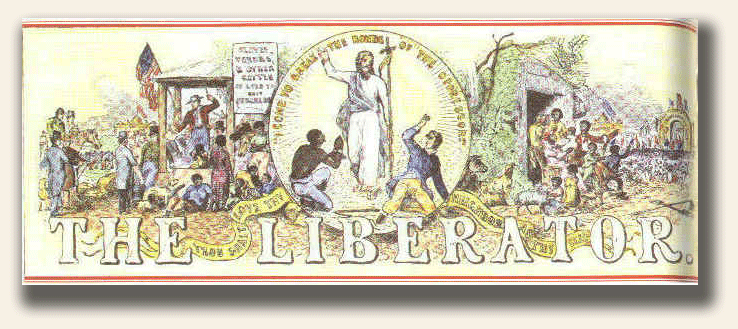 Within the past few months, three members of Timothy Hughes Rare & Early Newspapers each recommended the same website, The Liberator Files, as a great resource for exploring this well-known abolitionist title from the early/mid 1800’s. This Boston paper was published by William Lloyd Garrison, and provides wonderful context for this formative period in U.S. history – from the early 1830’s through the end of the Civil War. The Liberator Files, developed and maintained by Horace Seldon, includes a wealth of abolitionist related commentary in conjunction with a host of scanned Liberator images from William Lloyd Garrison’s own collection, which are currently held at the Boston Public Library. Thanks Horace, for your significant contribution to the world of rare & historic newspapers. Please enjoy!
Feel free to share with the rare newspapers community other historical and/or rare newspaper oriented websites you’ve found to be of use.
Stating the obvious…
April 17, 2010 by GuyHeilenman · Leave a Comment
Upon browsing an issue of Harper’s Weekly dated 10/21/1871, we came across an interesting tidbit which provides an obvious solution to what must have been a common problem. Please enjoy:

Featured websites – The Boston Journalism Trail…
April 15, 2010 by GuyHeilenman · Leave a Comment
 The Boston Journalism Trail is a fascinating on-line resource for anyone interested in early journalism in America – especially as was present in colonial era newspapers. The website was created and is maintained by Emmanual E. (Manny) Paraschnos, Graduate Program Director and Professor of Journalism at Emerson College, Boston, MA. Manny states, “I was born with ink in my veins…”, a fact which comes through loud and clear as you journey through the material found via The Boston Journalism Trail. Take the time to stroll through this wonderful resource. Click on the various landmarks to see a plethora of images showing the corresponding buildings, and where appropriate, original & historic newspapers. Of particular note is the “About the Boston ‘Newspaper Row’ ” link found at the bottom center of the page.
We owe Manny a debt of gratitude for his many contributions to the historic newspapers community. If you are planning to visit historic Boston, make your first stop The Boston Journalism Trail. Your trip will be enhanced by what you find.