
Search
The Rare & Early Newspapers Hobby

Receive the Newsletter

Buy Historic Newspapers

The (now) controversial Robert E. Lee monument unveiled in Richmond (1890)…
August 28, 2017 by GuyHeilenman · 1 Comment
 Whether or not the Robert E. Lee monument will remain in Richmond has yet to be determined, but considering the controversy, we thought it might be interesting to post the original Harper’s Weekly report from June 14, 1890 concerning the unveiling of the monument. The link provides the full text related to the image. The text reads, in part:
“The occasion of the unveiling of the Lee statue at Richmond, Virginia, on the 29th of May, possessed features that render it unique in history. It was a mighty tribute to the central figure of a lost-cause, attended by an undercurrent of satisfaction even that the cause was lost… The Confederate flag was everywhere conspicuously displayed… The military companies affectionately bore it in the line of march, but with it they bore the Stars and Stripes, and bore them loyally. The paradox is explainable only by the fact that the former no longer meant disunion… The opinion has with much reason been expressed that the occasion of such magnitude as the one described, with reference to the late Confederacy, is not likely ever to be repeated. General Lee personified what was best in a bad cause. His individual virtues gave the Southern people, who craved a demonstration commemorative of an indelible epoch in their lives, some substantial and unquestioningly credible to rally around. The honor to the hero of their vain struggle has been paid, and the full conditions for another gathering are wanting. It may therefore by surmised that in the great outpouring of the ex-Confederates at Richmond the final obsequies of the war of session have taken place, and the circumstances attending it show how completely the wounds of conflict have been healed, and a mist important chapter of American history closed. AMOS W. WRIGHT
The Day the Music Died? Mother Theresa dies… Princess Diana is laid to rest…
August 24, 2017 by GuyHeilenman · 3 Comments
 On February 3, 1959, Buddy Holly, Ritchie Valens, and the Big Bopper died in a plane crash shortly after takeoff, and inspired one of the most recognizable tunes of all time: American Pie (Bye, bye Miss American Pie), by Don Mclean – a song he says was inspired by his reaction to reading the account of the crash in the morning paper. Fast forward nearly 20 years to the morning paper for September 6, 1997, and one can only imagine the emotions evoked by the duel headlines: “The World Mourns Diana” and “Revered Mother Teresa Dies”. Two people – one young, one old… one living in abundance, one living in squalor… one with the soft skin of a new-born babe, one with wrinkles upon wrinkles… one incredibly rich, one overwhelmingly poor – yet both committed to making a difference in the lives of the needy… the infirm… the neglected… the destitute. In the blink of an eye, both passed into eternity, leaving a mantle just begging to be picked up by those whose lives they had touched.
What about you? What about me? Truth be told, we’re all just Candles in the Wind. What acts of kindness, goodness, and humble service are filling our days while our candles are still burning? Stirred emotions can be a salve for the soul if they lead to action. Have you picked up their mantel? Have I? Who among us is selflessly helping those who are unable to help themselves?
Yet another set of heart-challenging thoughts (questions) ran through my mind as my damp eyes leafed through the pages of The Arizona Republic (September 6, 1997), passed over the various images of Princess Di and Mother Teresa, absorbed the printed lyrics of The Candle in the Wind (by Elton John), and settled on the photo of the two, together, only months prior to their deaths:
What song does Mother Teresa get? Princess Di gets “A Candle in the Wind”, and the Buddy Holly, Ritchie Valens, and the Big Bopper get “American Pie”, but what about Mother Teresa? Who sings for her? And the 2nd question…
If February 3, 1959 is The Day The Music Died, then what is September 6th (or 5th), 1997? I’d love to know your thoughts.
Ticktock, ticktock, ticktock, ticktock…
August 14, 2017 by GuyHeilenman · Leave a Comment
What do Grace Kelly, Gene Kelly, Lillian Gish, Ruby Keeler, Gergory Peck, Henry Fonda, Stanley Kubrick, Madeline Kahn, DeForest Kelley, Fay Wray, Michael Landon, Dalton Trumbo, Sal Mineo, Robert Mitchum,  Anne Baxter, Rock Hudson, Orson Welles, Barbara Stanwyck, Ava Gardner, Greta Garbo, John Candy, Burt Lancaster, Anthony Perkins, Audrey Hepburn, Liberace, Cab Calloway, John Candy, Marlene Dietrich, Dean Martin, Orson Wells, Anne Baxter, Ava Gardner, William Holden, Ginger Rogers, Lana Turner, Gilda Radner, Fred Astaire, Rita Hayworth, Cary Grant, Mary Pickford, Bette Davis, Natalie Wood, Robert Shaw, Alfred Hitchcock, Andy Kaufman, Jackie Gleason, Charlie Chaplin, Joan Crawford, John Belushi, Jimmy Stewart, and Steve McQueen all have in common? Answer: There was a time when they were each on top of the world – adored by millions, and thanks to the silver screen’s ability to capture them in their prime, they seemed as if they would live forever. However, truth be told, the clock strikes midnight for everyone – regardless of their fame.
Over the past few months this reality was brought home to the staff at Rare & Early Newspapers as we discovered the death reports of some of the most famous Hollywood celebrities of all time – nearly all within Los Angeles newspapers. As Mark Twain not-so-subtly revealed through Ebenezer Scrooge in A Christmas Carol, and Frank Capra reinforced through the eyes of George Bailey (Jimmy Stewart – shown above) in It’s A Wonderful Life, sometimes a glimpse at the brevity of life can be a healing, re-purposing salve for the soul. With this in mind, please enjoy(?): Death Reports of the Hollywood Famous
An August, 2017 stroll back thru time – 50, 100, 150, 200, & 250 years ago…
August 3, 2017 by GuyHeilenman · Leave a Comment
 What news was reported in the month of August – 50, 100, 150, 200, and 250 years ago (1967, 1917, 1867, 1817, 1767)? Such a walk back through time via the eyes of those who read the daily and weekly newspapers of the period can be quite revealing. This is why we often say, “History is never more fascinating than when it’s read from the day it was first reported.” The following links will take you back in time to show the available newspapers from the Rare & Early newspapers website. There’s no need to buy a thing. Simply enjoy the stroll.
Announcing: Catalog #261 (for August, 2017) is now available…
August 2, 2017 by GuyHeilenman · Leave a Comment
Rare Newspapers’ monthly offering of collectible newspapers, Catalog 261, is now available. This latest collection of authentic newspapers is comprised of nearly 350 new items. Some of the noteworthy content includes:
• Phillis Wheatley letter in a 1774
• Deadwood newspaper with mention of Wild Bill Hickok
• New York Times reporting Lincoln’s assassination
• Newsbook dated 1609
• Quebec Gazette from 1775
• First “Confederate” newspaper to report Lincoln’s assassination
To view the above key issues and a whole lot more, go to: Catalog 261
(The catalog links shown above will redirect to the latest catalog in approximately 30 days.)
Mid-18th century math challenges found in Gentleman’s Magazines…
July 27, 2017 by GuyHeilenman · Leave a Comment
Two weeks ago, as we were exploring the varied content to be found in 18th and 19th century Gentleman’s Magazines, we took time to focus on the monthly mathematical challenges the publisher would serve up to the subscribers. At the time we provided our readers with a set of challenges from an issue dated May, 1768. Admitting they were a bit difficult, the following week, along with the available solutions which appeared in the August issue, we provided yet another set of mathematical exercises. The results to this 2nd set are shown below. Whether it is content covering the (now) historical events of the day, book reviews, obituaries, poetry, maps, plates (diagrams), and yes, even mathematical challenges, 18th and 19th century Gentleman’s Magazines never fail to deliver on a truly contemporary experience. As we’ve often said (slightly revised): “History (and poetry, and book reviews, and discoveries, and ____) are never more fascinating than when read from the day they were first reported.”
Solutions to the May, 1768 Gentleman’s Magazine’s math exercises…
July 20, 2017 by GuyHeilenman · Leave a Comment
Last week we posted a set of math exercises which were provided in the May, 1768 issue of The Gentleman’s Magazine. Today we post the solutions (see below). Understanding that the set of problems were a bit cryptic to the 21st century mind, the bottom of the solutions below provides yet another set of problems to explore – which appear a bit more straight-forward. We’ll post the solutions to these next Thursday. Before you throw in the towel, don’t forget the famous words of W.E. Hickson: “If at first you don’t succeed…”
The July (2017) Newsletter from Rare & Early Newspapers…
July 18, 2017 by GuyHeilenman · Leave a Comment
 Each month the staff of Timothy Hughes Rare & Early Newspapers sends out a newsletter to our members which includes special offers, discounts, alerts to new inventory, and information related to the rare newspaper collectible.
The July, 2017 newsletter is as follows:
Dear Friend of Rare & Early Newspapers,
|
|
If you would like to receive these free monthly newsletters, along with additional news and alerts concerning the hobby, go to:
FREE RARE & EARLY NEWSPAPERS MEMBERSHIP
Are you smarter than a 18th century 5th grader? Math exercises within Gentleman’s Magazines…
July 13, 2017 by GuyHeilenman · 2 Comments
As we continue to explore the diversity of content found on the pages of 18th and 19th century Gentleman’s Magazines, our attention was drawn to the abundance of Mathematical challenges found within many issues – particularly those from the 1700’s. Rather than opining on the difficulty level of the quests as opposed to what might be expected of the average reader of a common (blog) post or publication of the 21st century, especially since we have no idea as to the intended target audience. Instead, let’s just enjoy the challenge as if we were living just prior to the American War for Independence.
The challenge: On a somewhat regular basis the publisher would provide a set of Mathematical exercises and invite their subscribers to submit solutions. These responses would then be printed (along with the names of those who submitted them) within a future magazine – typically 1-3 months later. The set shown below is from an issue dated May, 1768. Go ahead and give the problems a try. As an act of 21st century kindness, next Thursday I’ll post the solutions which were submitted in 1768. Are you bold? Go ahead and reply with your solutions prior to next Thursday and allow the collectible world to observe your mathematical genius – or at least your ability to rival the math-prowess of a 17th century 5th grader – or mathematics professor of the period. Enjoy.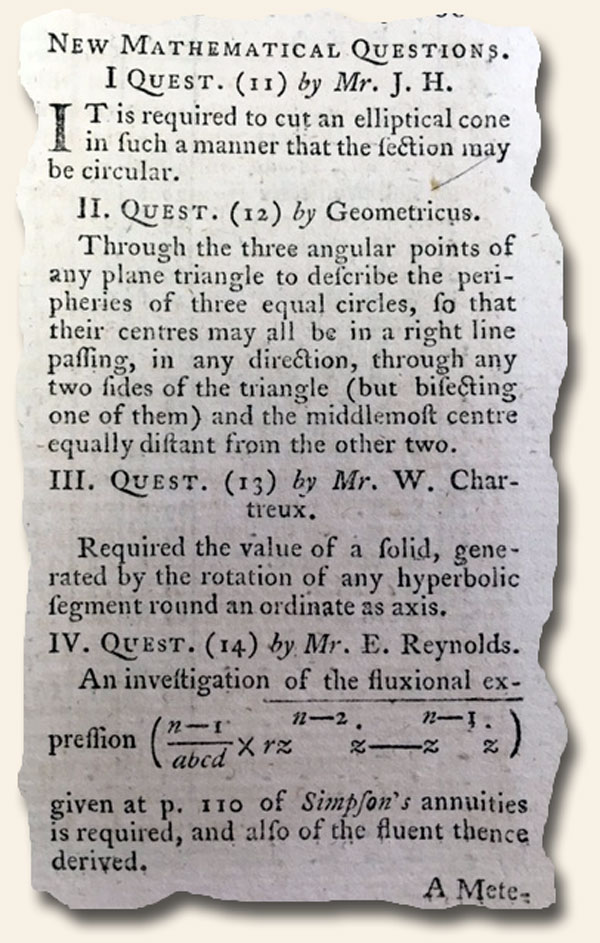
Some things actually do change…
July 10, 2017 by GuyHeilenman · Leave a Comment
 One of the things that struck me while discussing the American Declaration of Independence and Constitution with my children earlier this month was the insight of the American forefather’s demonstrated in their framing of the foundation of this new experiment in self-rule. While some might point to the flaws found within many of the founding documents, procedures, underlying beliefs, and early practices to poke holes in our current state of government, truth be told the seeds of change were sewn throughout the fabric of this new society – avenues which have allowed for peaceful and rightful adjustments to be made over time. Sure, there were times when peaceful change took a backseat, however, many changes have occurred through the prescribed method for making country-wide adjustments: the amendment process. This truth came to light recently when I came across a headline (Los Angeles Times, June 11, 1979) announcing a Supreme Court decision regarding the rights of the handicapped (see images). Was their prior decision regarding the Rehabilitation Act of 1973 correct? How about this related-decision? How were the rights of the handicapped perceived prior to the 1973 decision? Now? Sometimes the changes made over time are quite dramatic. At other times, the adjustments have as much to do with how we describe things, such as the 1990 Amendment which replaced all appearances of the word “handicapped” with “disabled.” Things really can and do change over time.
As a side note, I also happened to notice that on the same day, The Supreme Court refused to hear an appeal by Madalyn Murry O’Hair aimed at having the inscription, “In God We Trust” eliminated from all U. S. coins. Wikipedia notes: “”In God We Trust” as a national motto and on U.S. currency has been the subject of numerous unsuccessful lawsuits. The motto was first challenged in Aronow v. United States in 1970, but the United States Court of Appeals for the Ninth Circuit ruled: “It is quite obvious that the national motto and the slogan on coinage and currency ‘In God We Trust’ has nothing whatsoever to do with the establishment of religion. Its use is of patriotic or ceremonial character and bears no true resemblance to a governmental sponsorship of a religious exercise.” Yes, somethings do change, but others, at least for now, remain the same. However, thanks to the wisdom of those who have gone before us, “We, the People” have a given means for expressing our views and may continue to do so until those who wish to silence dissent rule the day. 