
Search
The Rare & Early Newspapers Hobby

Receive the Newsletter

Buy Historic Newspapers

Videos regarding the hobby… Private Collections…
May 30, 2009 by GuyHeilenman · Leave a Comment
Collecting rare and historic newspapers is a hobby with a personal flair. Although an individual may begin collecting random issues covering a wide variety of topics, eventually they typically settle on a specific area of interest. Perhaps it will be one of the war eras, the Old West era, or issues with Presidential signatures, acts, or addresses. One might derive pleasure from collecting Civil War battle prints or issues with decorative mastheads. Others may like to collect issues from each decade of the last few centuries or issues from each President’s administration. Yet another way to collect newspapers is to use them as a companion collectible for another area of collecting interest – images of sewing machines, inventions, railroading, early flight, dentistry, slave ads, from the year of each coin’s release within one’s collection, with a box score for each major baseball card held, etc. We’ve even known a number of collectors who have spent years focusing on a particular era (perhaps Civil War), who then migrate with a focus through time (perhaps moving on to the Revolutionary War and then Colonial eras). The possibilities are endless. In the end, one thing is for certain, like an heirloom violin, no two collections are exactly the same. Feel free to either share your areas of interest by commenting to this post or send us your collecting story (see more details below).
Timothy Hughes Rare & Early Newspapers continues to maintain and add to their own private/personal collection. The focus has been on one-of-a-kind/rare titles and major historic events. Even what one considers to be historic is somewhat subjective. Below is a video which was done a number of years ago which features Tim showing some of the Private Collection. Please enjoy!
– – – – – – – – – – – – – – – – – – – – – – – – – – – – – – – – – – – – – – – – – –
If you would like to share your story of how you became interested in collecting rare and/or historic newspapers, e-mail it to guy@rarenewspapers.com and place “My Story” in the subject field. Although not necessary, feel free to include an image. Please do not include your e-mail address or a personal website as part of the text of your story. We will post collector stories every few weeks and will send you a notice when your story appears. Thank you for your contribution to the community.
My Collecting Story… Richard Sloan…
May 28, 2009 by GuyHeilenman · 1 Comment
 I’ve been interested in the Lincoln assassination ever since I was thirteen years old. The 19th century images really grabbed me, and continue to give me a sense of what took place. As a New Yorker, my interest expanded to Lincoln’s N.Y.C. funeral, Lincoln’s prior trips to NY, Mrs. Lincoln’s NYC shopping sprees, and John Wilkes Booth’s activities in the city. In the course of all of this, I also became interested in 19th century NY photographers, theaters, hotels, and department stores. It has become obvious to me that period photographs convey and impart just so much. The old newspapers turned out to be the missing ingredient. There is nothing like holding an old NYC newspaper in my hand (or a weekly like Harper’s, Leslie’s, Gleason’s, etc;). Turning old pages that someone had turned in 1865 doesn’t just provide research information; it takes me back in time and shows me what life was like. It’s a wonderful experience to re-capture the sense of immediacy and news-gathering that someone had experienced back then when he or she turned those very same pages — whether it’s reading the details of Lincoln’s 1861 arrival in the city, reading the details of such events as his assassination, his funeral, finding out what parades took place in town the previous day, or what shows are currently playing in town. Old newspapers are time machines!
– – – – – – – – – – – – – – – – – – – – – – – – – – – – – – – – – – – – – – – – – –
Thanks for sharing your story Richard. If you would like to share your story of how you became interested in collecting rare and/or historic newspapers, e-mail it to guy@rarenewspapers.com and place “My Story” in the subject field. Although not necessary, feel free to include an image. Please do not include your e-mail address or a personal website as part of the text of your story. We will post collector stories every few weeks and will send you a notice when your story appears. Thank you for your contribution to the community.
Resources… The Library of Congress…
May 26, 2009 by GuyHeilenman · 1 Comment
 The Library of Congress has a wonderful collection of original newspapers along with an extensive digitized database of American titles. An informative website is maintained in an effort to provide useful information related to rare and historic newspapers. They describe themselves as:
“The Serial & Government Publications Division maintains one of the most extensive newspaper collections in the world. It is exceptionally strong in US newspapers, with 9,000 titles covering the past three centuries. With over 25,000 non-US titles, it is the largest collection of overseas newspapers in the world. Beyond its newspaper holdings, the Division also has extensive collections of current periodicals (70,000 titles) comic books (6,000 titles) and government publications (1 million items).”
Some of the features to be found at their Newspaper Division’s website are webcasts, a searchable data base, full text versions of many newspapers and periodicals, and a link to their ongoing project “Chronicling America”. Although we at Rare Newspapers maintain an extensive list of common reprints (thanks to Rick Brown at HistoryBuff.com) the Library of Congress also has an abbreviated list of common reprints with descriptions as to how one can determine whether their issue is authentic… or not.
Thanks L.O.C. for your ongoing efforts on behalf of historic newspapers.
Census with a bit of flair…
May 23, 2009 by TimHughes · Leave a Comment
“The Alaska Times” newspaper from Seattle, W.T. (Washington Territory), May 14, 1871, contains a very colorful front page article with a simple heading: “Alaska” which reports a census for Sitka. Enjoy reading how the inhabitants were categorized.

So what’s the earliest “London Gazette”?
May 21, 2009 by TimHughes · Leave a Comment
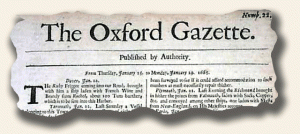 The world’s oldest continually published newspaper was begun in 1665 and still prints today, a staggering 345 year history which likely will never be broken by any other single title. Indeed, the newspaper still publishes today so it sets a more unbeatable record as each year passes.
The newspaper is titled “The London Gazette“, but collectors have occasionally seen issues of “The Oxford Gazette” and wondered about the connection.
First, the most convincing derivation of the term “gazette” is from “gaza”, the Greek word for a treasury or store. That newspapers are a “treasury or store” of information would allow for a plausible adoption of the term “gazette”.
In 1665 the Royal Court had been removed from London due to the Plague which had been ravaging the city. The smaller towns in the country seemed less susceptable to the contagion. So with a newspaper serving as a mouthpiece of the Royal Court it was logical that it would set up shop in Oxford, calling itself “The Oxford Gazette“.
But when the affects of the Plague seemed to have abated sufficiently for the Court to return to London, so did the newspaper. Twenty-three issues were published in Oxford, and with issue number 24 was the first with the title “The London Gazette“, a title which has remained unchanged for over three centuries.
So there might be a bit of a debate as to what the earliest issue is of “The London Gazette“. The earliest with this title would be issue #24, dated February 5, 1665 (1666 by today’s calendar), but argument certainly could be made that the first issue of “The Oxford Gazette” would qualify, it dated November 16, 1665.
Given its short life under the earlier title of “The Oxford Gazette”, such issues are extremely elusive. We have sold many over the past 33 years but rarely find them today.
Davy Crockett survived the Alamo?
May 16, 2009 by TimHughes · 1 Comment
 The report shown appeared in the “Staunton Spectator” newspaper of Virginia, May 5, 1836. Accuracy in reporting the news certainly wasn’t any better back in 1836. Have you ever found similar inaccurate reporting?
My Story… Carl Aspler…
May 14, 2009 by GuyHeilenman · Leave a Comment
 For me, I love history and the first time I came across an old paper (I think it was the coronation of George V in 1911), I was smitten. I loved reading the headlines as they were years ago.
In the 80’s I also began collecting antique maps (also my love of history and discovery), and these took over for a while. Now I have antique maps and newspapers!
What gets me excited about the old news is to enjoy the personal connection that people make with the various stories. For example I used to keep a number of the front pages framed in my office at work. One day, a colleague came in and told me how he had admired the “Titanic Sinking” headline. This fellow, originally from Northern Ireland, told me that his father worked at the Belfast shipyard that built the ship, and that he had actually worked on the building of the Titanic. After thinking about it for a while, I gave him the paper. It meant a lot to him, and we all had a few tears in our eyes.
On another occasion I was talking to a friend and discovered that his father had been a soldier in the Canadian Army and had participated in the ill-fated Dieppe Raid in 1942. His father was captured by the Germans and spent the rest of the war in a Prisoner Camp. When I showed his the newspaper from a few days later, mentioning his father as “missing in action” it was also a very moving moment. I decided that I can live without it, and gave it to him.
Yet another time I mentioned to someone in the Salvation Army that I had a paper describing the sinking of the Empress of Ireland in 1914. The ship was on it’s way to an international congress of the Salvation Army. Most of the 150 members of the Army on board were drowned as was the Salvation Army Band. This was a difficult time for the Army (in fact the band was not reconstituted until 1969). I donated the paper to the Salvation Army museum, where more people can appreciate the story.
I also amaze my family from time to time. A few months ago, my teenage daughter was doing a history project on the London Blitz of 1940. I offered to loan her a front page describing the German first bombing assault on London. She originally wasn’t sure that people would be interested in an old newspaper. The fact that everyone thought it was “so cool” also gained me extra points with my daughter…
– – – – – – – – – – – – – – – – – – – – – – – – – – – – – – – – – – – – – – – – – –
Thanks for sharing your story Carl. If you would like to share your story of how you became interested in collecting rare and/or historic newspapers, e-mail it to guy@rarenewspapers.com and place “My Story” in the subject field. Although not necessary, feel free to include an image. Please do not include your e-mail address or a personal website as part of the text of your story. We will post collector stories every few weeks and will send you a notice when your story appears. Thank you for your contribution to the community.
Baseball fans… can you help?
May 11, 2009 by TimHughes · Leave a Comment
 A customer was requesting a newspaper with a report of Nap LaJoie, one of the more notable names in baseball in the early 20th century, ending the 1901 season with a .422 batting average. He was one of only a few to do so in the 20th century (there’s been a 67 year dry spell since Ted Williams was the last to do so, in 1941).
Finding reports of batting averages in 1901 is very difficult, but I did find a report at the end of the season which notes: “Lajoie…took part in 131 games. He was at bat 554 times, made 226 singles, 48 doubles 12 triples and 13 home runs…”.
Never mind that the numbers are slightly off from the official record book, which notes 543 games, 229 singles, 48 doubles (only one correct), 13 triples and 14 homers, as such errors might be understandable. But even given the accurate numbers, in calculating his average one comes up with a sum of 304 successful at bats, divided by the number of games (543) giving an average of .560. But curiously, if you just took his 229 singles divided by 543 the result is exactly his recorded batting average: .4217, rounded out to .422.
Should I surmise that the term “singles” actually means “hits” by today’s terminology ? Was this the common practice back then, to call any type of “hit” a “single”? If so, when did they make the switch?
Thanks for your help !
Tim
No smoking in the court of King James…
May 9, 2009 by TimHughes · Leave a Comment
 The Gazette of the United States from Philadelphia, Nov. 24, 1790, includes an interesting item on a treatise of King James I, who was way ahead of his time in opposing smoking.
He considered it a: “…heinous sin…” and those who used it were: “…guilty of great vanitie & uncleannesse–of sinful and shameful lust…”. He considered it: “…harmfull to the brain–dangerous to the lungs–and in the black stinking fume thereof, nearest resembling the horrible stygian smoake of the pit that is bottomlesse.”
See the photo for the full text.
Sharing My Story… How I got started…
May 7, 2009 by TimHughes · 1 Comment

Tim Hughes, founder
Invariably there is the quizzical stare I get from anyone who asks “what do you do?” and I answer by saying, “I sell old newspapers.” The typical response is, “…what??” Any follow-up to the inquiry usually leads to, “How did you get started?”
We all have our own stories of what lead us to early newspapers, and mine may not but much different from yours.
I have always collecting something. I guess I was always intrigued by what was old, and coin collecting captured my interest when I was in 3rd or 4th grade, a hobby which still gets my attention but on a dramatically smaller scale. Collecting coins lead to old books, which lead to old bottles, which lead to old radios; and perhaps a few other items which struck my interest through the years.
I eventually found coin collecting a bit frustrating, as the rarities I needed to fill some holes in my collection were way beyond my budget. Coin collecting has always been a well exploited hobby so rare items were almost impossible to find at reasonable prices as the “heavy hitters” kept the prices quite high. I always dreamed of finding a collectible which few people knew about, where truly rare & historic items could be found at reasonable prices.
One day while browsing a local flea market I cam across an 1846 Philadelphia newspaper for $3. I was intrigued. I knew an 1846 coin in nice condition would be ten times that amount. I bought it, took it home and read all four pages and was fascinated by the content. I had found my new collectible and was hoping my dream had come true.
I expended much effort over the next several years looking for more newspapers and found several sources for 18th & 19th century issues at what I thought were amazingly low prices given my coin collecting experience.
Then one day I asked a source from whom I had been buying issues for $3 each if I could get a better price if I bought more than one. His response was fateful and set the course for the rest of my life: he said, “If you take 100 issues you can have them for $1 each”.
Although $100 was likely half of my net worth at the time, I sent the check, received my 100 issues, and starting advertising the issues for sale at $3 each (plus 25 cents for postage; which actually covered the cost).
As I sold the issues I bought more, and found more sources for different titles and different time periods. I eventually found several auction halls which regularly listed newspapers, and established contacts in England for early British material. In time I would travel not only throughout the Middle Atlantic & New England states but went to London each year to to search the back roads for antique & book shops which had material I could use.
Those were very exciting days, as material was plentiful and I bought voraciously. Buying today is more of a challenge so I take great comfort in knowing my appetite some 30 years ago was justified as much of our inventory of over 2 million newspapers was purchased long ago.
Good material still comes our way. Having our name in the marketplace for over 30 years and maintaining considerable Internet presence has allowed much great material to end up at our doorstep, a trend which–hopefully–will continue as we allow my dream to be realized by our customers: rare, historic material at reasonable prices.
In the coming months we will be posting the stories of other collectors as well. Details are forthcoming.