
Search
The Rare & Early Newspapers Hobby

Receive the Newsletter

Buy Historic Newspapers

18th century American magazines: one to share…
February 2, 2009 by TimHughes · 3 Comments
 Magazines published in 18th century America were relative few & far between when compared with newspapers of the same era. From the first magazine in 1741 through the Revolutionary War only 18 magazine titles were published, most lasting but a few issues. During the Revolutionary War only one magazine was in print, and it only lasted from January, 1775 through July, 1776, this last issue containing the Declaration of Independence.
Magazines have always been of interest to me since almost all titles carried various news of the day, typically within the back several pages, much like the British “Gentleman’s Magazine” had done since 1731. Some American magazines contained plates as well, but finding issues with the plates still intact can be extremely difficult and frustrating. The more noteworthy the plate, the less likely it will be present, typically removed by some previous owner many years ago. So when issues come on the market with significant plates still bound within the issue, it’s a moment of much excitement.
Here is one from our private collection, The Columbian Magazine from Philadelphia dated January, 1787, which contains a full page plate of “General Washington”, in addition to a foldout plate of the “Meteorological Observations” for the month of December, 1786. We are pleased to share these photos with our fellow collectors, and wish all of you the great luck in finding your own American magazine with notable prints!
Most historic: 1784 thru 1800…
January 20, 2009 by TimHughes · Leave a Comment
Continuing with our discussion on the “most historic” reports to be found in newspapers, we have been discussing the events of American history by era, the last being the 1801-1860 era. This post will discuss the most significant event in American history of the post-Revolutionary War, 18th century era from 1784 thru 1800.
Much happened in American history during this brief 17 year period but I’m not so sure there are many events which qualify as the “most historic”. From 1784 to 1787 much effort was made to organize the loosely attached colonies into a cohesive whole (see Articles of Confederation as an example), which ultimately led to the Constitutional Convention and the resultant Constitution which remains to this day. Through the ratification process it was evident that more rights needed to be clarified, resulting in the Bill of Rights of 1789. During this same year the first presidential election happened and the federal government was established, and in subsequent years a permanent site was created for the federal government, the Native Americans’ concerns were dealt with as the nation crew beyond the original 13 states, The Whiskey Rebellion challenged the collection of federal taxes, Jay’s Treaty with England was consummated, and growing troubles with France & other nations put greater focus on formalizing a federal military. All these events and more played a role in molding America during these critical formative years.

The Constitution of the United States of America
But the most historic? My vote has to go with the creation of the Constitution. And a newspaper with the printing of this document would be a very prized addition to any collection.
What is your thought?
The Articles of Confederation formally united the 13 colonies…
December 18, 2008 by TimHughes · 1 Comment
For a collector of historic American documents as printed in period newspapers a printing of the “Articles of Confederation” would be a very significant issue. With much credit to Wikipedia, the creation & importance of this document provides some fascinating reading:
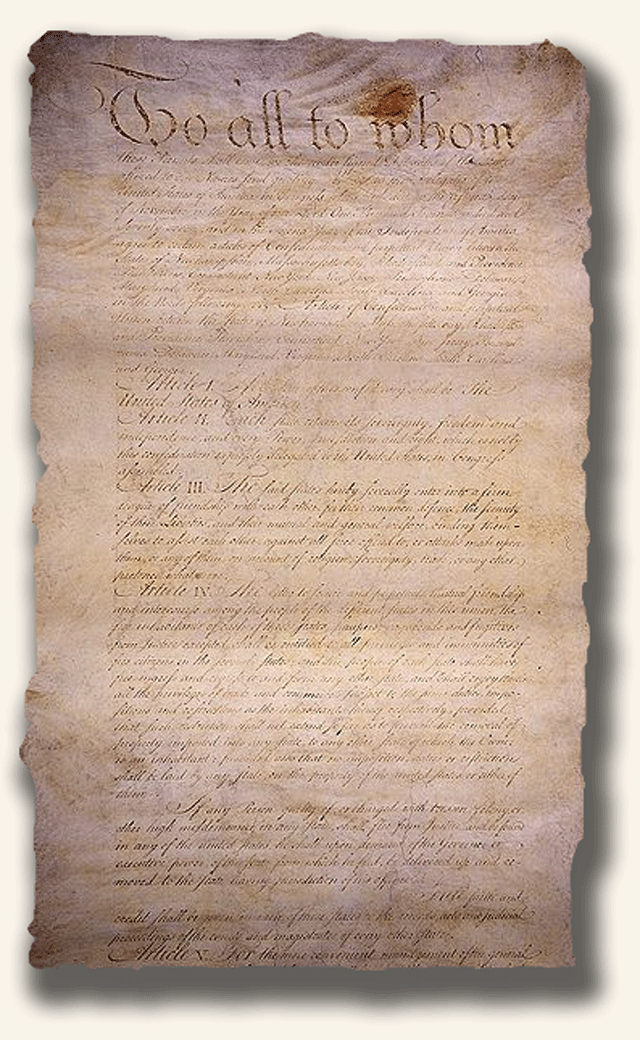 The Articles of Confederation was the governing constitution of the alliance of thirteen independent and sovereign states known as the “United States of America.” The Articles’ ratification, proposed in 1777, was completed in 1781, legally uniting the states by agreement into the “United States of America” as a union with a confederation government. Under the Articles (and the succeeding Constitution) the states retained sovereignty over all governmental functions not specifically deputed to the central government.
The last draft of the Articles was written in the summer of 1777 and adopted by the Second Continental Congress on November 15, 1777 in York, Pennsylvania after a year of debate. The Articles set the rules for operations of the “United States” confederation. The confederation was capable of making war, negotiating diplomatic agreements, and resolving issues regarding the western territories; it could not mint coins (each state had its own currency) nor could it borrow money, whether inside or outside the United States. An important element of the Articles was that Article XIII stipulated that “their provisions shall be inviolably observed by every state” and “the Union shall be perpetual”.
The Articles were created by the chosen representatives of the states in the Second Continental Congress out of a perceived need to have “a plan of confederacy for securing the freedom, sovereignty, and independence of the United States.” Although serving a crucial role in the victory in the American Revolutionary War, a group of “federalists” felt that the Articles lacked provisions for a sufficiently effective government. The key criticism by those who favored a more powerful central state (the federalists) was that the government lacked taxing authority; it had to request funds from the states. Another criticism of the Articles was that they did not strike the right balance between large and small states in the legislative decision making process. Due to its one-state, one-vote structure, the larger states were expected to contribute more but had only one vote. The Articles were replaced by the United States Constitution when created in 1787.
Our issue of the Pennsylvania Ledger dated March 11, 1778 contains the complete printing of the Articles of Confederation. The many photos will allow you to enjoy the significance of the newspaper and to appreciate how those who held this actual edition some 230 years ago might have felt knowing the independent colonies were joining together for a common cause–to not only provide a foundation for a united country which might some day–hopefully–become a world player, but for more immediate purposes, to survive the incursions of the British during the ongoing Revolutionary War. In 1778 no one knew how either effort might turn out.
Enjoy the issue!
The Green Mountain Boys…
October 30, 2008 by Historys Newsstand · 1 Comment
A few years ago while looking for Revolutionary War content for the catalog, I was both surprised and delighted to discover a report in the February, 1781 issue of Gentleman’s Magazine that mentioned the famous Green Mountain Boys of Vermont, and their equally famous leader Ethan Allen. The report reads: “Letters of a late date from America, formerly a rebel colonel, who resided at Bennington, in the upper part of New York, not well used, as he thought, by the Congress, has marched off with six hundred Green-mountain Boys, as they style themselves, and joined Major Carlton at Ticonderoga; and it is thought other townships will follow their example.” Although I have seen various newspaper reports mentioning Ethan Allen, this was the first and maybe the only reference to the Green Mountain Boys that I have seen in my twelve years at Hughes Rare & Early Newspapers.
If you’ve come across another report mentioning the Green Mountain Boys by name, feel free to share it.
Editor’s Note: Marc Pompeo is one of our in-house historians who has been on staff for more than a decade.
Eighteenth century featured newspaper…
October 23, 2008 by TimHughes · 1 Comment
One of the questions we field from customers quite often is “What truly spectacular, really historic item do you have to offer?”. One of our frustrations is that with many customers having a want list some of the  better items which come into inventory never make it to a catalog or our website, as they are quoted to those wanting the event and sold rather quickly.
But occasionally we come across an item which ranks near the top of the desirability list for many collectors and we offer it in a catalog or on our website for all to see, and for those not inclined to make a purchase they can vicariously enjoy the description and photos of a great newspaper which rarely comes to market.
Not long ago we added to our inventory a Connecticut Journal issue from July 10, 1776 with a rather inconspicuous report on the back page of this single sheet newspaper (verified by the American Antiquarian Society as complete in a single sheet) reading just as any collector would dream:
“Yesterday the CONGRESS unanimously Resolved to declare the United Colonies FREE and INDEPENDENT STATES.”
 As the description of the newspaper notes, It would be difficult to argue for a more significant news report in all of American history. Even the printing of the Declaration of Independence itself, which likely appeared in this newspaper a week or so later, would simply be evidence of the historic news which appeared first in this issue. This newspaper reports for the first time that America resolved to be independent, while the text of the Declaration of Independence that would follow would offer the particulars.
This is one of the better newspapers we have offered in our 32 years, and certainly a great addition to any rare newspaper collection. Click here to enjoy the photographs as the entire newspaper is visible on our site.
So what’s in a name?
September 18, 2008 by TimHughes · 2 Comments
In reading a report from a 1783 Connecticut newspaper this evening I found it interesting to what degree the last name “Arnold” was considered a disgrace. Note this report:
“Upon the memorial of Jonathan Arnold, of Hartford…a Sergeant in the Continental army & unfortunately  bears the sirname of the infamous Benedict Arnold, once a Major General in the army of the United States, now a traitor and deserter…some time after the desertion of the said Benedict, the Hon. Major General Baron Stuben, pitying the misfortune of any person friendly to the American cause doomed to bear the same name with a notorious traitor. offered…liberty to assume the name of Stuben, & by that name to be known and called…on his taking & assuming the said name of Stuben, to pay to him the sum of Two Dollars per month during the present war…”.
I wonder how many more Arnold families there could have been in this country today?