
Search
The Rare & Early Newspapers Hobby

Receive the Newsletter

Buy Historic Newspapers

From the private collection: a title to share…
January 26, 2009 by TimHughes · Leave a Comment
I have always be intrigued by unusually titled newspapers, and there are many from the past two to three hundred years.
 One from our private collection which is rather bizarre not just for its name but for its theme—analyzing the records of childhood deaths from the previous 100 years—is: “THE HISTORY OF CRADLE-CONVULSIONS” with an extended title including: “Vulgarly called Black and White Fits: Monthly Observations on the Weekly Bills of Mortality…” and even more (see photos).
The publisher uses the entirety of this single sheet newspaper to discussion the deaths of children, although modern translations are lacking as to what is meant by “cradle convulsions”, “black & white fits”, “gripes in the guts” or “convulsions of the bowels”, although one could guess. The text of the entire newspaper is shown here for your reading enjoyment.
Not surprisingly, a newspaper with such a morbid theme did not last long. In fact this issue “numb. 1” was the first and the last despite mention by the publisher of future monthly issues. According to Crane & Kaye this title is not held by any library in the United States.
Campaign newspapers: a hobby within a hobby…
January 19, 2009 by TimHughes · Leave a Comment
Before the days of television, radio and certainly the internet, how did Presidential candidates get their platforms across the the electorate? Daily newspapers could not be counted upon as most were politically aligned with one of the parties so reporting had an obvious bias.
“Campaign newspapers” were one vehicle for candidates. Rather than rely on the ethics of the local publisher, parties produced their own newspapers during the campaign with the emphasis on the platform of the candidate. Logically such newspapers were short-lived and are relatively rare today as a result.
William Miles did a book titled: “The People’s Voice: An Annotated Bibliography of American Presidential Campaign Newspapers, 1828-1984” which lists chronologically and by party over 700 titles. The following is excerpted from his Preface:
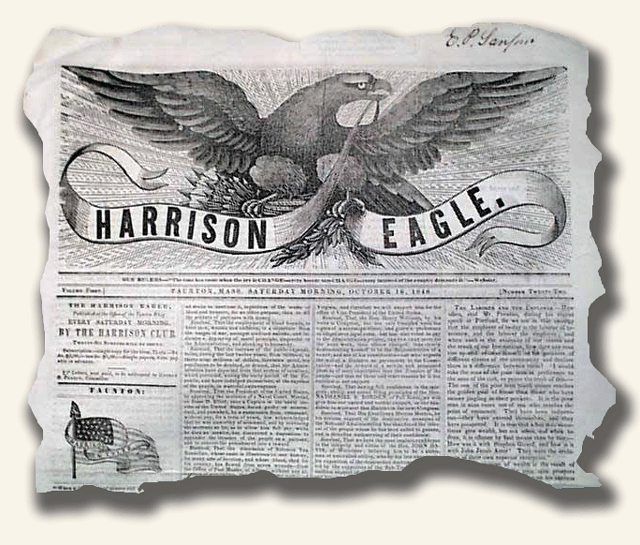 “Every four years since at least 1828 the campaign newspaper, like the campaign biography, song, poster, and similar election paraphernalia, has reappeared as a familiar part of the American presidential electoral process. Unlike the general party or partisan newspaper, these sheets were published specifically to support the cause of an aspiring candidate or an officially nominated ticket. Usually issued only during the period of the campaign itself, they were the campaign documents that emphasized the strengths and the importance of political organization at all levels; and to attack, generally in vitriolic language, the opposition. No matter if established and issued by party committees or by committed private individuals, or as “extras” and subsidized papers by already established partisan journals, the purpose was the same: organize the party faithful to work on behalf or electing the national, and by extension, the state and local tickets.”
Such elusive titles do provide an interesting array of titles including “Hickory Sprout” “Coon Hunter” “Harry Of The West” “Rebel Youth” “Hickory Tree” “On Our Way” “Rail Splitter” “Sober Second Thought” “Soup-Spiller” “Magician” “Grape Shot” “Rough & Ready” “Barnburner” “Dirty Shirt” “Kickapoo” and “Straight-Out Harrisonian” to name but a few.
Collecting campaign newspapers can be a fascinating hobby within a hobby, if only for the variety of titles available. Do you have any great-named campaign newspapers in your collection? Feel free to share.
An institutional need…
January 19, 2009 by TimHughes · Leave a Comment
One of our fellow collectors recently made the following inquiry seeking missing issues of an African-American newspaper from North Carolina. Not having any magical answers for him, I offer his request to all our customers in hopes someone might have a lead or suggestion. Feel free to respond through this blog.
African-American Newspaper–Durham, North Carolina
I’ve been casually interested in old newspapers and magazines for a number of years, and have regularly used them in my university classes (I recently retired as a professor of environmental policy at Duke, and often used them to document early conservation struggles.)
A few weeks ago, I got involved in a volunteer project at the historical collection of the Durham, NC county library, indexing microfilmed copies of a weekly African-American newspaper called the Carolina Times, published between 1927 and the present.
The content, especially in the 1930s and 1940s, is amazing. I had known a fair amount of Durham history, but was taken aback by the many specific injustices documented even here (supposedly one of the South’s most progressive cities) in the Jim Crow era. There is much original research still to be done, and the newspaper provides a vivid counterpoint to the local white media, which are also available.
Unfortunately, our microfilm lacks all issues between 1927 to 1937 and 1944-48. Also missing is the early version of the paper, the Durham Standard Advertiser, 1919-1927. Extensive searching reveals that no other library in the country has these issues, in any format (everyone has the same, incomplete, microfilm). I’ve used all my research skills to try to track them down, without success.
It would be a real contribution to both Durham history and African-American history to make this missing material available to scholars and others. Might you have any ideas? Private collectors? Archives that would not show up in the usual searches of libraries or internet troves. Peak circulation was 20,000 (in the 1940s) so it is not a completely obscure title. The paper’s offices burned in 1975, so the original archive was lost.
I can really recommend this kind of material to anyone interested in modern history. Any help with my own quest would be appreciated.
Rare Newspaper Collections Within Collections…
January 14, 2009 by GuyHeilenman · 3 Comments
From our guest contributor, *Morris Brill:
A significant segment of my newspaper collection is American and International Politics. This segment focuses on Presidents, World Leaders, Wars, Treaties, and Legislation.
Recently, while reviewing my collection of historic newspapers, covering the span of the past two centuries, I noticed I owned numerous newspapers referencing one world leader whose exploits spanned twenty-two years and whose name is one of the most recognizable in world history.
His fame is owed not only to his charismatic leadership but to the specific historic events with which he is associated.
Few world leaders can lay claim to a greater body of history than this leader, and collecting newspapers about this one man, alone, could occupy a collector’s time and interest for many years.
The story of this leader starts in 1789 with events leading up to his assumption of power on November 9, 1799 and continuing thereafter until his death in 1821.
NAPOLEON BONAPARTE stands monumental in history and the events he is associated with are among the most famous in military conflict.
My collection starts in 1791 when King Louis XV1, and his Queen Marie Antoinette, attempted to flee Paris dressed as servants to free themselves from captivity during the French Revolution. (The Mail; or, Claypoole’s Daily Advertiser – August 24, 1791)
This event is followed by the beheading of King Louis XV1, as reported in the Gazette of the United States of March 10, 1793.
 The following year Queen Marie Antoinette was beheaded as reported in the Courier of New Hampshire of March 6, 1794. This newspaper contains one of the most tender reports I have had the pleasure of reading in any newspaper of any event, and I attach it here for your reading pleasure.
http://www.newspapercollections.com/marieantoinettedeath.htm
The Boston Gazette of December 26, 1805 reports on the Battle of Trafalgar fought between the naval forces of England against the combined naval forces of France and Spain. It was during this battle that Horatio Nelson, England’s most revered naval commander, lost is life and left to posterity his famous words, “England expects that every man will do his duty.”
On March 9, 1813, as reported in the Salem Gazette, we read of Napoleon’s Retreat from Russia representing one of the most lethal military operations in world history. “Its sustained role in Russian culture may be seen in Tolstoy’s War and Peace and the Soviet identification of it with the German invasion of 1941-1945.”
The Weekly Messenger of June 6, 1814 tells the story of Napoleon’s Exile to Elba. This is followed by Napoleon’s Return From Elba as recorded in the Daily National Intelligencer of May 2, 1815.
 On August 25, 1815 the Weekly Messenger reported on what has become synonymous to a ‘final undoing’ The Battle of Waterloo. The Duke of Wellington, in reference to Napoleon, is quoted as saying: “I consider Napoleon’s presence in the field equal to forty thousand men in the balance.”
The Vermont Intelligencer of August 27, 1821 tells the final chapter with its report on The Death of Napoleon Bonaparte.
My collection of Napoleon Bonaparte related newspapers is certainly not comprehensive. I have used this example to illustrate that within a collection the collector can find eras that are worthy of a collection of their own.
Perhaps you have a collection of George Washington, Adolf Hitler, Winston Churchill, Franklin D. Roosevelt, Robert E. Lee or any of numerous other leaders whose names have been recorded in the annuals of history.
Please share with us your special interest and collection.
Morris Brill
* Background:
Morris Brill has been collecting newspapers for 45+ years with an emphasis on Political History, Air and Space, Famous and Infamous People, and Americana.
Morris possesses a Bachelor of Science Degree in Business Administration and History.
During an interview conducted by his hometown newspaper Morris was asked “What have you learned by collecting newspapers.”
Morris replied with the following:
“In essence I have learned that joy and sorrow walk hand in hand and that which we celebrate today may be the cause of our tears tomorrow, and yet, while we weep, the future is ready to bring us further elation.”
Thank you Morris. Your insight and contributions to the hobby are greatly appreciated.
AmeriCollector.com is back at it again…
November 22, 2008 by GuyHeilenman · Leave a Comment
 David Chesanow, at AmeriCollector.com, recently interviewed Tim to obtain his views concerning collecting newspapers related to the recent election. Two of the questions asked:
- Do you think people will start collecting Obama papers beyond the election?
- Do you anticipate this event raising interest in historic newspapers as a hobby (not investment)?
The answers to these questions, and more, may be viewed at AmeriCollector.com. Thanks David, for yet another positive contribution to the Rare Newspapers community.
America’s first newspaper… Check your attics.
November 20, 2008 by TimHughes · Leave a Comment
The very first newspaper printed in the American colonies was published in Boston in 1690 and titled “Publick Occurrences Both Forreign and Domestick”. It was a little paper with three pages of text. The fourth page was left blank for others to write handwritten pieces of news before being passed on to others. It was published by Benjamin Harris who had experience in publishing another newspaper in London several years prior to his arrival in the colonies, titled “Domestick Intelligence, Or News Both from City & Country”.
His Boston effort focused on local news but it also included gossip and unflattering reports. One account notes it contained: “…affections of a very high nature: As also sundry doubtful and uncertain Reports…”. The mixture of doubtful and uncertain reports, as well as a ban on printing without a license which Harris did not have, caused his first issue to also be his last. Reports note that the royal governor had the printing press destroyed and all known issues of that one date of September 25, 1690 confiscated.
To this day only one genuine issue of the newspaper is known to exist, and unfortunately it’s not in the United States: it is in the Public Records office in London. Some years ago it was loaned to The Newseum in Washington, D.C. (then located across the Potomac in Virginia) for a period of time, but I believe it has been returned to London.
The intriguing part of this story is that “all known issues were confiscated and destroyed”. But exactly when did this happen? Was it done several hours since it was printed, or a few days later? It was intended to be a monthly publication. Certainly the possibility exists that a few issues were not found & confiscated, and with the owners knowing of the search they may have purposely hidden them away.
Could an issue or two still exist in a Boston attic somewhere? Is there a private library where an issue was hidden among the pages of a book in hopes of not being confiscated? Could a renovation project to a Boston area home reveal an issue tucked within its walls over 300 years ago? It is fascinating to think that some examples could be found so long after being published. But to this date none have surfaced.
Speculation runs wild as to the value of an issue should it surface. It’s America’s very first newspaper, and none exist in America. What sort of price could be set on such an issue? What should be the future home of an issue should it be found?
Feel free to comment!
Contrasting pairs of historic newspapers: another way to collect…
November 11, 2008 by TimHughes · 2 Comments
The recent election, reflecting the great strides made socially & politically by the African-American community, brought to mind another opportunity in newspaper collecting not thought of by most. In preparing issues for a future Supplement the “Detroit Free Press” of June 12, 1963 struck me as a interesting contrast to the election of just a few days prior. The headline proclaimed: “NEGROES ENROLL AT ‘BAMA”, noting the struggles African-Americans had just to enroll in universities across the country during the 1950’s and 1960’s. Zoom forward just 45 years and the headline of the “USA Today” read “America Makes History – OBAMA WINS” noting America’s first African-American president. (We have this pair listed on eBay. Click here to view.) I don’t believe it’s a stretch to say that in 1963 the thought of an African-American president in any person’s lifetime was considered a serious possibility, yet it happened, and indeed America did make history.
Carrying forward with this “contrasting pairs” idea, a fascinating collection of newspapers could be built around this theme. How about a December, 1903 issue report on the Wright brothers’ first flight alongside  an issue of July 21, 1969 announcing man landing on the moon? How about an 1844 newspaper on the first successful telegraph transmission alongside an issue announcing the launching of the Telstar satellite, noting the achievements in distance communication? How about a 1920 newspaper reporting the ratification of the Suffrage Amendment giving women the right to vote, along side an issue just 64 years later reporting Geraldine Ferraro as the first female Vice Presidential candidate representing a major American political party? Consider the contrast in perspectives of having both a Yankee and Confederate newspaper for the same Civil War date. The advantage that newspapers offer to this interesting theme is they offer physical evidence of achievements & accomplishments…one can display such headline issues side by side.
What other “contrasting pairs” do you believe would be intriguing additions to an historical newspaper collection, and why?
Golden Nugget Contest Winners… Thank You!
November 7, 2008 by GuyHeilenman · Leave a Comment
Two weeks ago Timothy Hughes Rare & Early Newspapers… …History’s Newsstand ran a contest asking contributors to share their story of a time when they had purchased a newspaper (for one reason or another) only to discover upon reading the issue that it  also contained key historic or highly interesting content that they did not know was present when they initially obtained the issue. Many responded with their tales of discovery, and one of the hidden joys of the collectible was made known to all. Thanks to everyone who participated. Your participation made for great reading and certainly added to the community at large.
Never did I imagine selecting the three top “winners” would be so difficult. All of the tales were fascinating, making the decision nearly impossible. However, without explanation other than to say the decision process was based more on a gut feeling as opposed to any sort of highly defined selection process, the winners are:
Third Place (three-way tie) ~ $25 Rare Newspapers Gift Certificate: Joe Rainone & Andrew Robinson, for the shear quantity of contributions with interesting content – any of which easily could argue a higher placement, and Paul Sarna, for finding an article written by Lieutenant John F. Kennedy (with a picture of the youthful future President), in a May 7, 1945 (historic) Boston newspaper
Second Place ~ $50 Rare Newspapers Gift Certificate: David Sounik, for finding the printing of the Northwest Ordinance in a nondescript period newspaper.
First Place ~ $100 Rare Newspapers Gift Certificate: Alan Pollack, for finding the execution of Jack McCall (murderer of Wild Bill Hickok) in a n extremely rare old west title “The Black Hills Pioneer”. Wow!
As a thank you to all those who participated, and acknowledging that the most “beautiful” story is likely to be found in the eye of the beholder, all participants will also be receiving a 10% discount coupon for use on a future purchase (some restrictions apply). All discount coupons and certificates will be mailed on Tuesday, November 11th. To view all entries, please go to: Contest – Share your best “golden nugget discovery” with the world!
Thoughts on the most historic 19th century report…
October 21, 2008 by TimHughes · 7 Comments
A few weeks ago we had some interesting comments on what collectors thought was the most historic 20th century newspaper report. Let’s try the same with the 19th century. But given the tremendous diversity of events from 1801 thru 1900 I’m going to break the century into three parts: pre-Civil War; the Civil War; and post-Civil War. Let’s work our way backwards and discuss the post-Civil War era first.
There are many ways to approach “most historic”. My approach will be the most life-altering event with emphasis on “event”. One could argue that the second Industrial Revolution dramatically changed the world but it cannot be pinned down to a single date or event.
 Several items come to mind: the first successful Atlantic cable in 1866 was a major step in causing the world to be much smaller–a trend which continues to this day; the completion of the transcontinental railroad in the United States was a major step in the westward expansion & settlement of the United States which changed the country in many ways; and then there is the Battle of Wounded Knee which was the last battle in the American Indian Wars and the official end of the Old West. Not to be omitted would be the invention of the automobile by gentlemen in Germany in 1889.
I’m going to go with the completion of the transcontinental railroad. In thinking of the multitude of events which played off this event and how it changed the fabric of America (pardon the ethnocentrism) I’ll vote for it as the most historic event of the 19th century post-Civil War era.
What are your thoughts?
Finding those unexpected historical nuggets.
October 13, 2008 by TimHughes · 5 Comments
Few thrills are greater in the rare newspaper collecting hobby than finding the unexpected historic gem. Those moments of serendipity are the treasures we all hope for at some point in our quest for new additions to our collection.
I have come across many in my years of collecting with two among the more interesting.
Long before the days of the internet I subscribed to the catalogs of the prestigious Sotheby’s auction house in New York City as they occasionally ran Americana sales which included newspapers. One sale offered an  issue of the SOUTH CAROLINA GAZETTE from August of 1776. Trying to assemble one newspaper of all thirteen colonies from the Revolutionary War, this would be a new addition to that set. The lengthy catalog description noted some war skirmishes but nothing significant. But that was not a concern to me as I was only seeking a title from that colony from during the war, and the date of 1776 made it that much better. I placed my bid and was excited to learn I won the issue.
Several weeks later the issue arrived. In preparing it for my collection I casually looked over the content, and you can imagine my shock upon finding on page 2 a complete printing of the Declaration of Independence! I couldn’t imagine the incompetence of the cataloger–employed by Sotheby’s no less–who missed this report.
Not many years ago we purchased the newspaper holding of a public library in Massachusetts which includes a lengthy run of a Springfield newspaper, in fact two truckloads of volumes ranging from the mid-1800’s thru the latter part of the 20th century. Knowing the wealth of historical material which could be culled from this collection we put our attention to those events for several months upon its return to our office & warehouse in Williamsport. Some time later we realized that the sport of basketball was founded in Springfield. Could we be so fortunate to to find a report off the very first game every played? Did the local newspaper even report what is now an extremely significant event in the history of basketball?
Indeed they did. The Springfield Republican, March 12, 1892 issue reported somewhat inconspicuously on page 6 an event headed “Basket Football Game” played the day before (which we now recognize as the first public basketball game), with mention of James Naismith who is recognized as the founder of the sport. It was a thrill to find the report which languished for over 100 years, unbeknown to anyone, in the back shelves of a library. Curiously the curator of the Basketball Hall of Fame didn’t appreciate its significance, however the Smithsonian Institution did as it now is part of their collection.
What historical gems have you discovered serendipitously in issues purchased for another reason, or as part of a collection where nothing special was expected? Feel free to share your stories with other collectors!