
Search
The Rare & Early Newspapers Hobby

Receive the Newsletter

Buy Historic Newspapers

Who’s Who in Newspapers? Lewis H. Latimer edition…
January 16, 2026 by GuyHeilenman · 1 Comment
The 11th installment of: Who’s Who in Newspapers
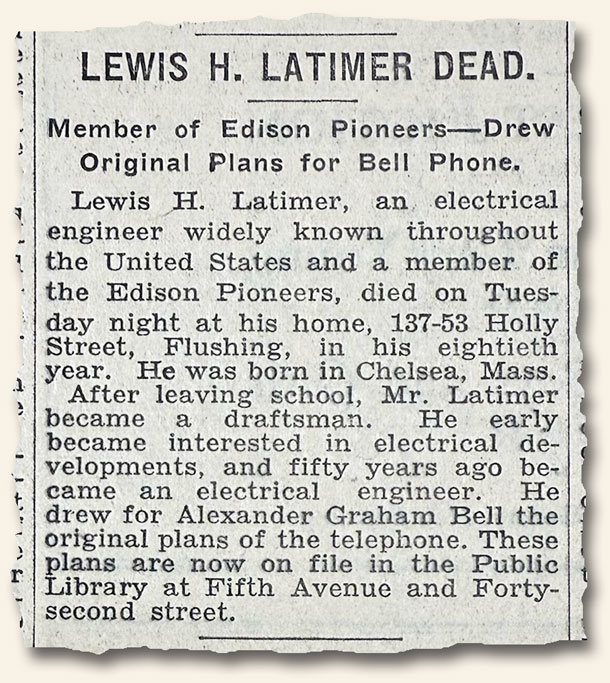
Lewis who? A collecting-friend recently asked us if we had the death report of Lewis H. Latimer. He sends us similar requests quite frequently, but it rare that I have never heard of the person who’s obit he is seeking. Lewis Latimer is one of the exceptions, and the time spent bringing myself up to speed was worth the effort. Such explorations are one of the attributes of collecting historic newspapers so fascinating. Shown below, absent of any editorializing, is what was found in The New York Times for December 13, 1928, followed by a bit of background. I hope you enjoy.
Our Listing on www.RareNewspapers.com:
Black Americana: Lewis H. Latimer’s death report – member of the Edison Pioneers…
THE NEW YORK TIMES, Dec. 13, 1928
* Death report of Lewis H. Latimer
* Member of the Edison Pioneers
* Credited for drawing plans for Alexander Graham Bell’s telephone
Page 29 has a 2-paragraph obituary headed: “LEWIS H. LATIMER DEAD”, which tells of the death of Black-American Lewis Latimer, a member of the Edison Pioneers. See background details below.
Other news of the day is found throughout.
Complete in 60 pages, slightly irregular along the left spine, in very good condition.
Background (Lewis Latimer): Lewis Howard Latimer (1848–1928) was a groundbreaking African American inventor, engineer, and draftsman whose work significantly shaped modern technology. Born in Massachusetts to parents who had escaped slavery, Latimer faced racial barriers throughout his life but persevered through self-education and determination. After serving in the U.S. Navy during the Civil War, he taught himself mechanical drafting and was hired by a Boston patent law firm.
Latimer played a key role in drafting the patent drawings for Alexander Graham Bell’s telephone in 1876. He later worked with Hiram Maxim and Thomas Edison, where he improved the carbon filament for incandescent light bulbs, making them longer-lasting, more affordable, and suitable for widespread use. He also authored Incandescent Electric Lighting (1890), the first technical book on the subject.