
Search
The Rare & Early Newspapers Hobby

Receive the Newsletter

Buy Historic Newspapers

Lead-up to a Nation… as reported in the newspapers of the day (reflecting back on March, 1776)…
April 3, 2026 by GuyHeilenman · Leave a Comment
-
Colonies in Flux – The Influence of Common Sense (Lead-up to a Nation – E31)
-
General William Howe – The Pennsylvania Ledger (Lead-up to a Nation – E32)
-
The Siege of Boston – Debate at the House of Commons (Lead-up to a Nation – E33)
-
Diverse Voices – Divisions of the Era (Lead-up to a Nation – E34)
We hope you are enjoying this year-long trek to the 250th anniversary of The United States through the eyes of those who were fully engaged, first hand. As mentioned previously, all accounts are rooted in what they read in the newspapers of the day.
“History is never more fascinating than when read from the day it was first reported.” (Timothy Hughes, 1975)
Lead-up to a Nation… as reported in the newspapers of the day (February, 1776)…
March 6, 2026 by GuyHeilenman · 1 Comment
-
Magazines of the Revolution – Wide Range of Daily Life (Lead-up to a Nation – E27)
-
Reports from the New-England Chronicle – Assault on Quebec (Lead-up to a Nation – E28)
-
The Massachusetts-Bay Proclamation – Turning Point Before Independence (Lead-up to a Nation – E29)
-
Paul Revere – The Essex Journal & New Hampshire Packet (Lead-up to a Nation – E30)
We hope you are enjoying this year-long trek to the 250th anniversary of The United States through the eyes of those who were fully engaged, first hand. As mentioned previously, all accounts are rooted in what they read in the newspapers of the day.
“History is never more fascinating than when read from the day it was first reported.” (Timothy Hughes, 1975)
Lead-up to a Nation… as reported in the newspapers of the day (January, 1776)…
February 6, 2026 by GuyHeilenman · Leave a Comment
-
Dr. B Church Jr – American Traitor (Lead-up to a Nation – E22)
-
Field Music Corps – The Drummer Boys of the Revolution (Lead-up to a Nation – E23)
-
Battle of Quebec – “Unsuccessful but Brave Attempt” (Lead-up to a Nation – E24)
-
Thomas Paine – Battle in the Tabloids (Lead-up to a Nation – E25)
-
The Burning of Norfolk – Nearly Annihilated (Lead-up to a Nation – E26)
We hope you are enjoying this year-long trek to the 250th anniversary of The United States through the eyes of those who were fully engaged, first hand. As mentioned previously, all accounts are rooted in what they read in the newspapers of the day.
“History is never more fascinating than when read from the day it was first reported.” (Timothy Hughes, 1975)
Lead-up to a Nation… as reported in the newspapers of the day (December, 1775)…
January 9, 2026 by GuyHeilenman · Leave a Comment
The Battle of Great Bridge – Decisive Patriot Victory (Lead-up to a Nation – E18)
The Capture of Montreal – High-water Mark (Lead-up to a Nation – E19)
Proclamation of Rebellion – Colonial Response (Lead-up to a Nation – E20)
Prohibiting Trade – Stopping trade between England and the Colonies (Lead-up to a Nation – E21)
We hope you are enjoying this year-long trek to the 250th anniversary of The United States through the eyes of those who were fully engaged, first hand. As mentioned previously, all accounts are rooted in what they read in the newspapers of the day.
“History is never more fascinating than when read from the day it was first reported.” (Timothy Hughes, 1975)
A rare, colonial “2nd forgery” with an intriguing backstory… Cape Fear (part II)…
December 29, 2025 by TimHughes · Leave a Comment
A few weeks ago we featured a post regarding this same issue: “Snapshot 1775 – North Carolina Declares itself Independent!”
Tim Hughes penned the following related post which provides the backstory:
The Cape Fear Mercury, from Wilmington, North Carolina, has a “purported” issue dated June 3, 1775. As the following story informs, this would have to be one of the more interesting colonial newspapers we’ve offered, primarily for being a forgery.
This newspaper began publishing on Oct. 13, 1769, and was suspended for about five months from the fall of 1774 to the spring of 1775. It ceased publication in September, 1775.
As for the intrigue–and this is just a brief explanation–a 1905 article in Collier’s magazine focuses on the existence of a June 3, 1775 issue of the Cape-Fear Mercury which contains on the front page the Mecklensburg Resolves, or a “declaration of independence” from North Carolina some 13 months before what was declared in Independence Hall. This was a hoax, believed to have been perpetrated by surviving document signers many years after the event, in an effort to show North Carolina was first in declaring independence from England. See much more online.
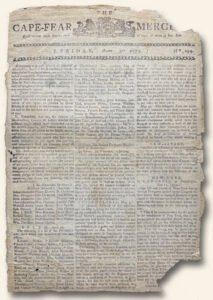 The following is taken from the well-respected “History & Bibliography of American Newspapers, 1690-1820” by Clarence Brigham. We’ve not seen such text devoted to an avowed forgery as this one in his two-volume reference set, which only speaks to its significance:
“…What purported to be an issue of this paper of June 3, 1775 was exploited in Collier’s of July 1, 1905 by S. Millington Miller, who claimed that he owned the original. The reproduction printed in Collier’s shows only the heading and part of the first and second columns…The paper was immediately believed to be fraudulent & in the ‘American Historical Review’…A. S. Salley and Worthington C. Ford showed the paper to be a forgery with the heading based upon an original issue of Nov. 24, 1769 owned by the American Antiquarian Society. The same defects in type, and even fly-specks in the 1769 issue appear in the spurious 1775 heading.
Miller made up his issue by setting up three columns of new matter, which included the Mecklenburg Resolves…But in giving his issue the date of Friday, June 3, 1775, no. 294, he erred in not knowing that Friday fell on June 2, and that because of a hiatus in publishing, the number of such a paper would be no. 258; also that by June, 1775, the heading [masthead] had been altered and the cut of the royal arms omitted. Later Miller manufactured a better forgery than the one furnished to Collier’s and differing in set-up–for example, the top line of the second column in the first forgery read “ford.—Messirs. Abednego Ramsdell, Dan-“, and in the second forgery: “of Charlestown.—Isaac Gardner, Esq. of.”.
At least 3 copies of this second forgery are now located–in the American Antiquarian Society, the Clements Library at the University of of Michigan, and in the possession of Oliver R. Barreett of Chicago…All of the forgeries were printed on one side of the leaf only, differing from the usual method of printing regular issues of 18th century newspapers.”
This issue we offer is seemingly just the fourth “second forgery” known to exist, unless it is one of the three cited above. The backstory is interesting and attests to what extent some might go to insist upon the greater prominence of North Carolina in early American affairs than what is currently found in history books.
Snapshot 1775 – North Carolina Declares itself Independent!
December 19, 2025 by GuyHeilenman · 1 Comment
According to The Cape-Fear Mercury (from Wilmington, North Carolina) dated June 3, 1775, North Carolina declared itself independent long before the 13 colonies did so in early July, 1776. However, there is a slight problem. The issue containing this announcement was a forgery! Whereas we’ve included a copy of the article below, to grasp the extent of this complex forgery, it would be best to read Tim Hughes’ explanation on the issue’s listing itself: The Cape-Fear Forgery. Enjoy.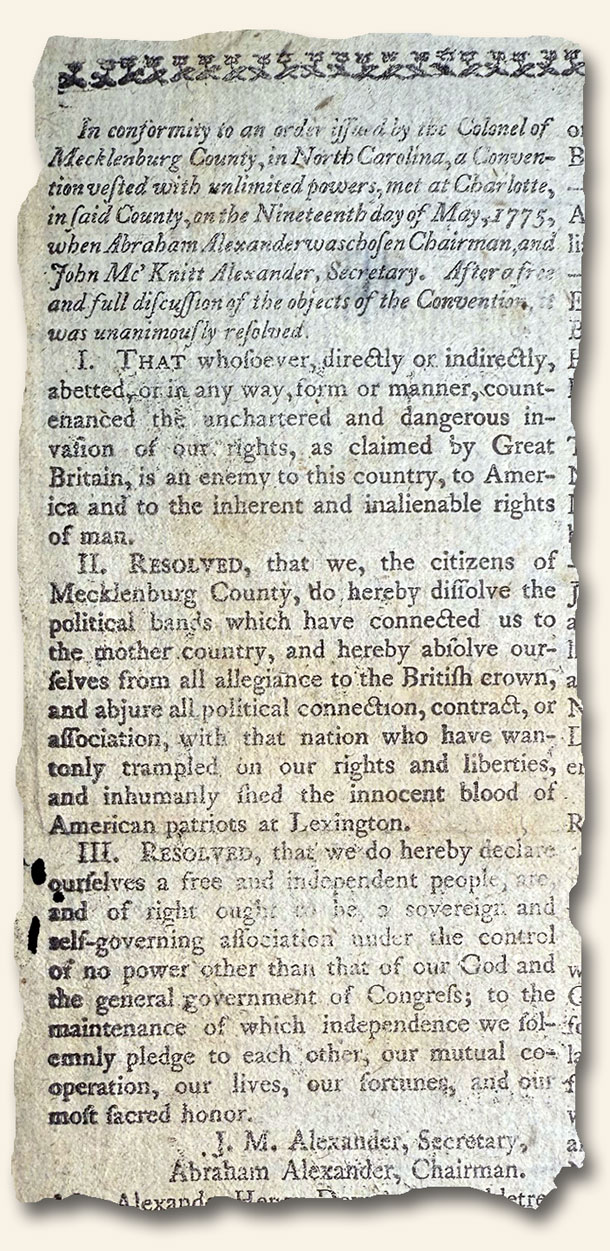
Lead-up to a Nation… as reported in the newspapers of the day (November, 1775)…
December 5, 2025 by GuyHeilenman · Leave a Comment
Continental Currency – No Power to Tax or Regulate (Lead-up to a Nation – E14)
League of Friendship-Articles of Confederation Underscored National Power (Lead-up to a Nation-E15)
James Rivington – From Impartial to Loyalist (Lead-up to a Nation – E16)
The Liberty Bell – Proclaim Liberty Through the Land (Lead-up to a Nation – E17)
We hope you are enjoying this year-long trek to the 250th anniversary of The United States through the eyes of those who were fully engaged, first hand. As mentioned previously, all accounts are rooted in what they read in the newspapers of the day.
“History is never more fascinating than when read from the day it was first reported.” (Timothy Hughes, 1975)
Lead-up to a Nation… as reported in the newspapers of the day (October, 1775)…
November 6, 2025 by GuyHeilenman · Leave a Comment
England Misses the Temper of the Times (Lead-up to a Nation – E9)
George Washington – Religious Freedom (Lead-up to a Nation – E10)
Ethan Allen and his Green Mountain Boys (Lead-up to a Nation – E11)
The Liberty Tree (Lead-up to a Nation – E12)
George Washington – Integrity, Leadership & Humility (Lead-up to a Nation – E13)
We hope you are enjoying this year-long trek to the 250th anniversary of The United States through the eyes of those who were fully engaged, first hand. As mentioned previously, all accounts are rooted in what they read in the newspapers of the day.
“History is never more fascinating than when read from the day it was first reported.” (Timothy Hughes, 1975)
Lead-up to a Nation… as reported in the newspapers of the day (Intro & Sept., 1775)…
October 3, 2025 by GuyHeilenman · Leave a Comment
British News Delayed – Lead-up to a Nation (E5)
Lord Dunmore and Colonial Unrest – Lead-up to a Nation (E6)
Patrick Henry – Lead-up to a Nation (E7)
Benjamin Franklin – Lead-up to a Nation (E8)
We hope you are enjoying this year-long trek to the 250th anniversary of The United States through the eyes of those who were fully engaged, first hand. As mentioned previously, all accounts are rooted in what they read in the newspapers of the day.
“History is never more fascinating than when read from the day it was first reported.” (Timothy Hughes, 1975)
Is it Patriot Day, Patriot’s Day, or are they interchangeable?
September 11, 2025 by GuyHeilenman · Leave a Comment
Is it Patriot Day? Yes. Is it Patriot’s Day? Yes again. Are they interchangeable? If someone had asked me yesterday, I would have thought they were one and the same; but the answer is: No! So, for those like me who thought they were one and the same, I hope what follows clears things up.
 Patriot Day
Patriot Day is a United States observance held every year on September 11 to honor the nearly 3,000 people who lost their lives in the terrorist attacks on September 11, 2001. Established by a joint resolution of Congress and signed into law in 2002, the day commemorates the victims of the attacks on the World Trade Center, the Pentagon, and United Airlines Flight 93, as well as the first responders who risked and sacrificed their lives. Americans observe the day with moments of silence, memorial services, and the lowering of flags to half-staff as a tribute to national resilience and remembrance.
Shown to the left is a report from the Los Angeles Times, dated Sept. 11, 2001.
Patriot’s Day
Patriots’ Day is a U.S. holiday commemorating the battles of Lexington and Concord, the first military engagements of the American Revolutionary War, fought on April 19, 1775. It originated in Massachusetts in the late 19th century to honor the bravery and sacrifice of colonial militiamen who resisted British forces. The holiday is observed annually on the third Monday in April, primarily in Massachusetts and Maine, with re-enactments, parades, and athletic events like the Boston Marathon. Patriots’ Day serves as a reminder of the American colonies’ fight for independence and the birth of the United States.
The following is a report from The New England Chronicle dated Sept. 7, 1775.