

Search
The Rare & Early Newspapers Hobby

Receive the Newsletter

Buy Historic Newspapers

Newspaper circulation in the 1700’s (revisited)…
June 13, 2016 by GuyHeilenman · Leave a Comment
 We often get queries as to what the circulation numbers were of colonial and later 18th century newspapers. Clarence Brigham, in his book “Journals & Journeymen” provides some helpful information.
The earliest comment on newspaper circulation in America was by publisher John Campbell in his Boston News-Letter of 1719. He notes that “…he cannot vend 300 at an impression, tho’ some ignorantly concludes he sells upwards of a thousand…”.
Famed publisher Isaiah Thomas remarked: “In 1754 four newspapers only were printed in New England…weekly, & the average number of copies did not exceed 600 from each press.”
Circulation gradually grew as the days of the Revolution approached. Rivington’s New York Gazetteer of Oct. 31, 1774 boated his weekly impressions “… increased to 3600…”, and Thomas noted in his Mass. Spy of Dec. 21, 1780 noted he had a pre-Revolutionary circulation of 3500 copies, then was driven out of Boston by the British invasion & established the Spy in Worcester. In 1775-6 circulation was 1500, in 1778-9 it was 1200, and in 1781 it did 500 impressions. He also noted that: “It has always been allowed that 600 customers, with a considerable number of advertisements, weekly, will but barely support the publication of a newspaper.”
Later Thomas noted that the famous Connecticut Courant of Hartford had a circulation which exceeded his Mass. Spy, that: “…the number of copies printed weekly was equal to, if not greater, than that of any other paper on the continent.”
In the last decade of the 18th century the number of newspapers increased, but circulation did not keep step & in generally averaged from 600 to 700. A few papers from larger cities were exceptions such as the Maryland Journal of Baltimore which claimed a circulation of near 2000. And the very popular Columbian Centinel would top the list of all 18th century newspapers in circulation with over 4000 per issue. Other popular late-18th century titles & their circulations included the Aurora with 1700; the Farmer’s Weekly Museum with 2000 and Porcupine’s Gazette with over 2000 in circulation in 1799.
But given these numbers, how many copies of any single date survived? A good question as certainly the vast majority were read and discarded. Outside of those held by institutions in bound volumes those which exist in collectors’ hands today almost assuredly came from deaccessioned institutional holdings and likely will be the only issues to see the light of day for many years to come.
(originally posted in 2009)
Chuckle for the day…
June 9, 2016 by TimHughes · Leave a Comment
The “Pennsylvania Packet“, Philadelphia, issue of September 24, 1788 contains on page 3: “Dean Swift’s idea of an attorney…”. You can read it for yourself (see below).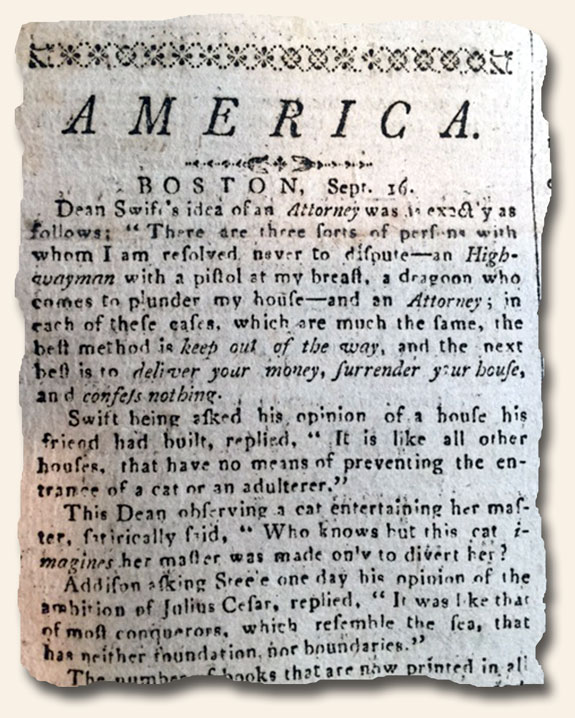
A May, 2016 stroll back thru time – 50, 100, 150, 200, & 250 years ago…
May 6, 2016 by GuyHeilenman · Leave a Comment
 What news was reported in the month of May – 50, 100, 150, 200, and 250 years ago (1966, 1916, 1866, 1816, 1766)? Such a walk back through time via the eyes of those who read the daily and weekly newspapers of the period can be quite revealing. This is why we often say, “History is never more fascinating than when it’s read from the day it was first reported.” The following links will take you back in time to show the available newspapers from the Rare & Early newspapers website. There’s no need to buy a thing. Simply enjoy the stroll.
Publius Lentulus’ 1st century description of Jesus Christ…
March 24, 2016 by GuyHeilenman · Leave a Comment
The February 3, 1787 issue of The Pennsylvania Packet and Daily Advertiser contains an 18th century translation of a letter self-described as being from Plubius Lutulus’ [Publius Lentulus’] to Caesar Tiberius (reg. 14-37 AD) which supposedly provides a contemporaneous description of Jesus Christ. Historians have spent countless hours trying to discover whether or not the letter is authentic. After more than a century of research, since there does not appear to be record of a Lentulus serving as Governor of Judea (which this letter suggests), most have come down on the side of it not being legitimate. Sadly, a 15 minute dig into the Bible could have saved them a considerable amount of energy.
The letter (see below) indicates the appearance of Jesus, with his long flowing hair, was quite a sight to behold. However, 1 Corinthians 11:14 makes it clear his hair could not have been long, and Isaiah 53:2 states: “He had no form or majesty that we should look at Him, and no beauty that we should desire Him.” End of discussion. Case closed.
Thankfully, whether or not Jesus is God’s Son… the Messiah… the deliverer of all who might believe, according to the Bible, is not dependent on such works of man. He either is who He says HE IS, or he is not who he said he was – and the proof will be in the pudding. Still, the letter does make for interesting reading. Happy Easter.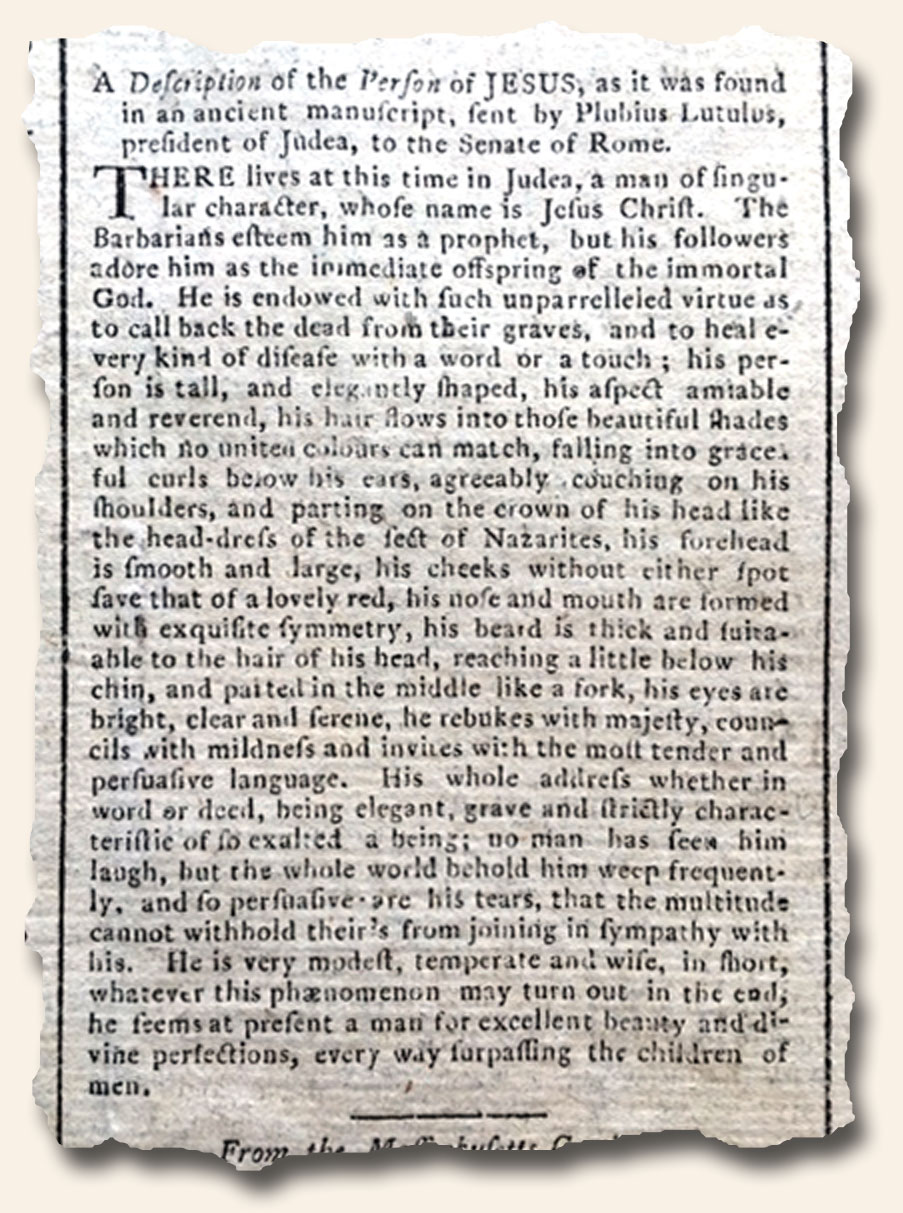
The Traveler… give it up for the second time, with a little help…
December 21, 2015 by The Traveler · Leave a Comment
 Today I traveled to Edinburgh by the way of The Edinburgh Advertiser dated December 20, 1765. There I found an account of a New Hamsphire stamp agent by the name of George Meserve being forced to resign for the second time. “…that Mr. Messerve, notwithstanding his late verbal resignation, determined to execute his office…about 400 resolute men, well equipped…Their purpose was to demand of Mr. Messerve a more explicit resignation…the repeated assurances from the Council, that the bale of stamped paper should not be opened…that they would never use them on any account, disarmed the populace of all their resentment…The stamped papers sent for the use of this province are lodged in the fort at Newcastle where they are to remain as a dead inactive lump of matter…”
~The Traveler
Archaeologists uncover secrets of historic Revolutionary War battle site…
November 19, 2015 by GuyHeilenman · Leave a Comment
 While reports of the events surrounding the skirmish at Lexington & Concord (1775) are few and far between, due to their undisputed importance, authentic newspapers with first-hand accounts are highly prized. A current archaeological effort in and around the area are sure to only increase public interest. The following article brings to light some of the recent finds:
Archaeologists uncover secrets of historic Revolutionary War battle site
The Traveler… not quite the intended effect…
November 2, 2015 by The Traveler · Leave a Comment
 Today I traveled to London by the way of The Post Boy dated November 1, 1715. While peace in Lithuania now prevailed, Poland was being torn into pieces. A proclamation was made “…that if any Gentleman should presume to mount on Horse-back, his House should be burnt, and his Wife and Children put to the Sword… However, it had a quite contrary Effect to what was expected; for the Nobility of the Palatinate of Cracow having mounted on Horseback, march’d towards Podgura and prevail’d with the Palatinate of Russia to join them; as several more are very ripe to do…The Muscovites, to the Number of 20000 Men, are arrived within 8 Leagues of this City, and pursue their March, with all speed, for Pomerania.”
~ The Traveler
A ghost robs a bank (revisited)…
October 29, 2015 by GuyHeilenman · Leave a Comment
And just in time for Halloween, a report from “The Observer” of London, January 1, 1797 (original post, 2010):
The Traveler… a sweet business…
September 21, 2015 by The Traveler · Leave a Comment
 Today I traveled to back London, England by The London Chronicle of September 21, 1765. I found the reporting of some sweet business happening in New England, the making of maple syrup! “Having chosen out a large maple-tree, suitable for the purpose, they with an axe box it…a kind of trough is prepared… in order to retain the sap as it runs down. By this means upwards of 30 gallons from one tree has been drawn in a day;… produces a sugar, the grain of which is equal in fineness to the the Jamaica… upwards of 600 lb. was made by one man the last season…”
~The Traveler
They put it in print… the Stamp Act…
August 27, 2015 by GuyHeilenman · Leave a Comment
 Some of the most noteworthy events in history have humble beginnings. Such is the case with the announcing of the passage of The Stamp Act in The Gentleman’s Magazine, March, 1765. Under the Historical Chronicle section is the rather inconspicuous note, “Lord Mansfield, as speaker, and the Earls Gower and Marchmont, by virtue of a commission from his majesty, gave the royal assent to the following bills: …for laying a stamp duty in the British colonies in America.” While this official notification of the Stamp Act most likely flew under the radar of most readers of the day, there is no doubt regarding its significance. I wonder which one-liners which go unnoticed today will prove similar ten years from now?