

Search
The Rare & Early Newspapers Hobby

Receive the Newsletter

Buy Historic Newspapers

Patrick Henry… A mid-19th century view…
November 30, 2010 by GuyHeilenman · Leave a Comment  Email This Post
|
Email This Post
|  Print This Post
Although much has been written about Patrick Henry, a December 18, 1840 issue of the Citizen Soldier, Vermont, gives us a glimpse as to how he was viewed within less than 50 years of his death. The end of the biography has a few extra treats as well. Although quite lengthy… please enjoy:


If you liked this post, you may also enjoy...
- Patrick Henry bio in the Citizen Soldier… 1840…
- One Thing Leads to Another… The Set Up for Patrick Henry’s Give Me Liberty Speech…
- Here’s to good health…
- Don’t tell the kids…
- St. Patrick’s Day in the news…
Amazing Stories… The Loch Ness Monster…
November 29, 2010 by GuyHeilenman · 2 Comments Email This Post
| Print This Post
Today we begin a series of “Amazing Stories” found within original newspapers. We’ve always stated, and newspaper collectors agree, “History is never more fascinating than when it is read from the day it was 1st reported”. Over the course of the next several months we are going to highlight some of the more interesting and/or amazing stories/reports to be found within historic newspapers. Today’s installment: the printing of the photograph and the corresponding report of… The Loch Ness Monster (see below). The article and photograph shown appeared in The New York Times dated April 22, 1934. Additional images are available at: Loch Ness Monster. Enjoy.
If you liked this post, you may also enjoy...
- All Things Nautical… 1773…
- “Collecting Newspapers – The Basics” (Part III) – Newspaper Care…
- My collecting story… M.B. in Sedro-Woolley, WA…
- They put it in print… when ghost stories were mainstream…
- Does the phonograph have a future?
Don’t tell the kids…
November 27, 2010 by GuyHeilenman · Leave a Comment Email This Post
| Print This Post
An article in the August 14, 1840 issue of The Citizen Soldier, Vermont, yields at least one perspective on how to be a successful student. Kids, please don’t try this at home. What does the phrase “having cold feet” mean anyway?
If you liked this post, you may also enjoy...
- Here’s to good health…
- With the holiday season upon us… thanks Bing!
- Patrick Henry… A mid-19th century view…
- Patrick Henry bio in the Citizen Soldier… 1840…
- Don’t try this at home. . . or ANYWHERE for that matter!
With the holiday season upon us… thanks Bing!
November 25, 2010 by GuyHeilenman · Leave a Comment Email This Post
| Print This Post
With the holiday season upon us it is time to dig out and dust off our collections of holiday-themed videos (movies??? Dvd’s???) for their annual viewing. One of our family favorites is Holiday Inn. Who can forget Bing Crosby’s vision:
Lazy
I want to be lazy
I want to be out in the sun
With no work to be done
Under that awning
They call the sky
Stretching and yawning
And let the world go drifting by…
However, before we sell all we have in our quest for the easy life running a New England Inn, or simply immobilize ourselves with longings for the lazy hazy days of Summer, an article we found in the September 4, 1840 issue of The Citizen Soldier (oddly enough – from Vermont) has a different perspective on laziness – providing ample food for thought:
If you liked this post, you may also enjoy...
- Here’s to good health…
- Don’t tell the kids…
- Patrick Henry… A mid-19th century view…
- Labor Day. . . End of Summer, Hurricanes Ramp Up…
- Patrick Henry bio in the Citizen Soldier… 1840…
A rare report… Wild Bill Hickok…
November 22, 2010 by TimHughes · 3 Comments Email This Post
| Print This Post
Some reports have gained greater notoriety long after the event happened, particularly those of the Old West which have been romanticized by television, movies and countless books on the era. The gunfight at the O.K. Corral is one, and the report of the killing of Wild Bill Hickok is another. Neither are commonly found in newspapers of the day with the Hickok report being one of the more difficult to find, and typically on a brief report when found.
We recently came across the “New York Herald” of August 13, 1876 with the report & thought it worth sharing: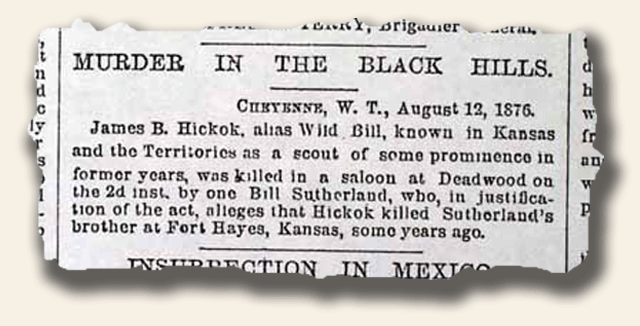
If you liked this post, you may also enjoy...
- Golden Nugget Contest – 1st place winner…
- Announcing: Catalog #261 (for August, 2017) is now available…
- One of the best we have seen…
- The post-Civil War: an era rich in history…
- First newspapers in South Dakota…
Here’s to good health…
November 20, 2010 by GuyHeilenman · Leave a Comment Email This Post
| Print This Post
An article the the September 4, 1840 issue of The Citizen Soldier, Vermont, provides a mid-19th century perspective (advice) for how to acquire good health. Try to imagine the follow-up letters to the editor in response had this appeared within this morning’s paper. Please enjoy:
If you liked this post, you may also enjoy...
- Don’t tell the kids…
- With the holiday season upon us… thanks Bing!
- The Traveler… traveling to Rio de Janeiro… part of the “health test”??
- Patrick Henry… A mid-19th century view…
- Patrick Henry bio in the Citizen Soldier… 1840…
The Traveler… Tolstoy and Johnstone… smile please!
November 18, 2010 by The Traveler · Leave a Comment Email This Post
| Print This Post
 In today’s travels, “The Call” from San Francisco dated November 18, 1910, carried articles on two interesting men in history. The first is well known to most, that being Count Leo Tolstoy in which the reporting of his life was wavering with the doctors believing he was fighting his last battle. It would be only a couple more days when the papers would be reporting of his death. The other may be one that is less know, Ralph Johnstone. He became a Wright Brothers exhibition pilot, set flight altitude records and the first pilot of the Wright team to die. Johnstone fell 500 feet to his death during a flight in Denver which is reported in this issue.
I also found that the Post Office was facing problems at that time as well. Be careful of how much time you spend at the post office as you just may be asked to say “cheese”!
~The Traveler
If you liked this post, you may also enjoy...
- The Traveler… first female aviator killed… turn-about is fair play…
- The Traveler… it does what?… make them stop!!!
- Who’s Who in Newspapers? Larry Walters edition (1982)…
- Snapshot 1909… The American Spirit takes flight…
- Solutions to the May, 1768 Gentleman’s Magazine’s math exercises…
My collecting story… Graham Dukes…
November 15, 2010 by GuyHeilenman · Leave a Comment Email This Post
| Print This Post
I have been collecting newspapers longer than most fellow enthusiasts, beginning when I was at school in England in 1943. My father went into a small second-hand shop and noticed that the owner, who sold candlesticks, old dinner plates and suchlike, was wrapping up the items in copies of the London evening “Star” for 1818, that he was tearing out of a bound volume. There were about 150 papers left and my father, who was well aware of my budding historical interest, bought the whole volume for threepence (10c).
From there I continued myself, often picking up items from shopkeepers who had no idea what they were. Nearly 70 years later, with several thousand items in store, (particularly London national papers, but also items from many other countries) some of my prize items, going back to the earlier sixteenth century, are still those that I found in the English back streets during my time as a schoolboy and later as a university student!
Graham Dukes
If you liked this post, you may also enjoy...
- My collecting story… B.D. in Thornhill, Ontario…
- My collecting story… J.R. in Ipswich (UK)…
- My Collecting Story… G. F. from Lexington, VA…
- My Collecting Story… G.F. in Lexington, Virginia…
- My collecting story… OHPC, Virginia…
Removing those annoying address labels…
November 11, 2010 by TimHughes · 2 Comments Email This Post
| Print This Post
 Fellow collector Morris Brill raises a question which others may have pondered as well: “Is there a safe way of removing the label without harming or staining the newspaper?”
Address labels come in various sizes. The earliest ones are generally from the post-Civil War years and those labels tend to be relatively narrow strips with just the subscriber’s name or an institution’s name. A city might be included as well. Those of the 20th century tend to be one-half to three-quarters of an inch tall and contain the full address of the subscriber.
If discretely placed above the masthead & not touching any text they can be quite harmless and add a certain “charm” and authenticity to the newspaper, but those which cover portions of the masthead or headline are annoying. And they can be removed.
 In every case I’ve encountered the glue is water soluble, and once softened the label can be peeled off with little trouble. Since the label is almost always of thicker paper stock than the newspaper, the quickest way to soften the glue is to moisten the reverse side, meaning the actual newspaper from page two. Once the outline of the label is felt (or hold up to the light & note the outline), I use a cotton swab and warm water (distilled would be best) to dampen the back side of the label. Patience and experimentation are important, as often two or three applications of water and up to ten minutes of waiting are required for the glue to soften such that the label can be removed by using an exacto-knife to peel it up from a corner.
Once removed and the dampness dries there may or may not be a minor water stain which remains, but I always find this much less offensive than the label covering part of the headline. It is my opinion that the value of the newspaper is enhanced by having the label removed despite a minor stain.
If you have had success with other methods of removing address labels, feel free to share.
If you liked this post, you may also enjoy...
- Removing old newspapers from bound volumes (disbinding)…
- Condition and pricing…
- “The Editor’s Dream”…
- The Titanic… and newspapers…
- Editors take note: be mindful of photos accompanying headlines…
New discovery… Who knows what one might find?
November 8, 2010 by GuyHeilenman · Leave a Comment Email This Post
| Print This Post
We’ve often mentioned that one of the pleasures of the Rare & Early newspaper collecting hobby is finding unforeseen historical nuggets buried deep within the pages of newspapers… just waiting to be unearthed.  This was recently brought to the surface again by a collector/history teacher who purchases 19th century wholesale lots (undescribed as to content) for his students and for personal use . His note is as follows:
This paper (from a wholesale lot) had a reference to a house vote for the “relief” of Susan Decatur, wife of naval hero Stephen Decatur. She had inherited $75,000 from her husband, who was killed in a duel in 1820. This is the equivalent of $1.4 million today. The bill was defeated. One of the nays was cast by Congressman Crockett (David). Minor, but priceless info. Your company does more good than you know.
Feel free to share your own discoveries with the collecting community.
If you liked this post, you may also enjoy...