
Search
The Rare & Early Newspapers Hobby

Receive the Newsletter

Buy Historic Newspapers

The Village Voice & the Culture…
August 21, 2020 by Stephanie Williams · Leave a Comment
An informed, intentional approach to diet is good for me. Left to pursue my preferences mindlessly, I might subsist on kettle cooked potato chips, with an occasional pickle or a chocolate chip cookie. Each of those has its worthy place within a more comprehensive whole, as does the literature one reads.  But variety is helpful — even to more thoughtfully discern likes and dislikes.
I turned from the early 1800’s to one of the most modern titles in our annals, The Village Voice. While the writing style is decidedly different, I was surprised to find enough similarities that I could discern the fingerprints of its antecedents in a random sampling of this publication from the 1980’s. Comparably, advertisements seem to take up close to one-fourth of the print space, although the subject matter differs widely. This Greenwich Village title has the expected focus on performing arts. Some of the movie names were familiar to me, as were a few of the bands who advertised upcoming events. It seems the Twilight Zone movie was not considered by Voice reviewers to be a cinematic success, despite the critical acclamation of its television forerunner. Cinema listings included Superman III, Return of the Jedi and The Survivors.
Distinctly anti-establishment in tone, the editorials tackle a range of hot topics, including the Catholic Church, West Bank occupation and the negative reaction to the musical movement of “serialism”. The writing is organized and thoughtful, exhibiting skill and professionalism. Most surprising to me is the piece by an investigative journalist whose three page report questions the qualifications of Reagan appointee William Clark.
Somehow, I hadn’t anticipated an intellectual discussion from The Village Voice, but having spent the time digging through, I am pleased to be proven wrong.
Gentleman’s Magazine & Insanity…
August 10, 2020 by Stephanie Williams · Leave a Comment
Living in a time of health concerns brought on by a previously unknown viral threat brings me a heightened awareness of the historical mysteries recorded in these ledgers from the past. Advertisements give a clue to the extensive maladies that troubled mankind hundreds of years ago, many of which remain challenges even today. Liver ailments, gout, yellowed eyes, rashes, sleeplessness, and obesity are just a few things for which patented tonics and trusted treatments abound. Based on a sampling of papers such as Leslie’s Illustrated, Harper’s Weekly and any of the Wild West titles in  the vast Rare & Early Newspapers collection, there is no doubt left that disease is a plague of the human condition.
Nothing, however, seems to baffle and burden society as a whole, and physicians in particular, as diseases of the mind. And The Gentleman’s Magazine that I pulled out from October of 1808 describes the tension brought about by the ignorance in a field so relevant to our existence.
In particular, the writer addresses Mr. Urban on the unfairness of the societal and ecclesiastical condemnation of suicide, without considering the mitigating circumstances of mental illness.
In consequence of an unusual conflux of suicidal cases occurring nearly together a few months ago, the feelings of Humanity appeared to be much outraged; many calumnious and violent opinions, mingled with false censure, were inserted in our daily prints; the conduct of Juries was the subject of much unqualified condemnation; and al almost entire ignorance of the true state of the awful cases brought under their cognizance, laid the foundation of much unmerited reproach.
His pointed statement halfway through the piece provides an explanation for suicide with the following question and answer: “Why does it appear that Suicide is more general than formerly? The answer is at hand: Insanity is an increasing disease. A few of the bulky catalogue of human ailments have evidently decreased; unfortunately, this is not of the number.”
There’s so much more in this article that speaks to the same subject today. While I don’t know concerning the correlation between the two, I do applaud the perspective towards those who suffer in this way. It was a lofty goal then and is, in my humble opinion, still.
It is an absolutely demonstrable fact, that in nine cases out of twelve of self-destruction which our daily papers record, the previous situation of the subject is known, and the fatal crisis might be prevented were this knowledge acted upon with firmness, promptitude, and that just method which honour, humanity, and justice demand.
My Collecting Story… G. F. from Lexington, VA…
July 31, 2020 by GuyHeilenman · Leave a Comment
The following is the next installment of our series in which we post the “stories” graciously submitted by our collecting friends during the pandemic of 2020.
Received your email today and thought what a great idea. . . so here goes an answer to “Which issue within your collection do you value the most and why?” I love US history and as soon as I earned a permanent salary, I started visiting historical sites and eventually turn ed to collecting items of interest, particularly US Civil War. I collected many of my Harper’s from numerous civil war shows; my favorite is a Richmond Examiner, 23 June 1864 (long before I knew about your website); it talked of Sherman’s campaign and how it would end like Napoleon’s in Russia! Great reading. Years went by and I am a docent at the Stonewall Jackson House in Lexington, VA (come by when this contagion is past and we’re open again). I prepared a presentation on Jackson in the Mexican War; I came across your site and ordered a “National Intelligencer,” 16 Nov 1847 and “The Union,” also dated 1847. Future Civil War luminaries their exploits abound. Finally, and not about the Civil War, my wife loves to explore Scottish roots and your site had several papers regarding the Scottish rebellion of 1746, referencing the Battle of Culloden – yep, I bought it as a Christmas gift for her. Your site piques my curiosity and I’ll remain a customer!
As additional “stories” are posted they will be available at: MY COLLECTING STORY. We did this many years ago as well – and their posts are also included.
The Woman’s Tribune & Frederick Douglass…
July 27, 2020 by Stephanie Williams · Leave a Comment
Many people who have faced difficult challenges in their personal lives become, in turn, sensitive to the struggles of others. It might be a similar difficulty, but it isn’t always. In the history of discrimination, a less-than-equal status has been designated to individuals or groups for reasons of socioeconomic status, color of skin, or gender. Specific 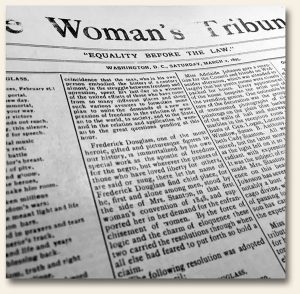 publications sprang up to give a voice to the unrepresented, and, at the very least, the power of the pen documented the demand to be heard. Within the newspapers of early America are the abolitionist papers and the working men’s papers and the women’s papers. The writers and editors called for equal status under the law, the right to own property (starting with the freedom of an individual over his or her own life) and the right to vote.
It’s this last one that has me looking intently at the front page of The Woman’s Tribune from March 2, 1895. In the first place, I noticed that the paper is much better quality than, say, the New York Times from this era. It seems the publishing board of this newspaper did not make the downgrade from rag paper. But mostly I noticed that the masthead “EQUALITY BEFORE THE LAW” is followed by the column heading “Frederick Douglass“. There is a poem written by Mary Lowe Dicks in honor of the great abolitionist, followed by a tribute/obituary that fills two columns delineating his impact for the cause of freedom. The ending portion is particularly poignant:
In him the hopes of his race were realized; in him humanity was dignified. The world is poorer because he is gone; humanity is richer because he came. The legacy of his life and service attests the truth that God keepeth watch above His own, that He shall turn and overturn until injustice dies and the right eternally triumphs.
I like this honoring of another who had a different set of obstacles to overcome, but was admired for the battle he fought and the way he waged it. I picture the huddled masses of abolitionists, suffragists, laborers — not pitted against one another, but rooting for the common goal of “liberty and justice for all.”
My collecting story… L.H. in Williamsport, PA…
July 23, 2020 by GuyHeilenman · Leave a Comment
Below we continue our series in which we post the “stories” graciously submitted by our collecting friends during the pandemic of 2020.
 (to unfamiliar surroundings) for me soon became so much more! Over the years each of our children have worked at the “History’s Newsstand” and have developed a deep appreciation of history and all it’s lessons.
As additional “stories” are posted they will be available at: MY COLLECTING STORY. We did this many years ago as well – and their posts are also included.
My collecting story… J. W. in Stow, MA…
July 20, 2020 by GuyHeilenman · Leave a Comment
Below we continue our series in which we post the “stories” graciously submitted by our collecting friends during the pandemic of 2020.
Why do I collect rare/historic newspapers? How did I get started?
In 2004, shortly after the Boston Red Sox won World Series, I received a January 7, 1920 copy of the New York Times as a gift from my wife. After not seeing any significant headlines in the paper, my wife  said, “Check out the sports page”. There on page 22 was the trade of Babe Ruth to the New York Yankees, the legendary “Curse of the Bambino”. This inspired my interest to assemble a collection that epitomizes what it meant to be a true Red Sox fan including the 1918 World Series victory (Christian Science Monitor dated September 12, 1918), the aforementioned sale the legendary slugger to the Yankees, the subsequent 86 years of agony including the ’46, ’67, ’75, and ’86 World Series defeats, and finally the breaking of “the curse” by beating the Yankees and Cardinals to win the World Series that I had just secured in my October 2004 copies of the Boston Globe.
During my efforts to find these papers at Rarenewspapers.com and on eBay, I found a 1791 copy of the Middlesex Gazette, Middletown, CT announcing that Vermont has become the 14th state of the union and the FIRST to enter under the terms of the new federal Constitution. My wife  and I were married in Vermont (where her parents lived for 35 years and where her ancestry has been traced to one of Ethan Allen’s brothers and the “Green Mountain Boys”) so it was of some personal interest as well. For only $30, I thought this paper was amazing and my wife suggested that I try to collect papers announcing statehood for each of our 50 states. With the prospect of searching for another 49 papers seeming a bit overzealous, I decided instead to focus on finding papers announcing statehood of the original 13 colonies.
 It took a couple of years to secure all these statehood ratification newspapers and in the process, I found a paper with Maine becoming a state in 1820. Although this was beyond the scope of my original search, I remembered that Maine’s statehood was a part of the Missouri Compromise. So certainly, I had to search for a Missouri statehood paper! This was what is equivalent to today’s Google searches are on so many levels … one piece of history leads to another to another to another! And with this, my affinity for newspaper collecting had begun.
At the same time, by reading books such as David McCullough’s “1776 “and “John Adams”, “The Founding Brothers” by Joseph Ellis, and James Madison’s notes on the Constitutional Convention, my interest in U.S. history was further awakened and my interest began to shift to 18th and 19th century papers. These papers provide primary source documentation described in rich and colorful language that is not experienced in academic settings. As my appreciation of the hobby grew, I began to assemble groups of papers that are linked together by a particular event or series of events that “tell the story” in real time by those who were living at the time. It is with this mindset and approach that I have continued to be an avid collector to this day.
As additional “stories” are posted they will be available at: MY COLLECTING STORY. We did this many years ago as well – and their posts are also included.
Still Learning… Womankind & Bread Flour…
July 13, 2020 by Stephanie Williams · Leave a Comment
Written during the heart of the Covid-19 pandemic of 2020…
There have been odd shortages during these recent times of collective concern, and my own personal challenge has been procuring my favorite flour for baking. I can’t understand why stock has been depleted in every brick-and mortar supplier as well as the major online providers. The positive takeaway is that more homes are filling  with the unparalleled aroma of freshly baked treats. In my opinion, the general well being of the entire planet might be elevated by that means.
Anyway, concerns for the homey details of life took me this week to the publication Womankind. Although it is shelved with our titles that often focus on suffrage in detail and politics in general, this is a different content altogether. The January 1893 issue holds a “Household Department” column headed “DOMESTIC ECONOMY. How to Cut Over Stockings for the Little Ones. How the Thoughtful Mother Can Save Many Dollars in the Course of a Year–Diagram for Remodeling Hosiery.” The title is quite daunting, but the attendant copy delivers on its promise with remarkable detail. Further subheadings deal with egg white for sore throats, lemon juice to whiten frosting, salad oil to remove tar and the ingredients to make coffee jelly. I can well imagine that households eagerly awaited the next installment of this handy publication. In fact, in a corner of the paper that solicited letters to “Aunt Celia” from area children, I found evidence of that very fact.
“My papa takes your paper and we like it very much. I don’t go to school now, but will go in the Summer. I have never gone to school much but I can read and write…I can help papa plow and tend to the bees, can help gin and grind.”
Advertisements for angler’s hooks, gloves, egg baskets, and cameras mix with cures for rheumatism, headache or obesity, and a litany of virtues proceeding from the ingestion of syrup of figs. It is a delightful, entertaining 18 page ticket to the late 19th century, and completely distracted me from my fruitless quest for a missing ingredient. Additionally, it reminded me how thankful I am for the levels of work that have been accomplished by others prior to my purchasing a ten pound paper sack of ground, filtered, cleaned and delivered flour.
Still Learning…Website Topical Searches
July 6, 2020 by Stephanie Williams · Leave a Comment
While working on a different topic, I came across a derogatory reference to California gold, which started me thinking of how little I know concerning that period in American history. I was born into the Information Age so there is no reason for me to remain in ignorance; the world wide web is packed with timelines and maps and diary excerpts. Since I work in a place that houses many original pieces concerning every era since the first colonists arrived, I decided to begin my research on the Rare Newspapers site.
 By merely typing “Gold Rush” in the search bar, I accessed 122 titles. As an experiment I only used the items and listing descriptions to obtain an overall working knowledge, and for entertainment purposes I thought it might be interesting to summarize my findings.
Modifying my results to an issue date sort, and beginning with the oldest first, I found the following attached to a paper dated September 28, 1848:
Page 3 has a lengthy article: “The Gold Region of California” which is from the very early period of the Gold Rush. It is mostly taken up with two letters from the gold fields, introduced with: “It would seem from late accounts that California is afflicted with some rich gold mines. The people there have been seized with madness on the subject & are abandoning the ordinary pursuits of life for the sake of hunting gold…”
Listings for publications from October, November and December of that year bear similar accounts and tell of the growing numbers of those involved. By January of 1849 the tone becomes cautionary:
Page 2 has: “California” which warns those thinking of heading to the gold fields to be very careful: “…large number of persons making preparations to proceed to El Dorado…will be obliged to undergo much suffering before reaching their wished-for haven & many will perhaps die on the passage…” with more. Also a short bit: “Death at the Gold Regions”.
Reading through all the write-ups I felt a bit more sure of my historical bearings when I encountered a familiar name that was not in this instance attached to a favorite brand of coffee (Pike’s Peak).
THE WASHINGTON UNION, Washington, D.C., August 29, 1858
* Pike’s Peak gold discovered
* Cherry Creek
* Start of Colorado gold rush
A page 2 report headed “Newly Discovered Gold Mines” says: “Monsieur Borden and company have arrived in Kansas City, from Pike’s Peak, Nebraska Territory. He reports newly discovered mines. He brought with him several ounces of gold, and confirms the existence of gold mines on Cherry Creek, branch south Platte; latitude 39”
It seems I have barely scratched the surface…
Still Learning… The Scientific American & the Cost of Cotton…
June 29, 2020 by Stephanie Williams · Leave a Comment
An 1862 series of issues from The Scientific American highlights farm equipment week after week. There are new inventions in the shape of plows, seed distributors and devices for shelling beans. Beyond agriculture, there are articles on engraving with electricity, followed by a detailed report of a boiler explosion. When I sat down with a stack of dates for the purpose of compiling this post, I lost track of an hour and a half of my life, poring through the smorgasbord of offered information. The 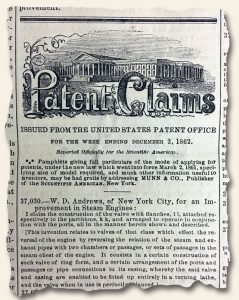 regular feature “Patent Claims” describes patents issued and rejected, while the American prizes won at the London World’s Fair applaud the successful application of those successful inventions. Finally, there are consistent complaints about the delinquency of the U. S. Patent Office.
However, I particularly appreciated the note from the editor in the issue dated November 22, 1862. The heading reads, “An Important Crisis in the History of Newspaper Publishing.” It describes the impact of the Civil War and the cotton supply on the printing industry, and serves as a reminder that large disasters and challenges within a nation have far-reaching effects on priorities and resources — often at an intensely personal level.
“This is a time of severe trial to all newspaper and book publishers; and the prosperity — yes, the very business existence — of may of them is suspended upon a slender thread. That hitherto great national blessing, cheap literature, is likely for the present to receive a severe shock, and possibly its death-blow…The war now being waged for our priceless national heritage is working sad mischief to the newspaper interest. A heavy tax is laid upon white paper…Paper-makers will not and cannot, prudently, enter into contracts to supply publishers. They will only sell from week to week at their own prices; and, as usual, spectators are busy in getting a hold of every article that goes into the manufacture of paper, with a view to still further enhance the price.”
In contrast to the challenges of today, we can look at this warning in hindsight. Munn & Company, Editors and Proprietors successfully navigated the economic upheaval, and “The Scientific American” is still being printed today. However, the quality of an issue from the 19th century is definitely superior…
My Collecting Story… J. N. from Galveston, Texas…
June 26, 2020 by GuyHeilenman · Leave a Comment
The following is the next installment of our series in which we post the “stories” graciously submitted by our collecting friends during the pandemic of 2020.
About 27 years ago I bought my first vintage newspaper about Galveston, the article published in a new York newspaper dated 1817 was a letter written in 1816 from Galveztown [Galveston], a person from the Mina Expedition writing to someone back east about the state of affairs in the  expedition, possibly a spy sent from Boston where the expedition started out, courtesy of the Simpson’s auction House conducting an auction at then Eibands, a close department store in downtown Galveston. A year later I was able to help co-found The Laffite Society. Two years later after much renovation I was asked to open an Antique store in the same location. Fast forward about 25 years I managed to collect about 70 News papers with articles thanks to help of Timothy Hughes, about the French in Texas and the infamous Jean Laffite, hero of the battle of New Orleans.
After Hurricane Ike, I decided that My collection was at risk in my home so I offered it for sale to a Houston Collector with a Museum, He later moved the Bryan Museum to Galveston Texas. I regret having to sell my collection but know it is in a much better location and will survive long after I have gone.
I could give many examples of what I learned from the articles that the Laffite Society may not be privy to and the additional articles of the period that aided in other research and enhanced my knowledge of my Art Collection and general interest.
I have based many speaking engagements on what is stated in the newspaper articles and now being asked to be filmed for my knowledge of the Laffite saga, I owe a lot to what I found in ‘The Nonus Collection’. So when the Musical, ‘Lonely and Lost, the Legend of Laffite’, is finally produced, just know that the newspapers of yesteryear have had a great influence on it, as have articles related to Hamilton!
As additional “stories” are posted they will be available at: MY COLLECTING STORY. We did this many years ago as well – and their posts are also included.