

Search
The Rare & Early Newspapers Hobby

Receive the Newsletter

Buy Historic Newspapers

Double-dated newspapers: the Julian and Gregorian calendars…
April 9, 2009 by TimHughes · 1 Comment
 If you have some 1600’s newspapers in your collection you may have a few with dates showing years as “1683/4″ or 1686/7”, or perhaps you have a few issues from a single year where a later date has an issue number lower than an earlier date, and you’ve wondered “how could this be?” Well, it’s due to the calendar, or more specifically which calendar was in use at the time.
Although the differences between the older Julian calendar and our current Gregorian calendar are many and very complicated and can be understood by visiting this site, the short answer is that in the latter part of the 17th century & a portion of the 18th century both calendars were in use in England, and the date of the issue would reflect which calendar was in use.
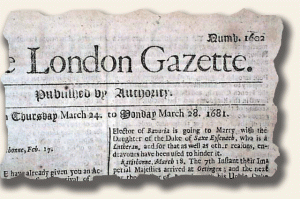 The new year of the older Julian calendar began on March 21, so an issue dated March 17, 1675 would be followed by the next weekly issue dated March 24, 1676. This would also mean that an issue dated December 31, 1675 would be followed by an issue dated January 7,1675. This was how the London Gazette dated it’s issues for much of the 17th and early 18th centuries. At first glance one would think that the issue of Jan. 7, 1675 was older than one dated December 31, 1675, but the opposite was true.
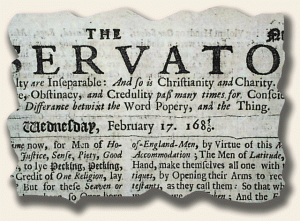 Other titles were a bit more helpful in noting the year of publication by dating issues from January 1 thru March 20 with a double-dated year such as “1684/5” or “1686/7” so the reader would know that it was from the year 1684 under the Julian calendar, or 1685 under the Gregorian calendar.
Some American newspapers of the 18th century have similar double dates, but by the beginning of the 19th century–if not reasonably before–newspapers had converted exclusively to the Gregorian calendar. The same was true with most of the Western world, while other portions of the globe adopted the Gregorian dating system much later.
Hopefully this answers a few questions you have had. Be in touch if we can be more helpful!
Red (British) tax stamps… They appear to be random…
April 2, 2009 by GuyHeilenman · Leave a Comment
 Recently a member inquired as to why the red-ink British tax stamps seemed to appear randomly within an issue – sometimes on the frontpage, sometimes on the backpage, and at other times somewhere within the issue. Although we had our thoughts on the subject, we called upon a collector of red-ink stamp issues, Randall Burt. His thought substantiated our “hunch”:
“These newsprint publishers bought their stock from the
paper makers, and then were required by law to pay the paper tax on it at the gov’t
house where the paper was taxed at current rates. The stamp was applied on
the blank sheets [pre-printing], then taken to their newspaper office where the news was added.
 These tax stamps were not always in a desirable place for the collector. J.H. Chandler & H. Dagnall wrote extensively on this subject in their “Newspaper & Almanac Stamps of
Great Britain,” as did several other noted revenue writers.” Randall Burt
Thanks for your insight Randall.
If you have additional questions you would like to see addressed through the History’s Newsstand Blog, please comment to this post of send your questions to guy@rarenewspapers.com.
A reference book for your shelves…
March 30, 2009 by TimHughes · Leave a Comment
 There are very few reference books which are exclusive to newspapers, so some of the better ones are about printing in general, peppered with historical accounts of newspaper publishing as well.
One of my favorites is such a book, titled “Printing In The Americas” by John Clyde Oswald. Done by the Gregg Publishing Company in 1937 it unfortunately is out of print, however copies can be found on book dealer shelves across the country. With the broad scope of internet sites abebooks.com and alibris.com I suspect it would not be difficult to find a copy.
There are 91 chapters totaling over 560 pages but it can essentially be considered to have three parts. first: a general history of printing in colonial America which includes much on early newspapers; second: a state by state review of the their first printing efforts, most of which were newspapers rather than books or pamphlets; and third: printing history in other countries of the Western hemisphere including Canada, Central America, South America and the West Indies, typically not dealt with in most printing history efforts.
I find the Midwest and Western states to have the most intriguing histories, filled with stories of tragedy & hardship in trying to operate a printing establishment in the wilds of America. There were far more failures than successes. Early printers must certainly have come from hearty and optimistic stock.
This is a title I would suggest you pursue. Given its format it doesn’t have to be read cover to cover, but rather chapters of interest stand alone as little histories in just a few pages.
Newspapers are not the only place to find buried treasure…
March 13, 2009 by GuyHeilenman · Leave a Comment
 During the past several months we have enjoyed exploring the hidden gems often found within rare and historic newspapers. One of our friends drew our attention to another recently discovered treasure which relates to our beloved historic collectible, specifically, the Revolutionary War era. There appears to be a new finding involving Bunker Hill in Boston, as reported by the Boston Globe:
Bunker Hill dead may lie under gardens… (read more)
A related graphic may be found at: http://www.boston.com/news/local/massachusetts/articles/2009/03/08/history_of_the_remains/.
Although history may never be more facinationg than when it’s read from the day it was 1st reported, current discoveries certainly add depth to our walk through the past.
Note: If you’ve never taken a Walking Tour of Historic Boston, it is worthy of your time. The next time your in the Boston area, this tour is a must.
The first newspaper in Utah…
February 23, 2009 by TimHughes · 2 Comments
There was a great migration to the West in 1847, just two years before a more historic wave of travelers prompted by the California gold rush, when about 2000 Mormons crossed the western plains seeking a location in which they could peacefully follow their religion. Led by Brigham Young, among the many items they included on their journey was a printing press purchased in Philadelphia.
What is now Utah belonged to Mexico in 1847 but the Mexican War, ongoing in 1847, would result in the 1848 treaty which would pass ownership to the United States. But since federal authorities never established a system of government for this new land, the Mormons took matters into their own hands and in 1849 organized the “State of Deseret” (land of the honey bee) with Brigham Young as governor.
 Volume one, number one of the DESERET NEWS newspaper, an eight page newspaper just 8 by 10 1/2 inches, appeared in Salt Lake on June 15, 1850 making it the very first newspaper published in Utah. It printed for just over one year before it was suspended for several months for lack of paper. Begun as a weekly, after just four months it became a semimonthly but returned as a weekly in 1854. Conditions for printing were harsh and crude so far from the more settled areas of the country over 1000 miles to the east.
We are pleased to share with our collectors the August 17, 1850 issue of the DESERET NEWS from our private collection, just the tenth number printed.
Removing old newspapers from bound volumes (disbinding)…
February 19, 2009 by TimHughes · 3 Comments
 At some point along your collecting journey you may have purchased a bound volume because a particular issue was of interest, not the entire lot of 100 or more found within. Perhaps you’ve given though to taking the volume apart to secure that single issue but were afraid to cause damage. It can be done and with some practice you can find the process that works best for your particular volume.
There were hundreds of ways newspapers were bound and each requires a personalized approach, but in general almost all have glue at the spine with various strings interwoven among the various issues. Most 18th & 19th century volumes used glue which is water soluble so Ideally it’s good to apply warm water to the exposed spine (scrape off as much of the leather as possible) and as the glue softens, scrape it off. This can take 30 minutes or more so it requires some patience. It may leave minor evidence of of water staining at the spine but the alternative of not removing glue is often leaving chunks of the spine with volume which is much more damaging.
Then use an exacto-type knife and cut as many of the strings as possible. Typically there are 4 or 5 cords running across the width of the spine around which the smaller strings, which run lengthwise down the volume, are wound. Cut at both sides of these cords and it will fall away. Then carefully lift each issue and “peel” them off much like pages of a tablet, keeping the knife handy to cut strings as they become more exposed.
 Typically the first several issues will have some damage at the spine but the remaining issues should remove more cleanly as you get the knack of the process. Best to start work on the issues as far removed from the issue you are wanting so that by time you get to your special issue you’ll have the experimenting work behind you.
Twentieth century volumes are more problematic in that the glue is often not water soluble so softening & scraping away the glue may not be an option, but give it a try anyway. In such cases be as diligent as possible in cutting the strings, and as each issue reveals itself in the “peeling away” process you’ll discover the process of how the volume was bound & consequently the tricks of how best to remove the remaining issues with little or no damage.
Bound or unbound: what’s the difference?
February 17, 2009 by TimHughes · 3 Comments
Many of our listings include a comment “never bound nor trimmed” and you may have wondered what that meant, or what the alternative might be. The alternative is what is mostly found in the market of early newspapers today: issues which have been “disbound” with trimmed margins.
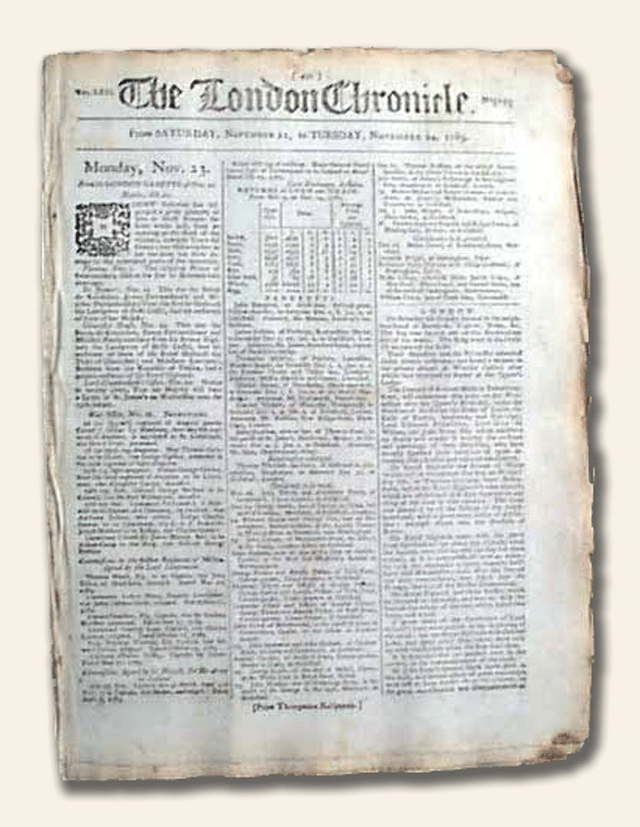 For hundreds of years it was common practice for institutions, typically libraries and historical societies, to maintain a complete set of newspapers which were within their scope of interest, commonly the locally published newspaper. And to make such storage easy so patrons could easily access issues of a specific year, newspapers were gathered together and bound into what was essentially a large book, typically 3, 6 or possibly 12 months to the volume depending on the number of pages per issue. The New York Times and other dailies of the mid-20th century bound just 15 issues per volume.
When microfilming became popular in the 1950’s institutions found this alternative a dramatic improvement over the “hard copy”, as microfilm took considerably less space, was much easier to handle, and easier to access the specific date or article needed. As a result, institutions “deaccessioned”, or got rid of the heavy, dusty volumes in favor of microfilm causing huge quantities of newspapers to come on the market. I would guess 98% of the early newspapers available today came from such bound volumes, as they can be carefully disbound, returning the newspapers once again to single-issue status. But with most institutions having already gone through this deaccessioning process, volumes of newspapers are getting increasingly difficult to find.
 In the binding process, much like the book binding process, the edges of the newspapers were trimmed with a guillotine cutter causing all 3 exposed edges to be neat & uniform. If a few of the newspapers were not neatly bound into their proper location some of the text might be lost when the volume was trimmed. You may have a few such issues in your collection.
This process explains why so many newspapers 100+ years old might look in near mint condition without a fold & with straight, even edges. They have been protected within the volume and likely sat on a shelf for over 100 years without being touched by human hands. Such issues are nice additions to newspaper collections.
But lucky is the person who is able to find a newspaper purchased off the street so many years ago and put away until being discovered, avoiding the binding and trimming process. The margins will be wider and most 8 page issues fold out to be one huge sheet of newspaper. Typically the downside to such issues is they are more heavily worn not having been protected within a bound volume, exposed to the elements, and typically handled much more frequently through the years.
In my opinion a never-bound, untrimmed issue would be preferable to a bound & trimmed issue as they are definitely more rare and exhibit their natural state as sold on the the date of issue. Finding such an issue in nice, clean condition is the best of both worlds, but condition is usually the trade-off: if you want your issues to be beautiful and clean, you’ll have more luck with disbound issues; if you want your issues to be “as issued” you’ll likely have to accept wear, soiling and ruffled margins.
How do you deal with the disbound or never-bound dilemma for issues going into your collection?
An Interview with Timothy Hughes…
February 16, 2009 by GuyHeilenman · 1 Comment
 BakerTowne Collectibles recently filmed an interview with Tim Hughes on their Collectibles Corner TV website. Tim appears about midway through the show at the 4:38 time stamp. Once the program fully loads you can drag the time tracker to this spot; however, if you have the time, Tammy’s (the host) entire program is enjoyable to view.
The interview may be found at: http://www.collectiblescornertv.com/?p=114; even better, view the interview below.
Thanks Tammy for your addition to the Rare Newspapers Community.
Stepping back: old catalogs show amazing prices…
February 12, 2009 by TimHughes · 3 Comments
 Being a collector, it is no surprise that I have kept at least one copy of every catalog we’ve published from the very first in 1976. I find it interesting to occasionally pull an old catalog off the shelf and browse through the offerings and marvel at some of the prices. They were competitive at the time. Although we emphasize collecting newspapers for the sake of collecting, as there is never a guarantee values will increase by the year, some old listings reflect some amazing prices.
 Catalog 77 was issued in early 1990. At that time our catalogs were just 5 1/2 by 8 1/2 inches with 32 pages and a total of two photos (actually photocopies). Here are a few listings and their prices you might find intriguing. No, they are no longer available for purchase!
Philadelphia Inquirer, Nov. 9, 1864 with ftpg. coverage of Lincoln’s 2nd election. $46
Chicago Tribune, Nov. 3, 1948 “Dewey Defeats Truman” (excellent condition) $160
Niles’ Weekly Register, 1816 Supplement with the Star Spangled Banner. $68
The Boston Gazette, Dec. 11, 1775 A rare issue published in Watertown. $395
 Cherokee Phoenix & Indians’ Advocate, New Echota, Georgia, Dc. 23, 1830 Very rare Cherokee newspaper. $155
New York Herald, Jan. 3, 1863 Printing of the Emancipation Proclamation. $115
Gazette, Paris, 1635 $68
Niles’ Weekly Register, April 16, 1836 Battle of the Alamo. $135
As much as you might like to buy these newspapers at these prices I’d like to have them back. Their values have increased dramatically through the years.
By the way, many of our old catalogs, going back to our very first, are available for purhase. Inquire.
Most historic: 1784 thru 1800…
January 20, 2009 by TimHughes · Leave a Comment
Continuing with our discussion on the “most historic” reports to be found in newspapers, we have been discussing the events of American history by era, the last being the 1801-1860 era. This post will discuss the most significant event in American history of the post-Revolutionary War, 18th century era from 1784 thru 1800.
Much happened in American history during this brief 17 year period but I’m not so sure there are many events which qualify as the “most historic”. From 1784 to 1787 much effort was made to organize the loosely attached colonies into a cohesive whole (see Articles of Confederation as an example), which ultimately led to the Constitutional Convention and the resultant Constitution which remains to this day. Through the ratification process it was evident that more rights needed to be clarified, resulting in the Bill of Rights of 1789. During this same year the first presidential election happened and the federal government was established, and in subsequent years a permanent site was created for the federal government, the Native Americans’ concerns were dealt with as the nation crew beyond the original 13 states, The Whiskey Rebellion challenged the collection of federal taxes, Jay’s Treaty with England was consummated, and growing troubles with France & other nations put greater focus on formalizing a federal military. All these events and more played a role in molding America during these critical formative years.

The Constitution of the United States of America
But the most historic? My vote has to go with the creation of the Constitution. And a newspaper with the printing of this document would be a very prized addition to any collection.
What is your thought?