

Search
The Rare & Early Newspapers Hobby

Receive the Newsletter

Buy Historic Newspapers

Responding to the patriotic call…
April 25, 2009 by TimHughes · Leave a Comment
 The Columbian Centinel newspaper from Boston, April 28, 1792 contains a very inconspicuous notice at the bottom of the front page which calls for recruits for the military. It’s the wording which is a delight, as the call was put forth:
“To the sons of ambition—Those noble fellows whose courage and superiority of soul dictate to them to enter the list of Fame…Her field is now open and filled with every inducement for a Soldier; every necessary of life and every chance for fortune. It will be your fault if she does not stamp on your names HERO to be caught by every ear…” with more.
See the photo for the full text of this delightful little gem from the 18th century.
Twelve issues, twelves different cities…
April 23, 2009 by TimHughes · Leave a Comment
Occasionally one finds a single title which had two or maybe three cities of publication, particularly some of the Old West titles which moved from place to place during their early years. Even the venerable Gazette of the United States moved from New York to Philadelphia when the seat of government moved, in order to be close to the political action it was reporting.
 The Trans-Continental had a different take on printing in different cities. It’s creation was a stroke of historical genius in the mind of its editor, W. R. Steele, when on May 24, 1870 over 130 passengers boarded a beautiful eight car Pullman train built under special orders of George M. Pullman specifically for this trip, the first chartered excursion by rail from the Atlantic to the Pacific. On board was carried small printing press which was used to publish 12 issues of the “Trans-Continental” newspaper, each at a different point along the round-trip journey. By what is read in these twelve issues it was a glorious affair enjoyed by all, amid the splendor of the finest mode of living ever constructed on wheels.
For their enjoyment, the passengers were lavished with the finest food, surrounded by a setting which few of the finest mansions constructed could rival. Sights of the new West as well as extraneous news & anecdotes of the day were recorded in the pages of this newspaper, witnessed by the passengers continually in awe of the splendor of the prairies, magnificence of the Rockies and the warmth & hospitality of the people they met along the way.
The Trans-Continental lasted but 42 days and twelve issues–six printed on the westward journey & six printed on the return to the east coast. What is unique is that each issue not only carries a different date but a different city of publication.
Unfortunately for the collector exceedingly few genuine issues of the Trans-Continental remain. Having a complete set in our private collection we had each issue professionally reproduced and bound into a SINGLE BOOKLET so any collector can read from one of the more intriguing & unusual newspapers of the 19th century.
You may never own an original but you can take some vicarious enjoyment in the trip by reading what those 130 passengers enjoyed nearly 140 years ago by clicking on the “single booklet” link above. After all, isn’t this what brought is all to the hobby in the first place?
The plight of newspapers & its impact on the hobby…
April 20, 2009 by TimHughes · 3 Comments
 In recent years–and to a greater degree recent months–we’ve been hearing about the demise of the newspaper, at least that edition which has appeared on newsstands & doorsteps for many generations. Much blame goes to the internet and our increasingly digital society, although the proliferation of cable news, now available 24 hours a day, shares in the blame as well.
For us hobbyists, who have collected the “hard copy” while they are still rolling off the presses across America, what will the impact be if print editions die off completely?
 If the past is any example I would suggest there will be heightened interest in collecting newspapers. Much of what is popular today in the collecting world are items which are now obsolete: phonograph records, old telephones, mustache cups, treadle sewing machines, and on and on. While one school of thought is that interest is heightened once an item is no longer produced, another thought is that collecting interest will fade when they are no longer produced. How many thousands of items which have faded from memory & long ago ceased production are not on the “radar” of collectors?
Let hear of your thoughts. You are the collectors; your passion and holdings may well be impacted one way or the other if current newspapers cease publication. How do you think this could impact the hobby?
Collection Spotlight: One man’s passion for pulp… From Antique Trader…
April 16, 2009 by GuyHeilenman · Leave a Comment
Joe Rainone, a member of the Rare & Early Newspapers Community, recently had a featured article in a post at AntiqueTrader.com. His passion is focused primary on pulp magazines, with some cross-over to collectible newspapers. The article begins:
 “My passion for collecting started in the mid 1980s although I did enjoy collecting stamps, coins and reading comics as a child. I started to collect comic books again with my 9-year-old son who loved Spider-Man. This was my introduction to popular fiction.
I became intrigued with pulp magazines. In time, I became more interested, not only in the artwork, but also the history of how and where it all began…”
To read more, go to http://www.antiquetrader.com/article/One_mans_passion_for_pulp. Great job Joe!
The rare newspaper community is pregnant with scores of members with their own collectible passion. One of the beauties of the hobby is the endless varieties of directions one’s collection can go. If you’d like to share about your collectible area of interest, please do.
Editorial policy (?) and the potential impact upon an issue’s collectibility…
April 11, 2009 by GuyHeilenman · Leave a Comment
The following are a few thoughts by Morris Brill (guest contributor) concerning slight differences in the printing of the Declaration of Independence within the London Chronicle (dated August 17, 1776) vs. the printing within the Gentleman’s Magazine (dated August, 1776):
Recently on Ebay two different sellers offered a printing of the Declaration of Independence in the Gentleman’s Magazine. I also noted your offering of the Declaration within the London Chronicle.
I (Morris) noted, while reading the text of Gentleman’s Magazine, as photographed on Ebay, a particular sentence in which two words were missing and substituted with a line, i.e. ___________
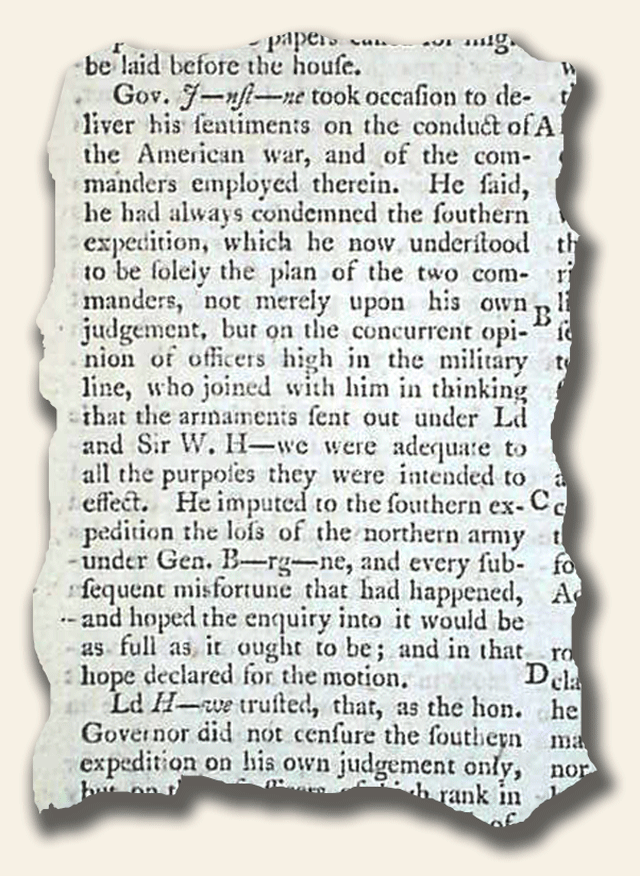 The sentence is as follows:
“A prince, whose character is thus marked by every act which may define a tyrant, is unfit to be the ruler of a free people.”
In the Gentleman’s Magazine the words ” prince” and “tyrant” are deleted.
I find it interesting that although the Gentleman’s Magazine and the the London Chronicle are both British that one paper printed the words prince and tyrant, yet the other did not.
To me, the deletion of the two words certainly diminishes the historic value of the printing as it appeared in the Gentleman’s Magazine, although I would not pass up the opportunity to own this paper. Perhaps it has to do with an opposing editorial policy, or the political persuasion of the two publishers.
Morris
Note: If anyone is aware of the formal policy which led to the deletion of certain words within the Gentleman’s Magazine, please share your insight with the rare newspaper community.
Double-dated newspapers: the Julian and Gregorian calendars…
April 9, 2009 by TimHughes · 1 Comment
 If you have some 1600’s newspapers in your collection you may have a few with dates showing years as “1683/4″ or 1686/7”, or perhaps you have a few issues from a single year where a later date has an issue number lower than an earlier date, and you’ve wondered “how could this be?” Well, it’s due to the calendar, or more specifically which calendar was in use at the time.
Although the differences between the older Julian calendar and our current Gregorian calendar are many and very complicated and can be understood by visiting this site, the short answer is that in the latter part of the 17th century & a portion of the 18th century both calendars were in use in England, and the date of the issue would reflect which calendar was in use.
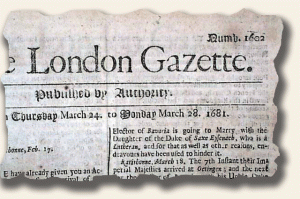 The new year of the older Julian calendar began on March 21, so an issue dated March 17, 1675 would be followed by the next weekly issue dated March 24, 1676. This would also mean that an issue dated December 31, 1675 would be followed by an issue dated January 7,1675. This was how the London Gazette dated it’s issues for much of the 17th and early 18th centuries. At first glance one would think that the issue of Jan. 7, 1675 was older than one dated December 31, 1675, but the opposite was true.
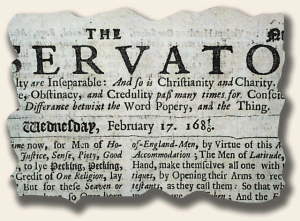 Other titles were a bit more helpful in noting the year of publication by dating issues from January 1 thru March 20 with a double-dated year such as “1684/5” or “1686/7” so the reader would know that it was from the year 1684 under the Julian calendar, or 1685 under the Gregorian calendar.
Some American newspapers of the 18th century have similar double dates, but by the beginning of the 19th century–if not reasonably before–newspapers had converted exclusively to the Gregorian calendar. The same was true with most of the Western world, while other portions of the globe adopted the Gregorian dating system much later.
Hopefully this answers a few questions you have had. Be in touch if we can be more helpful!
Red (British) tax stamps… They appear to be random…
April 2, 2009 by GuyHeilenman · Leave a Comment
 Recently a member inquired as to why the red-ink British tax stamps seemed to appear randomly within an issue – sometimes on the frontpage, sometimes on the backpage, and at other times somewhere within the issue. Although we had our thoughts on the subject, we called upon a collector of red-ink stamp issues, Randall Burt. His thought substantiated our “hunch”:
“These newsprint publishers bought their stock from the
paper makers, and then were required by law to pay the paper tax on it at the gov’t
house where the paper was taxed at current rates. The stamp was applied on
the blank sheets [pre-printing], then taken to their newspaper office where the news was added.
 These tax stamps were not always in a desirable place for the collector. J.H. Chandler & H. Dagnall wrote extensively on this subject in their “Newspaper & Almanac Stamps of
Great Britain,” as did several other noted revenue writers.” Randall Burt
Thanks for your insight Randall.
If you have additional questions you would like to see addressed through the History’s Newsstand Blog, please comment to this post of send your questions to guy@rarenewspapers.com.
Newspapers are not the only place to find buried treasure…
March 13, 2009 by GuyHeilenman · Leave a Comment
 During the past several months we have enjoyed exploring the hidden gems often found within rare and historic newspapers. One of our friends drew our attention to another recently discovered treasure which relates to our beloved historic collectible, specifically, the Revolutionary War era. There appears to be a new finding involving Bunker Hill in Boston, as reported by the Boston Globe:
Bunker Hill dead may lie under gardens… (read more)
A related graphic may be found at: http://www.boston.com/news/local/massachusetts/articles/2009/03/08/history_of_the_remains/.
Although history may never be more facinationg than when it’s read from the day it was 1st reported, current discoveries certainly add depth to our walk through the past.
Note: If you’ve never taken a Walking Tour of Historic Boston, it is worthy of your time. The next time your in the Boston area, this tour is a must.
The first newspaper in Utah…
February 23, 2009 by TimHughes · 2 Comments
There was a great migration to the West in 1847, just two years before a more historic wave of travelers prompted by the California gold rush, when about 2000 Mormons crossed the western plains seeking a location in which they could peacefully follow their religion. Led by Brigham Young, among the many items they included on their journey was a printing press purchased in Philadelphia.
What is now Utah belonged to Mexico in 1847 but the Mexican War, ongoing in 1847, would result in the 1848 treaty which would pass ownership to the United States. But since federal authorities never established a system of government for this new land, the Mormons took matters into their own hands and in 1849 organized the “State of Deseret” (land of the honey bee) with Brigham Young as governor.
 Volume one, number one of the DESERET NEWS newspaper, an eight page newspaper just 8 by 10 1/2 inches, appeared in Salt Lake on June 15, 1850 making it the very first newspaper published in Utah. It printed for just over one year before it was suspended for several months for lack of paper. Begun as a weekly, after just four months it became a semimonthly but returned as a weekly in 1854. Conditions for printing were harsh and crude so far from the more settled areas of the country over 1000 miles to the east.
We are pleased to share with our collectors the August 17, 1850 issue of the DESERET NEWS from our private collection, just the tenth number printed.
Removing old newspapers from bound volumes (disbinding)…
February 19, 2009 by TimHughes · 3 Comments
 At some point along your collecting journey you may have purchased a bound volume because a particular issue was of interest, not the entire lot of 100 or more found within. Perhaps you’ve given though to taking the volume apart to secure that single issue but were afraid to cause damage. It can be done and with some practice you can find the process that works best for your particular volume.
There were hundreds of ways newspapers were bound and each requires a personalized approach, but in general almost all have glue at the spine with various strings interwoven among the various issues. Most 18th & 19th century volumes used glue which is water soluble so Ideally it’s good to apply warm water to the exposed spine (scrape off as much of the leather as possible) and as the glue softens, scrape it off. This can take 30 minutes or more so it requires some patience. It may leave minor evidence of of water staining at the spine but the alternative of not removing glue is often leaving chunks of the spine with volume which is much more damaging.
Then use an exacto-type knife and cut as many of the strings as possible. Typically there are 4 or 5 cords running across the width of the spine around which the smaller strings, which run lengthwise down the volume, are wound. Cut at both sides of these cords and it will fall away. Then carefully lift each issue and “peel” them off much like pages of a tablet, keeping the knife handy to cut strings as they become more exposed.
 Typically the first several issues will have some damage at the spine but the remaining issues should remove more cleanly as you get the knack of the process. Best to start work on the issues as far removed from the issue you are wanting so that by time you get to your special issue you’ll have the experimenting work behind you.
Twentieth century volumes are more problematic in that the glue is often not water soluble so softening & scraping away the glue may not be an option, but give it a try anyway. In such cases be as diligent as possible in cutting the strings, and as each issue reveals itself in the “peeling away” process you’ll discover the process of how the volume was bound & consequently the tricks of how best to remove the remaining issues with little or no damage.