
Search
The Rare & Early Newspapers Hobby

Receive the Newsletter

Buy Historic Newspapers

Early reports can be unassuming…
May 17, 2010 by TimHughes · Leave a Comment
 As many collectors have found, the earliest report of an historic or significant event is often not the best or more detailed. Usually the report of a day or two later is best, when all the particulars were known and the accuracy more credible. Yet there is still the fascination of reading of a major event before it would become part of world history.
The first report of the Great Fire of London–one of the more notable events in 17th century British history–is somewhat unassuming. The bottom of the back page of “The London Gazette“, September 3, 1666, has a report datelined the day before noting: “About two a clock this morning a sudden and lamentable Fire brake out in this City, beginning not far from Thames Street, near London Bridge, which continues still with great violence, and hath already burnt down to the ground many houses thereabouts, which sad accident affected His Majesty with that tenderness, and compassion, that he was pleased to go himself in Person with his Royal Highness to give order that all possible means should be used for quenching the fire, or stopping its further spreading…” with a bit more (see).
The next several issues would provide more detail, but this first report gives some indication this was to be more than a small event. Indeed, it would grow to consume some 13,200 houses, 87 parish churches, and make homeless 70,000 of the city’s 80,000 inhabitants.
Rare Newspapers – distracting?
May 6, 2010 by GuyHeilenman · 2 Comments
One of the most common questions our Rare Newspapers’ staff is asked is, “How do you ever get anything done? Don’t you get distracted by the interesting content within the issues?” The answer is an enthusiastic, “YES!” One of the most enjoyable aspects of our daily interaction with early newspapers are these very “distractions”. Hardly a day goes by where we aren’t fascinated by or engaged in conversation resulting from the content within the issues we find.
One such discussion (distraction) was recently inspired by an issue of the Omaha Daily Bee dated June 28, 1919, which originally caught our attention because of its dramatic WWI headline, “PEACE TREATY SIGNED”, with a corresponding subhead, “China Alone Refuses To Sign Covenant That Ends Greatest War in History”. However, what caused our “distraction” was the front page text (shown in the image) regarding the “World’s Ten Greatest Peace Treaties“. Although this issue is no longer available, it can be viewed at: http://www.rarenewspapers.com/view/570082?acl=781584385. Much has occurred since the early 20th century. We wonder what such a list might include if it were printed on the front page of a tomorrow’s newspaper?
Resources of collectors…
April 29, 2010 by GuyHeilenman · 2 Comments
 One of the most frequently asked questions regarding the rare newspaper hobby concerns available resources. Awhile back we posted a general response to this on eBay titled, “What Resources are Available for Newspaper Collectors?”. Although we’ll continue to look at this question in detail, we thought newcomers might appreciate a general overview. An excerpt of this post is as follows:
1) Price Guide For Rare & Historic Newspapers?
2) Storage & Display Options For Colonial, Civil War & 20th Century Newspapers?
3) Reference Books On The History Of Old Newspapers?
4) A Club Of Collectors Of Old Newspapers?
Collecting rare & early newspapers from the colonial era through the Civil War & 20th century is a fun & fascinating hobby, but questions often arise: Is their a price guide, or a club of collectors? What storage & display options are recommended for the old newspaper hobbyist? How about reference material on the hobby?
1) Being a relatively unknown hobby has its advantages…
To view the entire post, please go to: “What Resources are Available for Newspaper Collectors?“
Featured websites – The Liberator Files…
April 22, 2010 by GuyHeilenman · Leave a Comment
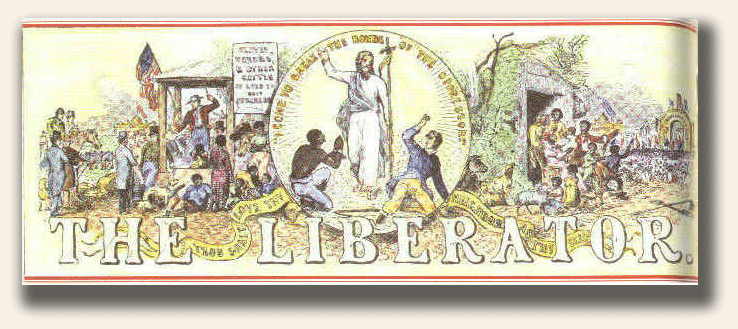 Within the past few months, three members of Timothy Hughes Rare & Early Newspapers each recommended the same website, The Liberator Files, as a great resource for exploring this well-known abolitionist title from the early/mid 1800’s. This Boston paper was published by William Lloyd Garrison, and provides wonderful context for this formative period in U.S. history – from the early 1830’s through the end of the Civil War. The Liberator Files, developed and maintained by Horace Seldon, includes a wealth of abolitionist related commentary in conjunction with a host of scanned Liberator images from William Lloyd Garrison’s own collection, which are currently held at the Boston Public Library. Thanks Horace, for your significant contribution to the world of rare & historic newspapers. Please enjoy!
Feel free to share with the rare newspapers community other historical and/or rare newspaper oriented websites you’ve found to be of use.
First newspapers in Louisiana…
April 19, 2010 by TimHughes · Leave a Comment
 Being a French settlement from the early 1700’s, it would be of no surprise that the first newspaper in present-day Louisiana was French: “Moniteur de la Louisiane” which began in New Orleans on March 3, 1794. Three years later it became the official mouthpiece of the government, and continued to print until the publisher’s death in July, 1814.
Louisiana’s first newspaper done by a publisher of English or American extraction was the “Union: New Orleans Advertiser and Price Current” by James Lyon, of Vermont, which began on Dec. 13, 1803. Just one day later Louisiana’s third newspaper began–a French publication–“Le Telegraphe, et le Commercial Advertiser“. Both these latter two endeavors began just a few months after the Louisiana Purchase. Actually “Le Telegraphe” began as a French publication but later changed to both French and English, a tradition which held true for many Louisiana newspapers at least through the Civil War.
James Gordon Bennett and his New York Herald…
April 8, 2010 by TimHughes · Leave a Comment
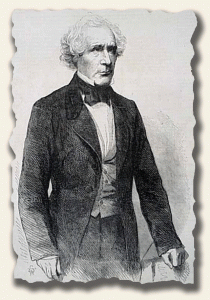
A book I am currently reading, “An Empire of Wealth” by John Steele Gordon, has a page or two concerning newspapers, mostly focused on the innovations of James Gordon Bennett (image to the left is from the Harper’s Weekly dated July 10, 1858) and his “New York Herald“, offering some insights new to me and likely new to you. It is a bit lengthy but has some interesting information I felt was worthy of sharing:
 “The biggest difference between the newspapers of the pre-industrial world and those of today was politics. Most general-interest newspapers were the instruments of political factions, praising one party and excoriating all others. They were, in reality, little more than an editorial page wrapped in some highly tendentious news.
A Scots immigrant to New York, James Gordon Bennett, changed all that. Born in 1795 into one of Scotland’s few Catholic families, Bennett was always a man apart, which can be an asset for a journalist. He was also remarkably ugly, with severely crossed eyes. When a young journalist interviewed him in the 1850’s at his office across from New York’s City Hall, he reported that Bennett ‘looked at me with one eye, while he looked out at the City Hall with the other.’
Well educated in Aberdeen, he wrote his first piece of journalism about the Battle of Waterloo, when he was twenty, and four years later, sensing greater opportunity, immigrated to the United States. He worked at a series of newspapers from Boston to Charleston before settling in New York where, three times, he tried to found a newspaper that would expound Jacksonian principles. Each attempt was a failure.
Steam, however, was changing the newspaper business as it was changing everything else by the 1830’s. The new rotary presses, powered by steam, could turn out thousands of copies of a newspaper a night and at a much lower price than had been possible before. Bennett decided to try something new. On May 6, 1835, with $500 in capital, an office in a dank cellar, and himself as the only employee, Bennett began publishing the “New York Herald“.
Bennett made the Herald nonpartisan in its news articles, sought always to be the first with the news, and sold it to a mass audience by having it hawked on the streets at a penny a copy by the armies of newsboys that would quickly become a feature of the American urban scene for more than a hundred years. None of these ideas was original with Bennett. But it was he who put them all together for the first time. He also introduced a dazzling array of other journalistic innovations. He was the first to print a weather report and to cover sports regularly. He was the first to cover business news and stock prices in a general-interest newspaper. And while ‘respectable’ papers weren’t supposed to notice such things, when a beautiful prostitute was murdered in one of New York’s more fashionable brothels, Bennett played the story for all it was worth.
The “Herald’s” circulation soared, and other papers were forced to follow suit as the city, and then the country, became transfixed with the story. Within a few years the ‘Herald” was among the city’s most successful papers. Bennett traveled to Europe, where he signed up correspondents in London, Rome and Paris to supply the “Herald” with exclusive copy, the world’s first foreign correspondents. He fought Congress to establish the principle that out-of-town newspapers had as much right to the congressional press galleries as the local papers, the beginning of the Washington press corps. He even coined the use of the world ‘leak’, to refer to the stores slipped to reporters by politicians for their own purposes.
As the telegraph began to spread across the country, Bennett exploited it to the hilt. When the Mexican Was broke out, only two years after Morse’s successful demonstration, Bennett organized a consortium of newspapers to fund a pony express from New Orleans to Charleston, which was connected to New York by telegraph. The reports the New York papers published were often days ahead of the official reports arriving in Washington.
By the time of the Civil War the “Herald” was, by far, the largest and most influential newspaper in the country, and all other major papers had followed its model, profoundly transforming the newspaper business. Its daily circulation during the war reached as high as 400,000, many times the total circulation of all American newspaper combined fifty years earlier.”
The Civil War…
April 1, 2010 by GuyHeilenman · Leave a Comment
Not too long ago we had a collector ask several questions regarding rare newspapers from the Civil War. We thought others might be interested in the questions and responses as well.
Most major city papers had a daily and bi-weekly edition, and some a tri-weekly edition. The cost of a newspaper from the pre-1890 era was no small expense, so the latter two were more affordable for many. I suspect the “Evening Edition” did not publish 7 days a week; perhaps 2 or 3, maybe 4 (?). If this was the case it was easy for them to fill in the balance of the issue with news from a day or two before as the type was already set and those who purchased it hadn’t read it. This was more clearly defined with the Phila. Inq. run we had because they had in the first column that it was the “tri-weekly” edition, and in the same issue was another masthead from the day before. The Tribune did not print such a notice, or at least I haven’t found it yet.
And such editions with 2 masthead are quite uncommon because libraries would have only subscribed to the regular daily edition, given their desire to document all news for every day, and 95% of early newspapers on the market came from some institution after microfilming. So the 2 masthead issues are typically only found as never-bound issues which have survived the years in attics, trunks, etc.
Thanks for the member inquiry which led to these responses from Tim. Feel free to send your questions, comments as well.
The first newspapers in Iowa…
March 22, 2010 by TimHughes · 1 Comment
The state of Iowa had various “owners” over the last 300+ years. It became a French possession in 1682, in 1762 was ceded to Spain, in 1800 it was returned to France, who in 1803 passed ownership to the United States under the terms of the Louisiana Purchase.
 In 1804-5 as part of the District of Louisiana it was under the government of the Indiana Territory. During the next seven years it was in the Missouri Territory, and from 1821-34 it was a part of the unorganized territory of the United States. From 1834-6 it was part of the Michigan Territory, and from 1836-8 a part of the Wisconsin Territory. In 1838 the Wisconsin Territory was divided & the western portion was named the Iowa Territory, which in 1846 was admitted as a state.
The first printing in the district was in 1836 when John King, who moved from Ohio to Dubuque, believed the town should have a newspaper and on May 11, 1836 began printing the “Visitor“, the first newspaper in Iowa. A year later the name changed to the “Iowa News“, and 4 years later to the “Miners’ Express“. Iowa’s second newspaper was the “Western Adventurer and Herald of the Upper Mississippi” (not sure how they fit that in the masthead) begun by Dr. Isaac Galland on June 28, 1837 in Montrose. It lasted for just a few months when the equipment was sold to James Edwards who took it to Fort Madison & on March 24, 1838 the first issue of the Fort Madison “Patriot” was published.
Uncut newspapers: leave as they are?
March 20, 2010 by TimHughes · 1 Comment
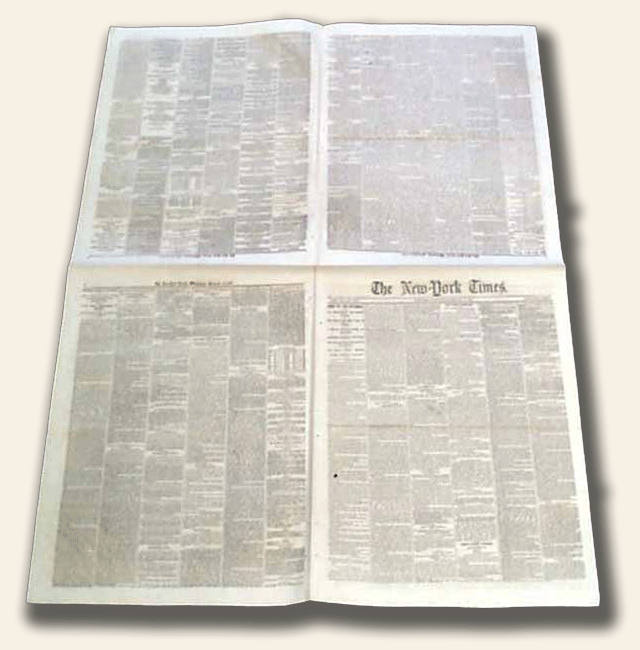 Fellow collector Morris Brill poses an interesting question worth sharing with others, along with my thoughts on the issue.
I suspect we have all encountered “uncut” newspapers from the 19th century, issues which are eight pages in length but which are essentially one large sheet of paper printed on both sides, then folded twice to produce the eight pages. This is how they came off the printing presses . Morris inquires:
“For the sake of maintaining the monetary value of such a newspaper is it best to leave the paper in this one piece condition or is it best to cut the paper so it folds normally like a book and the pages can be turned individually?”
Uncut issues are, for the most part, those which have survived the years by not being bound, kept loose by previous owners and eventually finding their way into the hands of collectors. Given that the vast majority of early newspapers in the collector market came from bound volumes once stored by libraries or other institutions then “disbound” into individual issues, uncut newspapers are relatively few in number. Once bound all margins, save for the spine, are guillotined at the bindery to produce an even, book-like edge thus losing the attachment at the top.
Since uncut issues are newspapers in the original state, as they were sold on the streets, my preference would be to keep them as such. Most collectibles tend to be more desirable in their original state: never clean an old coin; never paint an antique wagon; don’t removed the aged patina from an antique desk, etc. Are such newspapers more clumsy to read? Yes, to some degree. But they can be folded back and all 8 pages read with little difficulty. It’s obviously how it was done years ago as I’ve purchased several boxes of uncut 19th century newspapers which were folded many different ways, left as such by the reader.
They only time I might suggest cutting the top of an uncut sheet is the rare occasion when an issue was bound, causing all four leaves to be attached at the spine, yet the tops have not been trimmed. In such situations the newspaper cannot be folded back because of the attachment at the spine. I would take an exacto knife and cut the very top along the fold. Not much else can be done if the interior pages are to be read.
Collectors may have noticed that we charge a small premium for uncut newspapers. A downside to an uncut issue is they tend to be more worn than those bound as they have not been protected through the years by the bindings, but if one can obtain an issue which is both uncut and in great condition–and contains the Gettysburg Address–there’s a great item for any collection!
Featured websites – TeachHistory.com
March 18, 2010 by GuyHeilenman · Leave a Comment
 Teachers with a love of history, listen up! The following resource can improve your curriculum and make you a stronger educator. Students of history will enjoy the breadth and depth of the historical journey as well.
TeachHistory is a fantastic website (blog), developed and maintained by Ben Edwards, which provides engaging information & a plethora of useful educational resources related to history. It describes itself as:
“a blog dedicated to social studies and history teachers across the United States who use Colonial American history, imagination and multisensory teaching methods to inspire their students. Our goal is to provide a resource where teachers like you can access information about colonial history plus technologies, methods and products that are making a difference in education today.”
While Ben’s experience with teachers and students is varied, perhaps the most useful channel for keeping him in touch with the pulse of teacher/student interests and needs occur via the many intimate conversations had while engaging teachers and students through his Walking Tours of Historic Boston. Combine this with both his (historic) heritage and his natural love of history, and you have the making of a blog which is sure to stay relevant over time. Some of the recent posts include:
Colonel Shaw, Sergeant Carney and the 54th Massachusetts
Remembering Alex Haley and Roots
Black History Month: A Tribute to Phillis Wheatley
Young Ben Franklin and the Silence Dogood Letters
Teachers: Are You Engaging AND Empowering Your Students?
Many of the posts include detailed images and reference accounts of actual Rare & Early Newspapers – most of which come from his personal collection. Ben fully grasps a foundational truth regarding primary sources: “History is never more fascinating than when it is read from the day it was first reported.” Thanks Ben, for your contributions to both the Rare Newspapers and Educational communities.