

Search
The Rare & Early Newspapers Hobby

Receive the Newsletter

Buy Historic Newspapers

Collecting 19th Century… Pre-Civil War… Hidden gems abound…
May 17, 2013 by GuyHeilenman · Leave a Comment
An era rich in history… with hidden gems throughout…
Many rare newspaper collectors focus on the more memorable eras of history such as the Revolutionary War, the Civil War, or World War II. Brief date periods –as war events tend to be—can allow for a more concise collection without becoming unduly large if one concentrates on just the major events. Consequently, less notable eras often get over-looked without realizing there is a treasure trove of events which are both fascinating and historically significant found in period newspapers, and well within the range of the average collector.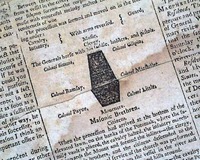
One such era would be the 1800-1860 period which we designate on our website as the “Pre-Civil War Era”. This was a transitional time in American history as the events of the Revolutionary War and the struggles with creating the federal government gave way to a more secure nation and a more independent America as the nation grew in both size and complexity.
This sixty year era offers a great wealth of events which were formative for the American landscape. The century began with continual coverage of the funeral of George Washington who died less than 3 weeks before the new century began. Thomas Jefferson was the first President to be elected in the 19th century and he did not escape the headaches of war, as the “Barbary Wars” fell within his tenure. He also lead the charge for the Louisiana Purchase which more than doubled the size of the nation and would be home, in full or in part, for 15 new states that would eventually join the Union. Newspaper reports on the Lewis & Clark Expedition were few and far between, but finding even brief mentions in a period newspaper can be quite a thrill.
As the country grew a wealth of notable events transpired & were noted in newspapers of the day. Presidential elections and inauguration are always popular, and there were many in this era: Jefferson, Madison, Monroe, John Quincy Adams, Jackson, Van Buren, William Henry Harrison, Tyler, Polk, Taylor, Fillmore, Pierce, Buchanan, and of course Lincoln, who was elected in this era, but would be inaugurated in the “Civil War Era”, a fascinating chapter of American history onto itself. For those who like to have :complete” collections, finding every election and inauguration is a doable quest.
The War of 1812 falls within this era and provides an opportunity for a sizable and notable collection on its own, from the declaration of War to the many naval battles, the attacks on Baltimore & Washington, the significant battle of New Orleans, and the treaty which ended the war. Collectors like that war events typically allow for collection “bookends” (war declaration and treaty of peace), between which they can become as focused as their budget will allow in collecting the major events.
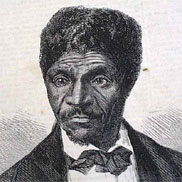 The slavery issue would remain a stain on the American fabric during this era, with events such as the Denmark Vesey and Nat Turner insurrections, and the more notable John Brown raid at Harper’s Ferry, as lead-ins to the Civil War. Abolitionist newspapers would be created, including the Liberator & the Emancipator among others, and names such as Frederick Douglass, Dred Scot, and William Lloyd Garrison would make their marks in American history forever. And it was very much a political issue as well with the Missouri Compromise being just one of several federal decisions which had slavery as a basis. Relations with the Native Americans were troubling also, with the Seminole War, the “Trail of Tears”, and the many broken treaties commonly reported in newspapers of the day.
The Texas Revolution of 1835-1836 has a spice of historical romance similar to the events of the Old West, as both were dramatized in movies. The memorable Battle of the Alamo (starring John Wayne on the big screen) and its fiercely heroic soldiers & citizens, who knowingly faced death to establish the independence of Texas, remains a proud moment in not just Texas but American history. The battles which lead up to that event, and those which followed can be found in newspapers of the day, and mention names we remember from history books including Sam Houston and Davy Crockett.
The Mexican War was another event which resulted in the expansion of the nation with all the major battles reported in newspapers of 1846 to 1848. Just a few years latter attention focused once more on the West with the California Gold Rush and all the romance of a nation heading west to find their fortune. The newspapers reported those thrills, but also reported the struggles & hardships which would befall the many on the trek to the West. Newspapers of the day were more frank than were history books 100 years later.
Westward expansion wasn’t limited to the battle fronts or the quest for gold, as the Missouri River Expedition, The Yellowstone Expedition, the Rocky Mountain exploration, and reports on the Santa Fe Trail were all reported as the adventurous were discovering and creating history—and reported first in newspapers of the day. Such expansion was responsible for states to be created, and reports of statehood for Alabama, Indiana, Michigan, and Illinois among others were detailed in newspapers, as were reports of changes needed in the United States flag to honor such additions.
The Erie Canal, creation of the cotton gin and the Pony Express were notable events during this period. Famous names were commonly found as their reports were making history & reported in newspapers as such, including the likes of Daniel Boone, John Jacob Astor, Bolivar, John Jay, Henry Clay, Horace Greeley, and Kit Carson to name but a few. Of special intrigue is finding reports of famous names before they became famous, such as inconspicuous mentions of Abraham Lincoln from 1848 when he was a member of Congress, or Jefferson Davis from 1833, nearly 30 years before becoming President of the Confederacy.
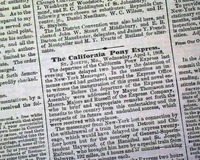 Judaica interest, reports of pirates, the Black Hawk Indian War, runaway slaves, William Henry Harrison’s one month Presidency, and the earliest reports of the Mormons and the journey across the country provide fascinating reading in newspapers of the pre-Civil War era. The Monroe Doctrine is just one of an endless list of historical documents and landmark Supreme Court decisions which were reported in newspapers of the day. Early newspapers from Hawaii, Florida, and Kentucky among others, more commonly found after the 1870’s are a special treat when found before the Civil War. And more than American history found their way into American newspapers. The Battle of Waterloo and the other Napoleonic Wars with mention of Buonaparte, Wellington and other key European figures put world history into perspective when such reports are found alongside notable events in American history.
If capturing history in the pages of the nation’s newspapers is your hobby, certainly there is much from the 1800 – 1860 period to excite any historical hobbyist. Do not overlook this fascinating era in the growth & development of the United States of America.
The War of 1812… through contemporary newspapers and more…
May 13, 2013 by GuyHeilenman · Leave a Comment
 Rare & original newspapers have always been an excellent resource for capturing the context, contemporary response, and details of historic events. This truth was brought home recently via Todd Andrlik’s, “Reporting the Revolutionary War: Before It Was History, It Was News“. Moving slightly into the future, Vice Admiral, U.S. Navy (retired) George W. Emery does the same in his work, “In Their Own Words – The Navy Fights The War Of 1812“. Yet again we are reminded that “History is never more fascinating than when it’s read from the day it was first reported.” Additional details worth exploring may be found at:
In Their Own Words: A New Look at the Naval War of 1812
Thanks for this latest contribution which brings the past into the present through the eyes of those who experienced the War of 1812 first-hand.
The Traveler… marching in Birmingham… Hitler’s end… your next party…
May 6, 2013 by The Traveler · Leave a Comment
 Today I traveled to Detroit, Michigan by the way of The Detroit News for May 6, 1963. There I found that for the past several days Birmingham, Alabama, has been witnessing the “Children’s Crusade”, in which several hundred students had skipped school to march for desegregation and civil rights. Today’s report states it was peaceful with singing, chanting and praying as it was Sunday. Oddly enough the only arrest made (as of this article) was of a white couple inside the church as they were not permitted inside the church.
Also in the paper was a headline “Found Hitler’s Body in ’45, Reds Say in War ‘Secrets'” which also included a large photo Adolf Hitler and his wife, Eva Braun. This was information being released about the disposition of Hitler’s body from the release of a book by Cornlius Ryan entitled “The Longest Day”.
Did you ever want to be the life of the party? There is a story of a 15-year-old boy that, with a novelty ring, “touted to possess ‘hypnotic’ powers”. Well, within a few minutes, he truly ended up placing a young lady into a trance but was unable to get her totally out of it. A call to her parents, a trip to the hospital, and a psychiatrist later, the trance was broken. Just be careful at your next party with your jewelry and what you say!
~The Traveler
The Civil War in newspapers…
April 29, 2013 by TimHughes · 1 Comment
Could there be a period in American history which fascinates and intrigues more than the Civil War? As we celebrate the 150th anniversary of the battle between the North and the South, collecting interest in genuine newspapers which reported the news as it was happening, remains strong among the relatively small number of rare newspaper collectors. Any visit to a Civil War collector’s show will give evidence to the high prices of genuine memorabilia, from guns to uniforms to every bit and scrap of war-related material a collector might desire. But newspapers remain a very welcomed low-priced option, perhaps largely because they have yet to be discovered by majority of Civil War collectors.
But that has always been the case with this hobby, regardless of the time period. Rare newspaper have always remained relatively unknown in the world of historical collectables—a reality which continues to amaze—but its consequence has provided one of the benefits of those who enjoy the hobby: low prices. Across the entire spectrum of collectables, be they coins, stamps, furniture, books, autographs, toys—you name it–items of comparable age to newspapers are much higher than newspapers.
And what a world is available to the Civil War collector who discovers rare newspapers. You name the battle or political event that happened from 1861 to 1865 and it will be found in a newspaper of the day. And this hobby allows a collection to showcase not just the events of the war but the lead-up to the conflict between the states, as the issue of slavery and the troubling relationship between the Northern and Southern states making news for more than a decade before the outbreak of war.
From the Battle of Fort Sumter to the assassination of Abraham Lincoln, a collector can create a notable collection of newspapers as large or small as their budget will allow. Some might focus on the top ten most significant battles of the Civil War (see previous post) and include newspapers with accounts of Fort Sumter, First and Second Bull Run (Manassas), Hampton Roads (the Monitor vs. the Merrimac), Shiloh (Pittsburg Landing), capture of New Orleans, Antietam, Gettysburg, Vicksburg, Chickamauga, fall of Atlanta, Savannah and Richmond as well as the surrender of General Lee to U.S. Grant. Wikipedia offers an excellent and very inclusive list of all the battles of the Civil War which can be used as a checklist for the collector seeking the most notable events of the war.
Typically daily newspapers have war reports on the front page with additional news on inside pages as well, and a select few included graphics. The “New York Times”, “New York Tribune” “New York Herald” and the “Philadelphia Inquirer” are—in my opinion—the “big 4” titles of the war, as they more than most printed Civil War maps and other war-related graphics on their front pages. Such issues remain favorites for framing and display.
Not to be overlooked are the political events and speeches which were perhaps more significant than the battles, including the election and inauguration of Abraham Lincoln, the Emancipation Proclamation and the Gettysburg Address. All events appeared in newspapers within a day of their happening.
Yet another area of focus for various collectors is the gathering of contemporary reports surrounding certain historic figures such as Abraham Lincoln, Robert E. Lee, Ulysses S. Grant, “Stonewall” Jackson, George Meade, James Longstreet, William Sherman, Jefferson Davis, Ambrose Burnside, Nathan B. Forrest, Colonel Robert Shaw, John Hunt Morgan (and his raiders), to name a few. Textbooks simply cannot capture the essence of these noteworthy individuals in the same way newspapers can.
Some collectors might focus on the Civil War from the Confederate perspective as newspapers from the Southern state are available, albeit more rare, and offer an interesting perspective on the events of the war. Issues from Richmond, the capital of the Confederacy, offer some of the best coverage of the war as all news eventually found its way to Richmond. And the editorials offer fascinating reading in the “Daily Richmond Examiner” or the “Daily Dispatch”. Charleston newspapers also offer great coverage, after all the war began in its harbor. The “Charleston Daily Courier” was one of the best, and one of but a few Southern newspapers which printed in the masthead “Confederate States of America”. Venturing beyond the more “common” of the Confederate titles, newspapers from other states are available, a few of the more accessible being the “Daily Progress” (from Raleigh) and the “Louisville Daily Courier” from Kentucky. The “Daily Memphis Appeal” is an intriguing title, as during its Civil War history it was chased by the Yankees out of Memphis and published in 8 other Confederate cities before succumbing in the final weeks of the Civil War.
A “Confederate” newspaper from the North might seem like a oxymoron, but “The Crisis” from Columbus, Ohio, was an intriguing newspaper by a copperhead publisher who was very much opposed to the Lincoln administration and strongly supported the Confederate effort believing that slavery could not be prohibited by law.
One cannot mention newspapers of the Civil War without discussing “Harper’s Weekly”, the illustrated newspaper which put all the action, drama and cruelty of war into the homes of every American. For the first time, citizens were able to see what their leaders looked like, as an abundance of portraits of the Civil War officers appeared throughout the war years, not to mention the great wealth of battle scenes and city views not found elsewhere during the Civil War. Not to be outdone by the Yankees, the Confederates created their own version of “Harper’s Weekly”, titled the “Southern Illustrated News” published in Richmond, but it was a poor imitation at best. It’s lack of success resulted in a considerably smaller circulation and obviously more rare title for collectors today.
Whatever your interest in the Civil War, collectible newspapers have much to offer. With prices relatively low for 150 year old items and containing virtually every event which happened during that fascinating era, a notable collection can be amassed which can be enjoyed and admired without breaking the bank. A fascinating world awaits those who discover this interesting collectible.
The Traveler… three cheers…
April 22, 2013 by The Traveler · Leave a Comment
 Today I traveled to Boston, Massachusetts, through the Independent Chronicle dated April 22, 1813. There I found Commodore Bainbridge was addressing the sailors of the Constitution as they had been invited to the Theatre. “Sailors, In the action with the Java you shewed yourselves men. You are this ev’ng invited to partake of the amusements of the Theatre. Conduct yourselves well… Let the correctness of your conduct equal your bravery, and I shall have additional cause to speak of you in terms of approbation.” He then informed them that on Monday morning, “pay to them the prize money in consideration of their good conduct in the actions with the Guerriere and Java. The crew received the information with great satisfaction, and gave the Commodore three cheers.”
The article has a concluding paragraph from a correspondent who had observed the attendance of the sailors and the comments to their appearance and behavior.
Blessed are the feet of those who bring good news – for a change.
Regarding the remainder of the issue, I wonder if James Madison suffered from writing cramps after all his signing???
~The Traveler
Gift of newspapers can spark a life-long hobby…
April 8, 2013 by TimHughes · Leave a Comment
 A recent piece on the web concerning the gift of a “stack of old newspapers” (see the hyperlink) to a grandson is a common story in our collecting world. A woman from Racine, Wisconsin, gave her grandson a box of historic newspapers, mostly World War II headline reports but including other events of the post-war era, collected by her husband. The photos show some nice banner headlines, several of the issues being the “Chicago Tribune” but including other titles from the Midwest.
Such finds, or gifts, are typically the catalyst for a new-found hobby. And newspapers from the last 60 or 70 years can be found for even the most modest of collecting budgets. Our website features major events of World War II, the Holocaust, the space race, baseball, Korean War, Vietnam War, Watergate–you name the event and it’s likely among the 2600+ issues from this era found on our website. Many prices range from $20 to $40 while some more significant events or dramatic headlines achieve higher values, and would be among the best newspapers for any collection.
For the beginning collector, the 20th century is an excellent entree to the much bigger world of our hobby which can includes newspapers back to the 16th century. Large headlines or events remembered by elder relatives bring to life the events which were formative to the American experience of the last 70 years. See: Stack of Old Newspapers
The Traveler… the strike is over… looking to the future…
April 1, 2013 by The Traveler · Leave a Comment
Today I journeyed to Detroit, Michigan by the way of The Detroit News of April 1, 1963. There I found that people of New York city would be able to enjoying their daily papers again as the 114-day newspaper strike had ended. Newspaper headlines read as “New York’s Alive Again!”, “Well, Hello There! We have News For You” and “Read All About It – Oh, What a Beautiful Morning”. “A series of labor disputes had shut down the papers for nearly four months and cost the city’s economy an estimated $250 million.” Some of the newspapers came back to print with the price of the issues being raised by half, some even doubled the cost per issue.
The back page of the issue features an article “Economists See a Future of Abundance – Full, Rich Life Only 40 Years Away… The Year 2000”. This is an interesting look at four decades into the future with articles of “Note of Caution on Planning”; “Ample Resources Seen for Future”; “More Funds Urged for Research”; “Taller Americans, Bigger Appetites”; “Energy Demand Due to Triple” and more. It also includes four interesting illustrations of the futuristic glimpses of life (see image below or click on link above). Ready to use your car that is able to take to the air to avoid the heavy traffic on the turnpikes and freeways?
~The Traveler
Collecting the Revolutionary War on a budget…
March 28, 2013 by TimHughes · 2 Comments
 I would argue that beyond the Civil War, the era of American history which evokes the most interest among our collectors is unquestionably the Revolutionary War. With a cast of characters who still rank among the most memorable in history—Washington, Adams, Hancock, Jefferson, Henry, Franklin, Paine, and more—and a plot, which if it were not true history would serve as an excellent screenplay for an exciting movie—an oppressed, energized people seek to break free from the reigns of oppression and dominance from abroad—it is easy to see how the events of the Revolutionary War continue to intrigue and offer a foundation upon which to reflect as today’s world grapples with many of the same issues despite the 230+ years which distance us from those notable events.
And what could be better than experiencing those events just as those who lived through them? Newspapers offer that opportunity. Genuine issues, once held and read by those who lived through those turbulent days before being relegated to the back shelves of libraries, are now part of the inventory of Hughes Rare & Early Newspapers. And at prices which might surprise many (see Revolutionary War issues for $60 and under), as a hobby which is relatively unknown to the collecting world has yet to cause demand and scarcity to drive prices beyond the means of the average collector. Of course, there are still many that fall into the category of what we refer to as, “The Best of the Best – Revolutionary War Edition“.
Of significance is that British titles, which offer excellent coverage of all American events given their role in attempting to placate the demands of the Americans while maintaining control of their colonies, allow ownership of battle reports of the war for under $100, with  some very notable events in the $200-$300 range. American newspapers remain among the most desired but their scarcity is reflected in their prices. With a collection of the “Pennsylvania Evening Post” which included the Declaration of Independence bringing $600,000 in auction recently, it would amaze many that the same document is available in London’s “Gentleman’s Magazine” issue of August, 1776 (took news 3-4 weeks to traverse the Atlantic) for under $4,000. Other disproportionate prices between British and American newspapers entice many to gravitate to the British titles while prices and availability remain attractive.
The “London Chronicle” is one of the better British titles in reporting the Revolutionary War. From the Battle of Lexington and Concord, to Bunker Hill, Battle of New York, Saratoga, Washington crossing the Delaware, treason of Benedict Arnold, Guilford Court House, to Cornwallis’ surrender at Yorktown, this newspaper offers coverage which equals the American newspaper accounts. In fact many British reports were taken verbatim from American newspapers. Of equal quality in report news of the day was the “Edinburgh Evening Courant” from Scotland as I have found all events of the Revolutionary War to be reported in this title as well. Other UK titles which covered the war include “The Glocester Journal”, “Aris’s Birmingham Gazette”, the “Edinburgh Advertiser” and the “Glasgow Mercury” to name a few.
But perhaps the best and most available title of the Revolutionary War period would be the “Gentleman’s Magazine” from London, it having a long printing history from 1731 to the 20th century so it encompasses not just the Revolutionary War in great detail by the entire scope of American history. As an added treat this title typically included one of more plates within each issue, which included maps as well. And during the years of the Revolutionary War were found many maps of American colonies, battle sites as well as large foldout maps showing the entire scope of the united colonies at that time. The maps alone have found a keen interest among collectors, separate from the issues in which they were stored for over 200 years. As is true with the British titles mentioned, “Gentleman’s” included all notable events and documents, including the Articles of Confederation, the Causes and Necessity For Taking Up Arms, all major battles of the war thru the treaty between Washington and Cornwallis, and even the document by King George III which officially ended the war. And all the major names of the war from both the British and American sides have found their way into the pages of “Gentleman’s Magazine”.
 American titles are available as well. Some of the more rare would be those from the South which are virtually impossible to find, and when they do surface their prices are beyond the means of most collectors. Some of the more commonly found titles would be the “Pennsylvania Evening Post” from Philadelphia, the “Pennsylvania Ledger” “Boston Gazette” (which featured an engraving by Paul Revere in the masthead), “The Pennsylvania Gazette” and “Pennsylvania Packet” among others. And dipping back a few years before the outbreak of the war, when tensions were building with much evidence in the newspapers of the day, the “Pennsylvania Chronicle” and the “Boston Chronicle” offer excellent insight into events of the day from the years 1767-1769 for under $200 for most issues.
Regardless of your interest in the Revolutionary War, whether it be the famous names that came to prominence, the battles of the war, or a focus on a singular event or locality, genuine newspapers of the day are available for the collector. It is a hobby with limitless possibilities, and offers a unique opportunity to literally hold history in your hands.
The 1600’s and 1700’s on a budget…
March 25, 2013 by TimHughes · Leave a Comment
A genuine collectible, over 300 years old, for $60 or less. Is there a field of collecting today which has items of such age– in nice condition–for $60? The hobby of collecting rare & historic newspapers likely sits at the top of what must  be a very short list. And such prices, along with tremendous availability of titles & content, are part of the intrigue of this fascinating hobby which remains unknown to almost everyone. And this, in large part, is the reason prices are outrageously low in comparison to the relative rarity of other collectibles. While issues do run the gamut price-wise from newsbooks (at the upper end) to coffeehouse newspapers (typically at the lower end), it is a fascinating field for the historical hobbyist on a budget ($20 and under).
The ‘London Gazette‘ is the world’s oldest continually published newspaper, having begun in 1665 and is still publishing today. With such historical depth you would expect to find virtually every major event in world history within its pages, and you would be right. The Great Plague and Great London Fire, William Penn being granted land in the New World, the death of noted pirate Captain Kidd, the battles of the French & Indian War and Revolutionary War and so much more are found in not only this title but other newspapers of the era. First reports of such notable events can sell in the thousands of dollars, but an interesting facet of this hobby is that follow-up reports of a few days later can fall well within the comfort level of the average collector.
Both age and graphic appeal come together in the London ‘Post-Boy‘ newspaper, with issues from the 1718-1725 period featuring two ornate engravings in the masthead in addition to a very decorative first letter of the text. Add to this the relative small size of this single sheet newspaper and you have a terrific item for display for under $55.
With American newspapers not beginning until the first decade of the 18th century (one title was published in 1690 but lasted just one day), and most American newspapers through the Revolutionary War being very rare, British titles are an excellent source for collecting all the notable events not only in American history, but in world history as well. And the reporting was often extensive, for remember that the colonies were part of Great Britain through 1776.
The ‘London Chronicle’ was a popular British newspaper which documented amongst its pages virtually all American events since its founding during the French & Indian War. Yet another periodical, the ‘Gentleman’s Magazine‘, is an  excellent source for period reports of American events since its beginning in 1731, and one of its features was the printing of maps of all corners of the globe, many of which show North America and specific colonies. From James Oglethorpe’s settling the colony of Georgia, to Ben Franklin‘s famous kite experiment, installation of the Liberty Bell, the enactment & repeal of the hated Stamp Act, all events of the Revolutionary War, to the mutiny on the Bounty & so much more, the ‘Gentleman’s Magazine’ offers a terrific repository of American and world history at very affordable prices. Plus, there are reports of Colonel George Washington from 1754 when he was just 22 years old and relatively unknown, and for the music buffs there are works by the composers Hayden, Handel, and death reports of Mozart and Beethoven within its pages. The early battles of Napoleon & other European reports are logically found in this title as well.
While American newspapers of the Revolutionary War and before are generally pricey, ranging in the $400 – $1000+ range, two notable exceptions exist being the ‘Boston Chronicle’ and the ‘Pennsylvania Chronicle’, both from the 1768-1769 years. Because their circulation was widespread they are among the more commonly held colonial titles by institutions, & consequently come on the market when libraries convert from hard copy to microfilm or digital. They detail the entire spectrum of American life from just before the Revolutionary War while providing an interesting perspective on American politics during those critical years. Complete, genuine issues are typically available for under $200.
American newspapers from after the American Revolution become more available and at dramatically lower prices while still containing a wealth of notable content on the founding years of the federal government. The ‘Pennsylvania Packet’ of Philadelphia was one of the more successful titles, and was the very first to print the Constitution of the United States. While that issue, September 19, 1787, ranks well into six figures, 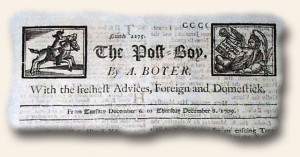 dates surrounding it are typically found in the $45 – $80 range and offer a perspective of life in the city where and when the Constitution was being created. The ‘Columbian Centinel’ from Boston was perhaps the most successful title in 18th century America and its pages document the complete scope of America politics and life from 1785 thru Washington’s election and inauguration to his death just weeks before the end of the century.
Other 18th century American titles which are within the budgets of even the most modest collectors are the ‘Connecticut Courant’, ‘Dunlap’s American Daily Advertiser’, ‘Gazette of the United States’, the ‘Massachusetts Spy’, and ‘The Herald, A Gazette For The Country’ and others. Nice issues from the formative years of the federal government can be had for under $50 each.
While first reports of the most historic events of the 17th and 18th centuries will always command top dollar among the most savvy of collectors, the hobby of collecting rare newspapers offers a tremendous wealth of issues at surprisingly low prices, while at the same time offering fascinating content on life only known to others through history books. And this hobby is one that offers the entire spectrum of political, economic, and social history to every collector. What other hobby can make that claim? But perhaps most importantly, this hobby let’s you hold—quite literally—history in your hands.
The Traveler… the battling suffragist… for the Irish…
March 18, 2013 by The Traveler · Leave a Comment
Today I traveled to Springfield, Massachusetts by way of the Springfield Daily Republican dated March 18, 1913 where I found coverage of a suffragist event held in England (see image below). The British militant suffragist had declared war against their sisters who were working for the vote for women by constitutional means. The meeting was thrown into disorder until ladies had to be ejected from the event and peace was restored.
In honor of St. Patrick’s Day, there are three small articles on the front page relating to this special day. One was of President Wilson wearing a shamrock sprig in his lapel and the reporting of “green” festivities at the Capitol. Another was the diversion of a waiters strike of the Irish national banquet in London. And the last is of Police Judge Killen who annually releases all the Irish from jail… check out that report!
~The Traveler