

Search
The Rare & Early Newspapers Hobby

Receive the Newsletter

Buy Historic Newspapers

The Articles of Confederation formally united the 13 colonies…
December 18, 2008 by TimHughes · 1 Comment
For a collector of historic American documents as printed in period newspapers a printing of the “Articles of Confederation” would be a very significant issue. With much credit to Wikipedia, the creation & importance of this document provides some fascinating reading:
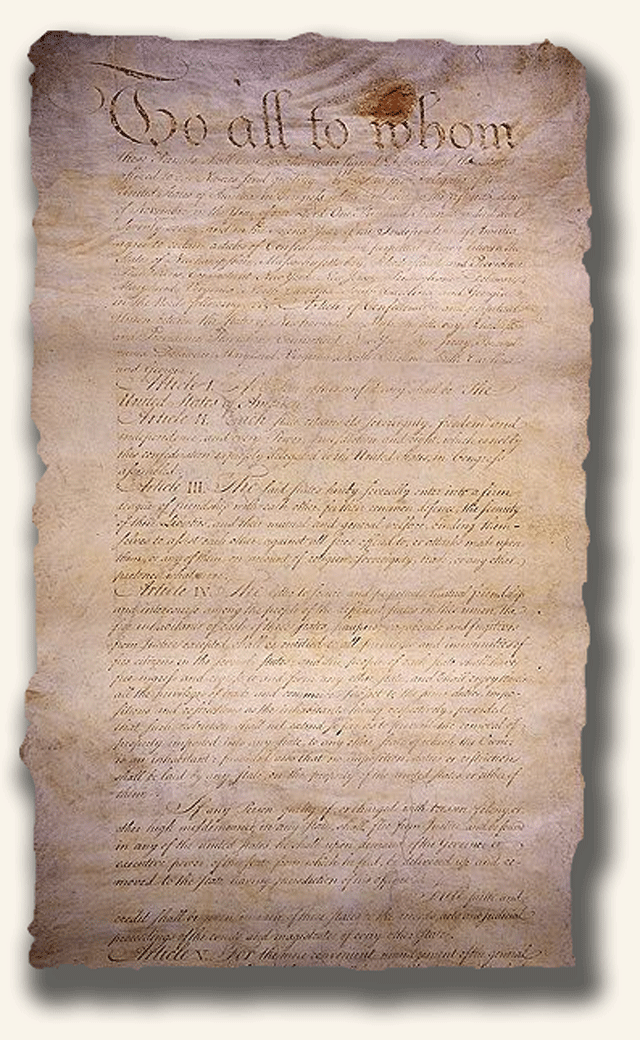 The Articles of Confederation was the governing constitution of the alliance of thirteen independent and sovereign states known as the “United States of America.” The Articles’ ratification, proposed in 1777, was completed in 1781, legally uniting the states by agreement into the “United States of America” as a union with a confederation government. Under the Articles (and the succeeding Constitution) the states retained sovereignty over all governmental functions not specifically deputed to the central government.
The last draft of the Articles was written in the summer of 1777 and adopted by the Second Continental Congress on November 15, 1777 in York, Pennsylvania after a year of debate. The Articles set the rules for operations of the “United States” confederation. The confederation was capable of making war, negotiating diplomatic agreements, and resolving issues regarding the western territories; it could not mint coins (each state had its own currency) nor could it borrow money, whether inside or outside the United States. An important element of the Articles was that Article XIII stipulated that “their provisions shall be inviolably observed by every state” and “the Union shall be perpetual”.
The Articles were created by the chosen representatives of the states in the Second Continental Congress out of a perceived need to have “a plan of confederacy for securing the freedom, sovereignty, and independence of the United States.” Although serving a crucial role in the victory in the American Revolutionary War, a group of “federalists” felt that the Articles lacked provisions for a sufficiently effective government. The key criticism by those who favored a more powerful central state (the federalists) was that the government lacked taxing authority; it had to request funds from the states. Another criticism of the Articles was that they did not strike the right balance between large and small states in the legislative decision making process. Due to its one-state, one-vote structure, the larger states were expected to contribute more but had only one vote. The Articles were replaced by the United States Constitution when created in 1787.
Our issue of the Pennsylvania Ledger dated March 11, 1778 contains the complete printing of the Articles of Confederation. The many photos will allow you to enjoy the significance of the newspaper and to appreciate how those who held this actual edition some 230 years ago might have felt knowing the independent colonies were joining together for a common cause–to not only provide a foundation for a united country which might some day–hopefully–become a world player, but for more immediate purposes, to survive the incursions of the British during the ongoing Revolutionary War. In 1778 no one knew how either effort might turn out.
Enjoy the issue!
Most historic pre-Civil War 19th century event…
December 15, 2008 by TimHughes · 3 Comments
Continuing with our discussion on the “most historic” reports to be found in newspapers, we have been discussing the events of American history by era, the last being the Civil War. This post will discuss the most significant event in American history of the 1801 – 1860 era.
Much in American history happened during these 60 years: from the Louisiana Purchase in 1803, the War of 1812 from 1812-1815, the Texas war for independence of 1836, the Mexican War of 1846-1848, the California Gold rush of 1949+, and the events leading up to the Civil War to name just a few.
But what single event during the period of 1801 – 1860 would rank as the most significant in American history? If you could only have one newspaper from the pre-Civil War era in your collection, what one event would you most desire to best represent the era and–in your opinion–most affected the future of American history?
 Arguments could be made for many events including those noted above, but also perhaps also the Monroe Doctrine of 1823, maybe a single event from the War of 1812, or the battle of the Alamo, or the treaty ending the Mexican War, or the Cherokee Trail of Tears, or perhaps even John Brown’s raid at Harper’s Ferry that would happen just before the outbreak of the Civil War.
In my opinion the Louisiana Purchase was the most significant. This purchase from France would double the land area of the United States and in time 13 states would be carved from it. The explorations of Lewis & Clark and the subsequent Westward migration of so many from the East would transform the nation in so many ways that its significance cannot be ignored. To me it was the most significant event in American history from 1801 to 1860.
What’s your thought? We would all love to hear.
Headline was ready: regardless of who won…
December 11, 2008 by TimHughes · Leave a Comment
Among the many curious newspapers we’ve encountered the last 32 years is a pair of the “Publix Opinion” newspapers from New York, both dated September 22, 1927. This was essentially a promotional newspaper 
 done by the Publix Theatres Corporation which owned various movie houses across the country.
The curiosity of this pair is that they both report on the famous Jack Dempsey – Gene Tunney boxing match fought the date of this issue. Obviously they had two editions ready to hit the streets depending on who won: “TUNNEY WINS” with subhead “Champion Retains Crown” was the one newspaper, and: “DEMPSEY WINS” with subhead: “Ex-Champ Regains Crown” read the other newspaper. Somehow both editions were bound into the volume of issues for the year, but I suspect none of the “Dempsey Wins” issues were offered on the street, as Gene Tunney won the fight.
This was the famous “long count” match during which there was some controversy as to whether Tunney, when knocked down, was actually down for 13 seconds versus 9 seconds before standing up and coming back to defeat Dempsey.
The text was written generically enough–or so they thought–to satisfy any reader of the newspaper. Or at least they didn’t care about inaccuracies, as there was no mention of Tunney hitting the canvas, nor the controversial long count. And they report the crowd was 160,000 when in fact it was 104,000.
Ultimately the report was just a lead-in to promote the showing of the film “Underworld” in the Publix Theatres (see last paragraph). An ad for the movie appears on page 3. Not surprisingly the contents of pages 2, 3 and 4 are identical in both issues.
Enjoy a fascinating curiosity!
They put it in print… I wonder why he did it?
December 8, 2008 by TimHughes · Leave a Comment
 As I’ve mentioned before, the curious, odd tidbits which are found in early newspapers provide a fascinating insight into life of a bygone era, and some chuckles as well. Here is an inconspicuous report in The Salinas City Index from California, dated June 5, 1873:
“An Indiana woman is mad because her husband took her very best sheet to hang himself, when there was an old cothes line in the cellar which was good enough for the purpose. She says he was always to extravagant, and too lazy to go into the cellar for anything.” It’s also interesting to note the improper use of “to”. Enjoy!
Curiosities are fun to collect…
December 4, 2008 by TimHughes · Leave a Comment
 The strange and the unusual make interesting additions to a newspaper collection, not only in the reports within the newspaper but the newspaper’s appearance as well.
 One issue from our private collection is significant for not only being a desirable title from Deadwood City in the
  “Black Hills” as noted in the dateline, but the front page and back pages have the columns printed alternately in red and blue ink. From what I can gather by the front page text they seem to be celebrating Washington’s birthday in a very creative way. It certainly makes for an unusual presentation. We have found that many newspapers from the Old West included unusual formats, likely due to the difficulties of printing so far from the metro areas of the East Coast.
Have you found some similarly unsual newspapers which are now in your collection? If so, what might they be?
Beginning of the Corvette era…
December 1, 2008 by TimHughes · Leave a Comment
A few weeks ago I did a post concerning cross-over collectibles; newspapers with significant content relating to another hobby.
Recently a terrific item came to light from our inventory which to many may seem interesting, but to the thousands of Corvette enthusiasts would be a cherished addition for their collection and a great display piece for the back seat of their 1953 Chevrolet Corvette.
The newspaper is the July 1, 1953 issue of THE DETROIT NEWS, with page 53 containing a photo captioned: “First fiber glass Corvette–Chevrolet’s first production model fiber glass Corvette sports car rolls off the company’s assembly line.” Plus there is a related article beneath the photo headed: “Production Line Starts: Plastic Corvette Begins to Roll“.
With Detroit being the automobile capital of the country–if not the world at that time–it is likely little if any coverage would have appeared in newspapers elsewhere, making this a particularly interesting issue. Imagine what a great collection of newspapers could be created by a car enthusiast: a Detroit newspaper announcing the beginning of all the classic automobiles so desirable today!
Just another great example of how old newspapers can find their way into many other hobbies.
Weaponry in the 17th century… distant cousin of the modern hand grenade…
November 28, 2008 by Historys Newsstand · Leave a Comment
 One of the key issues featured in our latest catalog is a newsbook of the Mercurius Politicus, from London, dated March 24, 1659. Newsbooks, for those unfamiliar with the term, were the forerunners of newspapers. This particular newsbook measures about 8 1/2 by 6 3/4 inches and has 16 pages. While looking for interesting content to describe, I noticed a report datelined “Marienburgh, March 5”, that contained details about a military engagement. In the report is word that: “..Colonel Drake came with a party back, fetching from hence Morter pieces, Balls, Handgranadoes, and other amunition, and is gone back to the army which lyeth near Rysenburgh…” In reading this passage I was fascinated by the term “Handgranadoes“. I did some research and discovered that the concept of “throwing” grenades may date to the Ming Dynasty in China, although the first known use of grenades occurred during the early to middle part of the 8th century. The research also suggested that some “Medieval petards” were small enough to be considered primitive hand grenades. Later, during the Song Dynasty, Chinese soldiers began to pack gunpowder into ceramic and metal containers, resulting in what one expert determined to be the prototype of the modern hand grenade. Variations of this prototype eventually appeared in Europe during the late 1460’s. About 200 years later,
  “Grenadoes”, according to a Wikipedia source, were used during the English Civil War (1642-1651). The source also says: “The word ‘grenade’ originated in the Glorious Revolution (1688), where cricket ball-sized iron spheres packed with gunpowder and fitted with slow-burning wickets were first used against the Jacobites in the battles of Killiecrankie and Glen Shiel. These grenades were not very effective….and, as a result, saw little use.” Obviously the mention of “handgranadoes” in the newsbook report confirms the use of such a weapon during the mid 1600’s. More importantly, this may be one of the earliest references to a distance cousin of the modern hand grenade to appear in newsprint. Note: The term “grenadier”, which is derived from the word grenade, was a classification given to soldiers in the 17th century with the specific role of throwing grenades. You simply never know what you might find while perusing collectible newspapers (and newsbooks).
Framing newspapers…
November 24, 2008 by TimHughes · 2 Comments

Tim Hughes, founder
One of the joys of collecting newspapers is sharing with others, but sharing can be problematic given the fragile nature of early paper.
Certainly 20th century newspapers offer the largest & most dramatic headlines–some taking the entire front page–but 18th and 19th century issues can be displayable as well. Civil War era newspapers occasionally had large front page maps, and others included graphic devices which draw much attention. And Harper’s Weekly and Leslie’s Illustrated issues of the 19th century offer a wealth of displayable prints. Even some 18th century newspapers have graphically appealing mastheads which make them perfect for display, not to mention many with wide, black “mourning rules” signifying the death of someone of prominence. But smaller headlines–typically just one column wide–and major content often appearing on inside pages do present challenges for proper display, but can be done. Such headlines on inside pages can be creatively folded, matted and framed in such a way to feature a somewhat small yet very significant report.
This relates to one of the common question received from customers: can historic newspapers be framed? The short answer is yes, in fact many of our issues are framed and hanging on walls in our office. But care must be taken to use only archival materials when selecting mat boards and backing boards so no acids transfer from the framing material to the newspaper. Virtually all professional framers use archival material today so this warning is more for those who choose to do their own work.
UV glass is important as well, and again is typically available through professional frame shops. This glass will filter out much of the harmful ultraviolet rays which may, in time, do damage to the newspaper if exposed to sunlight. But just to be sure I take care to hang newspapers in locations where little or no sun will touch the frame throughout the day.
So for those beautiful headlines in your collection which beg to be displayed, feel free to do so–but include some common sense as well.
Do you have newspapers from your collection framed? Feel free to share.
Most Historic 19th Century post-Civil War Headline… revisited…
November 22, 2008 by Historys Newsstand · Leave a Comment
 Although I think Tim’s choice was a good one (see his post), my choice for the most important event of the nineteenth century, post-Civil War is the invention of the first practical incandescent light bulb by Thomas Edison. His creation of this light bulb as well as his other inventions make him the most recognized inventor of the nineteenth century and perhaps of all time. In fact, reports about his most significant inventions were featured in several nineteenth century issues of Scientific American, more than any inventor of the era.
Newspapers, however, were slow but not reluctant to recognize Edison’s  achievements. As a result, there is no single report that marked his most famous invention. The reports were usually topical ones written by staff writers who visited Menlo Park, witnessed demonstrations of his inventions, or interviewed Mr. Edison. Images and a description were featured in the Scientific American issue dated March 22, 1879. Nevertheless, the impact of Thomas Edison’s incandescent light bulb and his other inventions are immeasurable and far-reaching. They continue to play a role in our daily lives and make the world a better place for all mankind.
I’d love to hear your thoughts.
Note: Images with a supporting article were featured in the March 22, 1879 issue of Scientific American.
America’s first newspaper… Check your attics.
November 20, 2008 by TimHughes · Leave a Comment
The very first newspaper printed in the American colonies was published in Boston in 1690 and titled “Publick Occurrences Both Forreign and Domestick”. It was a little paper with three pages of text. The fourth page was left blank for others to write handwritten pieces of news before being passed on to others. It was published by Benjamin Harris who had experience in publishing another newspaper in London several years prior to his arrival in the colonies, titled “Domestick Intelligence, Or News Both from City & Country”.
His Boston effort focused on local news but it also included gossip and unflattering reports. One account notes it contained: “…affections of a very high nature: As also sundry doubtful and uncertain Reports…”. The mixture of doubtful and uncertain reports, as well as a ban on printing without a license which Harris did not have, caused his first issue to also be his last. Reports note that the royal governor had the printing press destroyed and all known issues of that one date of September 25, 1690 confiscated.
To this day only one genuine issue of the newspaper is known to exist, and unfortunately it’s not in the United States: it is in the Public Records office in London. Some years ago it was loaned to The Newseum in Washington, D.C. (then located across the Potomac in Virginia) for a period of time, but I believe it has been returned to London.
The intriguing part of this story is that “all known issues were confiscated and destroyed”. But exactly when did this happen? Was it done several hours since it was printed, or a few days later? It was intended to be a monthly publication. Certainly the possibility exists that a few issues were not found & confiscated, and with the owners knowing of the search they may have purposely hidden them away.
Could an issue or two still exist in a Boston attic somewhere? Is there a private library where an issue was hidden among the pages of a book in hopes of not being confiscated? Could a renovation project to a Boston area home reveal an issue tucked within its walls over 300 years ago? It is fascinating to think that some examples could be found so long after being published. But to this date none have surfaced.
Speculation runs wild as to the value of an issue should it surface. It’s America’s very first newspaper, and none exist in America. What sort of price could be set on such an issue? What should be the future home of an issue should it be found?
Feel free to comment!