
Search
The Rare & Early Newspapers Hobby

Receive the Newsletter

Buy Historic Newspapers

An institutional need…
January 19, 2009 by TimHughes · Leave a Comment
One of our fellow collectors recently made the following inquiry seeking missing issues of an African-American newspaper from North Carolina. Not having any magical answers for him, I offer his request to all our customers in hopes someone might have a lead or suggestion. Feel free to respond through this blog.
African-American Newspaper–Durham, North Carolina
I’ve been casually interested in old newspapers and magazines for a number of years, and have regularly used them in my university classes (I recently retired as a professor of environmental policy at Duke, and often used them to document early conservation struggles.)
A few weeks ago, I got involved in a volunteer project at the historical collection of the Durham, NC county library, indexing microfilmed copies of a weekly African-American newspaper called the Carolina Times, published between 1927 and the present.
The content, especially in the 1930s and 1940s, is amazing. I had known a fair amount of Durham history, but was taken aback by the many specific injustices documented even here (supposedly one of the South’s most progressive cities) in the Jim Crow era. There is much original research still to be done, and the newspaper provides a vivid counterpoint to the local white media, which are also available.
Unfortunately, our microfilm lacks all issues between 1927 to 1937 and 1944-48. Also missing is the early version of the paper, the Durham Standard Advertiser, 1919-1927. Extensive searching reveals that no other library in the country has these issues, in any format (everyone has the same, incomplete, microfilm). I’ve used all my research skills to try to track them down, without success.
It would be a real contribution to both Durham history and African-American history to make this missing material available to scholars and others. Might you have any ideas? Private collectors? Archives that would not show up in the usual searches of libraries or internet troves. Peak circulation was 20,000 (in the 1940s) so it is not a completely obscure title. The paper’s offices burned in 1975, so the original archive was lost.
I can really recommend this kind of material to anyone interested in modern history. Any help with my own quest would be appreciated.
Rare Newspaper Collections Within Collections…
January 14, 2009 by GuyHeilenman · 3 Comments
From our guest contributor, *Morris Brill:
A significant segment of my newspaper collection is American and International Politics. This segment focuses on Presidents, World Leaders, Wars, Treaties, and Legislation.
Recently, while reviewing my collection of historic newspapers, covering the span of the past two centuries, I noticed I owned numerous newspapers referencing one world leader whose exploits spanned twenty-two years and whose name is one of the most recognizable in world history.
His fame is owed not only to his charismatic leadership but to the specific historic events with which he is associated.
Few world leaders can lay claim to a greater body of history than this leader, and collecting newspapers about this one man, alone, could occupy a collector’s time and interest for many years.
The story of this leader starts in 1789 with events leading up to his assumption of power on November 9, 1799 and continuing thereafter until his death in 1821.
NAPOLEON BONAPARTE stands monumental in history and the events he is associated with are among the most famous in military conflict.
My collection starts in 1791 when King Louis XV1, and his Queen Marie Antoinette, attempted to flee Paris dressed as servants to free themselves from captivity during the French Revolution. (The Mail; or, Claypoole’s Daily Advertiser – August 24, 1791)
This event is followed by the beheading of King Louis XV1, as reported in the Gazette of the United States of March 10, 1793.
 The following year Queen Marie Antoinette was beheaded as reported in the Courier of New Hampshire of March 6, 1794. This newspaper contains one of the most tender reports I have had the pleasure of reading in any newspaper of any event, and I attach it here for your reading pleasure.
http://www.newspapercollections.com/marieantoinettedeath.htm
The Boston Gazette of December 26, 1805 reports on the Battle of Trafalgar fought between the naval forces of England against the combined naval forces of France and Spain. It was during this battle that Horatio Nelson, England’s most revered naval commander, lost is life and left to posterity his famous words, “England expects that every man will do his duty.”
On March 9, 1813, as reported in the Salem Gazette, we read of Napoleon’s Retreat from Russia representing one of the most lethal military operations in world history. “Its sustained role in Russian culture may be seen in Tolstoy’s War and Peace and the Soviet identification of it with the German invasion of 1941-1945.”
The Weekly Messenger of June 6, 1814 tells the story of Napoleon’s Exile to Elba. This is followed by Napoleon’s Return From Elba as recorded in the Daily National Intelligencer of May 2, 1815.
 On August 25, 1815 the Weekly Messenger reported on what has become synonymous to a ‘final undoing’ The Battle of Waterloo. The Duke of Wellington, in reference to Napoleon, is quoted as saying: “I consider Napoleon’s presence in the field equal to forty thousand men in the balance.”
The Vermont Intelligencer of August 27, 1821 tells the final chapter with its report on The Death of Napoleon Bonaparte.
My collection of Napoleon Bonaparte related newspapers is certainly not comprehensive. I have used this example to illustrate that within a collection the collector can find eras that are worthy of a collection of their own.
Perhaps you have a collection of George Washington, Adolf Hitler, Winston Churchill, Franklin D. Roosevelt, Robert E. Lee or any of numerous other leaders whose names have been recorded in the annuals of history.
Please share with us your special interest and collection.
Morris Brill
* Background:
Morris Brill has been collecting newspapers for 45+ years with an emphasis on Political History, Air and Space, Famous and Infamous People, and Americana.
Morris possesses a Bachelor of Science Degree in Business Administration and History.
During an interview conducted by his hometown newspaper Morris was asked “What have you learned by collecting newspapers.”
Morris replied with the following:
“In essence I have learned that joy and sorrow walk hand in hand and that which we celebrate today may be the cause of our tears tomorrow, and yet, while we weep, the future is ready to bring us further elation.”
Thank you Morris. Your insight and contributions to the hobby are greatly appreciated.
Collecting statehood newspapers…
January 12, 2009 by TimHughes · 3 Comments
There are many “series” of historical significance which lend themselves nicely to the hobby of collecting newspapers. Reports of presidential elections, presidential inaugurations, major military battles, state-of-the-union addresses, and an issue from every possible decade are but a few ways to create a collection with a common theme.
 Statehood newspapers are a logical theme for collecting as well. With states joining the union from 1787 until the mid-20th century a very wide range of dates and reporting styles are evident. The earliest official statehood events were when each ratified the Constitution and can be challenging finds, although we’ve offered most if not all through the years. Later statehood entries were typically inconspicuous and brief, which adds to the quaintness of reporting styles of the 19th century given their historical significance.
Of recent attention is the 50th anniversary of Alaska statehood which happened on January 3, 1959. Later this summer we will celebrate the 50th anniversary of Hawaii, the last state to Join the Union.
The search can turn up some interesting tidbits and provide some trivia facts which would surprise most. Do you realize that five states joined the Union in the 20th century? (Oklahoma, New Mexico, Arizona, Alaska, Hawaii). What was the last of the 48 contiguous states to join? (Arizona: Feb. 14, 1912). What was the first state beyond the original 13 to join the Union? (Vermont: 1791). What was the only state to join the Union during the Civil War? (West Virginia: 1863). What was the first state to join in the 19th century? (Ohio: 1803).
Search for such issues can be fun and interest will grow with each statehood report found.
What other “series” of events have you found interesting?
Ways to collect: beautiful mastheads…
January 8, 2009 by TimHughes · Leave a Comment
 When I started collecting early newspapers many years ago, beyond the intrigue of something printed hundreds of years ago I was struck by the engravings found in the mastheads of many newspapers. I am still intrigued today, and I’ll admit that many of the newspapers found in our private collection are there because of their masthead engravings, not for their historic content. As a dealer one of my frustrations in the early years was publishing a catalog which did not accommodate photos. Later editions had a select few (most still do) but now many of our pricier catalog issues can be viewed online. And of course any newspaper we sell on our website or our eBay Store has multiple photos, allowing us to share the beauty of masthead engravings of centuries past.
 Eagle engravings are a favorite of mine and the variety available from the 18th & 19th century has to number well into the hundreds. The photo shows an issue of the “The Eagle”, the title apparently so obvious that the words never appeared in the masthead (but see the top of the first column). This is a rare title from Castine, Maine which lasted for only two years.
Themes in masthead engravings have been a focus of many of our customers. One man only buys newspapers with engravings of people shaking hands, and surprisingly I was able to find several for him.
What masthead engravings intrigue you? Do you have a favorite?
Collecting spurs research, spurs “neat stuff”…
December 26, 2008 by TimHughes · 1 Comment
As all of you know reading old newspapers can provide an interesting perspective on history, and cause one to question what we remember from history class of long ago. And with the advent of the internet, verifying some “facts” as reported 100+ years ago can lead to even more intriguing footnotes to history which we’d otherwise miss.
One interesting tidbit came to light earlier today and is worth sharing. The NEW YORK TRIBUNE of Feb. 28, 1862 includes on the backpage a printing of the words and music with a heading: “A Song That Is Now Rather Popular”. I recognize the music as the “Battle Hymn of the Republic”, and was aware of the lyrics which began: “John Brown’s body lies a mould’ring in the grave…” and of course the well known chorus (see photos). I was also aware that Julia Ward Howe wrote the words to “Battle Hymn…” but a website provided an interesting backdrop:
 “In 1861, after a visit to a Union Army camp, Julia Ward Howe wrote the poem that came to be called “The Battle Hymn of the Republic.” It was published in February, 1862, in The Atlantic Monthly.
Howe reported in her autobiography that she wrote the verses to meet a challenge by a friend, Rev. James Freeman Clarke. As an unofficial anthem, Union soldiers sang “John Brown’s Body.” Confederate soldiers sang it with their own version of the words. But Clarke thought that there should be more uplifting words to the tune.
Howe met Clarke’s challenge. The poem has become perhaps the best-known Civil War song of the Union Army, and has come to be a well-loved American patriotic anthem.”
Equally as interesting was another site concerning the “John Brown” mention, which I always presumed to be a reference to John Brown of Harper’s Ferry fame. Apparently not so:
“During a visit to Washington in the autumn of 1861, poet Julia Ward Howe attended a public parade and review of Union troops. On her way back to Willard’s Hotel she found her carriage delayed by marching regiments. To spend some time, she and her cohorts in the carriage sang a few of the war songs so popular those days, among them, “John Brown’s Body,” which contained the provocative words, “John Brown’s body lies-a-mouldering in the ground…. His soul is marching on.”
Howe would have assumed that the John Brown of the song was the famous abolitionist. But the song belonged to a young Scotsman in the Massachusetts Volunteer Militia who shared Brown’s name.
The Scotsman was well aware of John Brown the abolitionist. Having the same name made him a prime target for many good-natured jokes. As the soldiers marched, they would hammer out, in folk-song fashion, the tune that Julia Ward Howe would later hear. Lines like “His Soul’s Marching On” were meant to tease the Scotsman. But as the catchy verse traveled to other units, it was known only as a song about the John Brown who was captured at Harpers Ferry. New verses were constantly added:
Old John Brown’s body is a-mouldering in the dust,
Old John Brown’s rifleís red with blood-spots turned to rust,
Old John Brown’s pike has made its last, unflinching thrust,
His soul is marching on!
The morning after hearing the song, Julia Ward Howe wrote her own words to the tune. Soon after, it was published in the “Atlantic Monthly” as “The Battle Hymn of the Republic.”
John Brown the Scotsman would not live to hear this version. He died early in the war, drowned in the Shenandoah River at Front Royal, Virginia.”
Just a few of the interesting tidbits of history one learns by reading old newspapers!
From the private collection: “Yes, Virginia, there is a Santa Claus”
December 22, 2008 by TimHughes · 2 Comments
 Sometimes historical content in newspapers takes a back seat to seemingly innocuous items found which, in time, resonate through our culture without the slightest impact on history. Lincoln’s Gettysburg Address could be one example. And such was the case with an innocent letter written to THE SUN newspaper of New York City in 1897.
Eight-year-old Virginia O’Hanlon wrote a letter to the editor and the quick response was printed as an unsigned editorial in their Sept. 21, 1897 edition. The work of veteran newsman Francis Pharcellus Church has since become history’s most reprinted newspaper editorial, appearing in part or whole in dozens of languages in books, movies, and other editorials, and on posters and stamps. It has unquestionably become a part of Christmas culture over 110 years later.
At this special time of year we feel it appropriate to share not only the inquiring words of Virginia O’Hanlon but the timeless response just as it appeared in the newspaper in 1897.
May all of you allow the spirit of the Christmas season as beautifully expressed by Mr. Church find a special place in your heart and home this week.
The Articles of Confederation formally united the 13 colonies…
December 18, 2008 by TimHughes · 1 Comment
For a collector of historic American documents as printed in period newspapers a printing of the “Articles of Confederation” would be a very significant issue. With much credit to Wikipedia, the creation & importance of this document provides some fascinating reading:
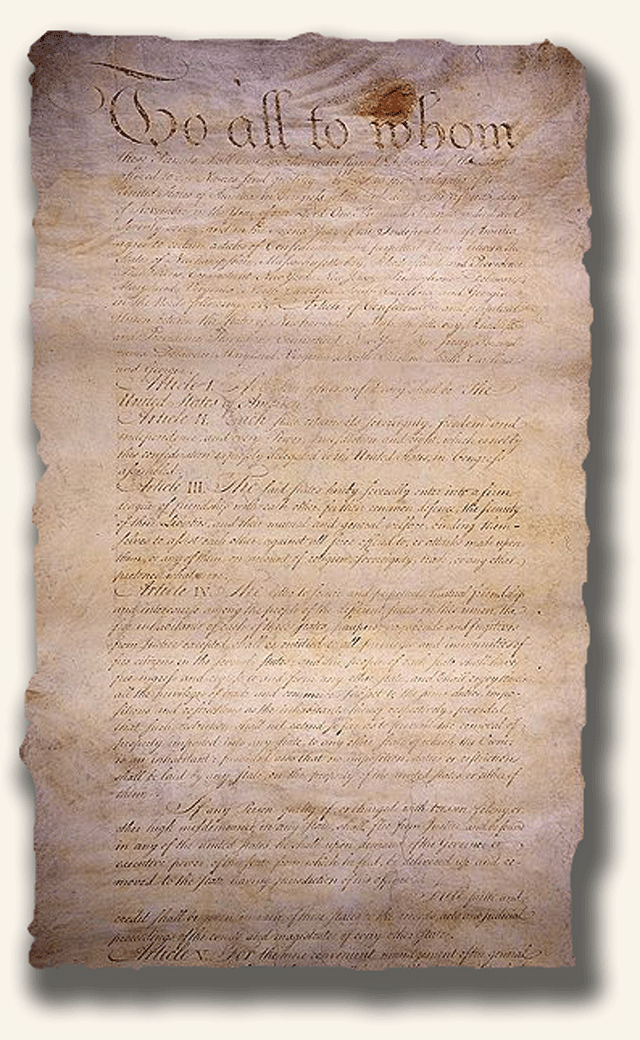 The Articles of Confederation was the governing constitution of the alliance of thirteen independent and sovereign states known as the “United States of America.” The Articles’ ratification, proposed in 1777, was completed in 1781, legally uniting the states by agreement into the “United States of America” as a union with a confederation government. Under the Articles (and the succeeding Constitution) the states retained sovereignty over all governmental functions not specifically deputed to the central government.
The last draft of the Articles was written in the summer of 1777 and adopted by the Second Continental Congress on November 15, 1777 in York, Pennsylvania after a year of debate. The Articles set the rules for operations of the “United States” confederation. The confederation was capable of making war, negotiating diplomatic agreements, and resolving issues regarding the western territories; it could not mint coins (each state had its own currency) nor could it borrow money, whether inside or outside the United States. An important element of the Articles was that Article XIII stipulated that “their provisions shall be inviolably observed by every state” and “the Union shall be perpetual”.
The Articles were created by the chosen representatives of the states in the Second Continental Congress out of a perceived need to have “a plan of confederacy for securing the freedom, sovereignty, and independence of the United States.” Although serving a crucial role in the victory in the American Revolutionary War, a group of “federalists” felt that the Articles lacked provisions for a sufficiently effective government. The key criticism by those who favored a more powerful central state (the federalists) was that the government lacked taxing authority; it had to request funds from the states. Another criticism of the Articles was that they did not strike the right balance between large and small states in the legislative decision making process. Due to its one-state, one-vote structure, the larger states were expected to contribute more but had only one vote. The Articles were replaced by the United States Constitution when created in 1787.
Our issue of the Pennsylvania Ledger dated March 11, 1778 contains the complete printing of the Articles of Confederation. The many photos will allow you to enjoy the significance of the newspaper and to appreciate how those who held this actual edition some 230 years ago might have felt knowing the independent colonies were joining together for a common cause–to not only provide a foundation for a united country which might some day–hopefully–become a world player, but for more immediate purposes, to survive the incursions of the British during the ongoing Revolutionary War. In 1778 no one knew how either effort might turn out.
Enjoy the issue!
Most historic pre-Civil War 19th century event…
December 15, 2008 by TimHughes · 3 Comments
Continuing with our discussion on the “most historic” reports to be found in newspapers, we have been discussing the events of American history by era, the last being the Civil War. This post will discuss the most significant event in American history of the 1801 – 1860 era.
Much in American history happened during these 60 years: from the Louisiana Purchase in 1803, the War of 1812 from 1812-1815, the Texas war for independence of 1836, the Mexican War of 1846-1848, the California Gold rush of 1949+, and the events leading up to the Civil War to name just a few.
But what single event during the period of 1801 – 1860 would rank as the most significant in American history? If you could only have one newspaper from the pre-Civil War era in your collection, what one event would you most desire to best represent the era and–in your opinion–most affected the future of American history?
 Arguments could be made for many events including those noted above, but also perhaps also the Monroe Doctrine of 1823, maybe a single event from the War of 1812, or the battle of the Alamo, or the treaty ending the Mexican War, or the Cherokee Trail of Tears, or perhaps even John Brown’s raid at Harper’s Ferry that would happen just before the outbreak of the Civil War.
In my opinion the Louisiana Purchase was the most significant. This purchase from France would double the land area of the United States and in time 13 states would be carved from it. The explorations of Lewis & Clark and the subsequent Westward migration of so many from the East would transform the nation in so many ways that its significance cannot be ignored. To me it was the most significant event in American history from 1801 to 1860.
What’s your thought? We would all love to hear.
Headline was ready: regardless of who won…
December 11, 2008 by TimHughes · Leave a Comment
Among the many curious newspapers we’ve encountered the last 32 years is a pair of the “Publix Opinion” newspapers from New York, both dated September 22, 1927. This was essentially a promotional newspaper 
 done by the Publix Theatres Corporation which owned various movie houses across the country.
The curiosity of this pair is that they both report on the famous Jack Dempsey – Gene Tunney boxing match fought the date of this issue. Obviously they had two editions ready to hit the streets depending on who won: “TUNNEY WINS” with subhead “Champion Retains Crown” was the one newspaper, and: “DEMPSEY WINS” with subhead: “Ex-Champ Regains Crown” read the other newspaper. Somehow both editions were bound into the volume of issues for the year, but I suspect none of the “Dempsey Wins” issues were offered on the street, as Gene Tunney won the fight.
This was the famous “long count” match during which there was some controversy as to whether Tunney, when knocked down, was actually down for 13 seconds versus 9 seconds before standing up and coming back to defeat Dempsey.
The text was written generically enough–or so they thought–to satisfy any reader of the newspaper. Or at least they didn’t care about inaccuracies, as there was no mention of Tunney hitting the canvas, nor the controversial long count. And they report the crowd was 160,000 when in fact it was 104,000.
Ultimately the report was just a lead-in to promote the showing of the film “Underworld” in the Publix Theatres (see last paragraph). An ad for the movie appears on page 3. Not surprisingly the contents of pages 2, 3 and 4 are identical in both issues.
Enjoy a fascinating curiosity!
They put it in print… I wonder why he did it?
December 8, 2008 by TimHughes · Leave a Comment
 As I’ve mentioned before, the curious, odd tidbits which are found in early newspapers provide a fascinating insight into life of a bygone era, and some chuckles as well. Here is an inconspicuous report in The Salinas City Index from California, dated June 5, 1873:
“An Indiana woman is mad because her husband took her very best sheet to hang himself, when there was an old cothes line in the cellar which was good enough for the purpose. She says he was always to extravagant, and too lazy to go into the cellar for anything.” It’s also interesting to note the improper use of “to”. Enjoy!