

Search
The Rare & Early Newspapers Hobby

Receive the Newsletter

Buy Historic Newspapers

Which was more useful?…
March 7, 2009 by TimHughes · Leave a Comment
 The “Morning Post and Daily Advertiser” newspaper of London, Dec. 4, 1792, has a report:
“A man in the county of Hereford advertises a Mare that has strayed, for which he offers a reward of Five Guineas. In the subsequent advertisement he advertises the elopement of his Wife, for the discovery of whom, he offers a reward of Five Shillings!”
The first newspaper printed in Hawaii…
March 5, 2009 by TimHughes · Leave a Comment
As was typical with the first newspaper publishing efforts in states and territories, the very first newspaper in Hawaii didn’t have great success. The SANDWICH ISLAND GAZETTE, published its first issue on July 30, 1836 and only lasted until 1839. Shortly after its demise came the SANDWICH ISLAND MIRROR & COMMERCIAL GAZETTE which lasted for less than a year. Although bearing a different name and issued monthly instead of weekly, it was essentially a continuation of the GAZETTE.
 Early printing in the Hawaiian Islands were by missionaries, and the SANDWICH ISLAND GAZETTE was no exception. Some of the content has religious overtones, however there is much secular reporting and advertisements as well.
We are pleased to share with out collectors our July 8, 1837 issue of the SANDWICH ISLAND GAZETTE, the volume 1, number 50 issue. Newspapers from Hawaii in the 1830’s are virtually unheard of in the collector market today.
Enjoy.
Contest: “In Search for the Unusual and Bizarre”…
March 2, 2009 by GuyHeilenman · 13 Comments
 Back by popular demand… A History’s Newsstand Blog contest…
“In Search for the Unusual and Bizarre”
Have you ever discovered an unusual or bizarre report while perusing a rare and early newspaper? If so, our members would love to hear about it. From March 2nd through March 9th we will be accepting your contributions/discoveries. 1st, 2nd, and 3rd place prizes will be offered for the most unusual/bizarre postings. To enter the contest simply find your most bizarre report and enter it as a comment to this post. Only one entry may be submitted per person. Please include the title and date of the issue along with the report (or a summary of the report if it is long).
 How will the winners be determined? Anyone may “vote” on their favorite choice starting March 10th – only one vote per person please. To vote, submit your selection by e-mail to guy@rarenewspapers.com. Choices must be made by the end of the day on 3/13/2009. Each Rare Newspapers’ staff member will also have one vote. The winners will be announced through the blog and by personal e-mail sometime during the week of 3/16/2009.
What will the winner receive? Winners will have their stories recognized on the blog, will receive a Rare Newspapers gift certificate worth $100 (1st place), $50 (2nd place), and $25 (3rd place), and will have the satisfaction of knowing they contributed to the enhancement of the rare newspapers collectible community.
You may want to view some of our own unusual/bizarre discoveries to help get you started. These are not eligible for the contest. They may be viewed at: https://blog.rarenewspapers.com/?cat=116
Please don’t hesitate. Share your bizarre or unusual report with the world!
Humorous content: Patience, my dear…
February 28, 2009 by TimHughes · Leave a Comment

A brief bit in the “Ocean Chronicle” newspaper of February 14, 1887 reads:
” ‘My dear’, said a young wife to her husband, ‘you have never taken me to the cemetery yet!’ ‘No, my love,’ he replied: ‘that is a pleasure I have yet in anticipation.’ “
No comments necessary. 🙂
Coffee House newspapers: a brief history…
February 26, 2009 by TimHughes · 2 Comments
 A number of titles on our website are referred to as “coffee house newspapers” with little explanation as to what they are. I think we owe our customers a bit of history on this interesting era.
During most of the 17th century newspaper publishing was very heavily regulated. All printing offices in England were under the control of the Surveyor of the Imprimery, or Press. Roger L’Estrange held the position in the latter half of the century and had the sole privilege of writing, printing & publishing newspapers, being involved in the “Intelligencer”, “The News”, the “City Mercury” and the “Observator“. His monopoly was broken in 1665 with the creation of the “Oxford Gazette”, renamed the “London Gazette” when it removed there after 23 issues in Oxford.
With the arrival of William of Orange in 1689 came a reduction of state control over the press. This new-found freedom gave the independent press a real impetus. Readers’ interests widened. Politics & religion were no longer everyone’s cup of tea, for it was in the post-1689 years that the coffee house as a meeting place for exchanging merchandise & ideas came into its own. Newspapers provided stimulus for conversations and gossip & entertainment became accepted & then demanded.
The London coffee-houses provided a gathering place where any man who was reasonably dressed could smoke his long, clay pipe, sip his coffee, read the newsletters of the day, or enter into conversation with other patrons. At this period when journalism was in its infancy and the postal system was unorganized and irregular, the coffee-house provided a center of communication for news and information. Runners were sent round to the coffee house to report major events of the day, such as victory in battle or political upheaval, and the newsletters and gazettes of the day were distributed chiefly in the coffee house. Most of the establishments functioned as reading rooms. In addition, bulletins announcing sales, sailings, and auctions covered the walls of the establishments, providing valuable information to the businessman who conducted much of his business from a table at his favorite coffee house.
During thie era, particularly the early years of the 18th century, newspapers such as the “Tatler“, “Spectator“, “Guardian” “Athenian Mercury” & “Rehearsal” among others were very much in vogue in the coffee houses, and were more dialogue in format with back & forth discussion of a specific topic rather than reporting of news of the day.
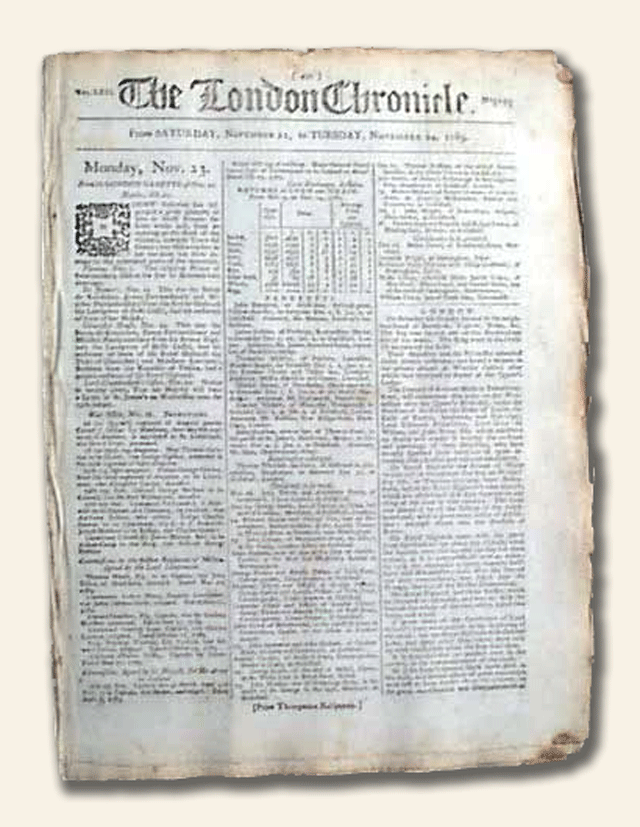
By the latter half of the 18th century coffee house culture had run its course, but left in its wake much interesting literary work by some notable names including Daniel DeFoe (wrote for “A Review Of The State Of The Nation“, Joseph Addison & Richard Steele among others. Newspaper format tended more towards reporting news events of the day with presses being established outside the boundaries of London as well as increased activity within the city. One of the more successful titles which flourished in the latter half of the 1700’s was the “London Chronicle“, many issues of which we offer on our website, catalogs and supplements.
The first newspaper in Utah…
February 23, 2009 by TimHughes · 2 Comments
There was a great migration to the West in 1847, just two years before a more historic wave of travelers prompted by the California gold rush, when about 2000 Mormons crossed the western plains seeking a location in which they could peacefully follow their religion. Led by Brigham Young, among the many items they included on their journey was a printing press purchased in Philadelphia.
What is now Utah belonged to Mexico in 1847 but the Mexican War, ongoing in 1847, would result in the 1848 treaty which would pass ownership to the United States. But since federal authorities never established a system of government for this new land, the Mormons took matters into their own hands and in 1849 organized the “State of Deseret” (land of the honey bee) with Brigham Young as governor.
 Volume one, number one of the DESERET NEWS newspaper, an eight page newspaper just 8 by 10 1/2 inches, appeared in Salt Lake on June 15, 1850 making it the very first newspaper published in Utah. It printed for just over one year before it was suspended for several months for lack of paper. Begun as a weekly, after just four months it became a semimonthly but returned as a weekly in 1854. Conditions for printing were harsh and crude so far from the more settled areas of the country over 1000 miles to the east.
We are pleased to share with our collectors the August 17, 1850 issue of the DESERET NEWS from our private collection, just the tenth number printed.
A Bizarre Report: Maybe she was angry about her name…
February 21, 2009 by TimHughes · Leave a Comment
 The “Courier of New Hampshire” newspaper from Concord, Nov. 21, 1795 has a page 3 item:
“Whereas my wife Sukey, having behaved herself much unbecoming a kind and dutiful Wife, and treated me in a cruel and inhuman manner, by beating, bruising, and otherwise ill-treating me–and having taken from me, without my leave and consent, and carried from my house our only child Robert Osgood, in the 7th year of his age; I therefore hereby forbid any persons harbouring or trusting said Sukey and Robert, or either of them, on my account, as I shall not pay any debt of their contracting after the date of this public notice.”
Removing old newspapers from bound volumes (disbinding)…
February 19, 2009 by TimHughes · 3 Comments
 At some point along your collecting journey you may have purchased a bound volume because a particular issue was of interest, not the entire lot of 100 or more found within. Perhaps you’ve given though to taking the volume apart to secure that single issue but were afraid to cause damage. It can be done and with some practice you can find the process that works best for your particular volume.
There were hundreds of ways newspapers were bound and each requires a personalized approach, but in general almost all have glue at the spine with various strings interwoven among the various issues. Most 18th & 19th century volumes used glue which is water soluble so Ideally it’s good to apply warm water to the exposed spine (scrape off as much of the leather as possible) and as the glue softens, scrape it off. This can take 30 minutes or more so it requires some patience. It may leave minor evidence of of water staining at the spine but the alternative of not removing glue is often leaving chunks of the spine with volume which is much more damaging.
Then use an exacto-type knife and cut as many of the strings as possible. Typically there are 4 or 5 cords running across the width of the spine around which the smaller strings, which run lengthwise down the volume, are wound. Cut at both sides of these cords and it will fall away. Then carefully lift each issue and “peel” them off much like pages of a tablet, keeping the knife handy to cut strings as they become more exposed.
 Typically the first several issues will have some damage at the spine but the remaining issues should remove more cleanly as you get the knack of the process. Best to start work on the issues as far removed from the issue you are wanting so that by time you get to your special issue you’ll have the experimenting work behind you.
Twentieth century volumes are more problematic in that the glue is often not water soluble so softening & scraping away the glue may not be an option, but give it a try anyway. In such cases be as diligent as possible in cutting the strings, and as each issue reveals itself in the “peeling away” process you’ll discover the process of how the volume was bound & consequently the tricks of how best to remove the remaining issues with little or no damage.
Bound or unbound: what’s the difference?
February 17, 2009 by TimHughes · 3 Comments
Many of our listings include a comment “never bound nor trimmed” and you may have wondered what that meant, or what the alternative might be. The alternative is what is mostly found in the market of early newspapers today: issues which have been “disbound” with trimmed margins.
 For hundreds of years it was common practice for institutions, typically libraries and historical societies, to maintain a complete set of newspapers which were within their scope of interest, commonly the locally published newspaper. And to make such storage easy so patrons could easily access issues of a specific year, newspapers were gathered together and bound into what was essentially a large book, typically 3, 6 or possibly 12 months to the volume depending on the number of pages per issue. The New York Times and other dailies of the mid-20th century bound just 15 issues per volume.
When microfilming became popular in the 1950’s institutions found this alternative a dramatic improvement over the “hard copy”, as microfilm took considerably less space, was much easier to handle, and easier to access the specific date or article needed. As a result, institutions “deaccessioned”, or got rid of the heavy, dusty volumes in favor of microfilm causing huge quantities of newspapers to come on the market. I would guess 98% of the early newspapers available today came from such bound volumes, as they can be carefully disbound, returning the newspapers once again to single-issue status. But with most institutions having already gone through this deaccessioning process, volumes of newspapers are getting increasingly difficult to find.
 In the binding process, much like the book binding process, the edges of the newspapers were trimmed with a guillotine cutter causing all 3 exposed edges to be neat & uniform. If a few of the newspapers were not neatly bound into their proper location some of the text might be lost when the volume was trimmed. You may have a few such issues in your collection.
This process explains why so many newspapers 100+ years old might look in near mint condition without a fold & with straight, even edges. They have been protected within the volume and likely sat on a shelf for over 100 years without being touched by human hands. Such issues are nice additions to newspaper collections.
But lucky is the person who is able to find a newspaper purchased off the street so many years ago and put away until being discovered, avoiding the binding and trimming process. The margins will be wider and most 8 page issues fold out to be one huge sheet of newspaper. Typically the downside to such issues is they are more heavily worn not having been protected within a bound volume, exposed to the elements, and typically handled much more frequently through the years.
In my opinion a never-bound, untrimmed issue would be preferable to a bound & trimmed issue as they are definitely more rare and exhibit their natural state as sold on the the date of issue. Finding such an issue in nice, clean condition is the best of both worlds, but condition is usually the trade-off: if you want your issues to be beautiful and clean, you’ll have more luck with disbound issues; if you want your issues to be “as issued” you’ll likely have to accept wear, soiling and ruffled margins.
How do you deal with the disbound or never-bound dilemma for issues going into your collection?
An Interview with Timothy Hughes…
February 16, 2009 by GuyHeilenman · 1 Comment
 BakerTowne Collectibles recently filmed an interview with Tim Hughes on their Collectibles Corner TV website. Tim appears about midway through the show at the 4:38 time stamp. Once the program fully loads you can drag the time tracker to this spot; however, if you have the time, Tammy’s (the host) entire program is enjoyable to view.
The interview may be found at: http://www.collectiblescornertv.com/?p=114; even better, view the interview below.
Thanks Tammy for your addition to the Rare Newspapers Community.