

Search
The Rare & Early Newspapers Hobby

Receive the Newsletter

Buy Historic Newspapers

In the beginning…
June 8, 2009 by TimHughes · 1 Comment
 Some collectors like to pursue a newspaper from each of the original thirteen colonies, and ideally one dated as close as possible to the beginning of that colony’s first newspaper. For those active in this pursuit, we offer this list of the earliest in each.
Although the first newspaper in America was published in Boston in 1690, Benjamin Harris’ “Publick Occurrences Both Forreign & Domestick” lasted by a single issue before being suppressed by the Royal authorities. The first successful Massachusetts newspaper–and the first in all of the colonies–started 14 years later in 1704, also in Boston, titled “The Boston News-Letter” which continued until the British occupation of the city in 1776.
Here are the remaining colonies and the newspaper titles. As you see, originally in titles was not a strength among the newspaper publishers:
American Weekly Mercury (Penna.), 1719
The New York Gazette, 1726
The Maryland Gazette, 1728
The Rhode Island Gazette, 1732
The South Carolina Gazette 1732
The Virginia Gazette, 1736
The North Carolina Gazette, 1751
The Connecticut Gazette, 1755
The New Hampshire Gazette, 1756
The Newport Mercury (Rhode Is.), 1758
The Georgia Gazette, 1763
The New Jersey Gazette, 1777
It may seem curious that New Jersey was the last of the colonies to have its own newspaper, however given its location between the major metro areas of New York and Philadelphia there likely wasn’t an incentive to create its own until much later than the others.
Reducing old maids and increasing the population…
June 6, 2009 by TimHughes · Leave a Comment
 The Connecticut Courant issue of Hartford dated October 18, 1790 contains a curious piece taken from a Virginia newspaper, noting that:
“…a serious petition is now drawing up…stating arguments in favour of polygamy, from the plain principles of reason: and praying that a man may legally marry two wives. This, it is thought, will be the most effectual means to extirpate the numerous race of old maids, and increase the population of the United States…”
Editors take note: be mindful of photos accompanying headlines…
June 4, 2009 by TimHughes · 1 Comment
 The “Second Extra” of the Atlanta Journal newspaper of November 22, 1963 has a curious–if not macabre–combination of headline and photo. As would be expected of an “Extra” of this date, the large & bold headline proclaims: “KENNEDY KILLED” but immediately beneath it is a photo of a street sweeper pushing his bucket which has a pair of trousers & boots protruding from the top, with the caption: “Sweeper Means What He Says”.
One might excuse the editor, for I’m sure that in rushing this edition to the streets as quickly as possible the planned headline was removed and the Kennedy death report quickly inserted with little thought as to what else was scheduled for top half that day’s edition. But it serves as an important lesson to budding newspaper editors everywhere: be mindful of what what might accompany an article or photo.
Extensive list of reprinted newspapers…
June 2, 2009 by TimHughes · Leave a Comment
 The Library of Congress, as we previously discussed, maintains a web listing of the eighteen mostly commonly found reprinted newspapers. Most reprints which turn up today will be found in this list, however many others do exist.
Rick Brown, who maintains the “historybuff.com” website and who edited the journal “Collectible Newspapers” for many years, created a master list of some 567 reprinted newspapers. Should you encounter a newspapers and you are suspicious of its genuineness, check the list of titles and dates on “American Newspapers Known to Have Been Reprinted” which can also be accessed from the home page of our website. If the title & date appear on this list your suspicions many be justified.
If you care to take an additional step towards determining genuineness, Rick offers a more detailed “Annotated Index of Newspapers Editions Known To Have Been Reprinted…” for a modest charge, which offers additional details for each entry.
Although reprinted editions are exeedingly rare in the hobby of early newspapers—and most common reprints are easy for even a novice to spot—having access to such a list is of much value to the hobby and can provide some comfort when pursuing historic newspapers for one’s private collection.
Videos regarding the hobby… Private Collections…
May 30, 2009 by GuyHeilenman · Leave a Comment
Collecting rare and historic newspapers is a hobby with a personal flair. Although an individual may begin collecting random issues covering a wide variety of topics, eventually they typically settle on a specific area of interest. Perhaps it will be one of the war eras, the Old West era, or issues with Presidential signatures, acts, or addresses. One might derive pleasure from collecting Civil War battle prints or issues with decorative mastheads. Others may like to collect issues from each decade of the last few centuries or issues from each President’s administration. Yet another way to collect newspapers is to use them as a companion collectible for another area of collecting interest – images of sewing machines, inventions, railroading, early flight, dentistry, slave ads, from the year of each coin’s release within one’s collection, with a box score for each major baseball card held, etc. We’ve even known a number of collectors who have spent years focusing on a particular era (perhaps Civil War), who then migrate with a focus through time (perhaps moving on to the Revolutionary War and then Colonial eras). The possibilities are endless. In the end, one thing is for certain, like an heirloom violin, no two collections are exactly the same. Feel free to either share your areas of interest by commenting to this post or send us your collecting story (see more details below).
Timothy Hughes Rare & Early Newspapers continues to maintain and add to their own private/personal collection. The focus has been on one-of-a-kind/rare titles and major historic events. Even what one considers to be historic is somewhat subjective. Below is a video which was done a number of years ago which features Tim showing some of the Private Collection. Please enjoy!
– – – – – – – – – – – – – – – – – – – – – – – – – – – – – – – – – – – – – – – – – –
If you would like to share your story of how you became interested in collecting rare and/or historic newspapers, e-mail it to guy@rarenewspapers.com and place “My Story” in the subject field. Although not necessary, feel free to include an image. Please do not include your e-mail address or a personal website as part of the text of your story. We will post collector stories every few weeks and will send you a notice when your story appears. Thank you for your contribution to the community.
My Collecting Story… Richard Sloan…
May 28, 2009 by GuyHeilenman · 1 Comment
 I’ve been interested in the Lincoln assassination ever since I was thirteen years old. The 19th century images really grabbed me, and continue to give me a sense of what took place. As a New Yorker, my interest expanded to Lincoln’s N.Y.C. funeral, Lincoln’s prior trips to NY, Mrs. Lincoln’s NYC shopping sprees, and John Wilkes Booth’s activities in the city. In the course of all of this, I also became interested in 19th century NY photographers, theaters, hotels, and department stores. It has become obvious to me that period photographs convey and impart just so much. The old newspapers turned out to be the missing ingredient. There is nothing like holding an old NYC newspaper in my hand (or a weekly like Harper’s, Leslie’s, Gleason’s, etc;). Turning old pages that someone had turned in 1865 doesn’t just provide research information; it takes me back in time and shows me what life was like. It’s a wonderful experience to re-capture the sense of immediacy and news-gathering that someone had experienced back then when he or she turned those very same pages — whether it’s reading the details of Lincoln’s 1861 arrival in the city, reading the details of such events as his assassination, his funeral, finding out what parades took place in town the previous day, or what shows are currently playing in town. Old newspapers are time machines!
– – – – – – – – – – – – – – – – – – – – – – – – – – – – – – – – – – – – – – – – – –
Thanks for sharing your story Richard. If you would like to share your story of how you became interested in collecting rare and/or historic newspapers, e-mail it to guy@rarenewspapers.com and place “My Story” in the subject field. Although not necessary, feel free to include an image. Please do not include your e-mail address or a personal website as part of the text of your story. We will post collector stories every few weeks and will send you a notice when your story appears. Thank you for your contribution to the community.
Resources… The Library of Congress…
May 26, 2009 by GuyHeilenman · 1 Comment
 The Library of Congress has a wonderful collection of original newspapers along with an extensive digitized database of American titles. An informative website is maintained in an effort to provide useful information related to rare and historic newspapers. They describe themselves as:
“The Serial & Government Publications Division maintains one of the most extensive newspaper collections in the world. It is exceptionally strong in US newspapers, with 9,000 titles covering the past three centuries. With over 25,000 non-US titles, it is the largest collection of overseas newspapers in the world. Beyond its newspaper holdings, the Division also has extensive collections of current periodicals (70,000 titles) comic books (6,000 titles) and government publications (1 million items).”
Some of the features to be found at their Newspaper Division’s website are webcasts, a searchable data base, full text versions of many newspapers and periodicals, and a link to their ongoing project “Chronicling America”. Although we at Rare Newspapers maintain an extensive list of common reprints (thanks to Rick Brown at HistoryBuff.com) the Library of Congress also has an abbreviated list of common reprints with descriptions as to how one can determine whether their issue is authentic… or not.
Thanks L.O.C. for your ongoing efforts on behalf of historic newspapers.
Census with a bit of flair…
May 23, 2009 by TimHughes · Leave a Comment
“The Alaska Times” newspaper from Seattle, W.T. (Washington Territory), May 14, 1871, contains a very colorful front page article with a simple heading: “Alaska” which reports a census for Sitka. Enjoy reading how the inhabitants were categorized.

So what’s the earliest “London Gazette”?
May 21, 2009 by TimHughes · Leave a Comment
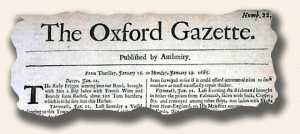 The world’s oldest continually published newspaper was begun in 1665 and still prints today, a staggering 345 year history which likely will never be broken by any other single title. Indeed, the newspaper still publishes today so it sets a more unbeatable record as each year passes.
The newspaper is titled “The London Gazette“, but collectors have occasionally seen issues of “The Oxford Gazette” and wondered about the connection.
First, the most convincing derivation of the term “gazette” is from “gaza”, the Greek word for a treasury or store. That newspapers are a “treasury or store” of information would allow for a plausible adoption of the term “gazette”.
In 1665 the Royal Court had been removed from London due to the Plague which had been ravaging the city. The smaller towns in the country seemed less susceptable to the contagion. So with a newspaper serving as a mouthpiece of the Royal Court it was logical that it would set up shop in Oxford, calling itself “The Oxford Gazette“.
But when the affects of the Plague seemed to have abated sufficiently for the Court to return to London, so did the newspaper. Twenty-three issues were published in Oxford, and with issue number 24 was the first with the title “The London Gazette“, a title which has remained unchanged for over three centuries.
So there might be a bit of a debate as to what the earliest issue is of “The London Gazette“. The earliest with this title would be issue #24, dated February 5, 1665 (1666 by today’s calendar), but argument certainly could be made that the first issue of “The Oxford Gazette” would qualify, it dated November 16, 1665.
Given its short life under the earlier title of “The Oxford Gazette”, such issues are extremely elusive. We have sold many over the past 33 years but rarely find them today.
Davy Crockett survived the Alamo?
May 16, 2009 by TimHughes · 1 Comment
 The report shown appeared in the “Staunton Spectator” newspaper of Virginia, May 5, 1836. Accuracy in reporting the news certainly wasn’t any better back in 1836. Have you ever found similar inaccurate reporting?