
Search
The Rare & Early Newspapers Hobby

Receive the Newsletter

Buy Historic Newspapers

Colorado’s first newspapers…
November 16, 2009 by TimHughes · 2 Comments
 Credit is given to John Oswald’s “Printing In The Americas” for much of the following:
Colorado was first organized as the “Jefferson Territory” in October, 1859 and Congress renamed it Colorado Territory in February, 1861. It would become a state in 1876 hence it’s nickname “Centennial State”.
Colorado’s first printing was done in on April 23, 1859, on which date two newspapers were established in Denver, a town named after James W. Denver, the territorial governor of Kansas, and now occupying the site of two towns originally called Auraria and St. Charles. The “Rocky Mountain News” was started by William Byers, John Dailey & Thomas Gibson. Byers became the sole owner in 1870. The second newspaper, the “Cherry Creek Pioneer“, was started by John Merrick but only lasted for just a single issue. But shortly thereafter the “Rocky Mountain Gold Reporter & Mountain City Herald” was started August 6, 1859 at “Mountain City, Jefferson Territory”. A few months later the same printing press was used to launch the “Western Mountaineer” at Golden, Colorado.
The first daily newspaper in Colorado was the “Daily Herald and Rocky Mountain Advertiser” dating from May 1, 1860, and nearly four months later the “Rocky Mountain News” also became a daily publication.
There being no United States mail throughout Colorado at that time the newspapers were delivered by carriers mounted on burros to the various mining camps at 25 cents per copy, or $24 per year. One can imagine with such a lack of efficient distribution how small the print runs were and how few issues would survive to the 20th century.
Keep in mind that these early publication dates coincided with the Colorado “gold rush” which ran from 1859 to 1861 or so. It was typical that newspapers would spring up in areas when population would boom and land development was flourishing. Newspapers were quick to arise wherever the people would be, as was the case in California, Alaska and many other Western states.
Any of these early Colorado newspapers from 1859 or the early 1860’s are exceedingly scarce and would be choice issues for any collection.
California’s first newspaper…
November 9, 2009 by TimHughes · 5 Comments
 For much of the information below we credit John Oswald’s work “Printing In The Americas”.
Printing in California began in 1825 when it was under Mexican rule, being not much more than engraved wood blocks used to make seal impressions. Some years later in 1833 with a new governor for the province an announcement of his arrival in California was issued, being the oldest known California imprint.
As for newspapers, the very first published in California was on August 15, 1846 with the beginning of the “Californian” in the city of Monterey, just five weeks after the United States flag has been raised over the city and California was proclaimed a part of the United States. The newspaper was published by Rev. Walter Colton, a champlain of the U.S. frigate ‘Congress” docked at Monterey and a one time editor of the Philadelphia “North American“, and Robert Semple. On April 24, 1847 Semple became the sole proprietor of the “Californian” and two weeks later he moved it to San Francisco.
The second newspaper in California was published as a venture of the Mormons. They created the “California Star“, the first regular number of which appeared January 9, 1847. On November 18, 1848 the Californian” and the “Star” merged, the name becoming the “Alta California“.
Since the population of California was relatively small before the gold rush of 1849 newspapers from this decade are exceedingly difficult to find. They become much more numerous from 1850 onwards, but any title from the 1846-1849 period would be considered a terrific find by any collector.
Twenty years later: revisiting an international event…
November 5, 2009 by TimHughes · 1 Comment
Those of us who may reluctantly fall into the category of the “middle aged” can reflect upon a number of historic events and our thoughts on when they happened. For me John F. Kennedy’s assassination and its announcement when I was in elementary school was the first major historic event I lived through, and experiences relating to it are still etched in my mind.
 Some events seem impossible to be reaching notable anniversary status as they seem to have happened in the recent past. Man walking on the moon is one–it recently passed its 40th anniversary–and the Nixon/Watergate mess is now over 35 years in the past.
The fall of the Berlin Wall is now at it’s 20th anniversary. It seems impossible. I clearly recall the considerable news coverage of the event and the following actions that would lead to German unity less than one year after the walls came down. Back then I had a customer from Berlin and was able consummate a purchase of various Berlin newspapers covering those events, knowing that newspapers from where the news was being made would always be the best to have in a collection.
I recently dug out several titles and editions and share with you perhaps the best, being an “Extra” edition of “Der Tages Spiegel” (translates to “The Daily Mirror”) of November 10, 1989. The entire front page of this folio-size newspaper is taken up with a huge photo of people climbing onto, and celebrating, at the Berlin Wall with the Brandenburg Gate in the background. the banner headline–and the only text on the front page–translates: “The Night They Opened The Border In Berlin”. The remaining 3 pages of this four page newspaper are taken up with various articles and many photos of the celebration.
It was a joyous and memorable event for the world, and yes, it really was 20 years ago.
Collector shares a nice find…
October 29, 2009 by GuyHeilenman · Leave a Comment
It’s always a thrill to find truly significant reports for very little money; proof that doing a bit of homework can be well rewarded.
A fellow collector (to whom who owe a special thanks for sharing his “find”) shares the uncommonly lengthy letter from Merriwether Lewis while on the Lewis & Clark Expedition, datelined at Fort Mandan, April 7, 1805. It appears on two inside pages of “The Balance & Columbian Repository” issue of August 13, 1805. Typically reports on Lewis & Clark are very brief. This is is not.
He shares this interesting letter for all who can appreciate reading history from the time it was made. Being a letter written directly Thomas Jefferson, how significant might this be? Any thoughts would be appreciated. Please enjoy the following:


Lincoln’s assassination in a Washington, D.C., newspaper…
October 26, 2009 by TimHughes · 7 Comments
 One of the (positive) frustrations we have always dealt with as a rare newspaper dealer is not being able to share some of the best material which comes our way. Not surprisingly very rare and very historic items have a waiting list of customers waiting for it to come into inventory and such newspapers are typically sold before they have the opportunity to be listed in a catalog. But here is where our blog is of value, allowing us an opportunity to share some nice material even though no longer available for purchase.
Holding true to the belief that newspapers from cities where historic events took place are the best to have, our recent sale of the “Daily Morning Chronicle” of April 15, 1865 from Washington, D.C. fits this description very well. Although purchased by a member with a *“want list” for such material, the issue is too fascinating not to share with others, hence this link to the listing and photos.
Enjoy one of the best newspapers to have on Lincoln’s assassination.
* Note: Although we manage a want list for key material, with thousands of such wants, the system is not perfect (i.e., we occasionally miss an item on someone’s want list and it ends up being purchased through a member or public offering). We simply promise to do the best we can. If you have key content of interest, feel free to be in touch.
Terrific “association” item in American history…
October 22, 2009 by TimHughes · 2 Comments
One of the joys in collecting early newspapers is discovering the little gem found buried in an issue which was innocuous at the time but which has since transcended to much greater importance in American history. The small advertisement shown, which appears on page 3 of the April 13 issue of the “Daily Morning Chronicle” of Washington, D.C., is one.
 Certainly Abraham Lincoln, and any other Washington, D.C. resident who read this ad, would not have given it a second thought, being a simple notice of the latest show on the stage of a local theater. But as history would tell us Abraham Lincoln attended this very performance of “The American Cousin” at Ford’s Theatre, starring Laura Keene, and would be assassinated there the evening of the 14th.
It’s fascinating to think the original owner of this newspaper may well have read that advertisement, and may actually have attended that performance only to become witness to one of the more dramatic & notable events of American history. This newspaper is truly a piece of Americana which could only be found in a Washington, D.C. newspaper. Certainly this ad would not have appeared in the other–more common–major city publications.
Feel free to respond and share with other readers any similar gems which you have discovered, & which would figure more prominently in history after their publication date. We hope you enjoyed this one!
The first newspaper in Alabama…
October 19, 2009 by TimHughes · 1 Comment
 Credit must be given to John Oswald’s “Printing In The Americas” for the following on first newspaper printed in Alabama:
“Samuel Miller and John B. Hood started the ‘Centinel” at Mobile, Alabama, on May 23, 1811, but there is some doubt as to whether it was actually printed there. It was a troublous time for the town. The district in which it was located was claimed by Spain as a part of Florida, which she owned, and it was not until 1812 that the Congress of the United States annexed the Mobile district to what was then called the Mississippi Territory. The following year Gen. James Wilkinson occupied it with a military force, which was not resisted by the Spaniards. It is probable that the printing of the “Centinel” was done at Fort Stoddert, further up the river in American territory. In 1817 the territory was divided, the eastern portion being named Alabama, after a tribe of Creek Indians which inhabited the district, with St. Stephens as its capital. The territory became a state in 1819.”
Some more prices, then and now…
October 6, 2009 by TimHughes · 1 Comment
Some months ago I reflected upon the value of newspapers we have sold years ago compared to more current values for the same title and event. Having published catalogs since 1977 it is interesting to pull out some of the early editions and see what we sold newspapers for many years ago.
Although we are careful to never recommend early or historic newspapers as investments, many have done well over the years. Not surprisingly, those which are most historic and less common have appreciated the best, while others—particularly titles which tend to come available from time to time—have appreciated but not at an exceptional pace. A few examples:
Within our catalogs created in 1980, twenty-nine years ago, are several entries which we still are able to keep in inventory such as “Harper’s Weekly” of July 22, 1876 with coverage of the Custer massacre. We sold it then for $32, and offer it today for $112. Using an inflation calculator the $32 would have inflated to $82.57 today. Also in “Harper’s Weekly” we sold Oct. 4, 1862 with a printing of the Emancipation Proclamation for $52 ($134.28 in today’s dollars), while today we sell it for $125. The same title for March 22, 1862 on the Monitor vs. the Merrimack sold then for $38 ($98.05 in today’s dollars) and for $113 today.
 Although “Harper’s Weekly” remains a very desirable title and has most certainly become more scarce as the years have gone by, I would not consider it a rare title. Consequently some prices have exceeded inflation while some have not.
But somewhat less common titles, and more significant events, have had more interesting price changes. In 1980 we sold the “New York Tribune” of April 4, 1865 which reported the fall of Richmond and had a huge eagle engraving on the front page, for $48 ($123.85 in today’s dollars). Not long ago we sold the same issue for $477. And in 1980 we sold the “Gazette of the United States” of March 2, 1791 on the creation of the Bank of the United States, for $19 ($49.03 in today’s dollars) and a more recent sale was for $775.
Of courses naivete (or perhaps stupidity) was the reason for many low prices years ago. Back in the “early years” I simply didn’t have the experience of knowing how desirable some events would be for collectors. If I bought an item for $20 and sold it for $30 I was happy.
Pricing has become much more sophisticated the last ten years or so, but I’m sure we still offer some interesting gems of history at relatively low prices which will take on much greater desirability as the years progress. Part of the fun of the hobby is seeking them out.
Before they became famous…or “infamous”…
September 19, 2009 by TimHughes · 2 Comments
 A special desire for many collectors is to find a newspaper mentioning a name which would not become famous for many years, such as the “Lincoln & Herndon” attorney advertisements from Springfield, Illinois in 1857, or a newspaper ad noting John Wilkes Booth appearing in a play in 1863.
The item shown in the photo fits this category, appearing on the front page of the “Detroit Free Press” in its November 1, 1959 newspaper. If a Kennedy assassination plot existed, the plans may have begun as early as…
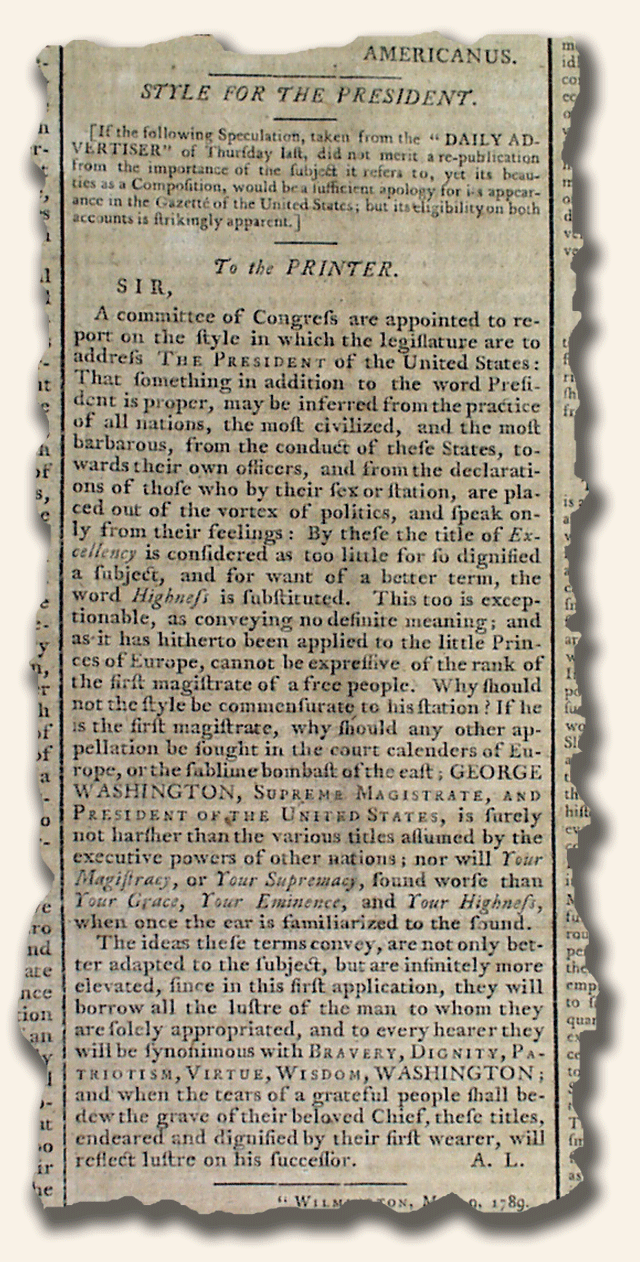
How shall we address the President?
August 31, 2009 by TimHughes · 2 Comments
Although we may think it odd today, back in 1789 when our federal government was just being formed and George Washington was inaugurated as America’s first President, there was little precedence as to how to address the new chief executive of the government. The only examples given by the European powers were royalty where “your highness” or “your excellency” were appropriate. But what about a democratically elected President?
The article shown is taken from the “Gazette of the United States” newspaper from New York, May 16, 1789, about two weeks after Washington was inaugurated. It provides some interesting insight in to the thoughts of the day when the government was truly in its infancy.