

Search
The Rare & Early Newspapers Hobby

Receive the Newsletter

Buy Historic Newspapers

The first newspaper in Alabama…
October 19, 2009 by TimHughes · 1 Comment
 Credit must be given to John Oswald’s “Printing In The Americas” for the following on first newspaper printed in Alabama:
“Samuel Miller and John B. Hood started the ‘Centinel” at Mobile, Alabama, on May 23, 1811, but there is some doubt as to whether it was actually printed there. It was a troublous time for the town. The district in which it was located was claimed by Spain as a part of Florida, which she owned, and it was not until 1812 that the Congress of the United States annexed the Mobile district to what was then called the Mississippi Territory. The following year Gen. James Wilkinson occupied it with a military force, which was not resisted by the Spaniards. It is probable that the printing of the “Centinel” was done at Fort Stoddert, further up the river in American territory. In 1817 the territory was divided, the eastern portion being named Alabama, after a tribe of Creek Indians which inhabited the district, with St. Stephens as its capital. The territory became a state in 1819.”
Some more prices, then and now…
October 6, 2009 by TimHughes · 1 Comment
Some months ago I reflected upon the value of newspapers we have sold years ago compared to more current values for the same title and event. Having published catalogs since 1977 it is interesting to pull out some of the early editions and see what we sold newspapers for many years ago.
Although we are careful to never recommend early or historic newspapers as investments, many have done well over the years. Not surprisingly, those which are most historic and less common have appreciated the best, while others—particularly titles which tend to come available from time to time—have appreciated but not at an exceptional pace. A few examples:
Within our catalogs created in 1980, twenty-nine years ago, are several entries which we still are able to keep in inventory such as “Harper’s Weekly” of July 22, 1876 with coverage of the Custer massacre. We sold it then for $32, and offer it today for $112. Using an inflation calculator the $32 would have inflated to $82.57 today. Also in “Harper’s Weekly” we sold Oct. 4, 1862 with a printing of the Emancipation Proclamation for $52 ($134.28 in today’s dollars), while today we sell it for $125. The same title for March 22, 1862 on the Monitor vs. the Merrimack sold then for $38 ($98.05 in today’s dollars) and for $113 today.
 Although “Harper’s Weekly” remains a very desirable title and has most certainly become more scarce as the years have gone by, I would not consider it a rare title. Consequently some prices have exceeded inflation while some have not.
But somewhat less common titles, and more significant events, have had more interesting price changes. In 1980 we sold the “New York Tribune” of April 4, 1865 which reported the fall of Richmond and had a huge eagle engraving on the front page, for $48 ($123.85 in today’s dollars). Not long ago we sold the same issue for $477. And in 1980 we sold the “Gazette of the United States” of March 2, 1791 on the creation of the Bank of the United States, for $19 ($49.03 in today’s dollars) and a more recent sale was for $775.
Of courses naivete (or perhaps stupidity) was the reason for many low prices years ago. Back in the “early years” I simply didn’t have the experience of knowing how desirable some events would be for collectors. If I bought an item for $20 and sold it for $30 I was happy.
Pricing has become much more sophisticated the last ten years or so, but I’m sure we still offer some interesting gems of history at relatively low prices which will take on much greater desirability as the years progress. Part of the fun of the hobby is seeking them out.
Before they became famous…or “infamous”…
September 19, 2009 by TimHughes · 2 Comments
 A special desire for many collectors is to find a newspaper mentioning a name which would not become famous for many years, such as the “Lincoln & Herndon” attorney advertisements from Springfield, Illinois in 1857, or a newspaper ad noting John Wilkes Booth appearing in a play in 1863.
The item shown in the photo fits this category, appearing on the front page of the “Detroit Free Press” in its November 1, 1959 newspaper. If a Kennedy assassination plot existed, the plans may have begun as early as…
How shall we address the President?
August 31, 2009 by TimHughes · 2 Comments
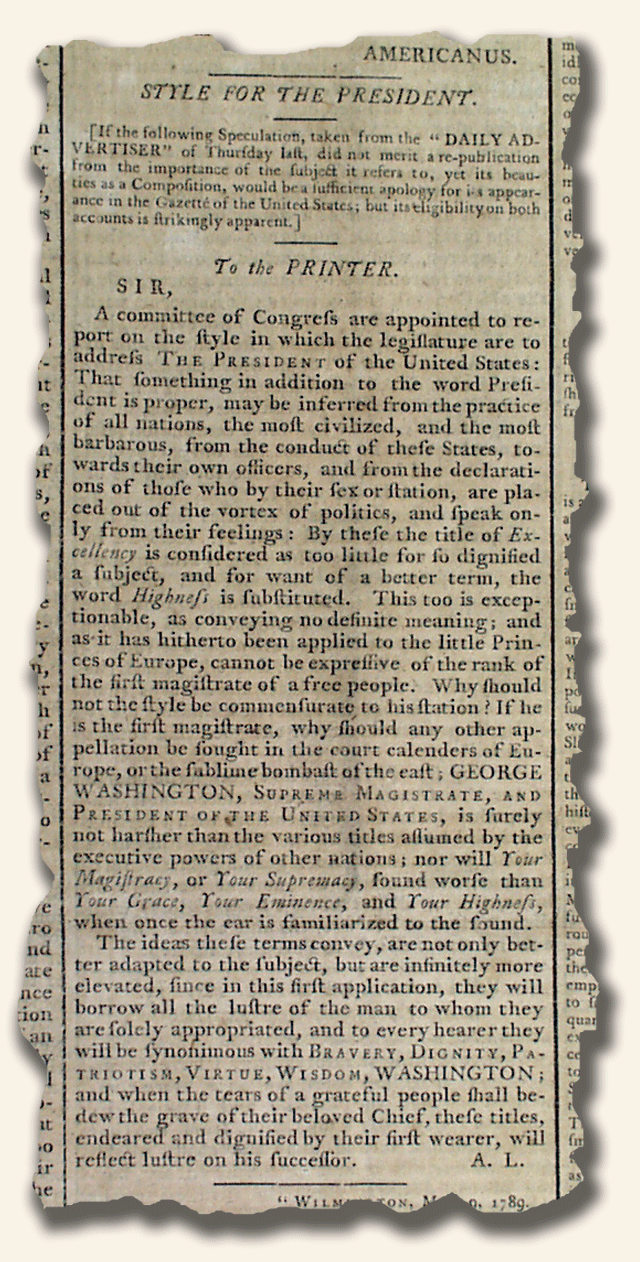
Although we may think it odd today, back in 1789 when our federal government was just being formed and George Washington was inaugurated as America’s first President, there was little precedence as to how to address the new chief executive of the government. The only examples given by the European powers were royalty where “your highness” or “your excellency” were appropriate. But what about a democratically elected President?
The article shown is taken from the “Gazette of the United States” newspaper from New York, May 16, 1789, about two weeks after Washington was inaugurated. It provides some interesting insight in to the thoughts of the day when the government was truly in its infancy.
What’s the best newspaper to have?
August 27, 2009 by TimHughes · 2 Comments
Most collectors of historic newspapers would agree that the best newspaper to have for an historic event is the city where it happened. Among the more notable would be the Boston Gazette reporting the Boston Massacre, the Honolulu issue on the bombing of Pearl Harbor, the Dallas newspapers on JFK’s assassination, and a Chicago newspaper covering the St. Valentine’s Day massacre. Stock market or finance related events are best in the Wall Street Journal, and when events happened in small towns which had no newspapers, the closest major city might be the next best thing.
But some events can’t be had—or can very rarely be had—from the city where “it” happened. What are the best issue in those situations? What’s the best issue for man landing on the moon? Or the atomic bomb dropping on Hiroshima & Nagasaki? Or the first manned flight around the earth? Or the discovery of the North Pole? Or Edison’s invention of the phonograph? What would be the best newspaper for the sinking of the Titanic?
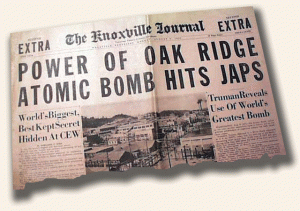 There are many answers; perhaps as many as there are collectors. But I’ll offer a few thoughts. Actually what brought all of this to mind was an issue I recently wrote up for a future catalog. It announced the dropping of the atomic bomb on Hiroshima and was from Knoxville, Tennessee. The headline reads: “Power Of Oak Ridge Atomic Bomb Hits Japs”. Keeping in mind that Oak Ridge, Tenn., the home of the Manhattan Project which developed the bomb, is less than 20 miles from Knoxville, it is not surprising that they localized the headline with mention of the role Oak Ridge played. I suspect no other newspaper in the country mentioned Oak Ridge in their headline on the atomic bomb drop. Outside of finding a Japanese newspaper from the day after, I suspect this Knoxville newspaper could be the best issue on this event.
Any space flight issue might best be from the Cape Canaveral area. Or perhaps the hometown of one of the astronauts involved. We offer a Wapakoneta, Ohio, newspaper on man walking on the moon as it’s Neil Armstrong’s hometown, and their headline is localized by: “NEIL STEPS ON THE MOON” while most newspapers reported “MAN WALKS ON THE MOON”.
The graphic appeal of the front page is a major factor as well and in the eye of many is always the deciding factor in determining the “best” for that event. We price Titanic issues almost entirely on the “wow” effect of the front page, as the larger the headline and more dramatic the look the better, regardless of where the newspaper was printed. This holds true for many 20th century events, such as D-Day, V-E Day, V-J Day and and any other military event. Some might argue that the “Stars And Stripes” would be the best paper for a military event, or perhaps newspaper from Washington D.C., home of the Pentagon.
We’d like to hear what you think on the best issues for historic events which can’t be found from the city involved. I’m sure your thoughts will spark other collectors to refine their holdings with better or more appropriate newspapers for notable events. Let us here from you!
So what’s the earliest “London Gazette”?
May 21, 2009 by TimHughes · Leave a Comment
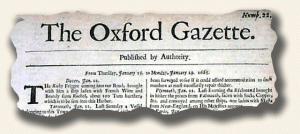 The world’s oldest continually published newspaper was begun in 1665 and still prints today, a staggering 345 year history which likely will never be broken by any other single title. Indeed, the newspaper still publishes today so it sets a more unbeatable record as each year passes.
The newspaper is titled “The London Gazette“, but collectors have occasionally seen issues of “The Oxford Gazette” and wondered about the connection.
First, the most convincing derivation of the term “gazette” is from “gaza”, the Greek word for a treasury or store. That newspapers are a “treasury or store” of information would allow for a plausible adoption of the term “gazette”.
In 1665 the Royal Court had been removed from London due to the Plague which had been ravaging the city. The smaller towns in the country seemed less susceptable to the contagion. So with a newspaper serving as a mouthpiece of the Royal Court it was logical that it would set up shop in Oxford, calling itself “The Oxford Gazette“.
But when the affects of the Plague seemed to have abated sufficiently for the Court to return to London, so did the newspaper. Twenty-three issues were published in Oxford, and with issue number 24 was the first with the title “The London Gazette“, a title which has remained unchanged for over three centuries.
So there might be a bit of a debate as to what the earliest issue is of “The London Gazette“. The earliest with this title would be issue #24, dated February 5, 1665 (1666 by today’s calendar), but argument certainly could be made that the first issue of “The Oxford Gazette” would qualify, it dated November 16, 1665.
Given its short life under the earlier title of “The Oxford Gazette”, such issues are extremely elusive. We have sold many over the past 33 years but rarely find them today.
Baseball fans… can you help?
May 11, 2009 by TimHughes · Leave a Comment
 A customer was requesting a newspaper with a report of Nap LaJoie, one of the more notable names in baseball in the early 20th century, ending the 1901 season with a .422 batting average. He was one of only a few to do so in the 20th century (there’s been a 67 year dry spell since Ted Williams was the last to do so, in 1941).
Finding reports of batting averages in 1901 is very difficult, but I did find a report at the end of the season which notes: “Lajoie…took part in 131 games. He was at bat 554 times, made 226 singles, 48 doubles 12 triples and 13 home runs…”.
Never mind that the numbers are slightly off from the official record book, which notes 543 games, 229 singles, 48 doubles (only one correct), 13 triples and 14 homers, as such errors might be understandable. But even given the accurate numbers, in calculating his average one comes up with a sum of 304 successful at bats, divided by the number of games (543) giving an average of .560. But curiously, if you just took his 229 singles divided by 543 the result is exactly his recorded batting average: .4217, rounded out to .422.
Should I surmise that the term “singles” actually means “hits” by today’s terminology ? Was this the common practice back then, to call any type of “hit” a “single”? If so, when did they make the switch?
Thanks for your help !
Tim
Historically significant: one from our inventory…
March 21, 2009 by TimHughes · Leave a Comment
 Although we would like to think we have a large number of interesting and fascinating newspapers within our inventory, there are few which float to the top when it comes to being very historically significant.
Our “American Weekly Mercury” from Philadelphia, 1735 is certainly one. The title and date alone would qualify its rarity, as American newspapers from that time are exceedingly scarce; from when Ben Franklin was just beginning his career. It is a handsome issue as well as the masthead features two wood engravings which make this a very decorative issue.
This was the first newspaper not only in Pennsylvania but also the Middle Colonies, having begun in 1719 by famed newspaper publisher Andrew Bradford, and continued until its demises in 1746. It was also just the third newspaper in all the colonies.
The content is certainly noteworthy, reporting on the very founding of the colony of Georgia. See the photos for the report and the involvement of James Oglethorpe. Its appeal as a purchase might be limited to those with a strong interest in Georgia history, but anyone could appreciate the value of having such an inconspicuous gem of a report on the front page of a newspaper.
Click on the link and enjoy.
Most historic: Pre-Revolutionary War…
March 16, 2009 by TimHughes · 5 Comments
As our last discussion point on the most historic event to have in an early American newspaper collection we’ll consider the pre-Revolutionary War era.
What a period of time, from the mid-1600’s thru 1775. Keep in mind that the only newspapers to be had with American content thru 1704 would be British, most likely limited to the Oxford/London Gazette. The “Boston News-Letter” as America’s first successful newspaper began in 1704 but it can be exceedingly difficult to find any American newspaper prior to 1730. In any case let’s consider the event & not the rarity of the newspaper itself. Remember, we’re dreaming here anyway.
Dig out your history books and give thought to what single historic event in American history from this period you would like to have in your newspaper collection.

Source: The Smithsonian
Much of the late 17th century was dealing with settling the “New World” and territorial issues not just with the Native Americans but the various European countries, all trying to establish a foothold, and increasing it at that. The early 18th century saw the creation of colonial governments and continuing territorial problems, leading to the French & Indian War, which in itself created financial problems in England which led to greater taxation in America to pay for related expenses. Of course the colonists were not keen on tightening controls and increased taxation levied by a government 3000 miles away and before long there was a revolution.
My choice would be the “Pennsylvania Journal & Weekly Advertiser” issue of Oct. 31, 1765. Known as the “tombstone edition” because of the great graphics, it signaled the beginning of the Stamp Act in America, the most hated of the taxes up to that point, only to be following by more from Great Britain. The Stamp Act was the catalyst for a disintegrating relationship with the mother country. This newspaper (see photo) is both visually dramatic and historically significant in presaging the biggest event in 18th century America history.
What’s your thought?
Most historic: The Declaration of Independence in your collection…
March 12, 2009 by TimHughes · 8 Comments
I’m not sure there is much of a contest for the “most historic event of the Revolutionary War”. Can anyone make a case for anything beyond the Declaration of Independence? We’d all love to hear from you if so.
 My experience is that this document is the most desired to have in an American newspaper, not just from this era but from the entire spectrum of American history. Well, an exception might be an issue of “Public Occurrences Both Foreign and Domestic“, the Sept. 25, 1690 newspaper printed in Boston which lasted but one day and of which only one copy is known to exist. I’d trade that remarkable find for a Declaration of Independence, but nothing else.
A year or so ago I was aware of a Philadelphia newspaper containing the Declaration of Independence which brought over $400,000 in auction. So much for the average collector adding an American printing to their collection, which is why interest has been heightened in British periodicals with the document.
And it did appear in at least several British magazines and newspapers. The popular “Gentleman’s Magazine” from London carried it in their August, 1776 issue as did the “Universal Magazine” and the “London Magazine“. The “Gentleman’s & London Magazine” carried the historic text in their September issue (note: the only American magazine in print in 1776, the “Pennsylvania Magazine”, carried the Declaration text in their July issue).
It’s curious that the “London Gazette” newspaper never printed the Declaration, likely for political reasons, but it did appear in the “London Chronicle” of August 17 as well as the “Edinburgh Evening Courant” issue of August 21. I suspect we’ve sold other British periodicals containing the Declaration through the years but their titles & dates escape me.
With American imprints containing the Declaration likely to remain out of reach for most collectors–but we always hope for that magical find–I would encourage consideration of printings in other periodicals. British titles are the best as there is no language barrier and they are from a country which had, should we say, a vested interest in the event. And their prices are still within the range of many collectors. The “Gentleman’s Magazine” printing are typically under $4000 when in inventory and the “London Chronicle” is still in four figures. I suspect French, Dutch or German printings would have less interest to the average collector, although their prices would be lower when they become available.
The key for any nice newspaper collection is having a period printing, meaning a report from the time it happened. A printing of the Declaration in 1799 or 1826 just wouldn’t have the collector appeal of a July, August, or even September printing from 1776.
How desirable is owning a period printing of the Declaration of Independence to you, and what date, title, or condition compromises are you willing to make to add such an issue to your collection?